BALTIMORE, MARYLAND — The United States is making a multibillion-dollar bet that Silicon Valley-style innovation can help solve one of its most pressing national security challenges: producing nuclear-powered submarines faster.
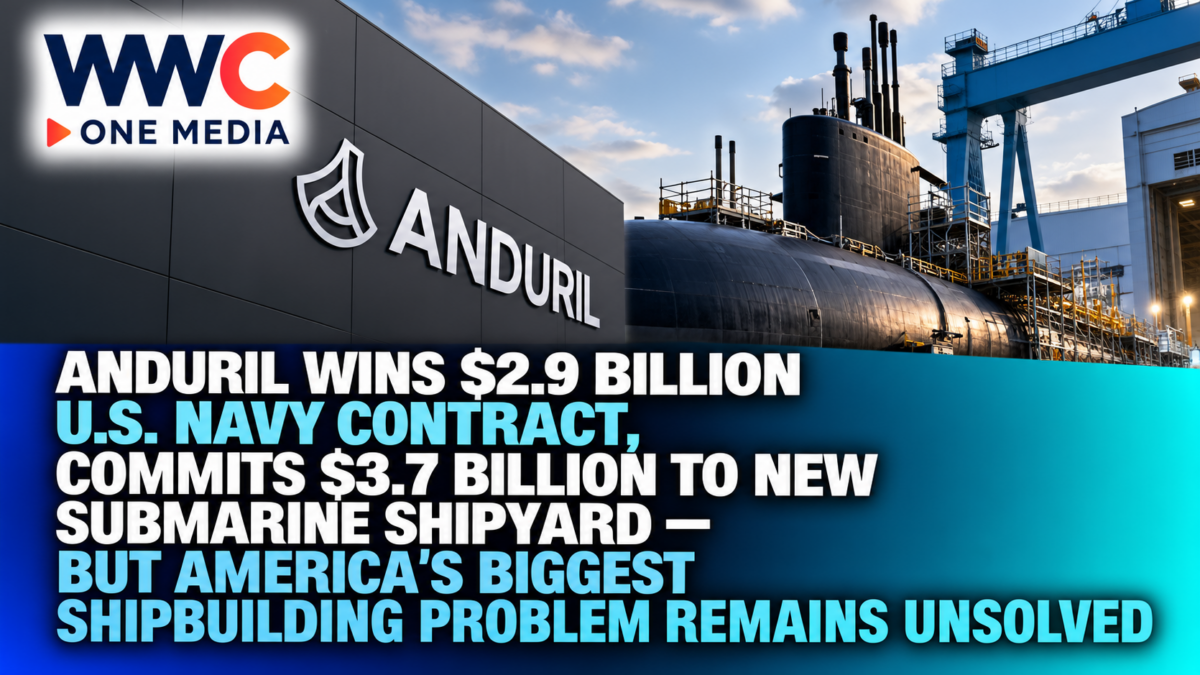
Defense technology company Anduril Industries announced on October 6 that it will invest $3.7 billion to develop a major manufacturing complex in Maryland after securing a U.S. Navy contract valued at up to $2.9 billion.
The new facility, called Arsenal-2, will manufacture critical components for Virginia-class nuclear-powered attack submarines.
Located at Sparrows Point in Baltimore County, the project will occupy more than 2 million square feet and is expected to begin production in 2030.
The announcement was attended by U.S. President Donald Trump, highlighting the strategic importance Washington places on strengthening the country’s defense manufacturing capabilities.
But the project is about more than constructing another industrial facility.
It represents a major test of whether advanced technology companies can help overcome the delays, workforce shortages and production bottlenecks affecting America’s naval shipbuilding industry.
Anduril’s $6.6 Billion Announcement Has Two Separate Components
The financial structure of the project is important.
Anduril has committed approximately $3.7 billion in private capital to develop Arsenal-2.
Separately, the U.S. Navy has awarded the company a contract worth up to $2.9 billion to manufacture submarine components.
Together, those commitments represent as much as $6.6 billion.
However, the entire amount should not be described as a direct government investment.
The $3.7 billion is Anduril’s planned private investment, while the $2.9 billion represents the maximum value of the Navy contract.
According to the company, Navy payments will be tied to demonstrated production results.
The arrangement is designed to place much of the financial execution risk on Anduril rather than taxpayers.
That creates significant pressure on the company to meet production targets.
The contract’s ultimate payments will depend on performance and applicable terms.
What Will Arsenal-2 Actually Produce?
Despite being described as a shipyard, Arsenal-2 is not initially intended to manufacture complete submarines.
Its immediate mission is to produce specialized components for the Virginia-class submarine program.
These will include torpedo tubes and other complex assemblies.
Torpedo tubes are essential components that allow submarines to launch torpedoes and certain other weapons.
They also require extremely demanding manufacturing and quality-control standards.
Anduril plans to expand its capabilities over time.
Industry officials have discussed the possibility of producing larger submarine modules and, eventually, entire hull sections.
However, those longer-term ambitions should not be confused with current contractual production commitments.
The company’s initial role is to strengthen the supply chain supporting existing submarine manufacturers.
Why Torpedo Tubes Are Suddenly a Major Priority
The U.S. Navy’s submarine production problems are not limited to assembling complete vessels.
Specialized components can delay an entire program.
A submarine may require thousands of parts, but a shortage of a small number of critical components can prevent production from advancing.
Torpedo tubes are among the manufacturing constraints affecting the Virginia-class program.
The Navy believes expanding production of these components could help accelerate submarine construction.
Anduril’s new facility is intended to provide additional capacity in an area where existing suppliers have struggled to keep pace with demand.
This makes Arsenal-2 strategically significant even though it will not initially build complete submarines.
The objective is to remove bottlenecks that slow the construction of vessels already needed by the U.S. Navy.
America Is Struggling to Build Submarines Fast Enough
Virginia-class submarines are among the most sophisticated vessels in the U.S. Navy.
They are nuclear-powered attack submarines designed for missions involving intelligence gathering, surveillance, anti-submarine warfare and other naval operations.
The United States has been working to increase their production.
However, the submarine industrial base faces substantial challenges.
These include shortages of skilled workers, limited supplier capacity, complex manufacturing requirements and delays affecting specialized equipment.
Only two major shipbuilders currently construct Virginia-class submarines: General Dynamics Electric Boat and Huntington Ingalls Industries’ Newport News Shipbuilding.
Anduril’s entry is therefore significant.
The company is seeking to become an additional major supplier within an established industrial network.
It is not replacing those shipbuilders.
Instead, it hopes to give them access to more critical components.
The Navy Wants More Submarines for the Indo-Pacific
The project also has broader strategic implications.
The United States considers undersea warfare an important part of its naval capabilities.
Submarines can operate across large areas while remaining difficult to detect.
Their ability to gather intelligence and operate in contested waters makes them particularly important in the Indo-Pacific.
The United States is also working with Australia and the United Kingdom through the AUKUS security partnership.
Under that arrangement, Australia is expected to acquire Virginia-class submarines from the United States in the 2030s, subject to the program’s requirements and implementation.
That adds pressure to an American submarine industrial base already facing production delays.
Washington must increase capacity to support its own fleet while meeting future commitments to allies.
Arsenal-2 is intended to contribute to that industrial expansion.
Software-Defined Manufacturing Is Anduril’s Main Selling Point
Anduril describes Arsenal-2 as a software-defined shipyard.
The concept involves integrating digital systems into manufacturing processes.
Rather than relying exclusively on traditional production management methods, Anduril plans to use software to coordinate fabrication, inspections, material movement and assembly.
The facility is expected to incorporate digital records and traceability systems for critical manufacturing operations.
Such systems could help managers identify production delays and monitor quality.
They may also improve coordination among suppliers and workers.
Anduril’s broader business model emphasizes automation and rapid technology development.
The company believes those capabilities can be applied to large-scale naval manufacturing.
However, the practical benefits remain to be demonstrated.
Building submarine components requires strict certification, precision engineering and quality assurance that cannot simply be bypassed through automation.
A Former Steelmaking Center Could Become a Defense Manufacturing Hub
Arsenal-2 will be developed at Tradepoint Atlantic, within the historic Sparrows Point industrial complex.
The site previously played an important role in America’s steel and shipbuilding industries.
Bethlehem Steel operated major facilities there, and the surrounding area contributed to wartime ship production.
The new investment is intended to restore large-scale maritime manufacturing activity to the location.
Maryland officials have welcomed the project as a significant economic opportunity.
The development is expected to support new manufacturing jobs and additional business activity.
Local suppliers, contractors and training institutions could also benefit.
But the economic impact will depend on the company’s ability to complete the facility and achieve its operating targets.
More Than 3,100 Jobs Could Be Created
According to Anduril and Maryland officials, the new shipyard is expected to create more than 3,100 permanent jobs.
The project could also indirectly support more than 11,000 additional jobs.
That brings the estimated total employment impact to more than 14,000 positions.
These figures are projections rather than jobs already created.
The facility will require workers with expertise in manufacturing, welding, engineering, automation and quality control.
Recruiting and training those employees will be a major challenge.
America’s defense manufacturing industry has repeatedly reported difficulty attracting enough qualified workers.
Anduril plans to recruit from industries including commercial aerospace and automotive manufacturing.
Vocational education and workforce training are expected to play important roles.
Maryland Is Offering Additional Support
Maryland and Baltimore County have also announced plans to support the project through economic-development incentives.
According to the governor’s office, state and county commitments could match up to 13% of Anduril’s anticipated private investment.
Some of those commitments will require legislative approval.
The support package includes potential investments in workforce training infrastructure.
Maryland officials estimate that the project could eventually generate more than $2 billion in annual economic output.
They also project approximately $312 million in annual wages.
Those figures reflect anticipated economic activity once the project develops.
They should not be mistaken for guaranteed annual revenue or wages already being paid.
A California Factory Will Begin Work Before Maryland Opens
Although Arsenal-2 is expected to begin production in 2030, Anduril is not waiting until then to enter the submarine supply chain.
The company is developing a separate manufacturing facility in Orange County, California.
That facility is approximately 160,000 square feet.
Anduril intends to begin producing submarine components there before the Maryland site becomes operational.
The California operation will focus on early production activities, including torpedo tubes.
USNI News reported that Anduril has already begun developing torpedo-tube prototypes.
The company expects the California facility to contribute to production capacity ahead of Arsenal-2’s opening.
This phased strategy could allow Anduril to gain manufacturing experience before scaling operations at the much larger Maryland complex.
Palmer Luckey’s Growing Pentagon Role Attracts Attention
The announcement also comes shortly after Anduril co-founder Palmer Luckey received a new role in a Pentagon initiative.
According to CNBC and USNI News, Luckey was named a co-director of Project Meridian, an initiative examining future military capabilities and warfare requirements.
The appointment highlights the increasing visibility of technology executives within U.S. defense planning.
Luckey helped establish Anduril in 2017 after previously founding virtual-reality company Oculus.
Anduril has since expanded into military drones, autonomous systems, surveillance technology and other defense applications.
The new Navy agreement marks an important expansion into manufacturing components for major conventional defense platforms.
However, Luckey’s advisory involvement and Anduril’s Navy contract are distinct developments.
The appointment does not, by itself, establish improper influence over the contract award.
Questions about government contracting should be evaluated using procurement records and documented evidence.
Technology Companies Are Challenging Traditional Defense Contractors
Anduril’s growth reflects a broader change in the American defense industry.
Technology companies are increasingly competing for contracts traditionally associated with established military manufacturers.
Their appeal often centers on software, artificial intelligence, autonomous systems and faster product development.
The Pentagon has been exploring ways to accelerate procurement and encourage innovation.
But submarine manufacturing presents challenges that differ substantially from producing drones or computer software.
Components must withstand demanding operating environments.
Safety and quality-control requirements are extremely strict.
Failures can have serious consequences for crews and national security.
For that reason, Anduril will need to demonstrate that its manufacturing approach meets the standards required by the Navy.
Existing Shipbuilders Welcome Additional Capacity
The project’s announcement does not mean established shipbuilders are being displaced.
General Dynamics Electric Boat and Newport News Shipbuilding remain responsible for constructing Virginia-class submarines.
Anduril’s planned components would support their production programs.
Newport News Shipbuilding welcomed efforts to expand the submarine industrial base.
The company said additional component manufacturing capacity could contribute to faster deliveries.
This response highlights the industry’s underlying problem.
The United States needs more productive suppliers, not simply more contracts.
A new manufacturing facility can only help if it produces certified components reliably and on schedule.
What About the Government’s Reported 40% Stake?
During the October 6 announcement, President Trump said American taxpayers would receive a 40% interest in the project.
Reuters and the Associated Press reported the statement.
However, the precise structure and legal meaning of the proposed interest were not fully explained in the initial reporting.
It remains unclear how the arrangement would be implemented and whether it would involve direct ownership, specific contractual rights or another financial structure.
The available information therefore does not support presenting a fully defined 40% government equity stake as an established fact.
Additional contractual disclosures would be necessary to understand the arrangement.
For taxpayers, the important questions concern financial risk, potential returns and government oversight.
Those issues deserve clarity because the project involves both substantial private investment and a major federal contract.
The Biggest Risk Is Execution
Anduril has ambitious plans.
It wants to invest billions of dollars, establish a major manufacturing complex and contribute to increased U.S. submarine production.
But the project faces significant challenges.
Construction must proceed on schedule.
Specialized manufacturing equipment must be installed.
Thousands of workers must be recruited and trained.
Production processes must satisfy demanding Navy requirements.
And the company must demonstrate that its components meet the necessary standards.
A delay in any of those areas could affect the project’s timeline.
The Navy’s performance-based payment structure is intended to create incentives for Anduril to deliver.
But financial incentives cannot eliminate engineering and workforce risks.
Why the 2030 Deadline Matters
Arsenal-2 is expected to begin production in 2030.
That means the project will not immediately solve existing submarine-delivery delays.
Even after the facility opens, production must increase before the Navy can benefit fully from additional capacity.
The timeline matters because the United States is already under pressure to expand submarine output.
The planned California operation could provide some earlier benefits.
However, the Maryland project represents a longer-term investment.
Its success will be measured by whether it eventually delivers qualified components in sufficient quantities.
Could Arsenal-2 Change America’s Defense Industry?
The project could become an important example of cooperation between emerging defense technology companies and traditional military manufacturers.
If Anduril succeeds, its software-driven approach may demonstrate ways to improve complex defense production.
That could encourage further investment in advanced manufacturing.
It may also provide lessons applicable to other parts of the defense industry.
But such benefits remain possible outcomes rather than established results.
Submarine manufacturing requires precision, reliability and years of technical experience.
Anduril will need to combine its technological expertise with the practical demands of heavy industry.
The difference between a successful demonstration and sustained large-scale production is substantial.
The Bigger Question Is Whether America Can Build Faster
The United States is committing enormous financial resources to strengthening its military-industrial base.
Anduril’s new shipyard is one part of that effort.
The company plans to spend $3.7 billion.
The Navy has awarded a contract worth up to $2.9 billion.
More than 3,100 permanent jobs are projected.
And a historic industrial site is expected to return to major maritime production.
But the investment alone cannot guarantee faster submarine deliveries.
That depends on actual manufacturing performance.
Anduril believes software-driven production can help eliminate the bottlenecks that have slowed America’s Virginia-class submarine program.
The Navy is backing that ambition with a major performance-based contract.
But the bigger question is whether the company can turn a $6.6 billion industrial commitment into the reliable submarine components the United States needs—or whether the same workforce shortages, engineering challenges and production delays will continue to constrain American naval power.