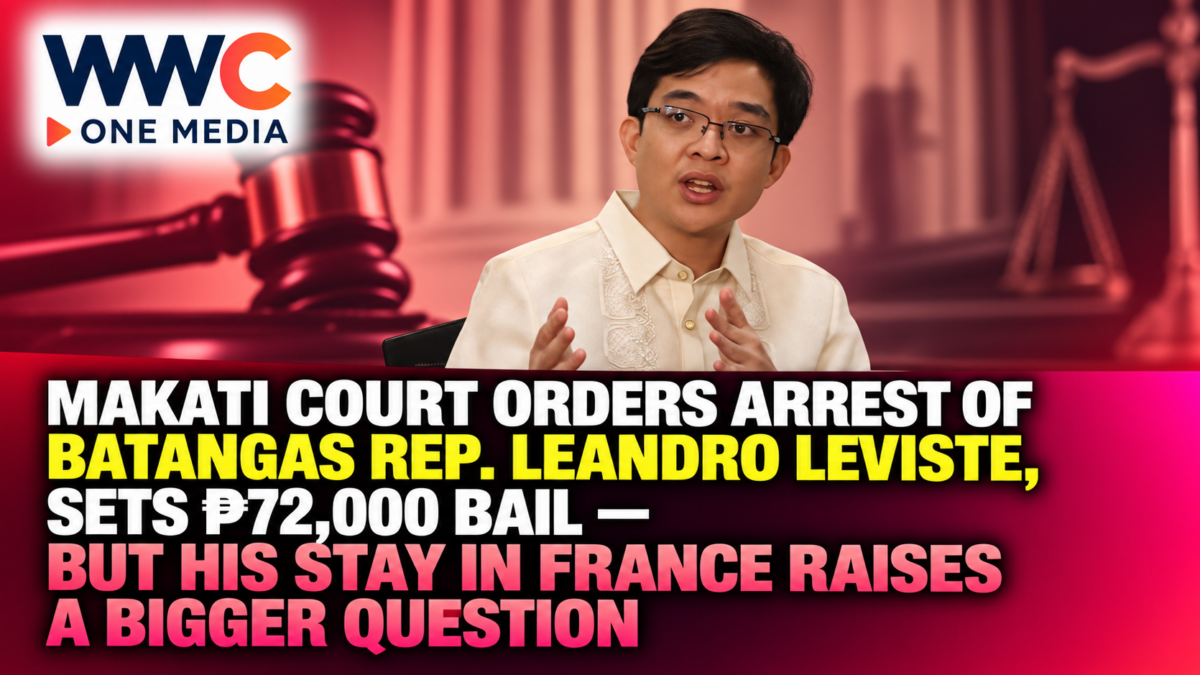
MANILA, PHILIPPINES — Batangas Representative Leandro Leviste is facing a new legal challenge after a Makati court ordered his arrest over an alleged violation of the Public Service Act, adding to the growing scrutiny surrounding his former solar-energy businesses and political activities.
The arrest warrant was issued on October 5, 2026, by Makati Regional Trial Court Branch 235.
Presiding Judge Ricardo A. Moldez II directed law enforcement authorities to arrest Leviste and bring him before the court.
Bail was set at ₱72,000.
The development comes while the Batangas 1st District congressman remains outside the Philippines.
Leviste was last reported to be in France, where his mother, Senator Loren Legarda, is reportedly receiving medical treatment.
But the circumstances have raised questions about how authorities will implement the court order and when the lawmaker will return to the country.
The arrest warrant marks a significant development in the legal scrutiny surrounding Leviste, although the charge remains an allegation and no conviction has been established.
Makati Court Issues Arrest Warrant
According to documents obtained by GMA News and other Philippine media outlets, the warrant names Leandro Antonio L. Leviste as the accused.
The court cited an alleged violation of Section 25 of Commonwealth Act No. 146, as amended by Republic Act No. 11659, otherwise known as the Public Service Act.
The warrant instructs law enforcement officers to locate and arrest the congressman and bring him before the court.
The National Bureau of Investigation confirmed receiving the arrest order.
NBI Director Melvin Matibag acknowledged the warrant during an October 7 interview with TV5.
Copies were also furnished to relevant police authorities.
The warrant itself confirms the charge and bail amount but does not describe the specific transaction or conduct underlying the allegation.
That distinction is important because the precise factual basis of the filed charge has not yet been fully detailed in the publicly reported document.
Why Is Leviste Reportedly in France?
Leviste’s reported presence overseas has become one of the most closely watched aspects of the case.
According to TV5, the congressman left the Philippines on August 2, 2026, on a flight to Hong Kong.
His mother, Senator Loren Legarda, separately traveled through Hong Kong on the same date, with France reportedly serving as her final destination.
Legarda’s spokesperson, lawyer Tony La Viña, has explained that the senator traveled abroad for medical treatment involving a lung illness.
He also said Leviste was accompanying and caring for his mother.
The explanation comes amid public questions about the extended absence of both lawmakers.
However, the existence of an overseas trip does not automatically establish that a person is evading legal proceedings.
Bilyonaryo reported that neither Leviste nor Legarda was subject to a travel restriction when they departed the Philippines.
The latest development therefore raises an important distinction between their departure in August and the arrest warrant issued in October.
NBI May Coordinate With Immigration Authorities
Following the issuance of the warrant, the National Bureau of Investigation is expected to coordinate with other government agencies to determine the lawmaker’s status and facilitate implementation of the court order.
According to DZRH and Daily Tribune, authorities are considering coordination with the Bureau of Immigration.
Such coordination could help establish whether Leviste has returned to the Philippines and clarify relevant travel information.
However, the warrant should not automatically be interpreted as an international arrest order.
A Philippine court warrant does not, by itself, establish that French authorities are required to arrest the lawmaker.
Any action involving foreign authorities would require a separate legal basis and applicable international procedures.
For now, the central question is how Leviste will respond to the pending Philippine court proceedings.
What Is the Public Service Act?
The Public Service Act governs obligations imposed on companies and individuals involved in certain public services.
The law addresses regulatory responsibilities and penalties for violations.
Section 25, as amended by Republic Act No. 11659, concerns knowing and willful failures to perform certain legal obligations required under the Act.
The amended provision provides penalties that can include a fine of up to ₱2 million or imprisonment of more than six years and up to 12 years, or both, depending on the circumstances and a court’s eventual findings.
These are statutory penalties, not punishments already imposed on Leviste.
The ₱72,000 bail amount also should not be confused with a fine.
Bail is intended to secure an accused person’s appearance in court under applicable legal requirements.
It does not represent an admission of guilt or a final judgment.
DOE Previously Filed Complaint Over Solar Para Sa Bayan
The arrest warrant comes against the backdrop of an earlier complaint involving Leviste’s former solar-energy business.
In May 2026, Energy Secretary Sharon Garin filed a complaint before the Department of Justice against Leviste and several officials of Solar Para Sa Bayan Corporation.
The Department of Energy alleged that the company failed to fulfill obligations under a legislative franchise granted in 2019.
That franchise, established through Republic Act No. 11357, authorized Solar Para Sa Bayan to develop renewable-energy microgrids and electricity distribution systems serving remote and underserved communities.
The government’s concern centered on whether the company had complied with the obligations attached to that privilege.
According to the DOE, the company had failed to demonstrate the required level of project development and regulatory compliance years after receiving the franchise.
Government Questions Seven Years of Alleged Inactivity
The Department of Energy’s earlier complaint alleged that Solar Para Sa Bayan had not fulfilled its commitments to deliver electricity to intended beneficiaries.
The agency said it found no sufficient records showing compliance with certain permit applications, reporting requirements and project obligations.
It also questioned the company’s operations under the franchise.
The allegations attracted attention because the franchise was intended to help bring electricity to communities with limited or no access to reliable power.
The DOE argued that failure to carry out those obligations could undermine the public purpose of the franchise.
However, these remain government allegations.
The publicly available arrest warrant does not provide enough detail to independently establish which specific alleged acts formed the basis of the court charge.
Leviste Previously Rejected DOE Allegations
Leviste has previously challenged the government’s accusations against his solar company.
Following the May complaint, the lawmaker described the case as weak and questioned its timing.
He suggested that the complaint was connected to political disagreements involving other government officials.
Leviste had also previously acknowledged that Solar Para Sa Bayan had stopped operating and said he had divested his ownership interest before entering politics.
The DOE, however, argued that the company’s obligations under its legislative franchise required further examination.
Those competing positions remain relevant to the broader controversy.
Leviste’s earlier statements should not be treated as a response to the October 5 warrant unless he specifically addresses that court order.
As of the reports reviewed for this article, no verified new statement from Leviste directly responding to the warrant had been established.
Solar-Energy Controversy Has Broader Implications
The case has implications beyond the political future of one lawmaker.
The Philippines continues working to expand electricity access in remote communities and increase its use of renewable energy.
Microgrid projects can be particularly important in areas where connecting households to the main electricity grid is expensive or technically difficult.
Companies awarded legislative franchises or government-backed energy contracts are expected to comply with their legal obligations.
That makes regulatory oversight important.
However, enforcement actions must also follow due process.
The government must establish its allegations through appropriate legal proceedings, and respondents must be given the opportunity to contest the evidence.
The case therefore highlights the relationship between energy development, corporate accountability and the responsibilities attached to public-service franchises.
Separate Ombudsman Investigation Adds to Scrutiny
Leviste and Senator Legarda have also faced scrutiny involving separate allegations connected to solar-energy projects.
In July, the Office of the Ombudsman announced an investigation involving the lawmaker, his mother and alleged irregularities in energy-related arrangements.
Ombudsman Jesus Crispin Remulla publicly discussed allegations involving unfinished solar projects and financial obligations.
Those investigations are separate from the specific Public Service Act charge identified in the October arrest warrant.
This distinction is essential.
The existence of several investigations does not mean that every allegation has resulted in a formal criminal charge.
Nor does it establish that the people under investigation are guilty.
Each proceeding must be assessed according to its own evidence and legal requirements.
Legarda’s Presence Abroad Has Drawn Political Attention
Senator Loren Legarda’s overseas stay has also attracted public scrutiny.
Her spokesperson has said she is receiving medical treatment in France.
Leviste has reportedly accompanied her.
However, questions about their absence have continued amid the investigations involving the lawmaker.
The government has raised concerns about their extended stay overseas, while Legarda’s camp maintains that her travel is related to medical needs.
No conclusion about criminal responsibility can be drawn simply from their reported location.
The immediate legal issue concerns Leviste’s obligation to respond to the court proceedings against him.
The ₱72,000 Bail Amount Is Not a Conviction
One of the most important details is the bail set by the court.
The Makati RTC fixed bail at ₱72,000.
That provides a mechanism for Leviste to seek provisional liberty under the applicable legal rules.
However, posting bail would not automatically dismiss the criminal case.
Nor would it amount to an admission that the allegations are true.
The case could still proceed through arraignment and other judicial stages.
Likewise, the issuance of an arrest warrant does not mean the court has already determined guilt beyond reasonable doubt.
The presumption of innocence remains applicable.
For accurate reporting, the distinction between an accusation, an arrest warrant, bail and a conviction must be maintained.
What Happens Next?
Several developments will determine the next stage of the case.
Authorities will need to establish Leviste’s current location and determine how the warrant can be implemented under applicable law.
Leviste may respond through his lawyers, seek appropriate legal remedies or arrange to appear before the court.
The case’s progress will also depend on the formal allegations and supporting evidence presented in court.
Another important development would be a public explanation of the precise acts alleged to constitute the Section 25 violation.
That would provide greater clarity about the connection, if any, between the warrant and the Department of Energy’s earlier complaint.
Until those details are available, speculation about additional charges or potential penalties should be avoided.
A Bigger Test of Accountability and Due Process
The arrest warrant places Leviste under significant legal pressure.
As a sitting member of the House of Representatives, he occupies a position of public responsibility.
But public office does not eliminate the right to due process or the presumption of innocence.
The government has an obligation to enforce laws governing public services.
The accused has the right to challenge the allegations and present a defense.
The courts must determine whether the prosecution can establish the alleged violation.
Those principles remain essential regardless of the political personalities involved.
Leviste Faces a New Legal Challenge While Overseas
The latest development adds another chapter to the controversies surrounding the Batangas lawmaker.
The Makati RTC has issued an arrest warrant.
The NBI has acknowledged receiving the order.
Bail has been fixed at ₱72,000.
And Leviste was last reported to be in France accompanying his mother during medical treatment.
But the legal process is still developing.
The publicly reported warrant does not fully detail the factual basis of the charge, and no conviction has been announced.
Leandro Leviste now faces an arrest order from a Philippine court while reportedly remaining overseas.
The bigger question is how the congressman will respond to the warrant—and whether the proceedings will clarify the allegations surrounding his former solar-energy business.
For the public, the outcome will test both the government’s ability to enforce obligations attached to energy franchises and the courts’ responsibility to ensure that allegations are resolved through evidence and due process.