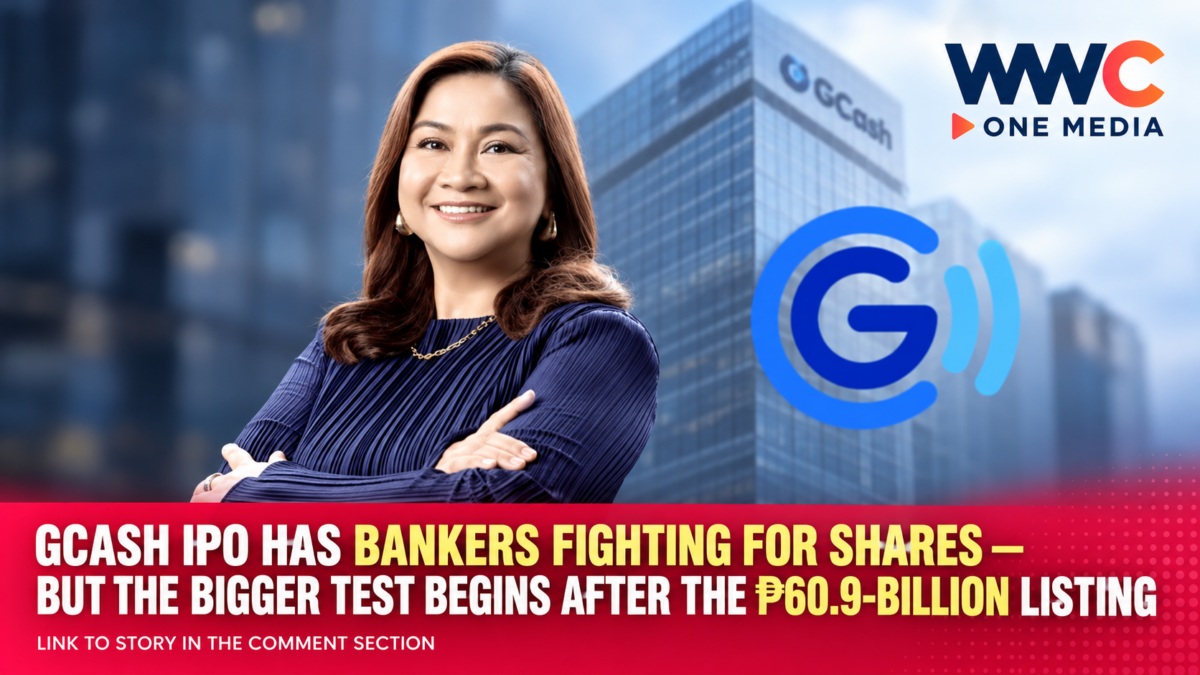
MANILA — Demand for GCash parent Mynt Inc.’s blockbuster initial public offering has become so intense that local bankers are literally joking about “fighting” for more shares — a remarkable turnaround for a Philippine stock market that has spent much of 2026 struggling with weak trading and sluggish fundraising.
The domestic offer opened on October 6 with investors scrambling for a slice of what could become the largest initial public offering in Philippine history.
BDO Capital & Investment Corp. president Eduardo Francisco said orders from large Philippine institutions, including the Government Service Insurance System and Social Security System, were stronger than expected, forcing local underwriters to push for a bigger allocation.
“The total demand we’re seeing is exceeding historical demand for local IPOs,” Francisco said, according to InsiderPH.
He joked that once bankers enter allocation meetings, they start “elbowing each other” because everyone wants more shares for their clients.
That scramble highlights just how much investor sentiment changed after Mynt priced the offer at ₱6.60 per share — significantly below the original maximum price of ₱10.
At that level, GCash’s parent is being valued at roughly ₱442 billion, instantly placing it among the most valuable financial companies in the Philippines.
IPO Could Raise as Much as ₱60.9 Billion
Mynt is offering approximately 8.03 billion common shares in the base transaction.
At ₱6.60 each, the IPO is expected to raise around ₱53 billion.
An additional 1.204 billion shares may be sold through the overallotment option.
If that option is fully exercised, total proceeds could reach approximately ₱60.9 billion.
That would allow Mynt to surpass Monde Nissin’s 2021 offering and claim the record for the biggest Philippine IPO.
The shares are scheduled to list on the Philippine Stock Exchange under the ticker:
GCASH
with trading expected to begin on October 20, 2026, subject to remaining regulatory and market conditions.
Foreign Investors Want the Shares Too
The battle is not only happening among Philippine investors.
Mynt said its institutional bookbuilding was oversubscribed multiple times, with strong demand from both foreign and domestic institutions.
Before the public offer even began, more than 20 cornerstone investors had committed approximately ₱36.5 billion.
Those investors include major global financial institutions such as:
BlackRock,
T. Rowe Price,
Capital Research and Management,
Citadel,
HSBC Global Asset Management,
and the International Finance Corporation.
Local institutions include ATRAM Trust, BPI Asset Management and China Bank Capital, among others.
Those commitments alone cover a substantial portion of the base transaction.
InsiderPH estimated cornerstone investors could absorb roughly 68.8% of the offer if the overallotment is not exercised, or about 59.8% if the greenshoe is fully used.
That leaves significantly fewer shares available for other investors.
Local Traders Went From Too Many Shares to ‘Crumbs’
Perhaps the clearest sign of the sudden demand shift came from a local trader quoted by InsiderPH.
Before pricing, some trading desks reportedly believed they would have plenty of GCash shares to distribute.
After the final price dropped to ₱6.60 and institutional demand accelerated, the situation reversed.
“A few weeks ago the office was saying we have a lot of shares,” the trader said.
“Now it looks like we’re getting crumbs.”
That change illustrates why IPO pricing matters so much.
At the original ₱10 maximum price, investors would have been paying a much richer valuation.
At ₱6.60, the shares entered the market at a substantially more attractive level.
The final price is around 34% below the original ₱10 reference ceiling.
That discount appears to have turned a highly anticipated IPO into an allocation battle.
Retail Investors Can Enter With Just ₱660
Mynt is also making the IPO unusually accessible to ordinary Filipinos.
GCash users can subscribe through GStocks PH in the GCash app.
The minimum order is 100 shares.
At ₱6.60 per share, that means retail investors can participate for just:
₱660.
Mynt says the platform can provide eligible users with real-time share allocation, creating one of the most digitally accessible IPO processes ever attempted in the Philippine market.
That could bring thousands of first-time investors into equities.
The PSE has said it expects the GCash listing to help attract new retail market participants, especially because investors can subscribe through a platform many already use daily.
Why the GCash IPO Matters to the Entire Philippine Market
The Philippines badly needs a successful blockbuster listing.
Equity fundraising activity has been weak in 2026.
Reuters reported that Philippine equity transactions had raised only about $227 million before the Mynt offer, with fundraising down roughly 71% from a year earlier.
Trading activity has also been subdued, with many Philippine stocks still near historically low valuations.
That is why BDO Capital’s Francisco believes the GCash IPO could have a broader effect.
During international roadshows, he said foreign investors began asking whether other undervalued Philippine companies might also offer opportunities.
That is exactly the spillover effect the PSE has been hoping for.
A strong GCash debut could remind global investors that the Philippines still has investable growth companies outside traditional banking, property and conglomerates.
GCash Is Becoming a Public-Market Test of the Philippine Digital Economy
For years, GCash has been one of the most recognizable consumer technology brands in the country.
Its evolution has been dramatic.
The platform began primarily as a mobile wallet.
It has since expanded into:
payments,
savings,
credit,
insurance,
investments,
merchant services,
and other digital financial products.
That transformation helped turn Mynt into one of Southeast Asia’s most valuable fintech companies.
The IPO now gives public investors their first chance to directly price that growth story on the Philippine stock exchange.
Profit Growth Is Slowing — And That Matters
The excitement surrounding the IPO should not obscure the financial risks.
Reuters reported that Mynt’s net income increased around 7.3% in the first half of 2026, while revenue rose approximately 10.4%.
Those are positive numbers.
But they are slower than the hypergrowth investors once associated with GCash.
That means the market will increasingly focus on:
how quickly lending expands,
how profitable new products become,
whether credit losses remain controlled,
and whether GCash can continue growing after already reaching a huge percentage of the Philippine population.
The company is no longer being valued like an early-stage startup.
It is being valued like a major financial institution.
That raises the standard investors will apply.
At ₱442 Billion, GCash Is Already a Financial Giant
The ₱6.60 IPO price implies a valuation of roughly ₱442 billion.
That would place Mynt among the country’s most valuable financial businesses, behind only the largest listed banking groups.
The comparison is significant.
Traditional banks such as BDO and BPI have:
physical branches,
large deposit franchises,
corporate lending businesses,
wealth-management units,
and decades of earnings history.
GCash is building something very different.
Its advantage is reach.
Millions of Filipinos already use the app for daily payments.
The company’s strategy is to convert that enormous user base into customers for broader financial services.
If successful, Mynt could increasingly compete with banks without having to build thousands of branches.
The IPO Is Mostly Not Fresh Capital
Investors should also understand where the proceeds go.
A large part of the transaction involves secondary shares sold by existing shareholders, rather than newly issued shares.
The PSE-approved structure includes around 1.61 billion primary shares and approximately 6.42 billion secondary shares in the base offer.
That means most of the money raised from the base IPO will go to existing investors selling part of their stakes, rather than directly into Mynt’s balance sheet.
The proceeds from the primary shares that do go to the company are intended for:
digital financial-services expansion,
product development,
and general corporate purposes.
That secondary-heavy structure is not unusual for a mature private company.
But it is important for investors evaluating how much new capital Mynt itself will receive.
Existing Investors Finally Get Liquidity
GCash’s rise created enormous paper gains for its early shareholders.
The IPO now provides some of them with an opportunity to convert a portion of those gains into cash.
Mynt’s shareholder base has included major names such as:
Globe Telecom,
Ayala Corp.-linked entities,
Ant Group,
Japan’s MUFG,
and other private investors.
The listing also gives remaining shareholders a publicly traded valuation for their stakes.
That may increase strategic flexibility for the company after listing.
Why the ₱6.60 Price Changed Everything
The strongest part of the GCash IPO story may ultimately be the pricing decision.
Mynt could have tried to maximize proceeds near the original ₱10 ceiling.
Instead, it settled at ₱6.60.
That reduced the initial valuation and total funds raised.
But it also dramatically improved the chances of a heavily oversubscribed book and potentially strong first-day trading.
For an IPO of this size, that tradeoff can matter.
A company can choose a higher price and risk weak aftermarket performance.
Or it can price more conservatively and leave some upside for new shareholders.
The demand reported this week suggests investors believe Mynt chose the second route.
But Oversubscription Does Not Guarantee a Stock-Market Rally
This is the crucial warning.
Strong IPO demand before listing does not guarantee that GCash shares will surge once trading begins.
Institutional allocations can be tight.
Retail demand can be intense.
But after October 20, the market will continuously reprice the company based on:
earnings,
growth forecasts,
interest rates,
competition,
credit quality,
and overall Philippine market sentiment.
A successful IPO bookbuild is only the first test.
The harder one begins when investors can buy and sell freely.
Maya Remains a Serious Competitor
GCash also does not operate without competition.
Maya has built a strong position in digital banking and lending.
Traditional banks are expanding their own mobile platforms.
Fintech competition is becoming increasingly aggressive across payments, credit and savings.
GCash has scale.
But scale does not guarantee permanent dominance.
That means investors buying the IPO are betting that Mynt can turn its huge existing user base into sustained long-term profitability before competitors capture more of its customers.
GCash Could Become a Blueprint for More Tech IPOs
The Philippine Stock Exchange is also watching the deal for another reason.
The local market has historically been dominated by:
banks,
property developers,
utilities,
conglomerates,
and consumer companies.
Large technology IPOs are rare.
PSE President and CEO Ramon Monzon said the exchange hopes Mynt’s listing will encourage more fintech and digital-economy businesses to raise capital locally.
If GCash trades well after listing, founders and venture investors may become more willing to consider Manila rather than waiting for an overseas listing or private sale.
If the stock disappoints, the opposite could happen.
Bankers Are Fighting for Shares — But Investors Will Soon Fight Over Valuation
For now, the mood is unmistakably bullish.
Foreign institutions want more.
Local funds want more.
Retail investors can enter for ₱660.
Bankers are asking for additional allocations.
The institutional book is oversubscribed multiple times.
And the transaction could become the biggest IPO the Philippines has ever seen.
That is a dramatic reversal for a market that badly needed a flagship listing.
But October 20 changes the conversation.
Before listing, the question is:
Who can get GCash shares?
After listing, the question becomes:
What are those shares actually worth?
GCash has already proved that investors want a piece of its story.
The bigger test is whether the same investors will still be fighting for the stock once the excitement of the IPO disappears and Mynt has to justify a roughly ₱442-billion valuation quarter after quarter.