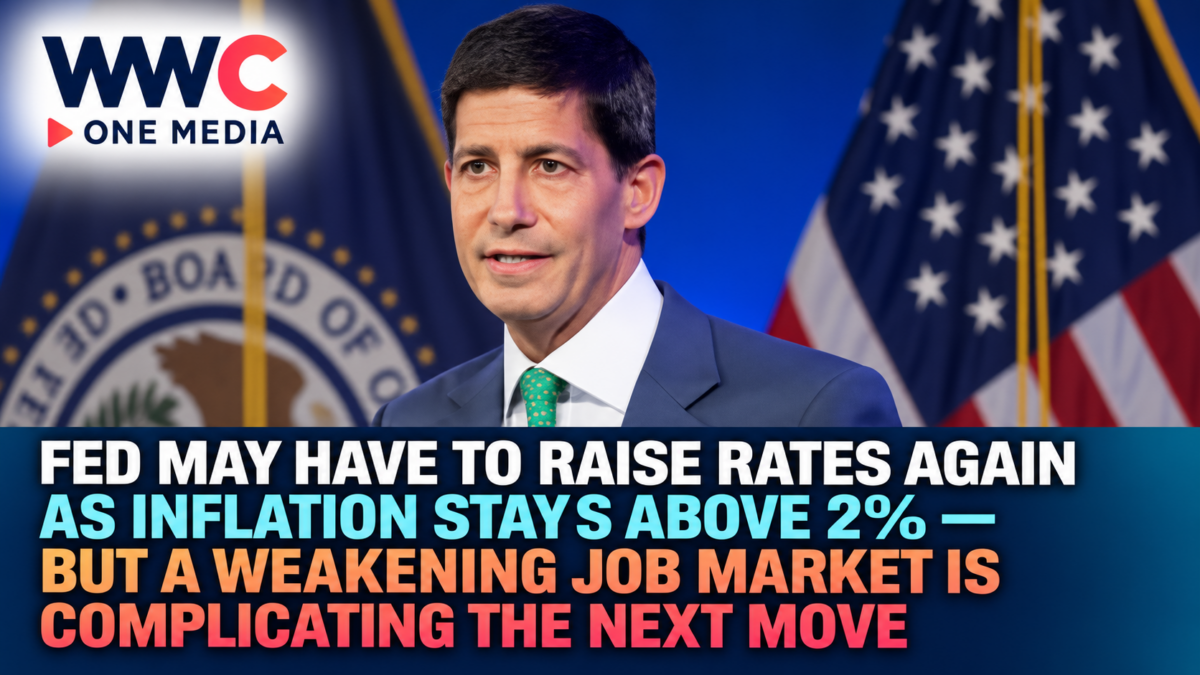
NEW YORK — Wall Street may be celebrating record highs, but the Federal Reserve’s inflation fight is far from finished.
The U.S. central bank could ultimately have to raise interest rates further because inflation remains stubbornly above its 2% target, according to Thornburg Investment Management’s Josh Rubin, even as weaker employment data is giving policymakers a reason to move more cautiously.
Rubin told CNBC that the U.S. remains a considerable distance from the Fed’s inflation goal and warned that interest rates may need to stay higher — or move higher again — if price pressures do not continue easing.
His warning comes just weeks after the Federal Reserve delivered its first rate increase in more than three years, raising the federal funds target range by 25 basis points to 3.75% to 4% on September 16.
The Fed said inflation remained elevated and that the increase was intended to support a “timelier” return to its 2% objective.
But since then, the economic picture has become much more complicated.
Inflation is still too high.
The job market is slowing.
Oil remains expensive.
Tariffs and supply-chain problems are adding fresh price pressures.
And investors are trying to determine whether September’s increase was the beginning of another rate-hiking cycle — or simply a warning shot.
Inflation Is Still Well Above the Fed’s Goal
The strongest argument for additional tightening is simple:
Inflation has not returned to 2%.
The Fed’s preferred inflation gauge, the personal consumption expenditures price index, rose 3.4% from a year earlier in August, according to the latest available data.
That was cooler than analysts expected, but still far above the central bank’s target.
Core inflation, which removes volatile food and energy prices, has also remained elevated.
For Fed officials, that means the battle has not been won.
A period of inflation around 3% may feel dramatically better than the post-pandemic surge, but it is still roughly one percentage point above the level policymakers define as price stability.
And several new inflation risks have emerged.
Oil Is Back Near $100
Energy has become one of the Fed’s biggest problems.
Brent crude has been trading around $100 a barrel amid ongoing conflict in the Middle East and disruptions to global energy flows.
Higher oil prices can raise:
gasoline prices,
airfares,
shipping costs,
manufacturing expenses
and ultimately consumer prices.
The Fed typically tries not to react too aggressively to temporary energy shocks.
But if those shocks persist, they can spread into broader inflation expectations and wage demands.
San Francisco Fed President Mary Daly said on October 6 that whether more rate hikes are required will depend heavily on whether shocks including tariffs, oil prices and AI-related demand prove temporary or persistent.
That is the central dilemma.
One oil spike may be tolerable.
Several overlapping inflation shocks may not be.
Services Inflation Is Also Showing Warning Signs
It is not only energy.
The September ISM services survey showed that input-price pressures climbed to their highest levels since 2022.
The U.S. services sector continued expanding, but businesses reported rising costs tied to fuel, commodities and supply-chain strains.
That matters because services make up the majority of the U.S. economy.
If inflation spreads beyond gasoline and imported goods into rents, healthcare, professional services and wages, bringing inflation back to 2% becomes much harder.
Rubin’s argument is essentially that markets may be underestimating how much work remains.
Dallas Fed’s Logan Says At Least 50 Basis Points More May Be Needed
Some Fed officials have already made a much more hawkish case.
Dallas Fed President Lorie Logan said the central bank may need at least another 50 basis points of rate increases to bring policy into a “modestly restrictive” position and put inflation clearly back on track toward 2%.
Fed Governor Michael Barr has also argued that additional hikes will probably be required.
Barr pointed to elevated energy prices and enormous AI-related capital spending as reasons the economy may be stronger — and inflation more persistent — than policymakers had expected.
Those comments suggest September’s hike may not have been a one-off.
But other Fed officials are urging patience.
New York Fed’s Williams Says There Is No Urgency
New York Fed President John Williams has taken a more cautious position.
Williams said the Fed may need only one additional rate hike this year and argued there is no immediate need to rush into another increase.
Vice Chair Philip Jefferson and other officials have similarly suggested that policymakers should wait for more data before making the next move.
That caution became even more important after the latest U.S. jobs report.
September Jobs Growth Collapsed to Just 29,000
The U.S. economy added only 29,000 jobs in September, far below the roughly 90,000 economists had expected.
Previous months were also revised lower by a combined 60,000 jobs.
The unemployment rate edged up to 4.2% from 4.1%.
Average hourly earnings increased only 0.1% during the month, slowing the annual wage-growth rate to 3.0%.
Those numbers significantly changed the rate debate.
A weakening job market reduces the urgency for another immediate hike because higher rates would make borrowing even more expensive and could further slow hiring.
The Fed has two mandates:
stable prices
and
maximum employment.
Inflation is still too high.
But employment is now showing clearer signs of cooling.
That creates exactly the kind of policy conflict central bankers dislike.
Markets Now Expect an October Pause
Before the weaker labor data, investors saw a much larger chance that the Fed would raise rates again at its October 27-28 meeting.
That probability has fallen sharply.
Reuters reported that policymakers were already leaning toward skipping an October hike before the jobs report, and the weak employment numbers strengthened the case for waiting.
Markets now overwhelmingly expect rates to remain unchanged at the October meeting.
The more realistic question may be whether the next hike arrives in December.
That would give the Fed more time to examine:
inflation,
employment,
oil prices,
consumer spending,
and the effects of September’s hike.
One More Rate Hike Could Still Come This Year
Fed officials have not declared victory.
Cleveland Fed President Beth Hammack said there is still time to evaluate the data before the October meeting, while acknowledging that another move may ultimately be needed.
The Fed’s own September communication also signaled that additional tightening remained possible.
So the current baseline is increasingly looking like:
pause in October,
then reconsider in December.
That is very different from saying the hiking cycle is over.
Treasury Yields Are Already Doing Some of the Fed’s Work
There is another reason policymakers may be able to wait.
Bond markets have tightened financial conditions on their own.
The 10-year Treasury yield recently climbed above 5.3%, its highest level in roughly two decades.
Higher Treasury yields push up borrowing costs across the economy.
Mortgage rates rise.
Corporate loans become more expensive.
Consumers pay more for credit.
Stock valuations face pressure.
In effect, financial markets can tighten the economy even without another official Fed hike.
Rubin also highlighted another concern: growing hedge-fund participation in the Treasury market.
He warned that the leverage used by some hedge funds could contribute to greater bond-market volatility.
That issue is becoming increasingly important as Treasury issuance grows and money-market demand for short-term government debt slows.
Hedge Funds Could Make the Bond Market More Fragile
Leveraged trading strategies allow hedge funds to amplify relatively small differences in bond prices.
That can improve market liquidity during normal conditions.
But it can also create risk.
If yields suddenly move against heavily leveraged positions, investors may be forced to unwind trades rapidly.
That can cause:
sharp price swings,
forced selling,
liquidity stress
and potentially wider financial instability.
The Treasury market is the foundation of the global financial system.
So volatility there matters far beyond bond investors.
Reuters reported that slower money-market-fund inflows and expectations of further Fed tightening are already making parts of the short-term Treasury market more volatile.
Wall Street Is Acting as If the Fed Will Manage a Soft Landing
The remarkable part is that stocks are barely behaving like monetary policy is tightening.
On October 6, the S&P 500 and Nasdaq both closed at record highs as investors continued pouring money into technology and AI-related companies.
Stocks rallied even with:
oil near $100,
Treasury yields above 5%,
and the Fed having just resumed rate increases.
That suggests Wall Street is betting on an unusually favorable outcome:
Inflation cools.
The Fed tightens only slightly more.
The labor market slows but does not collapse.
Corporate earnings remain strong.
And AI investment keeps economic growth resilient.
That is effectively the soft-landing trade.
But the Fed Still Has a Credibility Problem if Inflation Stalls
For policymakers, the danger is that inflation becomes stuck around 3%.
If that happens, businesses and households may begin treating higher inflation as normal.
Workers may demand larger raises.
Companies may raise prices more aggressively.
Long-term inflation expectations could move higher.
Once that happens, returning inflation to 2% becomes much more painful.
That is why officials such as Logan and Barr favor moving rates higher before expectations become unanchored.
The Fed learned during the 1970s that allowing inflation to become embedded can eventually require much more severe tightening.
Higher Rates Would Hit Housing First
American households would feel additional Fed tightening quickly.
Mortgage rates are already elevated.
Credit-card borrowing remains expensive.
Auto-loan rates are high.
Business financing costs have risen sharply.
Another 25 or 50 basis points of hikes would add further pressure.
Housing is particularly sensitive because a higher mortgage rate dramatically changes what a buyer can afford each month.
That creates a politically difficult situation.
The Fed needs to reduce demand enough to cool inflation.
But the mechanism for doing that involves deliberately making credit more expensive.
The Next CPI Report Could Decide Everything
The most important upcoming inflation report will arrive shortly before the Fed’s late-October meeting.
Reuters notes that the next consumer price index release could still change policymakers’ thinking.
A surprisingly hot number could revive the possibility of another immediate hike.
A softer report would strengthen the case for waiting until December — or potentially doing nothing at all.
That makes the next inflation release one of the most important pieces of economic data of the autumn.
The Fed Is Walking an Increasingly Narrow Line
The policy challenge is becoming clearer.
Raise rates too aggressively and the Fed could turn a cooling labor market into a recession.
Stop too early and inflation could become entrenched above 2%.
Wait too long and the central bank may eventually have to raise rates even higher.
That is why Rubin’s warning matters.
The market may be focused on whether the next hike happens in October or December.
The more important question is how high rates ultimately need to go before inflation is genuinely defeated.
The federal funds rate is now 3.75% to 4%.
Inflation remains above 3%.
Oil remains elevated.
Services prices are still showing pressure.
And several Fed officials believe at least one more hike will be necessary.
At the same time, job creation has fallen sharply and the unemployment rate is edging upward.
The Fed is therefore caught between two risks it cannot easily solve at the same time: inflation that refuses to return to 2% and a labor market that may already be losing momentum.
Wall Street is betting policymakers can navigate both without breaking the economy. The next few months will show whether that confidence is justified — or whether interest rates still have further to climb than investors want to believe.