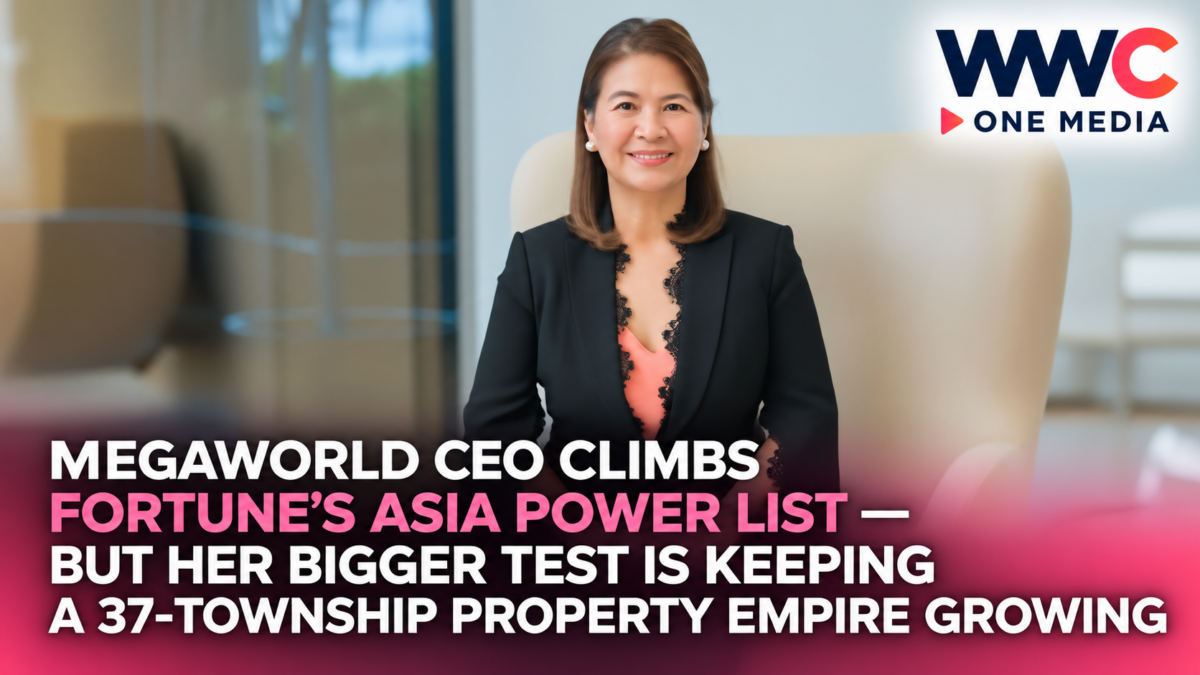
MANILA — Lourdes Gutierrez-Alfonso was already helping build Megaworld when the company was still a young property developer in 1990. Nearly four decades later, she is running one of the Philippines’ largest real estate groups — and Fortune has again named her among Asia’s 100 most powerful women in business.
The Megaworld president and chief executive ranked No. 87 on Fortune’s 2026 Most Powerful Women Asia list, improving five places from No. 92 last year.
It is her third consecutive appearance on the regional ranking, according to InsiderPH, and makes her the only female executive representing Philippine real estate on this year’s list.
But the recognition comes at an interesting moment.
Megaworld has never been larger.
Its township network now stretches across 37 developments nationwide, its office portfolio remains one of the biggest in the country, and its hotels, malls and leasing businesses are becoming increasingly important sources of recurring income.
At the same time, the property market is no longer growing as effortlessly as it did during the industry’s strongest expansion years.
That means Gutierrez-Alfonso’s real test is no longer helping build Megaworld.
It is keeping the property giant growing through a slower and more complicated cycle.
From employee No. 6 era to CEO
Gutierrez-Alfonso joined Megaworld in 1990, only about six months after founder Andrew Tan established the company.
Fortune notes that she has been with the developer almost from the beginning and became president and CEO in June 2024.
That makes her rise unusual among large Philippine corporations.
She did not arrive from an outside multinational or competitor to take the top job.
She spent decades inside the company as it transformed from a relatively small residential developer into a diversified property group spanning:
residential towers;
office buildings;
shopping malls;
hotels;
mixed-use townships;
and real estate investment trusts.
That institutional memory is one reason her leadership story stands out.
Megaworld’s scale has changed dramatically
Fortune describes Megaworld as the Philippines’ largest office developer.
But offices now represent only one part of the business.
The company’s township strategy has become its defining model.
Instead of developing isolated condominiums, Megaworld builds large mixed-use districts where people can live, work, shop, stay in hotels and access entertainment in the same area.
The model includes developments such as:
Eastwood City;
Newport City;
McKinley Hill;
Uptown Bonifacio;
Iloilo Business Park;
Mactan Newtown;
Southwoods City;
and several provincial estates.
According to InsiderPH, Megaworld now has 37 townships across the country.
That scale helps explain why Fortune continues to rank Gutierrez-Alfonso among Asia’s influential business leaders.
2025 was Megaworld’s most profitable year yet
Megaworld posted record net income of ₱24 billion in 2025, up 11% from the previous year.
Revenue rose 5% to ₱86 billion.
Leasing income climbed 11% to ₱22 billion, demonstrating how offices, malls and other recurring-income assets increasingly cushion the company when residential property sales become uneven.
That shift is strategically important.
Property developers historically depend heavily on selling new residential units.
But condo demand can be cyclical.
A company with large recurring rental income has more protection when buyers become cautious.
Gutierrez-Alfonso has emphasized that diversified recurring income has become one of Megaworld’s strongest defenses against market volatility.
But 2026 growth has slowed
Fortune did not ignore that challenge.
Its profile notes that Megaworld’s growth has slowed sharply enough for the company to reduce 2026 launches and capital spending.
First-half profit increased only 5%.
Megaworld reported ₱12.7 billion in net income for the first six months of 2026, also up 5% year on year.
That is still growth.
But it is much more modest than the double-digit profit expansion investors often associate with strong real estate cycles.
The environment has become harder because of:
higher borrowing costs;
more cautious condominium buyers;
elevated construction expenses;
global economic uncertainty;
and an office market still adapting to hybrid work and changes in BPO demand.
That makes execution more important than headline expansion.
Fully leased offices remain one of Megaworld’s biggest strengths
Megaworld has continued reporting strong performance in parts of its office portfolio.
Fortune highlighted 24 fully leased office towers housing around 80,000 workers.
Megaworld separately reported that office lease renewals reached about 122,000 square meters in the first half of 2026.
That is important because the Philippine office market remains uneven.
Companies with high-quality locations and established township ecosystems may have an advantage in keeping tenants.
A fully occupied office tower does more than generate rent.
Workers support nearby:
restaurants;
retail stores;
condominiums;
transport services;
and hotels.
That is one of the economic ideas behind Megaworld’s township model.
Each business segment can strengthen the others.
Hospitality is becoming another major growth pillar
Megaworld is also expanding aggressively in hotels.
The company announced in August that it plans to grow its hospitality portfolio to nearly 12,000 rooms.
That places hospitality alongside offices and malls as another recurring-income business.
It also gives Megaworld exposure to the continuing recovery in Philippine tourism.
As international and domestic travel expands, hotels can create revenue streams less directly tied to condominium sales.
That diversification matters especially when residential markets slow.
The company increasingly looks less like a traditional condominium developer and more like a broad real estate operating platform.
MREIT adds another layer to the strategy
Megaworld has also used MREIT, its listed real estate investment trust, to recycle capital from mature properties into new developments.
In July, Megaworld raised ₱5.6 billion through block sales of MREIT shares ahead of another planned wave of asset infusion.
The company said proceeds would be reinvested into new recurring-income developments inside its townships.
That structure can help the company grow without relying entirely on traditional debt.
A completed office or commercial building can be transferred into MREIT.
Megaworld can then recycle the capital into new developments.
For Gutierrez-Alfonso, managing that cycle efficiently is becoming increasingly important.
Fortune’s list measures more than company size
Fortune’s Most Powerful Women Asia ranking is not based solely on revenue.
The magazine says its editors evaluate candidates using several factors:
the scale and performance of the business they lead;
innovation;
influence;
career trajectory;
and broader impact.
That makes the ranking partly quantitative and partly editorial.
It should not be interpreted as an objective scientific measurement of power.
But it does provide a useful snapshot of which female executives Fortune believes are having the largest business impact across Asia.
The 2026 list covers 100 women from 14 markets, with technology contributing the largest group at 16 leaders and banking following with 14.
Four Filipinas made the 2026 list
Gutierrez-Alfonso is one of four Philippine executives included this year.
GCash chief executive Martha Sazon ranked highest among the Filipinas at No. 35.
Land Bank of the Philippines CEO Lynette Ortiz ranked No. 77.
Gutierrez-Alfonso placed No. 87.
UnionBank CEO Ana Maria Aboitiz Delgado ranked No. 98.
Their inclusion spans four very different sectors:
fintech;
banking;
government finance;
and real estate.
That gives the Philippine group unusually broad representation across the economy.
Gutierrez-Alfonso moved up while the competition became tougher
Moving from No. 92 to No. 87 may look modest.
But the ranking itself became more competitive.
Fortune says 24 of the 100 women on the 2026 list are newcomers.
DBS Group CEO Tan Su Shan retained the No. 1 position.
Grace Wang of Luxshare Precision remained No. 2.
Lens Technology founder Zhou Qunfei surged 25 places to No. 3.
The growing influence of technology executives reflects where much of Asia’s corporate power is shifting.
For a traditional real estate executive to remain on the list for three consecutive years therefore says something about Megaworld’s scale and Gutierrez-Alfonso’s durability.
Her biggest legacy may be the township model
The most important part of Gutierrez-Alfonso’s story is arguably not her CEO title.
It is how long she has participated in Megaworld’s transformation.
The company’s early business focused heavily on residential real estate.
Its later strategy evolved toward integrated urban districts.
That township model eventually became one of the most copied strategies in Philippine property development.
Competitors now routinely develop mixed-use estates combining homes, offices, retail and hotels.
Fortune specifically considers innovation and whether a leader’s company executes strategies later adopted by competitors when assessing its ranking.
Megaworld’s township strategy fits directly into that broader industry shift.
But the next property cycle could be harder than the last
Past success does not guarantee the next decade.
Philippine developers are entering an environment where buyers are more selective and financing is more expensive.
Metro Manila’s condominium market has faced elevated unsold inventory.
Hybrid work has altered office demand.
And capital-intensive township developments require billions of pesos over long periods.
That means Megaworld must become more disciplined about:
where it launches projects;
how much inventory it introduces;
which cities can support new townships;
and how quickly recurring-income businesses can offset residential volatility.
Gutierrez-Alfonso’s leadership will increasingly be judged on capital allocation rather than simple expansion.
Provincial growth is becoming more important
One advantage Megaworld has is geographic diversification.
The company has moved aggressively beyond Metro Manila into cities and growth corridors around the country.
Provincial townships can benefit from:
infrastructure investment;
BPO expansion;
tourism;
rising local incomes;
and decentralization away from the capital.
But provincial projects also carry risks.
Demand in smaller markets can be less predictable.
Large mixed-use estates take years to mature.
And overbuilding can create excess supply.
Megaworld therefore needs to balance expansion with actual local demand.
The company is also strengthening its leadership bench
Megaworld and parent Alliance Global Group have recently recruited experienced executives from rival property groups and other sectors.
That includes former Ayala Land executives joining Megaworld’s malls and hospitality operations.
Former Finance Secretary Carlos “Sonny” Dominguez also joined Megaworld’s board as lead independent director in September.
Those appointments suggest the company is preparing for a more complex phase of growth.
Running a nationwide portfolio of townships, malls, hotels, offices and residential projects requires deeper specialization than the business needed in its early decades.
Gutierrez-Alfonso’s role increasingly becomes one of coordinating that larger system.
Megaworld is also returning more cash to shareholders
In August, Megaworld raised its dividend by 25% to a record ₱3.8 billion.
That sends an important message to investors.
Property companies often consume enormous amounts of capital.
Increasing dividends while continuing to expand suggests management wants to demonstrate confidence in cash generation.
But it also adds pressure.
Shareholders increasingly expect not only growth but sustainable returns.
That makes disciplined spending even more important.
Fortune recognition is prestigious—but performance still matters more
Power rankings create headlines.
Investors ultimately care about something more concrete:
profits.
cash flow.
dividends.
occupancy.
property sales.
and returns on invested capital.
Gutierrez-Alfonso’s rise to No. 87 is recognition of a career spanning nearly the entire history of Megaworld.
But Fortune itself points out that 2026 growth has moderated.
That creates a useful contrast.
Her influence may be rising internationally at precisely the moment her company faces a more demanding operating environment.
That may make this recognition more meaningful
Leading a property company during a boom is one thing.
Leading through a slower cycle is different.
Megaworld now has to prove that the diversification it spent decades building actually works.
Its office portfolio must continue producing rent.
Hotels must grow.
Malls need traffic.
MREIT must recycle capital efficiently.
Residential projects must be launched carefully.
And 37 townships need to keep generating economic activity.
That is the business challenge behind Fortune’s ranking.
Nearly four decades after joining, Gutierrez-Alfonso is now responsible for protecting what she helped build
When Gutierrez-Alfonso joined Megaworld in 1990, the company was barely beginning.
Today, it is one of the largest real estate groups in the Philippines.
She moved from helping build that organization to running it.
Fortune has now recognized her among Asia’s most powerful women for the third consecutive year.
But the next chapter may be the most important.
Megaworld already proved it can grow from an upstart developer into a nationwide property giant.
Now Gutierrez-Alfonso has to prove that the model can keep generating growth when the property cycle becomes harder.
And that may ultimately matter far more than moving five places higher on any power list.