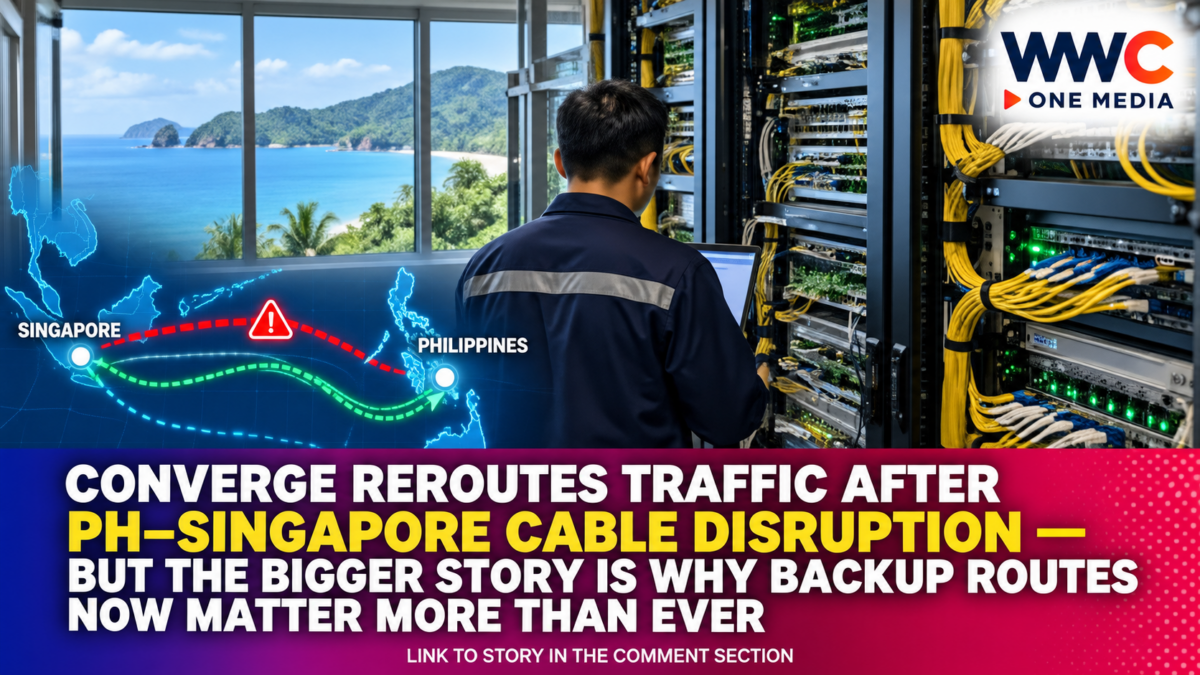
MANILA, Philippines — Converge ICT Solutions Inc. said its recent investments in international submarine cables helped shield customers from a major Philippines–Singapore connectivity disruption, allowing the broadband provider to reroute traffic almost immediately and avoid a much wider outage.
The disruption struck an international submarine cable link connecting the Philippines and Singapore on Friday, October 2, affecting access to some websites and applications hosted in Singapore.
Converge said it shifted internet traffic to alternative routes, particularly through the newly activated Bifrost Cable System, resulting in little to no interruption for most residential and enterprise customers.
Some users still experienced difficulty accessing Singapore-hosted services, but the company said the impact was limited compared with what could have happened if its network had depended on a single route.
The incident became one of the clearest tests yet of Converge’s multibillion-peso push to build more international capacity.
Converge says five years of planning paid off
Converge CEO and co-founder Dennis Anthony Uy said the company began planning for additional international cable routes roughly five years ago precisely because submarine cable failures are inevitable.
“We have planned our investments in these international cable systems as early as five years ago precisely in anticipation of these incidents,” Uy said.
That planning centered on two major systems:
Bifrost, which connects the Philippines to Singapore, Indonesia, Guam and the United States;
and SEA-H2X, which links the Philippines with Hong Kong, Hainan, Thailand and Singapore.
Together, the systems give Converge multiple paths for international traffic instead of forcing data through one vulnerable corridor.
Bifrost became the immediate backup route
The Bifrost system was particularly important during the outage.
Converge said traffic was rerouted primarily through Bifrost after the Philippines–Singapore cable problem emerged.
The more than 20,000-kilometer trans-Pacific system connects Southeast Asia to the United States through a route involving Indonesia, Singapore, Guam and the Philippines.
Converge operates the Philippine branch through its international cable landing station in Davao and holds rights to one fiber pair on the system’s main trunk.
The company’s latest infrastructure disclosure describes Bifrost as having an upgraded design capacity of more than 260 terabits per second.
That makes it one of the highest-capacity international links available to Converge.
SEA-H2X adds another escape route
Converge’s second major international system, SEA-H2X, provides another layer of redundancy.
The roughly 6,000-kilometer cable connects the Philippines with Hong Kong, Hainan, Thailand and Singapore and lands in La Union.
Converge is part of the consortium behind the system.
Its own infrastructure disclosure lists SEA-H2X with an initial design capacity of 160 Tbps, while earlier industry coverage cited higher ultimate design figures depending on system configuration.
The important point is not the exact headline capacity.
It is that Converge now has geographically different international cable options.
If one route fails, traffic can potentially be shifted to another.
That is the essence of network redundancy.
The cable problem affected more than one telecom company
The outage was not isolated to Converge.
Other Philippine internet providers also experienced service problems after the Philippines–Singapore cable route went offline.
Globe Telecom, for example, also rerouted internet traffic through alternative international links while the affected connection was being restored.
Reports from the Philippine Daily Inquirer said several internet service providers were affected by the disruption, illustrating how dependent local connectivity remains on a relatively small number of international subsea routes.
The affected Philippines–Singapore segment was later restored, with services returning to normal after repairs and network adjustments.
That means this particular incident was short-lived.
But the lesson may be much more permanent.
Submarine cables carry the internet most users never see
For ordinary consumers, the internet feels wireless.
Phones connect through Wi-Fi.
Laptops access cloud applications.
Video calls appear instantly.
Streaming platforms load on demand.
But much of the international data behind those services ultimately travels through fiber-optic cables lying on the ocean floor.
These submarine cables form the physical backbone of the global internet.
That means a damaged cable can affect:
cloud platforms,
international websites,
video conferencing,
financial transactions,
gaming,
content streaming,
corporate systems,
and cross-border data services.
Southeast Asian governments and telecommunications companies increasingly treat subsea cables as critical infrastructure because damage can have economic, security and resilience implications.
Cable outages are not rare accidents
Submarine cables can fail for many reasons.
Fishing activity can damage lines.
Ship anchors can cut cables.
Undersea landslides and earthquakes can disrupt them.
Construction can create accidental breaks.
And in some parts of the world, geopolitical tensions have increased concerns about intentional sabotage.
That means operators cannot realistically build a network based on the assumption that every cable will remain available at all times.
The safer approach is to build multiple routes.
If one fails, traffic moves elsewhere.
That is exactly what Converge says happened during the October outage.
The Philippines is particularly exposed
The Philippines’ geography makes redundancy even more important.
The country is an archipelago located in one of the world’s most disaster-prone regions.
Earthquakes, typhoons and undersea geological activity are persistent risks.
At the same time, Filipinos increasingly depend on cloud services, streaming, online banking, digital commerce and remote work.
That combination makes reliable international connectivity a national economic issue rather than simply a telecommunications problem.
Converge’s network now includes more than 964,000 kilometers of fiber-optic assets nationwide, according to its corporate profile.
But even an enormous domestic fiber network still needs reliable international exits.
If the offshore links fail, a powerful domestic network can still become isolated from overseas content and cloud infrastructure.
AI is making the capacity problem even bigger
Uy said Converge expects international bandwidth demand to keep rising because of artificial intelligence and cloud computing.
That expectation is well-founded.
AI workloads can involve huge transfers of data between data centers.
Cloud applications depend heavily on international connectivity.
Streaming continues to expand.
Businesses increasingly store software, databases and customer systems in overseas cloud infrastructure.
“With the current high demand for artificial intelligence and cloud computing, international data traffic will just continue to rise,” Uy said.
That means the issue is no longer simply whether a country has enough bandwidth today.
Telecom operators need enough excess capacity to survive future traffic growth and unexpected failures.
Converge is building a much larger digital infrastructure platform
The submarine cables form only one part of Converge’s infrastructure strategy.
The company has been developing what it calls its National Digital Infrastructure, combining:
nationwide fiber,
international submarine cables,
cable landing stations,
satellite connectivity,
and data centers.
Its international systems include Bifrost and SEA-H2X alongside its existing C2C-EAC connectivity.
The company also operates landing stations in Davao and La Union and has expanded its data-center footprint in Metro Manila and Pampanga.
The broader strategy is to position Converge not just as an internet-service provider but increasingly as infrastructure for enterprises, hyperscalers, cloud platforms and international data traffic.
The company is spending heavily on network resilience
Converge allocated as much as ₱23 billion in capital expenditures for 2026, roughly 30% higher than its previous year’s spending.
A significant portion is being directed toward expanding and hardening its network.
The company said it routinely invests in redundant fiber routes so that damage to one segment does not automatically cause widespread service interruption.
The strategy mirrors what happened during the Philippines–Singapore cable disruption.
Redundancy costs money when everything is working normally.
Its value becomes obvious only when something breaks.
The financial stakes are also getting larger
Converge is protecting a business that has become increasingly large.
The company generated ₱44.8 billion in revenue in 2025, up 10.2% from the previous year.
Net income reached ₱11.9 billion, while enterprise revenue grew more than 20%.
By the end of March 2026, its total subscriber base had reached around 3.09 million, driven partly by rapid growth in prepaid fiber services.
That means even a short disruption can potentially affect millions of residential users and thousands of businesses.
For enterprise customers, outages can be particularly costly.
Factories, banks, retailers, call centers and cloud-dependent companies cannot simply stop operating every time an international cable fails.
Reliability therefore becomes a competitive advantage.
The rest of the industry is building redundancy too
Converge is not alone in expanding international connectivity.
Globe Telecom joined the consortium developing the Candle Cable System, an approximately 8,000-kilometer network connecting the Philippines with Japan, Taiwan, Indonesia, Malaysia and Singapore.
The system is designed for up to 570 Tbps of capacity and will have Philippine landing points in Nasugbu and Baler.
Meanwhile, the Department of Information and Communications Technology said Converge, Globe and PLDT were discussing a separate $500-million domestic submarine cable that could run around the Philippine archipelago and also function as a sensor network for earthquakes, tsunamis and maritime activity.
These projects show where the telecommunications industry is headed.
More routes.
More landing stations.
More capacity.
And fewer single points of failure.
Redundancy matters more than headline speed
Philippine internet competition is often marketed around speed.
Providers advertise faster Mbps.
Consumers run speed tests.
Telecom companies celebrate rankings.
But the October disruption highlights another metric that can matter just as much:
resilience.
An ultra-fast internet connection is not useful if an international cable failure disconnects users from the services they need.
That is why telecom infrastructure is increasingly judged not only by maximum speed but by how well it performs when something goes wrong.
Networks need spare capacity.
They need alternate routes.
They need backup power.
And they need systems capable of moving traffic quickly when failures occur.
Consumers may never notice when redundancy works
There is an irony in resilient infrastructure.
When it works perfectly, customers barely notice it.
A cable fails.
Traffic shifts.
Websites continue loading.
Video calls remain connected.
Businesses continue processing transactions.
Users may never know a serious technical incident happened underneath them.
That appears to be what Converge is highlighting from the October disruption.
The company says some users encountered difficulty reaching Singapore-hosted applications, but widespread failure was avoided because traffic could be moved elsewhere.
That is a very different outcome from an outage in which millions of customers lose access until repairs are completed.
But no network is completely outage-proof
The incident should not be interpreted as proof that Converge—or any telecom operator—can eliminate disruptions.
Redundant networks can still fail.
Multiple cables can be damaged simultaneously.
Routing systems can experience faults.
Power problems can affect landing stations.
Cyberattacks can create separate disruptions.
And natural disasters can damage infrastructure across multiple locations.
Redundancy reduces risk.
It does not remove it.
That distinction is important because phrases such as “shielded users” or “resilient network” should not be confused with guarantees of uninterrupted service.
The next digital race is about who stays online when something breaks
For years, Philippine telecommunications competition centered on coverage and speed.
The next phase is increasingly about something less visible.
Reliability.
As artificial intelligence, cloud computing, online banking and digital commerce place more of the economy on international networks, even short connectivity failures can become expensive.
Converge’s investments in Bifrost and SEA-H2X were planned years before this particular outage.
During the Philippines–Singapore cable disruption, those investments finally faced the kind of real-world test they were designed for.
The cable failed—but most Converge customers reportedly stayed connected.
And that may be the bigger story.
Because in the next era of Philippine connectivity, the strongest network may not simply be the one that promises the highest speed.
It may be the one that has somewhere else to send your data when the main route suddenly disappears.