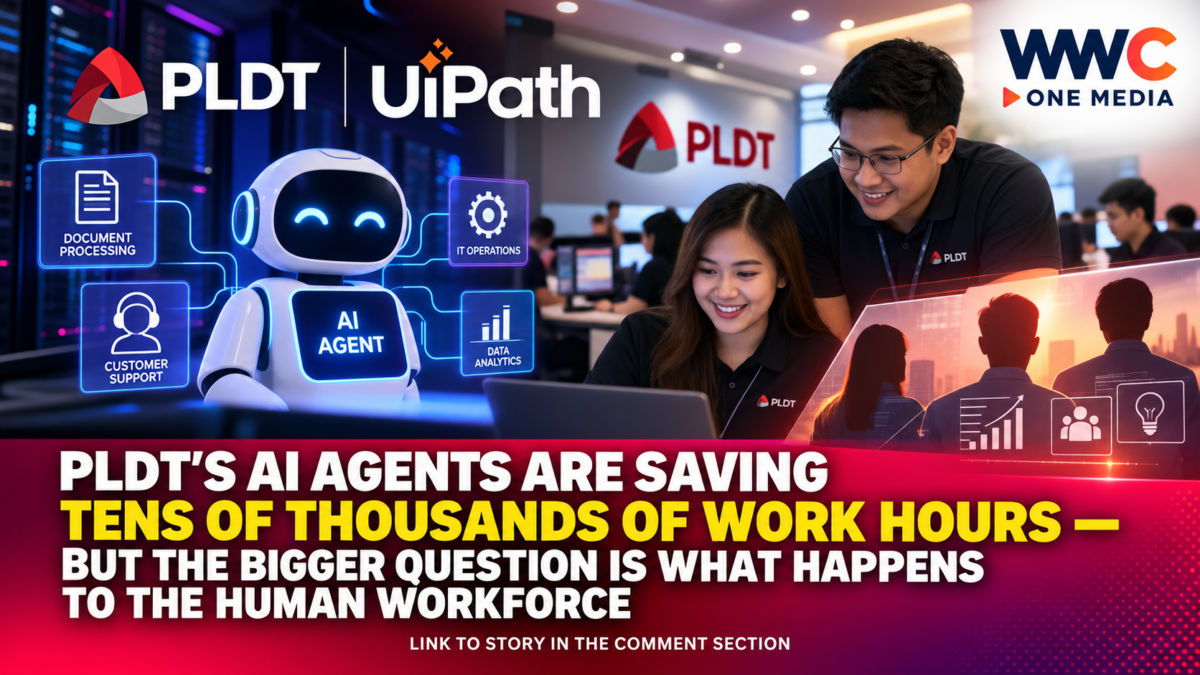
MANILA, Philippines — PLDT is pushing artificial intelligence deeper into its operations, saying a new generation of AI agents is already eliminating tens of thousands of hours of manual work every year while helping employees create sales proposals, retrieve complex information and assess risks far faster than before.
The Philippine telecommunications giant recently won a Silver Award at the 2026 UiPath AI Breakthrough Awards for its enterprise transformation, recognizing the deployment of three major AI systems: Ellie, KAI and ERICA.
Unlike simpler chatbots that mainly answer questions, these tools are being used inside actual business workflows.
That shift matters.
PLDT is no longer experimenting with AI purely as a productivity assistant.
It is increasingly using AI to perform parts of work that previously required employees to search, prepare, analyze and coordinate information manually.
And according to the company’s own estimates, the time savings are already substantial.
Ellie alone could save up to 25,000 hours a year
At the center of PLDT’s AI push is Ellie, short for Enablement and Intelligence Engine.
The AI-powered assistant combines internal enterprise knowledge with live customer relationship management data to help sales teams automatically generate customized proposals and presentations.
PLDT estimates that Ellie can reclaim approximately 18,000 to 25,000 hours of manual work every year.
Sales teams are reportedly spending 40% to 60% less time producing standard proposals and presentations.
The company also says proposal error rates have fallen by around 40% to 50%.
Those figures are significant because proposal preparation is often one of the least visible but most time-consuming parts of enterprise sales.
Employees may have to collect technical specifications, pricing information, customer histories, product details and presentations before even reaching the actual sales conversation.
Automating much of that work gives sales teams more time to interact directly with customers.
PLDT says upsell rates have increased
Ellie is not being used only to save time.
PLDT says its sales teams have also observed a 20% to 50% increase in upsell rates after deploying the platform.
The system monitors customer-health indicators and can identify warning signs such as falling product usage or delayed payments.
It can then alert relationship managers that a customer may be at risk of leaving—or may be a candidate for another product or service.
That is an important evolution.
AI is moving beyond simply helping employees complete paperwork.
It is beginning to influence which customers employees contact, when they contact them, and what they offer.
If those gains hold over time, the value to PLDT could eventually come less from reducing labor hours and more from generating additional revenue.
KAI turns days of research into seconds
PLDT’s second major tool is KAI, or Knowledge, Automation, Intelligence.
The AI agent is designed to retrieve information from internal knowledge systems and generate contextual answers for employees.
Before KAI, PLDT says some research requests could take as long as five days.
The same information can now reportedly be retrieved in one to three seconds.
The company estimates KAI eliminates approximately 25,000 to 30,000 hours of manual work annually, equivalent to the productive capacity of roughly 12 full-time employees.
The Philippine Star earlier reported that PLDT became the first telecommunications company in Southeast Asia to deploy UiPath’s advanced agentic AI solution for enterprise use when KAI was introduced earlier in 2026.
PLDT executives said the objective was to give employees immediate access to information during customer conversations instead of forcing them to stop and search across multiple systems.
That can improve both speed and consistency.
ERICA is attacking one of the slowest corporate processes
The third major agent is ERICA, which focuses on enterprise risk intelligence.
PLDT says ERICA has reduced manual effort involved in risk assessment by 97% to 99%.
Risk reviews can require employees to gather information across many documents, systems and business units before identifying potential operational, financial or compliance issues.
Automation can accelerate those tasks significantly.
But this is also where AI use becomes more sensitive.
Risk decisions can have serious consequences.
That means companies still need human oversight, audit trails and controls around how AI reaches conclusions.
The productivity benefit may be enormous, but so is the need for governance.
Together, the AI agents could be reclaiming more than 40,000 hours
Using PLDT’s own estimates, Ellie and KAI alone could eliminate roughly 43,000 to 55,000 hours of manual work per year.
That figure does not even include all of the time potentially saved through ERICA and other AI systems being deployed across PLDT Home, Smart and the wider group.
For perspective, 50,000 working hours is roughly equivalent to the annual work time of more than two dozen full-time employees, depending on the work-year assumption used.
But that comparison should be interpreted carefully.
A reduction in manual hours does not automatically mean those jobs have disappeared.
PLDT says the objective is to free employees for more complex, customer-facing and higher-value work rather than simply replace them.
PLDT has repeatedly said AI should augment workers
Earlier this year, PLDT Chief Operating Officer Menardo Jimenez Jr. said the company wanted AI to create opportunities rather than merely eliminate roles.
He described automation as increasingly inevitable but argued that companies should use it to improve what employees can accomplish.
That philosophy is visible in several of PLDT’s current deployments.
At PLDT Home, AI handles straightforward inquiries and certain after-hours customer-acquisition tasks, while human agents remain responsible for more complex interactions.
The company has said this allows people to spend less time answering repetitive questions and more time dealing with customer concerns that require judgment or empathy.
That “human plus AI” model is becoming increasingly common across customer-service industries.
AI is already working 24/7 at PLDT Home
PLDT Home began using AI tools in June to keep parts of its customer-acquisition operation available 24 hours a day, seven days a week.
Prospective customers can browse fiber plans, ask common questions and complete parts of the subscription process outside normal business hours.
Human agents step in when a request becomes more complicated.
PLDT said the move was partly designed for customers such as business-process outsourcing workers who may be awake and online at unconventional hours.
This shows another advantage of AI beyond labor savings:
software does not have normal office hours.
A digital agent can respond at 2 a.m. without requiring an employee to remain on duty solely to answer routine questions.
AI-assisted service centers could save customers 5,000 waiting hours every month
The consumer business is also using AI inside physical service centers.
PLDT Home has rolled out an AI-powered support system developed with Amdocs that performs real-time diagnostics and helps frontline staff resolve customer issues faster.
Once fully deployed, PLDT estimates the platform could save customers roughly 5,000 hours of waiting time every month.
The system is intended to reduce the need to pass simple problems through multiple backend support layers.
That matters because one of the biggest complaints about traditional telecom customer service is not necessarily the complexity of the technical problem.
It is the amount of time customers spend being transferred between teams.
PLDT is scaling AI far beyond three agents
Ellie, KAI and ERICA are only part of PLDT’s broader strategy.
In August, PLDT and Smart expanded their partnership with Microsoft, building on an investment in 1,000 Microsoft 365 Copilot seats.
Employees are using Copilot for tasks including:
drafting communications,
summarizing meetings,
analyzing information,
and supporting decision-making.
The goal is to make AI part of ordinary workflows rather than confining it to isolated pilot projects.
That distinction is important.
Many companies announce AI trials.
Far fewer reach the stage where thousands of employees regularly use AI across day-to-day operations.
PLDT is trying to move into that second category.
The company is moving from automation to “agentic AI”
Traditional automation generally follows predefined rules.
If a certain event occurs, the software performs a predetermined action.
Agentic AI aims to go further.
It can interpret information, decide among possible actions and carry out multiple steps toward a goal with less constant human instruction.
That is why companies such as PLDT are particularly interested in the technology.
A conventional automation tool might transfer data from one spreadsheet to another.
An AI agent could potentially:
understand a customer request,
search multiple internal systems,
identify the appropriate solution,
prepare a proposal,
and suggest the next action for an employee.
That difference helps explain why enterprise software companies are describing agentic AI as the next major phase of business automation.
Philippine businesses are moving in the same direction
PLDT is not alone.
Companies across the Philippines are increasingly experimenting with AI systems that automate work previously done manually.
Research cited by Philstar found 78% of Filipino workers across 13 industries now use AI in their daily work, based on a survey of more than 3,500 employees.
Workers reported using AI for communication, information processing, decision support and digital tasks.
Philippine companies have also reported dramatic reductions in reporting and analysis time.
In several workshop examples reported by Philstar, tasks that previously took four to six hours were completed in minutes with AI assistance—although those examples were participant-reported and still required human review.
The broader direction is clear:
AI is moving rapidly from experimentation to ordinary office work.
Customer service may change even faster
Customer service is one of the areas where agentic AI is being adopted most aggressively.
Recent Twilio research cited by InsiderPH found that AI agents already handle around 46% of customer-service conversations in the Philippines, with businesses expecting that figure to rise to 61% by 2027.
That does not necessarily mean human customer-service jobs disappear.
But it does suggest the work is changing.
AI is increasingly handling:
routine questions,
basic account requests,
initial diagnostics,
information retrieval,
and standardized transactions.
Humans are being pushed toward more complicated exceptions, emotional interactions, escalations and relationship management.
That shift can make human roles more valuable—but potentially more demanding.
The BPO sector is facing the same transformation
The trend is especially important for the Philippines because of the country’s enormous business-process outsourcing industry.
BPO operators are increasingly adopting human-in-the-loop agentic AI, where machines execute routine workflow steps while people remain responsible for judgment and complex interactions.
Teleperformance, one of the world’s largest outsourcing companies, said this year it plans to make virtually its entire workforce AI-enabled, describing the future as a hybrid workforce combining humans and AI agents.
That matters because PLDT’s transformation is not happening in isolation.
It is part of a much larger change in the type of work being performed across the Philippine services economy.
Productivity gains also create uncomfortable questions
PLDT emphasizes that AI is freeing employees for higher-value work.
That can be true.
But large productivity improvements inevitably raise workforce questions.
If software allows the same number of employees to serve more customers, companies may not need to hire as many people as they otherwise would have.
If research requiring several employees can be completed in seconds, some traditional roles may shrink.
If proposals are generated automatically, administrative workloads change.
The effect may initially appear through slower hiring and redesigned jobs rather than mass layoffs.
That possibility is increasingly central to the global AI debate.
Productivity gains are economically valuable.
But the benefits depend partly on whether companies successfully retrain workers for the tasks that automation does not replace.
AI outputs still need oversight
There is another important limitation.
AI can produce incorrect answers.
It can misinterpret information.
It can hallucinate facts.
It can reproduce outdated internal knowledge.
And systems connected to company databases can create privacy and cybersecurity risks if poorly governed.
For PLDT, those risks are especially significant because the company handles customer data and critical telecommunications infrastructure.
This is why enterprise AI needs controls around:
data access,
accuracy,
human review,
cybersecurity,
model governance,
and accountability.
Saving hours is valuable only if the work produced during those hours remains accurate.
PLDT’s AI infrastructure ambitions go beyond internal productivity
The group is also investing heavily in infrastructure designed to support AI workloads.
PLDT subsidiary ePLDT operates VITRO Sta. Rosa, a hyperscale data center with around 50 megawatts of capacity, one of the country’s largest facilities.
The site has been positioned to support cloud computing and increasingly demanding AI applications.
PLDT therefore has exposure to AI from two directions.
It is using AI internally to reduce costs and improve service.
At the same time, its data-center business can benefit as other companies demand more computing capacity for their own AI systems.
That makes artificial intelligence both an operational tool and a potential revenue opportunity for the group.
The biggest payoff may come from revenue, not cost cutting
The most interesting number in PLDT’s announcement may therefore not be the tens of thousands of hours saved.
It may be the reported increase in upselling.
If Ellie helps sales teams identify customer needs faster and increases upsell rates by 20% to 50%, AI moves from being a cost-efficiency technology into a revenue-generation technology.
That is where enterprise AI becomes particularly attractive.
Saving labor hours has a natural ceiling.
A company can only cut so much administrative work.
But using AI to sell more products, retain more customers and improve conversion can potentially create a much larger economic impact.
That will be the metric investors should watch.
Awards are easy. Sustained results are harder.
PLDT’s UiPath award gives the company international recognition.
But technology awards do not determine whether an AI strategy succeeds.
The real measures will be operational.
Do response times stay lower?
Do sales actually improve?
Do customers experience better service?
Do employees become more productive?
Do error rates continue falling?
And can PLDT scale AI without compromising customer data, accuracy or trust?
Those questions become more important as AI moves deeper into the organization.
The bigger transformation is happening quietly
The most disruptive part of PLDT’s AI rollout may be that customers and even employees eventually stop thinking of it as an AI project.
A proposal simply appears faster.
A sales representative gets the answer immediately.
A risk review that once took days is completed in minutes.
A customer receives help at midnight.
The technology disappears into the workflow.
That is often when technological change becomes most consequential.
PLDT says its AI agents are already reclaiming tens of thousands of work hours every year.
The bigger question is what companies do with those hours after they get them back.
If employees spend that time solving harder problems, serving more customers and generating more revenue, AI could become one of PLDT’s most powerful productivity tools.
But if automation ultimately reduces the amount of human work companies need, the next transformation may not be measured only in hours saved—it could also reshape the jobs Filipinos are hired to do.