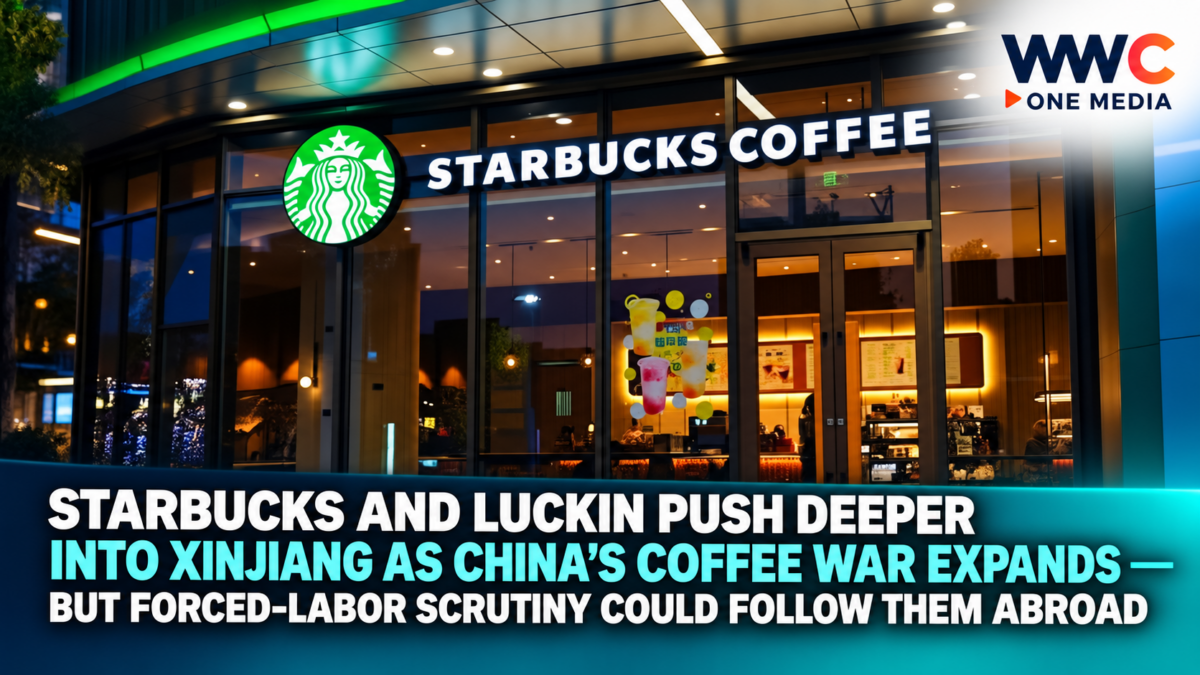
BEIJING — Starbucks and Luckin Coffee are pushing deeper into China’s far-western Xinjiang region as the country’s coffee war reaches one of its most politically sensitive markets, but the expansion is raising a much bigger question: can global consumer brands separate commercial growth in Xinjiang from mounting international scrutiny over forced labor and human rights?
Starbucks opened its first two stores in Xinjiang on September 29, 2026, both in the regional capital Urumqi—one at the Grand Bazaar and another at Urumqi Tianshan International Airport.
The openings put the American coffee giant into a market where domestic rival Luckin Coffee was already established, having opened its first 11 self-operated Urumqi stores in 2024, according to Chinese reporting.
On the surface, this is another chapter in China’s increasingly intense coffee competition.
But Xinjiang is not an ordinary expansion market.
The region has been at the center of years of allegations from governments, researchers and human-rights groups involving mass detention, religious restrictions, coercive labor-transfer programs and forced labor affecting Uyghurs and other predominantly Muslim ethnic minorities.
China rejects those claims and says Xinjiang enjoys economic development, stability and religious freedom.
That tension now places some of the world’s best-known coffee brands inside one of international trade’s most contested supply-chain debates.
Starbucks immediately faced backlash in Washington
Starbucks’ Urumqi openings triggered a rapid political response in the United States.
Republican Rep. John Moolenaar, chairman of the House Select Committee on China, called on Starbucks to close the stores, arguing that an American company should not expand in a region facing extensive human-rights allegations.
Reuters reported that Moolenaar described the move as “morally bankrupt.”
Human Rights Watch and the World Uyghur Congress also criticized the expansion, arguing that international corporate investment can help Beijing portray Xinjiang as a normalized tourism and commercial destination despite unresolved rights concerns.
Beijing fired back.
China’s Foreign Ministry dismissed genocide allegations as lies and accused U.S. institutions of politicizing Xinjiang.
Chinese officials instead point to rising tourism, retail activity and investment as evidence of economic normalization in the region.
That leaves global companies operating in Xinjiang caught between two completely opposing narratives.
Starbucks says it plans to stay
Despite the political criticism, Starbucks China CEO Molly Liu has indicated that the company intends to continue investing in Xinjiang.
Chinese reporting quoted Liu as saying that entering the region was about expanding Starbucks’ network and developing deeper relationships with local consumers.
The company already operates around 8,000 stores across China.
Its Xinjiang move comes shortly after a major change in ownership.
In April, Starbucks completed a transaction giving Chinese investment firm Boyu Capital a 60% stake in its China retail business, while Starbucks retained 40% and continued licensing its brand and intellectual property.
The partnership has an ambitious goal:
take Starbucks from roughly 8,000 Chinese stores to 20,000 over time.
That makes expansion into previously untapped markets such as Xinjiang strategically understandable.
Politically, however, it is much more complicated.
Luckin got there first
Starbucks is also under enormous pressure from domestic competition.
Luckin Coffee has transformed China’s coffee market through an aggressive combination of low prices, app-based ordering, rapid store openings and heavily promoted drinks.
By the second quarter of 2026, Luckin had approximately 36,310 stores, overwhelmingly concentrated in China, compared with Starbucks’ roughly 8,000 Chinese locations.
Luckin generated approximately 15.9 billion yuan in second-quarter revenue, up 28.5% year on year, with more than 112 million monthly transacting customers.
That enormous scale helps explain why Starbucks can no longer afford to ignore markets where domestic chains are expanding.
Luckin’s Xinjiang presence predates Starbucks’ arrival.
China Daily reported that the chain opened 11 self-operated stores in Urumqi in May 2024, while rival Cotti Coffee had also entered the region.
So Starbucks is not creating Xinjiang’s coffee market.
It is entering one already being built by Chinese competitors.
Xinjiang ingredients are also entering consumer products
This is where the story becomes more complicated than simply opening cafés.
Luckin has previously marketed beverages containing agricultural ingredients from Xinjiang.
Its corporate filings describe products featuring Aksu apples from Xinjiang, which were used in beverages including its Apple C Americano and Aksu Apple Latte.
There is no evidence in that disclosure that those ingredients were produced using forced labor.
But Xinjiang agricultural supply chains receive unusually intense international scrutiny because Western governments argue that state-organized labor-transfer programs can make it difficult for companies to reliably determine whether participation by workers is genuinely voluntary.
The U.S. State Department has previously cited what it describes as forced-labor indicators in Xinjiang’s labor-transfer system.
China disputes that characterization and describes employment programs as poverty-reduction and vocational initiatives.
For global consumer companies, that disagreement creates a compliance problem that does not disappear simply because a supplier has formal documentation.
Forced-labor rules are becoming a trade issue, not just an ethics issue
The commercial risk has also increased dramatically.
The United States has moved beyond corporate pressure and human-rights statements toward direct trade enforcement.
In July 2026, the Office of the U.S. Trade Representative imposed additional trade measures after conducting Section 301 investigations covering 60 economies that it said had failed to adequately prohibit or enforce bans on forced-labor imports.
China was among the economies examined.
The USTR said weak forced-labor import controls distort competition because companies using forced labor—or goods incorporating forced-labor inputs—can potentially produce products at artificially low cost.
The U.S. also separately enforces the Uyghur Forced Labor Prevention Act, or UFLPA, under which goods linked to Xinjiang can face heightened scrutiny at the American border. U.S. Customs and Border Protection continues publishing enforcement statistics covering shipments stopped under the law.
That means a supply-chain issue that begins inside China can potentially become an export problem thousands of kilometers away.
Starbucks has explicit rules banning forced labor
Starbucks publicly states that forced labor is prohibited within its coffee supply chain.
Its C.A.F.E. Practices sourcing framework requires suppliers to meet social-responsibility standards, with independent verification intended to protect workers and ensure compliance with rules covering wages, child labor and forced labor.
That is important context.
Opening a Starbucks café in Xinjiang does not by itself establish that Starbucks coffee contains Xinjiang-produced ingredients or forced-labor inputs.
The coffee served at the locations may come from Starbucks’ broader verified sourcing network.
Operating a store in a controversial region and sourcing goods produced through forced labor are two separate issues and should not be conflated without evidence.
But critics argue there is also a reputational question.
Even if the coffee itself comes from somewhere else, can a global company operate safely in an economy where independent labor due diligence can be difficult?
That is the question Starbucks now faces.
Starbucks has confronted supply-chain allegations in China before
The company has already experienced how difficult supply-chain verification can become.
In 2024, China Labor Watch alleged that coffee farms supplying Starbucks and Nestlé in Yunnan had labor practices inconsistent with the companies’ ethical standards, including excessive working hours and alleged child labor.
The Washington Post reported that both companies began examining the allegations.
Those allegations involved Yunnan, not Xinjiang, and should not be confused with the current dispute.
But the episode demonstrated a broader problem.
Large multinational companies may establish sophisticated supplier standards while still struggling to verify every farm, contractor and labor relationship in sprawling agricultural supply chains.
That challenge becomes even greater in politically sensitive regions where independent audits can face restrictions.
Starbucks is also facing shareholder pressure
Xinjiang scrutiny is beginning to reach Starbucks investors as well.
The National Center for Public Policy Research’s Free Enterprise Project recently filed a shareholder proposal asking Starbucks to disclose its potential exposure to forced labor in Chinese supply chains, particularly involving solar products.
Days later, the organization publicly criticized Starbucks’ Xinjiang openings and asked management to explain the decision to shareholders.
The organization represents one shareholder-advocacy perspective rather than a regulatory finding.
Still, the development illustrates how Xinjiang-related issues can migrate from political debate into corporate governance.
Companies may face questions not just from customers and lawmakers, but from investors examining supply-chain, legal and reputational risk.
The commercial appeal of Xinjiang is obvious
There is also a reason companies keep entering the region.
Xinjiang has a population of tens of millions and is being heavily promoted by Beijing as a tourism and trade destination.
Chinese official figures cited by China Daily showed the region welcomed approximately 323 million tourist visits in 2025, with tourism spending reaching about 370 billion yuan, or roughly $52 billion.
Retail sales reached 263 billion yuan during the first eight months of 2026.
Urumqi has also developed into an increasingly important transport hub linking China to Central Asia and Europe.
For Starbucks, Luckin and other consumer brands, that represents an emerging pool of customers.
Ignoring the market therefore carries an opportunity cost.
Entering it carries another kind of cost.
Starbucks needs Chinese growth badly
The stakes are especially high for Starbucks.
China was once one of the company’s most important growth stories.
But its dominance has been eroded dramatically by homegrown competitors.
Reuters reported that Starbucks’ estimated Chinese coffee-shop market share fell from around 34% in 2019 to 14% in 2024.
Luckin, Cotti and other chains have competed aggressively through discounting, delivery and constant product launches.
Starbucks ultimately chose to bring in Boyu Capital to help localize the business and regain momentum.
Its strategy now depends partly on expanding beyond the largest Chinese cities.
Xinjiang fits that strategy.
The question is whether political risk could undermine the commercial logic.
Luckin has an international problem too
Luckin’s situation is different because it is a Chinese company.
But the chain is increasingly looking abroad.
It has expanded into markets including Singapore, Malaysia and the United States, while building a consumer brand that increasingly competes with Starbucks internationally.
That makes supply-chain scrutiny more relevant.
A product sold entirely inside China faces one regulatory environment.
A product exported to the United States or another market with strict forced-labor legislation can face another.
Luckin’s growth therefore increases the importance of documenting the origins of agricultural ingredients used across its beverages.
Again, use of an ingredient from Xinjiang does not prove forced labor.
But entering Western markets can expose sourcing practices to much more aggressive regulatory and political examination.
The two coffee giants now face very different risks
Starbucks and Luckin are fighting for the same Chinese customers, but their vulnerabilities are different.
Starbucks faces a reputation problem.
It is an American brand with public commitments involving human rights, responsible sourcing and ethical business practices.
Operating in Xinjiang therefore gives U.S. lawmakers and advocacy groups an obvious target.
Luckin faces an internationalization problem.
Its enormous domestic business gives it scale Starbucks can no longer match in China.
But the further Luckin expands outside China, the more important international trade rules, sourcing disclosures and forced-labor restrictions become.
Those risks are different, but they intersect in Xinjiang.
China sees the controversy very differently
Any accurate account also has to include Beijing’s position.
China has repeatedly denied accusations of genocide and widespread forced labor in Xinjiang.
Foreign Ministry spokesman Guo Jiakun said recent criticism of Starbucks’ expansion was politically motivated and that the region enjoys social stability, economic prosperity, ethnic unity and religious harmony.
Chinese state media have portrayed the arrival of Starbucks and other foreign businesses as evidence that Western attempts to isolate Xinjiang economically have failed.
From Beijing’s perspective, multinational investment validates its argument that the region is normalizing and prospering.
From critics’ perspective, the same investments risk legitimizing policies they consider abusive.
That is why even two coffee shops can become geopolitical symbols.
The bigger battle is no longer just Starbucks versus Luckin
China’s coffee war is usually told as a business story.
Premium experience versus low prices.
American brand versus Chinese challenger.
Large cafés versus app-driven pickup.
Starbucks versus Luckin.
But Xinjiang introduces a completely different dimension.
Globalization means ingredients, companies and brands increasingly cross borders governed by different standards.
A product that is legal to manufacture and sell in China may face investigations or restrictions when it moves abroad.
A business decision celebrated as expansion inside China may trigger congressional condemnation in Washington.
And an ingredient marketed domestically for its regional identity may receive intense scrutiny when a company becomes global.
That makes Xinjiang more than Starbucks’ newest expansion market.
It is becoming a test of whether multinational and Chinese consumer brands can continue separating commercial growth in China from the increasingly aggressive human-rights and trade rules surrounding Chinese supply chains.
And as Luckin expands abroad while Starbucks tries to rebuild its Chinese business, the coffee war may soon be fought on something much bigger than price, store count or who makes the better latte.
The next battle could be over where every ingredient came from—and whether companies can prove how it was produced.