NEW YORK, United States — October 31, 2026
Wall Street is heading into one of its most consequential weeks of the year as major technology earnings, the US midterm elections and a closely watched employment report converge just days after a sharp selloff in artificial intelligence-related stocks.
CNBC’s Jim Cramer warned investors against assuming the worst of the technology sector’s decline was already over, pointing to a crowded calendar of events capable of producing further market volatility.
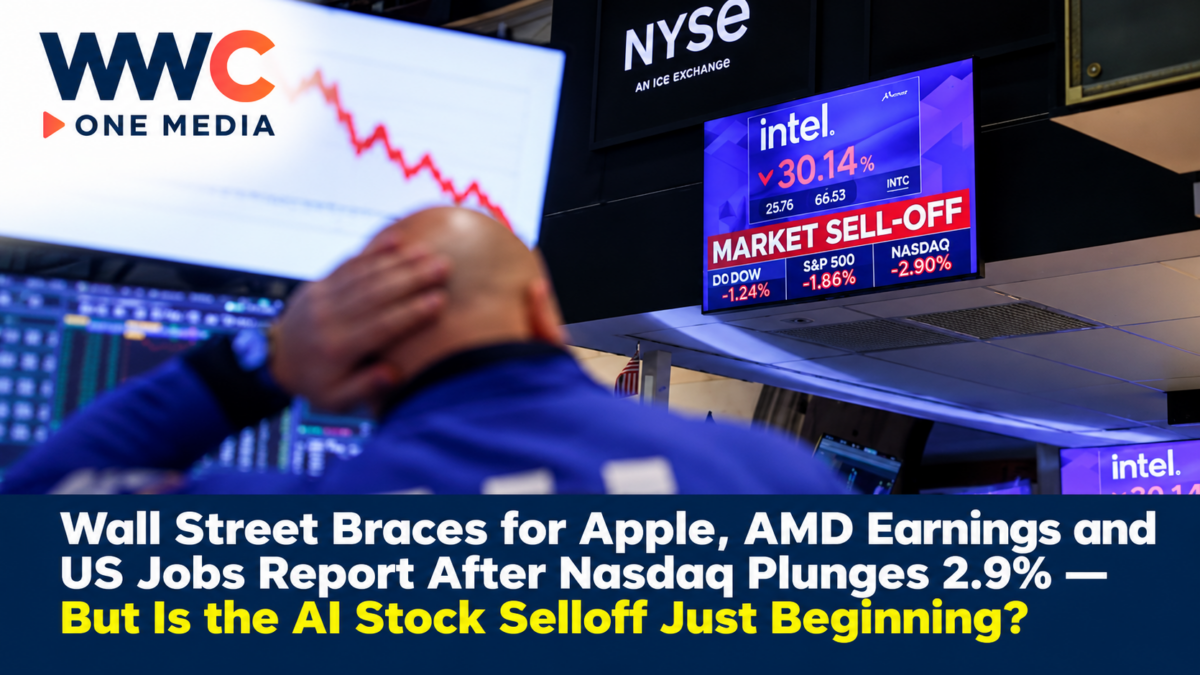
The warning followed a turbulent Friday, October 30, when the technology-heavy Nasdaq Composite plunged 2.9%, the S&P 500 lost 1.8%, and the Dow Jones Industrial Average declined 1.1%.
For the full week, the Nasdaq lost approximately 2%, while the S&P 500 fell 0.6% and the Dow declined 0.9%.
Investors were already uneasy about the staggering cost of building AI infrastructure when disappointing technology earnings and outlooks intensified selling pressure.
Now, attention turns to Apple, Advanced Micro Devices, Palantir, Qualcomm and the official October US employment report.
With confidence in the artificial intelligence investment boom weakening, can strong corporate results stabilize the market—or could the next wave of earnings expose even greater financial risks?
Cramer Warns Investors Not to Assume the Selloff Is Over
During his October 30 week-ahead commentary, Cramer argued that investors should remain cautious following a difficult period for technology stocks.
The concern is not simply whether individual companies are profitable.
It is whether their share prices already reflect expectations that may be difficult to satisfy.
AI-related businesses have attracted substantial investment because of expectations for rapid growth in cloud services, automation, computing hardware and enterprise software.
However, some leading companies are committing enormous amounts of capital to data centers and specialized chips before the full financial returns are known.
That creates a dilemma for investors.
A company may report impressive revenue growth and still face share-price declines if its earnings outlook, capital spending or margins disappoint.
Cramer’s warning reflects that tension.
His interpretation is an investment opinion, not evidence that the Nasdaq has entered a prolonged bear market or that another crash is inevitable.
Nasdaq Plunges 2.9% as Technology Stocks Come Under Pressure
The latest Wall Street selloff followed earnings and forecasts from several major technology businesses.
Intel suffered one of the most dramatic declines, with shares falling nearly 29% after issuing a disappointing outlook.
The result raised questions about the strength of the personal computer market, manufacturing costs and competitive pressures.
Amazon also faced scrutiny over its enormous AI spending commitments, despite rapid growth in Amazon Web Services.
Investors have become increasingly focused on how quickly cloud providers can recover the money being invested in AI infrastructure.
These developments helped push the Nasdaq down 2.9% on Friday.
The decline was particularly significant because technology shares have been a major source of broader US stock market gains.
Nevertheless, the selloff did not erase all of the market’s earlier advances.
According to Associated Press figures, the Nasdaq remained approximately 9.4% higher for the year after Friday’s decline.
This distinction matters when discussing whether recent weakness represents a correction, a broader change in market leadership or the beginning of a deeper downturn.
AI Stocks Face a Valuation Reality Check
The recent volatility highlights a debate that has intensified across Wall Street.
Investors increasingly recognize that demand for AI computing services is substantial.
But they are becoming less willing to assume that every company investing in the sector will earn attractive returns.
WWC ONE MEDIA previously explored this issue in AI Stocks Plunge 16% Despite Record Profits and $600 Billion Spending Spree — But Is Wall Street’s Biggest Tech Bubble About to Burst?.
The report examined the growing difference between strong operating performance and weaker technology share prices.
A company’s earnings can rise while its stock declines if investors lower the valuation multiple they are willing to pay.
This becomes particularly important when expectations are extremely high.
The next round of earnings will help determine whether companies can justify current market valuations with actual revenue growth, profitability and cash flow.
Monday: Apple Earnings Could Set the Tone for Technology Stocks
Apple is scheduled to report fiscal fourth-quarter 2026 financial results on Monday, November 2, after the US stock market closes.
The company plans to hold an earnings call at 5 p.m. Eastern time.
Investors will examine demand for Apple’s latest iPhones, growth in its services division and management’s expectations for the holiday shopping season.
Apple is also facing questions about its artificial intelligence strategy, hardware costs and the profitability of its newer products.
Analysts cited by Investor’s Business Daily expect approximately $113.4 billion in September-quarter revenue and earnings of $1.99 per share.
Those figures represent analyst estimates rather than reported results.
Cramer has expressed confidence in Apple’s long-term prospects while acknowledging that a high earnings valuation leaves little room for disappointing news.
For shareholders, the key issue will be whether Apple’s results and forward-looking commentary justify those expectations.
A strong quarter could support sentiment.
A disappointing forecast could intensify concern about expensive technology stocks.
Palantir Offers Another Test of AI Software Demand
Palantir is also scheduled to report earnings after the US market closes on November 2.
The company has attracted investor interest because of its work in AI-powered software, data analysis and government and commercial technology.
Investors will focus on revenue growth, demand from enterprise customers and the profitability of its expanding AI operations.
Cramer has pointed to positive customer feedback as a reason for optimism about Palantir.
However, customer enthusiasm is not itself a financial result.
The earnings report will provide evidence of how effectively that demand is translating into revenue and operating performance.
Palantir’s results could also help investors distinguish between businesses already generating commercial revenue from AI applications and companies mainly depending on expectations of future adoption.
Tuesday: AMD Earnings Could Decide the Next Move in AI Chips
Advanced Micro Devices is scheduled to release its third-quarter results on Tuesday, November 3, after the US market closes.
AMD confirmed the date in an official October 6 announcement.
Management will discuss the results during a 5 p.m. Eastern earnings call.
The semiconductor company expects approximately $13 billion in third-quarter revenue, plus or minus $300 million, based on its earlier guidance.
Investors will examine demand for its EPYC server processors, Instinct AI accelerators and personal computer chips.
AMD is competing for a larger share of the global AI infrastructure market.
Its products are used in servers, cloud systems and advanced computing applications.
But semiconductor demand is not uniform across the industry.
A strong AI data-center business can coexist with weaker demand for conventional PCs.
Intel’s disappointing results have increased attention on these differences.
Cramer expects AMD to perform better than Intel, but that remains his assessment ahead of the results.
AMD’s actual earnings and fourth-quarter outlook will provide the next important evidence.
Big Tech’s Spending Race Raises Questions About Cash Flow
The debate surrounding AMD is directly connected to the spending plans of major cloud computing companies.
Amazon, Microsoft, Alphabet, Meta and other technology groups are investing heavily in chips, data centers, networking equipment and electricity infrastructure.
WWC ONE MEDIA examined the broader trend in Big Tech’s $750-Billion AI Gamble Shakes Wall Street as Core Businesses Slow — But Will the Spending Ever Pay Off?.
The major uncertainty is not whether AI infrastructure costs money.
It is whether the resulting services will generate enough revenue and profit to justify the investment.
JPMorgan Global Research estimated in October that global AI-related capital expenditure could approach $900 billion in 2026.
The firm also identified power availability, equipment shortages, financing and public opposition as potential constraints.
Those pressures could affect both cloud computing providers and their semiconductor suppliers.
For AMD, the earnings report will help investors assess whether demand for AI hardware remains sufficient to support management’s growth expectations.
Microsoft’s $25-Billion Bond Offering Highlights the Financing Question
The AI spending race is also transforming how technology giants finance their growth.
Microsoft announced the pricing of a $25-billion senior unsecured debt offering on October 29.
WWC ONE MEDIA covered the transaction in Microsoft Raises $25 Billion in Massive Bond Sale as AI Spending Explodes — But Is Big Tech’s Debt Gamble Getting Dangerous?.
The company said proceeds could be used for general corporate purposes, including capital expenditure, working capital and other obligations.
The offering should not be interpreted as a claim that all $25 billion was designated exclusively for AI projects.
Nevertheless, the transaction illustrates how technology infrastructure investment is increasingly drawing on debt markets.
Borrowing can provide flexibility, particularly for profitable companies with strong credit profiles.
But it also creates interest and repayment obligations.
Wall Street will be watching whether cloud companies can produce sufficient free cash flow to support their investments.
Tuesday’s US Midterm Elections Add Political Uncertainty
November 3 will also bring the US midterm elections.
The results could change control of the House of Representatives and influence the balance of power in Washington.
For financial markets, potential consequences include changes in congressional oversight, fiscal policy and the prospects for new legislation.
Cramer has expressed concern that increasing political opposition to large data centers could affect construction activity in some communities.
Data centers require significant electricity, water, land and supporting infrastructure.
Communities may support the associated economic activity while raising concerns about environmental impacts, utility costs and local resources.
But it would be inaccurate to suggest that any particular election result will automatically stop US data-center development.
Congressional control, state policy, permitting decisions and private investment commitments all affect the outcome.
WWC ONE MEDIA previously examined potential sector effects in JPMorgan Maps the Stocks That Could Win After the Midterms — But Gridlock May Be Wall Street’s Favorite Outcome.
That report discussed how healthcare, energy, technology and defense businesses could respond differently depending on the election result.
For investors, the election introduces another source of uncertainty alongside earnings.
Wednesday: Qualcomm and Private Payrolls Draw Attention
On November 4, Qualcomm is among the major technology companies scheduled to report earnings.
Its performance will offer further evidence about semiconductor demand, especially in smartphones and connected devices.
Investors will be interested in the direction of demand from handset manufacturers and the company’s outlook for newer technologies.
The ADP National Employment Report is also scheduled during the week.
This private-sector payroll estimate can provide additional information about hiring trends before the official government employment report.
However, ADP figures and the Bureau of Labor Statistics payroll estimates use different methodologies.
They do not always move in the same direction.
A strong or weak ADP result therefore does not guarantee the same outcome in Friday’s official jobs report.
Friday: The US Jobs Report Could Move the Entire Market
The week concludes with one of the most closely watched economic releases.
The US Bureau of Labor Statistics is scheduled to publish its October Employment Situation report on Friday, November 6, at 8:30 a.m. Eastern time.
The report will contain updated measures of nonfarm payroll employment, unemployment and average hourly earnings.
Investors will examine whether job creation is accelerating, slowing or remaining relatively weak.
Wage growth will also receive particular attention because of its implications for inflation and consumer purchasing power.
A strong labor market can support consumer spending and business revenue.
But unexpectedly rapid wage growth could raise concerns about persistent inflation.
Conversely, weaker hiring could increase expectations that the Federal Reserve may eventually ease monetary policy.
Cramer expects solid hiring without excessive wage pressure.
That is a forecast, not a confirmed result.
The official report may differ substantially from economists’ expectations.
Federal Reserve Policy Remains a Major Market Influence
The Federal Reserve left its benchmark interest-rate target unchanged during its October meeting.
Its decision came against a backdrop of uncertainty involving growth, employment and inflation.
Financial markets will now assess whether November’s economic data alter the outlook for future interest rates.
For technology shares, interest-rate expectations are particularly relevant.
Many fast-growing companies are valued partly on profits expected far into the future.
Higher interest rates can reduce the present value investors assign to those future earnings.
That is one reason Treasury yields have become important to technology valuations.
WWC ONE MEDIA previously examined this relationship in AI Stocks Keep Defying 5% Treasury Yields — But Cramer Warns the Market May Be Ignoring a Dangerous Signal.
The article explored the risks associated with expensive growth stocks when borrowing costs and bond yields remain elevated.
The November jobs report could influence that debate by changing expectations for future Federal Reserve action.
What This Means for Asian and Philippine Investors
The approaching US market events are relevant beyond Wall Street.
Asian semiconductor companies are connected to the same global technology supply chains supplying chips, memory, equipment and other components.
Large swings in US technology shares can affect investor sentiment across Taiwan, South Korea, Japan and other regional markets.
Filipino investors with exposure to US equities through international funds may also experience market volatility.
However, an AMD earnings disappointment would not automatically mean all Asian technology companies will report weaker profits.
The impact would depend on each company’s customers, products, contracts and market position.
Likewise, changes in US employment and interest-rate expectations can influence the US dollar and international capital flows.
These developments may affect emerging-market financial conditions, including in the Philippines.
The scale and direction of those effects cannot be known before the actual data and market responses.
The Bigger Question: Is Wall Street Facing a Temporary Correction or a Deeper AI Reckoning?
The week of November 2–6 will test several competing narratives.
Apple will provide evidence about consumer technology demand.
Palantir will offer a window into commercial AI software adoption.
AMD and Qualcomm will help clarify semiconductor conditions.
The midterm elections may reshape policy expectations.
And the October jobs report will provide important evidence about the strength of the US labor market.
No single event will determine the future of the stock market.
But the combination could influence whether investors regain confidence in expensive technology companies or demand more convincing proof of sustainable earnings.
The Bottom Line
Jim Cramer’s latest week-ahead warning arrives after a sharp October 30 selloff that drove the Nasdaq down 2.9% and the S&P 500 down 1.8%.
Investors are questioning the profitability and financial sustainability of enormous AI infrastructure investments.
Apple and Palantir are scheduled to report on November 2, while AMD and the US midterm elections take center stage on November 3.
Qualcomm and additional economic releases follow, before the official October US employment report on November 6.
The earnings, election results and employment figures have not yet been released.
As Wall Street enters a week packed with major corporate announcements, political uncertainty and critical economic data, one question now dominates the market: Will strong earnings and steady employment restore confidence in the AI boom—or could the next round of results reveal that technology investors have been paying too much for growth that may take years to deliver?