GLOBAL MARKETS | October 20, 2026
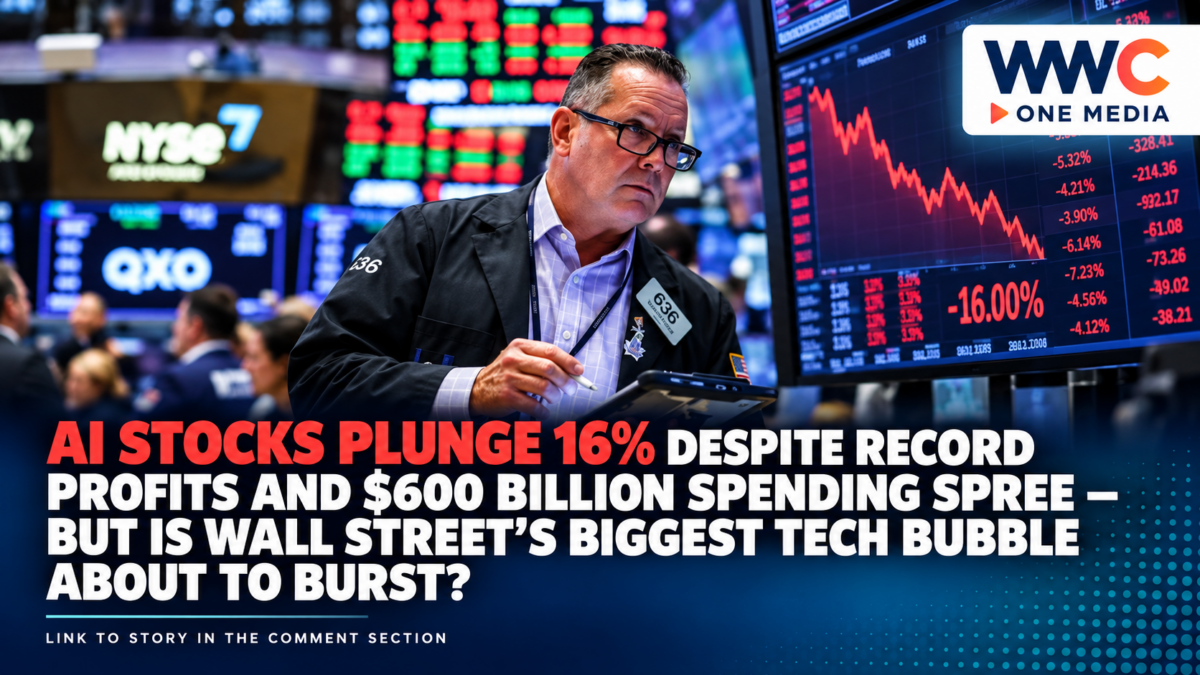
Artificial intelligence stocks are facing a brutal reality check as global semiconductor shares tumble, billions in market value disappear, and investors question whether Big Tech’s enormous AI investments will ever generate profits large enough to justify their cost.
The unsettling twist? Demand for artificial intelligence remains strong, major chipmakers are reporting record earnings, and the world’s largest technology companies are still pouring hundreds of billions of dollars into building the infrastructure powering the AI revolution.
Yet Wall Street is no longer convinced that booming demand automatically means endlessly rising stock prices.
The Philadelphia Semiconductor Index suffered eight consecutive losing sessions through October 16, shedding approximately 16% in its longest losing streak since the 2008 global financial crisis, according to Channel News Asia.
The selling spread across Asia, where major semiconductor producers suffered particularly sharp declines.
South Korea’s SK hynix lost roughly 24% during the week, while Samsung Electronics declined approximately 18%. Japan’s Kioxia Holdings plunged nearly 24%, and Taiwan Semiconductor Manufacturing Company (TSMC) fell about 5%.
These declines raised an uncomfortable question for investors worldwide: What happens when the AI revolution continues growing, but the companies powering it can no longer justify their sky-high valuations?
Big Tech’s $600 Billion AI Spending Spree Comes Under Scrutiny
At the center of the controversy is the extraordinary amount of money technology giants are investing in artificial intelligence.
Microsoft, Amazon, Alphabet and Meta are expected to spend approximately $600 billion combined during 2026 on data centers, advanced processors and related infrastructure.
The spending is intended to support everything from generative AI assistants and cloud computing to increasingly sophisticated AI systems capable of automating business activities.
But these projects require expensive semiconductor chips, massive computing facilities, reliable electricity supplies and continued investment in newer hardware.
For investors, the concern is no longer simply whether AI technology works.
The real question is whether companies can earn enough from their investments before the infrastructure becomes outdated or additional capital spending becomes necessary.
That uncertainty is now weighing on companies throughout the AI supply chain.
TSMC Reports Record Profit — Yet Shares Still Get Hit
One of the clearest examples of the contradiction is Taiwan’s TSMC, the world’s largest contract semiconductor manufacturer and a crucial supplier to Nvidia.
TSMC reported third-quarter net profit of NT$763.1 billion, equivalent to approximately US$23.5 billion, representing nearly 69% growth from a year earlier.
Quarterly revenue increased 50.9% to around NT$1.5 trillion, supported by powerful demand for advanced chips.
The results marked the company’s sixth consecutive quarter of record profit.
Despite those impressive numbers, its shares were caught in the broader semiconductor selloff.
The market reaction illustrates a growing distinction between strong corporate performance and a stock price that already assumes years of exceptional growth.
Even companies delivering record profits can experience sharp declines when investors begin questioning how much future expansion is already reflected in their valuations.
Rising US Interest Rates Add Another Threat
The selloff has also been intensified by concerns about inflation and US monetary policy.
Stronger-than-expected American inflation revived expectations that the Federal Reserve could maintain higher interest rates or tighten monetary policy further.
Higher interest rates create two major problems for the AI investment boom.
First, they reduce the present value of profits that investors expect companies to generate many years into the future, putting pressure on highly valued growth stocks.
Second, they increase financing expenses for companies that depend on borrowing to construct AI data centers and acquire computing equipment.
This combination is especially challenging for businesses investing enormous amounts of money today while depending on future revenue growth to support those expenditures.
The concern is particularly acute among smaller AI infrastructure providers that lack the financial resources of established technology giants.
CoreWeave Highlights the Debt Risks Behind the AI Boom
US cloud infrastructure company CoreWeave has become a prominent example of the financial pressure affecting the sector.
Its shares plunged more than 15% during the previous week amid concerns about its substantial debt burden, financing costs and complex commercial relationships across the AI industry.
CoreWeave has expanded aggressively to supply high-performance computing resources to AI developers and technology companies.
However, investors have become increasingly concerned about whether such capital-intensive businesses can maintain their growth if borrowing costs remain elevated.
The issue extends beyond one company.
Across the industry, investors are examining whether AI infrastructure projects can generate reliable cash flow, maintain attractive profit margins and survive periods of tighter financing.
A business can experience strong demand and still face financial difficulties if the cost of supplying that demand becomes too high.
Reuters: Data Center Projects Face Financing Pressure
Reuters reported on October 15 that rising interest rates and the recent market selloff were testing the financing environment for major AI data center investments.
Some companies have delayed or abandoned planned fundraising and public market transactions as investors demand stronger financial fundamentals.
Projects associated with prominent investors, including Blackstone, Nvidia and SoftBank, have faced greater scrutiny.
Despite the turbulence, Reuters also reported continuing activity in Asian data center transactions, suggesting that institutional interest in the sector has not disappeared.
The contrast shows how AI infrastructure financing is becoming more selective.
Businesses with established customers, dependable contracts and stronger balance sheets may have an advantage over companies dependent on aggressive borrowing and optimistic future projections.
Asian Technology Markets Feel the Shock
The retreat in semiconductor stocks has created renewed volatility across Asian markets, where many companies play essential roles in the global AI supply chain.
South Korean manufacturers dominate important segments of advanced memory production, while Taiwan is central to sophisticated chip manufacturing.
Japanese firms also provide equipment, components and memory technologies essential to modern data centers.
On October 20, Reuters reported that Asian equities weakened as investors weighed geopolitical risks and upcoming corporate earnings.
South Korea’s Kospi suffered particularly heavy losses, demonstrating the vulnerability of markets with significant exposure to semiconductor and technology companies.
However, the turmoil has not been entirely one-directional.
Associated Press reported that US AI-related stocks staged a rebound on October 19, with Nvidia gaining 1.4% and helping lift the Nasdaq.
That recovery suggests investors have not abandoned artificial intelligence entirely, even as they become increasingly cautious about valuations and financing conditions.
Is the AI Bubble Finally Bursting?
The central debate is whether the latest downturn represents an ordinary market correction or the beginning of a deeper collapse in AI-related valuations.
There are reasons for caution.
AI infrastructure investments require immense amounts of capital, and companies may need years to recover their spending.
At the same time, rapidly advancing technology could make some expensive equipment less economically competitive before investors receive their expected returns.
Competition from more efficient AI models and alternative technologies could also place downward pressure on pricing and profit margins.
But there are important reasons not to declare the AI boom over.
TSMC’s record earnings show that demand for advanced semiconductor manufacturing remains substantial.
Major technology companies continue investing in AI infrastructure, and businesses worldwide are expanding their use of AI-powered software and services.
The more likely near-term scenario may be a market that increasingly distinguishes financially sustainable AI companies from those whose valuations depend on exceptionally optimistic expectations.
A correction in stock prices does not automatically mean the underlying technology has failed.
What Investors Should Watch Next
Attention is now turning toward upcoming financial results and spending forecasts from Nvidia, Microsoft, Alphabet, Amazon, Meta and other leading technology companies.
Investors will be watching whether AI investment continues expanding, whether semiconductor demand remains resilient and whether higher operating expenses begin squeezing profit margins.
The Federal Reserve’s interest-rate outlook will also remain crucial, particularly for debt-dependent data center developers.
Evidence of slowing infrastructure orders, canceled projects or financial distress among major AI suppliers could deepen concerns.
Conversely, stronger earnings, sustainable financing and clearer evidence that businesses are generating meaningful revenue from AI could help restore investor confidence.
For now, the AI market appears to be entering a new phase in which financial performance matters as much as technological promise.
The biggest risk may not be that artificial intelligence fails to transform the global economy. It may be that AI succeeds — while investors discover they paid far too much for the companies expected to lead the revolution.










