SINGAPORE — November 4, 202
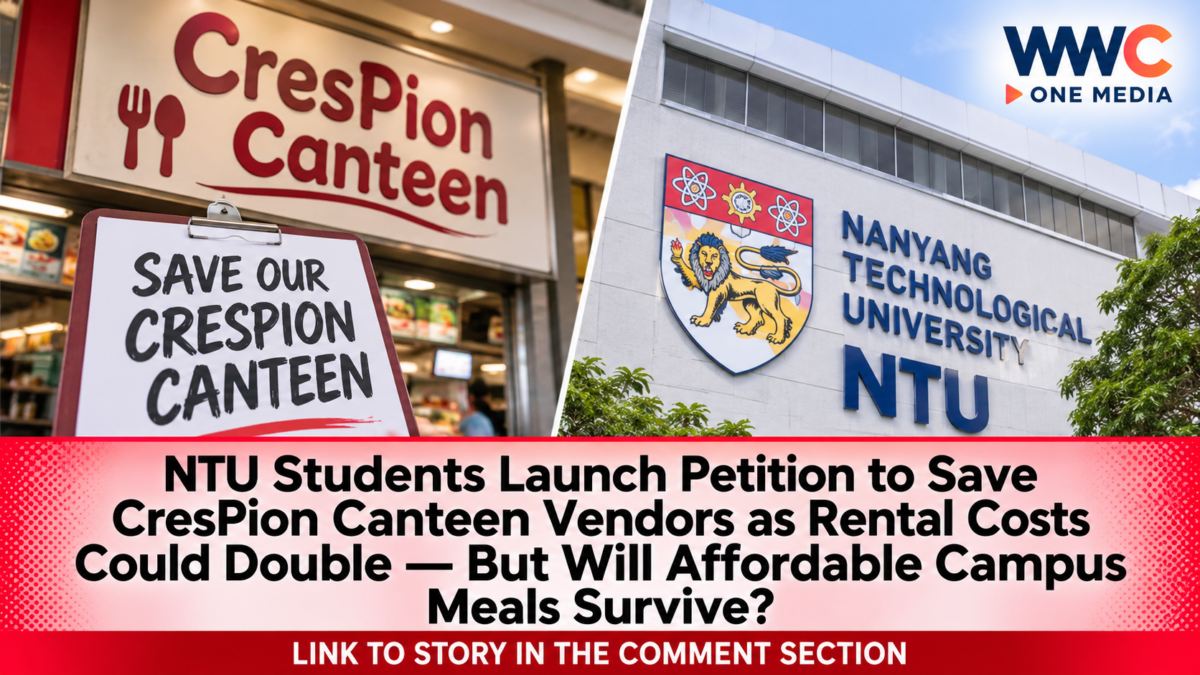
A growing student campaign at Nanyang Technological University (NTU) is calling on the university to protect the existing food vendors at CresPion Canteen, warning that a major increase in operating costs could force familiar stalls out and threaten affordable meals for students.
The petition, titled “Save Our CresPion Canteen,” had attracted 1,533 signatures as of November 3, according to AsiaOne.
The campaign, shared by student group NTU Financial Aid and Friends, centres on a change in canteen management and the financial terms reportedly facing existing stallholders.
NTU’s Office of Commercial and Auxiliary Services (OCAS) is changing the operator from Food Haven to Food Paradise, with renovation work scheduled to begin on December 11, 2026.
Students fear that the proposed rental increases and renovation charges could make it financially difficult for existing vendors to continue operating.
The concern goes beyond losing familiar food stalls. Students also worry that replacing established vendors could mean fewer affordable meal options at a canteen relied upon by residents of Crescent and Pioneer Halls.
Monthly Vendor Costs Could Rise From S$3,600 to More Than S$7,100
One of the petition’s biggest concerns is the reported increase in monthly operating costs.
According to the students, existing vendors currently pay approximately S$3,600 per month to Food Haven. This reportedly includes rental, cleaning and management fees, as well as gross turnover payments.
Under the proposed arrangement, monthly costs could exceed S$7,100, with an additional 5 per cent gross turnover payment, the petition claims.
Gross turnover, commonly abbreviated as GTO, refers to a percentage of a stall’s monthly sales paid to the landlord or operator on top of its base rent.
The figures were reportedly obtained through interviews with stakeholders who requested anonymity. They have not been independently confirmed by NTU.
If the figures are accurate, the monthly costs could more than double for some vendors.
But the financial burden does not end with recurring expenses.
S$20,000 Renovation Fee Adds to Vendors’ Concerns
The petition also claims that existing stallholders face an additional S$20,000 renovation fee under the incoming operator’s arrangements.
For small food businesses, this could represent a substantial upfront expense, particularly when combined with higher monthly operating costs.
The students argue that vendors who have spent years building relationships with customers should not be forced to leave simply because they cannot absorb the new financial requirements.
Some existing stalls are regarded as important parts of the CresPion community, providing meals to students and campus workers who regularly depend on affordable food.
The petition warns that if current vendors leave, their replacements could offer more expensive options.
However, the final outcome will depend on the confirmed commercial terms and whether existing stallholders are offered arrangements that allow them to continue.
Students Fear Their Food Bills Could Eventually Increase
The petition is not only about the businesses operating inside CresPion. It also raises concerns about the everyday cost of eating on campus.
Students who live in university halls often depend on nearby canteens for regular meals. For those managing limited budgets, even relatively small increases in food prices can add up over an academic term.
The campaign argues that higher rental and operating expenses could eventually be passed on to customers.
It also points out that vendors experience periods of reduced business during university holidays, when fewer students remain on campus.
According to the petition, this can mean up to four months of lower customer traffic, making higher fixed costs particularly difficult to manage.
The students therefore want NTU to consider the financial realities of operating a campus food stall throughout the entire academic year, rather than focusing only on the potential commercial returns.
Four Demands Directed at NTU’s Commercial Office
The Save Our CresPion Canteen petition outlines four main demands.
First, students want existing vendors to be allowed to remain without having to absorb the additional renovation charges and steep rental increases.
Second, they want NTU to keep campus food and rental costs affordable, arguing that students and workers should not bear the consequences of higher operating expenses.
Third, the petition criticises what it describes as profit-maximising practices, saying NTU should prioritise its responsibilities to the university community.
Finally, students want greater consultation with people affected by decisions involving campus facilities and services.
Their central argument is that students and stallholders should have a meaningful opportunity to express their concerns before changes become difficult to reverse.
AsiaOne reported that it had contacted NTU for further information. The university’s response will be important in clarifying the proposed arrangements and the options available to existing vendors.
Singapore’s Hawker and Food Businesses Are Already Facing Cost Pressures
The CresPion dispute comes amid wider concerns about the sustainability of affordable food businesses in Singapore.
Food operators have to manage ingredients, manpower, utilities, cleaning, equipment and rental expenses while trying to keep prices acceptable to customers.
A recent Channel NewsAsia report examined how rising ingredient and operating costs are changing the way some hawkers prepare their food, with certain operators reducing expensive ingredients or adjusting their menus rather than increasing prices.
That wider pressure is relevant to the NTU dispute: when operating expenses rise, small food businesses have limited room to absorb every additional cost indefinitely.
The challenges facing food operators can also be seen in the experience of New Horse Noodles, whose two founders decided to close their Singapore hawker stall after only five months, explaining that the demanding lifestyle was not sustainable for them.
The closure involved different circumstances from the CresPion dispute, but it highlights the difficult realities behind running a food business and the challenges of keeping a stall operating over the long term.
When Food Businesses Struggle, Workers and Communities Feel the Impact
The consequences of changes in the food sector can extend beyond owners and customers.
WWC One Media previously reported on Crystal Jade’s closure of four Singapore outlets amid restructuring, with approximately 120 workers affected.
Although the circumstances differ from those facing CresPion’s stallholders, the story illustrates how changes in food-business operations can affect employees and the wider community.
At university canteens, the relationship between vendors and customers can be especially personal. Students may visit the same stalls every day, while workers become familiar faces throughout their time on campus.
A previous WWC One Media report captured that connection when a Temasek Polytechnic student organised a birthday surprise for a beloved canteen worker, showing how food-service staff can become meaningful parts of campus life.
For CresPion students, the concern is therefore not simply about whether the canteen receives a renovation. It is also about whether the people and affordable food options that have served the community will still be there afterwards.
The Bigger Question: Can NTU Upgrade Its Canteen Without Pricing Out Existing Vendors?
The planned renovation may bring changes to CresPion Canteen, but students are questioning whether those improvements should come at the expense of existing stallholders and affordable meals.
The petition’s reported figures have yet to be independently confirmed by NTU, and the university’s explanation of the new operator’s terms remains important.
There may be commercial reasons behind a change in operator, but students and vendors are asking for greater transparency about how the transition will affect the people who use and operate the canteen every day.
With renovation scheduled to begin on December 11, the timeline is becoming increasingly important.
For vendors, the decision could determine whether they can afford to continue serving their customers. For students, it could determine whether some of their most familiar and affordable meal options remain available.
The petition’s 1,533 signatures show that the issue has attracted considerable attention within the NTU community.
The question now is whether NTU and Food Paradise can find a workable arrangement that modernises CresPion Canteen while protecting the vendors, workers and students who have made it part of everyday campus life.