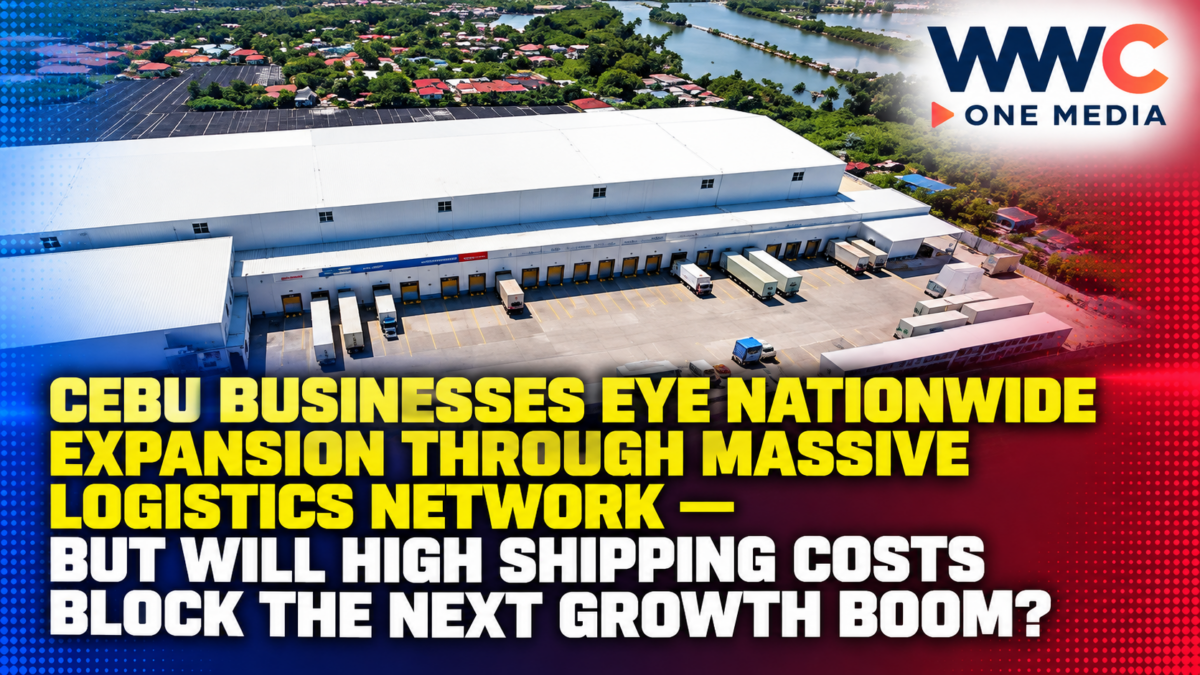
CEBU CITY, PHILIPPINES — Cebu’s business community is setting its sights on markets far beyond the Visayas, as logistics companies and government officials push for better transportation links, modern warehouses and stronger supply chains to help local enterprises compete nationwide.
At the FAST Logistics Solutions Forum 2026, held October 21 at Seda Ayala Center Cebu, industry executives and government representatives emphasized that the province’s economic potential depends not only on attracting investments but also on moving goods reliably and affordably.
The message comes as Filipino entrepreneurs confront a familiar problem: producing a competitive product is often easier than delivering it to buyers in distant provinces.
For businesses hoping to enter major supermarkets, supply restaurants or reach customers across Luzon, Visayas and Mindanao, transportation expenses can become a major obstacle.
FAST Logistics Group says its nationwide network offers an alternative to building expensive warehousing and delivery infrastructure independently.
Meanwhile, the Cebu provincial government is exploring a Mega Food Hub in Naga City that could connect farmers and fishers with buyers across the region.
However, the opportunity comes with a warning.
High shipping expenses, congestion, unpredictable delivery schedules and infrastructure gaps could prevent business expansion plans from becoming actual investments.
Can Cebu’s entrepreneurs turn stronger logistics connectivity into a nationwide business breakthrough—or will the cost of moving goods continue limiting their growth?
CEBU BUSINESSES LOOK BEYOND THE VISAYAS
According to InsiderPH’s October 26 report, participants at the FAST Logistics Solutions Forum discussed how businesses could expand distribution outside Cebu by gaining access to established transportation and supply-chain networks.
The event brought together manufacturers, entrepreneurs, exporters, logistics executives and government representatives.
Its theme, “Cebu in Motion: Leveraging Logistics Solutions to Expand Business and Investment,” reflected the province’s ambition to improve its competitiveness.
Cebu already benefits from its position as a commercial and transport center connecting several major Philippine regions.
But geographic location alone does not guarantee success.
A business selling products in Cebu may still struggle when attempting to supply stores in Metro Manila, Iloilo, Bacolod, Davao or other cities.
Long-distance distribution requires inventory planning, appropriate storage, dependable transportation and effective coordination among multiple service providers.
For smaller businesses, those requirements can make expansion difficult.
The forum explored ways to overcome those barriers.
FAST LOGISTICS OFFERS A NATIONWIDE DISTRIBUTION NETWORK
FAST Logistics Group chief operating officer for transport Bobby Lim presented the company’s integrated transportation and warehousing capabilities.
FAST operates more than two million square meters of warehouse space nationwide.
It reports capacity exceeding one million pallet positions for dry and temperature-controlled goods.
The network manages more than 3,100 trucks daily through relationships with over 900 trucking partners.
The company also works with 14 shipping lines and two airline partners.
These resources support the movement of goods through land, sea and air transportation.
The operational figures are substantial.
However, they describe FAST’s existing nationwide network, not additional warehouses or trucks newly constructed or purchased for Cebu as a result of the October forum.
For Cebu businesses, the opportunity lies in accessing available logistics services and exploring new distribution arrangements.
WHY THIRD-PARTY LOGISTICS COULD HELP SMALL BUSINESSES
One focus of the forum was third-party logistics, commonly known as 3PL.
Under this arrangement, businesses outsource selected supply-chain operations to specialized providers.
Services may include warehousing, inventory management, transportation, distribution and order fulfillment.
A company producing packaged food, for example, may lack the financial resources to build warehouses in several provinces.
Working with a logistics provider could allow it to distribute products through an existing network instead.
This approach may reduce the need for large upfront infrastructure investments.
It can also give entrepreneurs access to expertise in scheduling, product handling and transportation coordination.
However, outsourcing does not guarantee lower costs.
Businesses still pay service fees and must evaluate contract terms, delivery performance and the needs of their products.
The practical question is whether a logistics partnership can provide better value than managing distribution independently.
CEBU PRODUCTS COULD REACH MANILA, ILOILO AND MINDANAO
FAST identified several potential distribution destinations accessible through its network.
These include Manila, Iloilo, Bacolod, Dumaguete, Tagbilaran, Davao, Cagayan de Oro, General Santos, Butuan and Zamboanga.
For Cebu manufacturers and small businesses, reaching these markets could create opportunities to supply retailers, distributors and corporate customers.
The benefits could extend to packaged food, household products, apparel, industrial supplies and other goods.
However, entering a new market requires more than delivery capability.
Businesses must also identify customers, negotiate acceptable prices, meet quality requirements and maintain reliable inventory.
Expanding distribution before establishing sufficient demand can create additional costs.
Logistics should therefore form part of a broader business plan.
THE PROPOSED CEBU MEGA FOOD HUB COULD HELP FARMERS AND FISHERS
Another major development discussed during the forum was Cebu’s proposed Mega Food Hub in Naga City.
Cebu Provincial Investment and Promotions Office head Paulo Uy highlighted the facility as a possible link between agricultural producers and larger commercial markets.
The proposed hub could support collection, consolidation, cold storage, processing, packaging and distribution.
Potential buyers include supermarkets, hotels, restaurants and customers in other provinces.
For farmers and fishers, more efficient distribution could help reduce handling difficulties and improve access to commercial buyers.
Cold storage may also help preserve perishable products when properly operated.
However, the Mega Food Hub remains a proposed initiative.
It should not be described as a completed, fully operational facility or as a project with guaranteed commercial results.
Before implementation, important issues must be addressed, including financing, capacity, operating arrangements, reliable utilities and sufficient demand.
WHY COLD STORAGE MATTERS FOR AGRICULTURE
Fresh food requires appropriate handling throughout the supply chain.
Fish, meat, dairy products and some fruits and vegetables can deteriorate when exposed to unsuitable temperatures.
Cold-chain services help maintain controlled conditions during storage and transportation.
For agricultural producers, access to reliable temperature-controlled infrastructure can reduce certain risks associated with spoilage and quality deterioration.
It may also make products more suitable for buyers with strict delivery requirements.
But cold storage requires dependable electricity, maintenance, monitoring and appropriate packaging.
If those supporting services are unreliable or too expensive, a food hub may struggle to deliver its intended benefits.
That is why the proposed Naga City project must be evaluated as an integrated commercial and logistics operation rather than simply a warehouse construction project.
HIGH LOGISTICS COSTS THREATEN CEBU’S COMPETITIVENESS
Independent reporting by SunStar Cebu highlighted a major concern raised at the same forum.
Government officials and industry representatives warned that high logistics expenses and unpredictable deliveries could prevent Cebu from converting its strategic location into actual business investment.
Transport charges are only one part of the challenge.
Companies may also incur additional costs from congestion, missed delivery schedules, inventory delays and longer turnaround times.
For smaller enterprises, unpredictable deliveries can make it difficult to accept orders from large customers.
A business may produce quality goods but still lose commercial opportunities if it cannot deliver the required quantity on time.
This problem can affect both domestic market expansion and export competitiveness.
SHIPPING, PORTS AND ROADS MUST WORK TOGETHER
Cebu’s economic position depends heavily on connections between highways, ports, warehouses and distribution centers.
Goods may travel by truck from a factory to a port before being transferred to a vessel.
After arriving at another island, they may require additional trucking and storage before reaching the buyer.
Every transfer introduces potential costs and delays.
A reliable supply chain therefore requires coordination across several transport modes.
Maritime industry leader Capt. Rodien Paca emphasized the need for efficient ports, dependable shipping, connected roads, a skilled workforce and better digital systems.
He also highlighted congestion, inconsistent truck restrictions and other operational bottlenecks affecting the logistics sector.
These concerns show that warehouse capacity alone cannot solve Cebu’s transport challenges.
A PROPOSED PORT FEE HIKE COULD ADD MORE PRESSURE
The logistics expansion discussion also comes amid disagreement over proposed cargo-handling tariff increases at the Port of Cebu.
In early October, BusinessMirror reported that port cargo-handling operators were seeking a 25% increase in domestic arrastre and stevedoring charges.
The Cebu Chamber of Commerce and Industry supported a staggered adjustment, suggesting 10% in the fourth quarter of 2026 and another 15% in the first quarter of 2027.
The Mandaue Chamber of Commerce and Industry opposed an increase under prevailing economic conditions.
The dispute illustrates the competing pressures facing Cebu’s logistics industry.
Cargo-handling businesses face higher fuel, labor and other operating costs.
Importers, manufacturers and smaller businesses worry that higher charges could undermine competitiveness.
Importantly, the 25% increase was a proposal under discussion, not proof that the full increase had already taken effect.
GOVERNMENT MOVES TO IMPROVE TRANSPORT COORDINATION
SunStar Cebu reported that the Department of Trade and Industry had been coordinating with logistics stakeholders to identify supply-chain challenges.
Discussions have included transport restrictions, fuel costs and the movement of goods.
In May 2026, Cebu Governor Pamela Baricuatro issued Executive Order 28 to establish a common truck-ban schedule within the provincial government’s jurisdiction.
The objective was to make delivery schedules more predictable.
However, the extent and effectiveness of implementation remained unclear in the reporting reviewed.
Cebu’s provincial investment office also reported more than ₱100 million in access-road investments supporting development in southern Cebu.
These efforts could improve conditions for manufacturers and agricultural businesses.
But successful implementation will depend on coordination among local governments, transport operators and infrastructure providers.
LOCAL TRUCKING OPERATORS COULD GAIN NEW BUSINESS
The expansion of integrated distribution networks may also create opportunities for Cebu’s trucking companies.
FAST encouraged local fleet owners and transport operators to explore participation in its nationwide network.
Such partnerships could provide access to additional delivery demand.
For some operators, joining a larger logistics network may help improve vehicle utilization and coordination.
However, commercial participation would depend on accreditation, service requirements, pricing and contractual arrangements.
The forum did not establish that specific numbers of new trucking jobs or contracts had already been secured.
Those outcomes should be measured through completed agreements and actual business activity.
DIGITAL TECHNOLOGY MAY IMPROVE DELIVERY EFFICIENCY
Cebu’s logistics discussion also includes technology.
SunStar reported on October 25 that FAST was exploring artificial intelligence tools for transportation planning and shipment visibility.
The company has been moving from an in-house transportation management system toward an AI-enabled platform from FarEye.
Such systems can support route planning, dispatch coordination and tracking of shipments.
They may also help companies identify operational problems earlier.
However, technology does not automatically solve congestion or port delays.
FAST had not disclosed independently verified figures showing how much the new tools reduced costs or delivery times.
Any productivity claims should therefore be treated as expected benefits until measured results are available.
WHAT INDEPENDENT COVERAGE CONFIRMS
InsiderPH’s October 26 article focused on FAST’s logistics capabilities and Cebu businesses’ opportunities to expand beyond regional markets.
FAST’s own forum report confirms the October 21 event, participants, nationwide infrastructure figures and services presented.
SunStar Cebu independently reported the event and examined the economic obstacles facing local businesses.
Its coverage emphasized the importance of dependable deliveries, access to buyers and the risks associated with excessive logistics costs.
BusinessMirror separately documented the cargo-handling tariff dispute, adding context about the pressures on businesses using Cebu’s ports.
Together, these sources support the central story.
Cebu has substantial opportunities to expand business connections, but the commercial benefits remain dependent on practical improvements rather than announcements alone.
WHAT THIS MEANS FOR CEBU’S SMALL BUSINESSES
For entrepreneurs seeking to expand beyond Cebu, several lessons emerge.
A wider market is valuable only when products can be delivered reliably and competitively.
Businesses must evaluate the full cost of transportation, storage, inventory and order fulfillment.
They should also consider the quality of potential logistics partners and the availability of distribution channels in target markets.
Farmers and food producers may require specialized facilities such as cold storage.
Manufacturers may need coordinated warehousing and predictable freight schedules.
Trucking operators may benefit from participating in larger transport networks.
But every expansion decision should be supported by realistic demand forecasts and cost estimates.
THE BIGGER QUESTION: CAN CEBU BECOME A STRONGER NATIONAL LOGISTICS GATEWAY?
Cebu’s strategic position between the country’s major island groups creates opportunities for trade, manufacturing and distribution.
The existing FAST Logistics network offers businesses access to nationwide warehousing, trucks, shipping and air freight arrangements.
The proposed Mega Food Hub in Naga City could also create new connections between agricultural producers and commercial buyers.
Government efforts to improve access roads and transport coordination provide another part of the picture.
However, expensive and unreliable logistics remain a major obstacle.
Businesses need more than facilities and promotional forums.
They need predictable schedules, competitive service costs, dependable utilities and customers willing to buy their products.
The real test of Cebu’s logistics ambitions will be whether local enterprises can reach more customers, reduce avoidable costs and create sustained business activity.
And as the province pushes to become an even stronger center for Philippine trade, one question remains:
Will nationwide logistics networks and the proposed Cebu Mega Food Hub finally unlock bigger markets for Cebu businesses — or will rising freight costs, port bottlenecks and unreliable deliveries prevent the next major growth breakthrough?