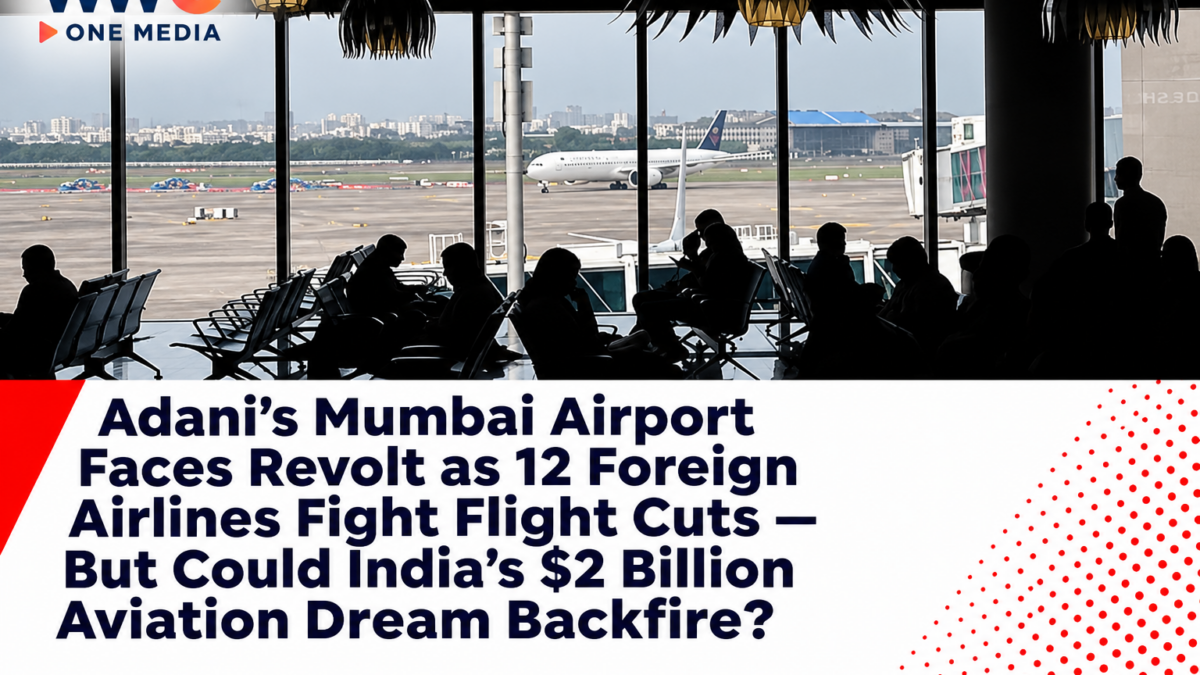
MUMBAI, India — November 12, 2026 — Indian billionaire Gautam Adani’s ambitious airport expansion strategy is facing a major test as international airlines challenge plans to reduce flights at Mumbai’s main airport and redirect some services to the newly developed Navi Mumbai International Airport.
The dispute has escalated beyond a routine disagreement over flight schedules.
Twelve foreign airlines have sought intervention from India’s Ministry of Civil Aviation after they were denied slots for the summer 2027 scheduling period at Chhatrapati Shivaji Maharaj International Airport (CSMIA), according to reporting by Mint and other Indian news outlets.
The affected carriers operate approximately 112 weekly flights connecting Mumbai with 14 international destinations.
Their objections come as Adani Airport Holdings seeks to redevelop an aging terminal at the existing Mumbai airport while building passenger traffic at Navi Mumbai, a major aviation project intended to ease congestion in India’s financial capital.
At the heart of the controversy is a difficult question: Can one private airport group control the transition between two major airports without undermining airline competition, passenger convenience or established international aviation arrangements?
For Adani, the outcome could determine whether its enormous investment becomes a model for India’s airport modernization—or an example of the risks associated with concentrating critical transport infrastructure under a powerful private operator.
Why Adani Wants to Reduce Flights at Mumbai Airport
The dispute centers on the planned reconstruction of part of Terminal 1 at Mumbai’s existing international airport.
Mumbai International Airport Limited (MIAL), operated by Adani Airport Holdings, says the aging infrastructure requires redevelopment.
The project involves Terminal 1B, where structural concerns have been identified following a fire earlier in 2026.
The operator argues that reconstruction will temporarily reduce the airport’s ability to accommodate passengers.
To manage the disruption, MIAL initially proposed reducing international departure capacity at Terminal 2 by approximately 33%.
That translated to 265 weekly departure slots out of roughly 770.
The objective was to create room for domestic flights displaced by Terminal 1 construction.
Airlines were encouraged to shift some services to Navi Mumbai International Airport or suspend affected operations temporarily.
Adani maintains that the changes are necessary to manage congestion and preserve operational safety.
However, airlines argue that major schedule reductions require stronger justification, consultation and adherence to established slot-allocation procedures.
The disagreement has now become an important test of India’s aviation regulatory framework.
Twelve Foreign Airlines Challenge the Decision
The latest confrontation involves 12 foreign carriers, predominantly from the Gulf and West Asia.
According to Mint’s November reporting, these include Saudia, Gulf Air, Qatar Airways, Kuwait Airways, Oman Air, Air Arabia, Flynas, Flyadeal, Riyadh Air, Jazeera Airways, SalamAir and Nepal Airlines.
Together, the affected airlines operate approximately 16 daily departures, or 112 weekly departures, from Mumbai.
The services connect the city with 14 international destinations.
The airport operator reportedly accommodated 38 of the 50 international airlines seeking slots for the summer 2027 schedule, while the other 12 were denied the requested allocations.
The affected airlines have challenged the decision through India’s aviation authorities.
Their concern is not merely about losing a preferred departure time.
Airlines build schedules around aircraft availability, crew assignments, connecting flights, airport services and passenger demand.
Relocating a service to another airport can create operational and commercial costs.
For travelers, it may also mean changing transportation arrangements, increasing travel times and potentially losing convenient connections.
The carrier objections raise the question of whether runway-capacity management can justify the disruption of established airline operations.
Gulf Airlines Warn of Possible Hajj Travel Disruptions
The dispute has also taken on an international dimension.
Gulf Air and Saudia have objected to the planned changes, according to a November 11 Mint report.
Saudia warned that reduced access to Mumbai could disrupt Hajj and Umrah-related travel.
The concern is particularly significant because Mumbai is an important departure point for Indian pilgrims traveling to Saudi Arabia.
Mint reported that Mumbai accounted for approximately 15% of India’s Hajj pilgrims in 2026, representing more than 26,000 travelers.
The affected airlines are questioning whether their existing slot rights can be removed without adequate regulatory consultation.
They are also examining whether operations transferred to Navi Mumbai would fall under existing bilateral aviation arrangements in exactly the same way as flights serving Mumbai’s older airport.
These issues remain subject to regulatory interpretation.
The objections do not establish that the transfer proposal violates international agreements.
However, they show how a local infrastructure decision can create wider diplomatic and commercial consequences.
Why Airlines Are Rejecting the Navi Mumbai Transfer
At first glance, moving flights from an overcrowded airport to a modern alternative may appear reasonable.
But airlines argue that the transition is more complicated.
Navi Mumbai International Airport is located roughly 50 kilometers from the existing Mumbai airport, creating different ground-transportation requirements for passengers.
An airline moving its operations must evaluate whether travelers will continue choosing its services from the new location.
The airline must also consider terminal facilities, baggage handling, cargo operations, staff transportation and airport operating costs.
The International Air Transport Association has reportedly sought further assessment of Navi Mumbai’s operational readiness, including ground handling, cargo infrastructure and crew accommodation.
Meanwhile, airlines have asked MIAL to provide more detailed information about the structural condition of Terminal 1 and the capacity available at Terminal 2.
Some carriers argue that a less disruptive redevelopment schedule could be considered.
Adani’s airport operator maintains that temporary capacity reductions are necessary.
The disagreement is therefore partly about whether the proposed measures are proportionate to the infrastructure problem.
Adani’s Two-Airport Strategy Faces Its Biggest Operational Test
The dispute matters because Adani controls a major part of the aviation infrastructure serving Mumbai.
Through its airport holdings business, the group operates the existing Mumbai airport and is involved in the development and operation of Navi Mumbai International Airport.
The latter is one of India’s most ambitious aviation infrastructure investments.
Earlier Bloomberg reporting described the Navi Mumbai project as a roughly $2.1-billion development intended to relieve congestion and strengthen India’s international aviation connectivity.
For decades, Mumbai has struggled with the limitations of its existing airport infrastructure.
The city has enormous demand for domestic and international travel, but expanding capacity at its established airport is difficult because of surrounding urban development.
Navi Mumbai was designed to address that problem by creating another major gateway for the metropolitan region.
The new airport could eventually support additional flights, passengers, logistics activity and commercial investment.
However, building an airport does not automatically persuade airlines to move there.
Airlines make route decisions based on passenger demand, profitability and operational suitability.
That means the success of Adani’s strategy will depend partly on whether carriers view Navi Mumbai as an attractive alternative rather than a destination imposed through reductions at the existing airport.
BlackRock and Temasek’s $1 Billion Investment Raises the Stakes
The Mumbai controversy comes shortly after Adani Airport Holdings attracted major international investment.
In September 2026, a consortium involving BlackRock-managed funds, Singapore’s Temasek, Premji Invest and Alpha Wave Global agreed to invest approximately $1 billion in the airport business.
The transaction valued Adani Airport Holdings at roughly $18 billion before the new capital injection.
The investment provides funding for airport expansion, related commercial developments and improvements to passenger services.
As WWC ONE MEDIA reported in its analysis of the $1-billion BlackRock and Temasek investment in Adani Airports, the group’s ambitions extend far beyond operating traditional passenger terminals.
Adani wants to develop large commercial districts around airports, including hotels, offices, retail facilities and other businesses.
Its longer-term ambitions include increasing airport passenger capacity and competing for additional airport concessions.
However, the Mumbai dispute highlights a challenge that financial investment alone cannot resolve.
Airport expansion requires the cooperation of airlines, regulators, passengers and other stakeholders.
A financially powerful operator can build infrastructure, but commercial success depends on whether the aviation industry is willing and able to use it.
Could Adani’s Control of Both Airports Create Competition Concerns?
The confrontation is attracting attention partly because Adani has interests in both Mumbai airports.
When separate airport operators compete for airlines, carriers may have more flexibility to choose a location based on commercial considerations.
When one group controls both major gateways serving a metropolitan region, the economic incentives can be more complicated.
An operator developing a new airport may have a commercial interest in encouraging airlines to move there.
That does not prove that Adani is improperly forcing airlines to relocate.
The company says the capacity changes are needed because of the redevelopment of aging infrastructure.
However, the overlap between the two airports’ ownership makes regulatory transparency especially important.
Authorities must determine whether any reduction in capacity is justified by safety and operational requirements.
They must also assess whether slot allocation complies with applicable aviation guidelines.
The wider question is how India can attract private investment into critical infrastructure while preserving fair treatment for airlines and passengers.
India Is Betting on Private Airport Operators to Support Aviation Growth
India’s aviation industry has expanded rapidly, supported by rising incomes, growing domestic travel demand and airline investment.
The government has increasingly relied on private-sector participation to modernize airports.
Adani Airport Holdings has become one of the country’s largest private airport operators.
Its portfolio includes airports in Mumbai, Ahmedabad, Lucknow, Mangaluru, Jaipur, Guwahati and Thiruvananthapuram, alongside Navi Mumbai.
Rival GMR Airports also operates major aviation infrastructure in India and overseas.
These companies bring access to capital, operating expertise and commercial development capabilities.
But the growing concentration of airport operations among a small number of groups has prompted questions about competition and oversight.
Adani’s Mumbai dispute illustrates why effective regulation remains essential even when infrastructure is privately managed.
Airport operators must be able to undertake necessary safety improvements.
Airlines must also receive consistent and transparent treatment when slots are allocated or withdrawn.
The interests of passengers cannot be overlooked.
What the Philippines Can Learn From Mumbai’s Airport Battle
The dispute has relevance beyond India.
The Philippines is also expanding its use of public-private partnerships to modernize major airports and reduce congestion around Metro Manila.
Ninoy Aquino International Airport is undergoing modernization under the San Miguel-led New NAIA Infra Corporation.
Meanwhile, the government continues pursuing additional airport capacity through Clark, Bulacan’s New Manila International Airport and the proposed Sangley Point International Airport.
As WWC ONE MEDIA reported in its coverage of Indian infrastructure giant GMR’s interest in the ₱150-billion Sangley airport project, developing additional gateways requires more than financing and construction.
Authorities must also address airspace coordination, transportation links, regulatory approvals and airline demand.
India’s experience demonstrates how difficult it can be to move passengers and carriers between airports, even when the new facility promises better infrastructure.
The same challenges may become increasingly relevant to Greater Manila as additional airport projects advance.
Cebu Shows Why Airline Cooperation Matters
Mactan-Cebu International Airport offers another useful comparison.
The airport has undergone substantial modernization through a public-private partnership and is seeking to expand its role as an international transfer hub.
Its CEB Connects initiative aims to make journeys involving multiple airlines and flights more convenient.
As WWC ONE MEDIA examined in its report on Cebu Airport’s successful PPP and regional hub ambitions, the airport’s competitive position depends not only on modern terminal facilities but also on passenger experience and effective airline coordination.
A separate WWC ONE MEDIA report on Star Alliance’s efforts to improve travel across 26 airlines highlighted the importance of managing connections, baggage and service standards across complex airline networks.
These examples are not identical to Mumbai’s dispute.
However, they reinforce a broader lesson: Airport infrastructure delivers its greatest benefits when airline operations and passenger convenience are built into the strategy.
Can Navi Mumbai Become a Successful Alternative?
Navi Mumbai has the potential to provide much-needed additional aviation capacity.
Its development may help distribute passenger traffic, create employment and support businesses across the surrounding region.
But becoming a successful international gateway will require sustained airline participation.
Passengers must have practical ground-transportation options.
Airlines must be confident about the airport’s facilities, costs and commercial prospects.
Regulators must ensure that established procedures are followed.
The strongest outcome would be a transition that allows redevelopment of Mumbai’s older airport while encouraging airlines to expand at Navi Mumbai under clear and commercially sustainable arrangements.
A prolonged confrontation, by contrast, risks damaging confidence and complicating travel planning.
What Happens Next for Adani and the Airlines?
As of November 12, 2026, the dispute over the summer 2027 flight schedule remains a matter of regulatory and commercial disagreement.
The affected airlines are seeking intervention from India’s Ministry of Civil Aviation.
They are questioning the basis for the capacity reductions and requesting clarity about their established slot allocations.
Adani’s airport operator maintains that reconstruction at Terminal 1 requires temporary operational adjustments.
The government will need to consider the safety rationale, the impact on airline operations and the applicable slot-allocation framework.
No final ruling establishing wrongdoing by Adani has been identified in the reporting reviewed.
The outcome could influence how future airport transitions are managed across India.
The Bottom Line: Adani’s Airport Ambitions Face a Reality Check
Gautam Adani’s aviation strategy is built around one of India’s biggest infrastructure opportunities: transforming overcrowded airports into a modern network capable of handling growing passenger demand.
Navi Mumbai International Airport is central to that ambition.
But the dispute involving 12 foreign carriers demonstrates that airport expansion is not simply an engineering or investment challenge.
It is also a matter of competition, regulatory credibility and passenger trust.
The reported loss of 112 weekly departure slots for affected foreign carriers, along with the broader controversy over capacity reductions, has turned Mumbai into an important test of India’s airport governance.
For Adani, a successful resolution could strengthen confidence in the group’s ability to manage complex infrastructure projects.
A prolonged dispute could intensify questions about the responsibilities of private operators controlling major transportation gateways.
The biggest question is whether Adani can modernize Mumbai’s aviation system while protecting the rights of airlines and passengers—or whether the attempt to build India’s next great airport hub will expose the risks of concentrating too much aviation power in one company’s hands.