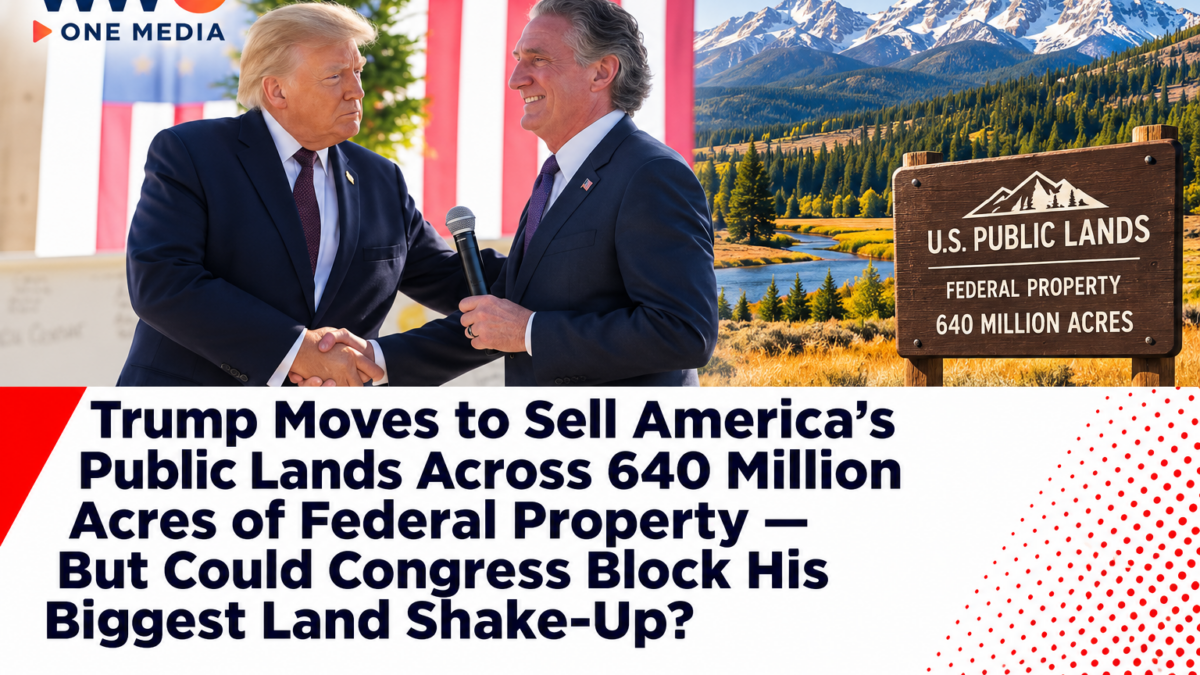
WASHINGTON, D.C. / MANILA, Philippines — November 12, 2026 — President Donald Trump’s administration is preparing a major shift in how the United States manages its vast public lands, unveiling a strategy to sell federally owned property to states, local governments and Native American tribes in an effort to shrink Washington’s real estate holdings.
The controversial policy appears in the US Department of the Interior’s newly released 2026–2030 Strategic Plan, which calls for reducing the federal government’s land ownership while expanding opportunities for economic development, energy production and locally managed conservation.
The proposal potentially changes the direction of decades of federal public-land policy.
The United States owns roughly 640 million acres of federal land, much of it concentrated in Western states such as Nevada, Utah, Alaska, Idaho and Wyoming.
However, the administration has not disclosed how many acres it intends to sell, which properties could be affected, or how much revenue the government hopes to generate.
Interior Secretary Doug Burgum argues that better land management can support economic growth, energy production and more efficient use of taxpayer resources.
But the proposed shift is already facing opposition from lawmakers in both parties, environmental organizations, hunters, outdoor recreation groups and public-land advocates.
The biggest question is whether Trump’s plan will unlock valuable land for housing and development—or trigger a political battle over the future of America’s publicly owned natural resources.
Trump Administration Announces Plan to Reduce Federal Land Ownership
The Interior Department’s new strategic plan contains an explicit commitment to reduce the amount of land owned by the federal government.
Rather than concentrating exclusively on managing its existing properties, the department intends to offer selected federal lands for purchase by states, municipalities and tribal governments.
Officials argue that reducing the federal estate would allow Washington to focus on properties considered nationally significant.
The administration also wants some proceeds from land transactions to support conservation projects elsewhere.
The strategic plan does not provide a specific list of properties or a target number of acres.
That distinction matters because the announcement establishes a policy direction, not a completed land sale.
Before transactions can proceed, officials must determine which properties are legally eligible for disposal and whether the necessary approvals can be obtained.
The administration’s goal is to reduce federal management responsibilities while giving state, tribal and local authorities greater opportunities to direct land use.
Critics argue that the policy could weaken federal oversight and potentially open the door to development that limits public access.
America’s Federal Estate Covers Roughly 640 Million Acres
The scale of federally owned land makes the proposal politically and economically significant.
The US federal government owns approximately 640 million acres, representing more than one-quarter of the country’s land area.
The Interior Department manages much of that territory through agencies such as the Bureau of Land Management, National Park Service and Fish and Wildlife Service.
Federal land supports numerous activities, including outdoor recreation, wildlife conservation, livestock grazing, mining, energy development and cultural preservation.
Ownership is especially concentrated in Western states.
In Nevada, nearly 80% of land is federally controlled.
That creates longstanding tensions between federal authorities and communities seeking additional space for housing, infrastructure and commercial development.
Supporters of greater local control argue that government ownership can restrict growth in areas where privately developable land is scarce.
Opponents counter that federal ownership protects important landscapes and ensures that people across the country retain access to shared natural resources.
The administration’s latest proposal reopens that debate.
Doug Burgum Wants a Different Approach to Public Lands
Interior Secretary Doug Burgum has consistently advocated a more development-oriented approach to federal land management.
His department argues that public resources should support economic opportunities while maintaining appropriate conservation measures.
The new strategic plan reflects that philosophy.
It calls for greater cooperation with states, tribal governments and local communities.
It also emphasizes reducing administrative barriers and improving the efficiency of land-management decisions.
The Interior Department says the proceeds from some property transactions could support conservation elsewhere.
However, important questions remain unresolved.
Would states and local governments retain purchased properties for public use?
Could they later sell them to private developers?
What restrictions would protect wildlife habitats, recreation areas and culturally significant locations?
The strategic plan does not resolve those questions for individual properties.
Any actual sale would need to comply with applicable law and the terms of the transaction.
Land Sales Could Help Address Housing Shortages, Supporters Say
One of the central arguments for selling selected federal properties concerns housing affordability.
Some Western communities are surrounded by federally controlled land, limiting opportunities for residential expansion.
Supporters believe carefully selected land sales could make additional space available for housing construction.
In 2025, Burgum and Housing and Urban Development Secretary Scott Turner explored using underutilized federal property to support affordable housing.
The American Enterprise Institute also advanced a proposal suggesting that selected federal land could accommodate approximately 1.5 million homes over a decade.
That figure is a research proposal, not a government construction commitment or confirmed forecast.
New residential development would still require financing, roads, water, electricity, local approvals and sufficient market demand.
Simply transferring ownership would not automatically make homes affordable.
For critics, the concern is that land presented as an opportunity for housing could ultimately be developed for other commercial purposes.
For supporters, the issue is whether government ownership is preventing communities from meeting legitimate development needs.
Energy Development Could Become Another Major Beneficiary
The strategy also calls for land transfers and exchanges that could support expanded energy production.
Trump’s administration has made increased domestic oil, natural gas and mineral production a central economic priority.
Federal public lands contain substantial energy and mineral resources.
Changes in land management could influence where projects are permitted and how quickly they proceed.
On November 5, the Interior Department separately proposed revisions to Bureau of Land Management planning regulations, arguing that the changes would reduce unnecessary bureaucracy and improve coordination with state governments.
Supporters believe more efficient land-use planning could accelerate infrastructure and energy investment.
Environmental groups warn that weaker oversight could increase pressure on sensitive landscapes.
The government must still operate within applicable environmental and public-land laws.
A strategic commitment to expand development does not automatically authorize drilling, mining or construction on every affected property.
Trump’s AI Data Center Expansion Raises Related Concerns
The latest plan comes as the administration faces scrutiny over proposals to use federal land for artificial intelligence infrastructure.
As WWC ONE MEDIA previously reported in its investigation into Trump’s AI data-center expansion across more than 17,000 acres of public land, Senator Martin Heinrich has questioned proposals involving at least 15 potential projects across six Western states.
The projects could support data centers, electricity infrastructure and related facilities.
Heinrich has requested information about developers, locations, environmental assessments and the legal basis for the proposals.
The senator’s inquiry reflects concerns about the possible environmental consequences of using public land for large private infrastructure projects.
However, the AI data-center proposals are separate from the newly announced land-sale strategy.
They should not be treated as properties already approved for sale.
The two developments nevertheless demonstrate the administration’s broader interest in increasing economically productive uses of federal land.
Republicans and Democrats Push Back Against the Proposal
The new land-sale strategy is attracting opposition from both major political parties.
Republican Representative Ryan Zinke of Montana, who served as Interior secretary during Trump’s first administration, has publicly opposed selling or transferring public lands.
His office said he would vote against legislation supporting such transactions before his departure from Congress.
Democratic Senator Martin Heinrich of New Mexico has also pledged to resist federal land sales.
Heinrich argues that public land should remain under public ownership for the benefit of Americans.
The bipartisan resistance is significant because it demonstrates that opposition is not confined to environmental organizations or Democratic lawmakers.
Hunting and fishing communities, outdoor recreation advocates and some Western conservatives have historically opposed proposals that could reduce public access.
For the administration, winning support from Congress may prove difficult.
Even lawmakers who support energy production or economic development may disagree with selling federally controlled property.
Congress Previously Blocked a Major Public-Land Sale Proposal
The controversy follows an unsuccessful congressional effort in 2025.
During negotiations over major federal legislation, Utah Republican Senator Mike Lee proposed allowing the sale of more than 2 million acres of federal land.
The measure was presented partly as a way to support housing and development in Western states.
However, the proposal generated strong opposition, including from members of Lee’s own party.
It was ultimately removed from the legislative package.
That precedent suggests the administration’s new strategy could face substantial resistance if it requires congressional authorization.
The 2025 acreage figure should not be confused with the November 2026 policy.
The latest strategic plan does not establish a comparable target for land sales.
Federal Law Limits Which Public Lands Can Be Sold
The Interior Department cannot simply sell any federal property it chooses.
The Federal Land Policy and Management Act of 1976 established a general policy of retaining public lands in federal ownership unless disposal meets specified legal criteria.
The Bureau of Land Management has authority to dispose of certain lands, but that authority is limited.
Potential sales may require findings that parcels are difficult or uneconomic to manage, that disposal would serve important public objectives, or that other statutory conditions are satisfied.
Protected lands are subject to additional restrictions.
National parks, wilderness areas and other specially protected properties cannot simply be offered for unrestricted sale through an ordinary policy announcement.
Environmental review, land-use planning and public participation may also be required.
Consequently, Trump’s strategic plan does not override existing federal legislation.
Congressional action may be necessary to achieve some of the administration’s broader objectives.
This is one reason the proposal’s implementation remains uncertain.
Environmental Groups Warn of Long-Term Consequences
Conservation organizations argue that the new approach could undermine protections developed over decades.
Their concerns extend beyond wildlife habitats.
Federal lands provide opportunities for hiking, camping, fishing, hunting and other recreational activities.
They also protect watersheds, historic sites and culturally important landscapes.
A transfer to another government entity does not automatically eliminate these benefits.
However, state and local governments may operate under different management rules, budget pressures and development priorities.
Critics worry that some properties could eventually be sold to private interests or subjected to more intensive commercial use.
Supporters argue that local governments may be better positioned to manage certain parcels and make decisions reflecting community priorities.
The outcome would depend heavily on which lands are selected and what conditions apply to their transfer.
Conservation Funding Faces a Separate Policy Shift
The strategic plan also proposes changing how the Interior Department uses money from the Land and Water Conservation Fund.
The fund receives approximately $900 million annually under federal law and supports conservation and outdoor recreation.
The administration wants to place greater emphasis on conservation and recreation-access arrangements involving privately owned lands.
This approach is intended to avoid expanding the federal government’s landholdings.
The change has attracted concern because the fund has historically supported land acquisition as well as other conservation activities.
Some conservation advocates argue that acquisition is necessary to protect sensitive properties or maintain public access.
Others believe conservation agreements with private landowners can achieve important results without requiring permanent government ownership.
The administration’s proposed change must still operate within the legal requirements governing the fund.
Could Public-Land Sales Generate Significant Revenue?
Selling federal property could produce revenue for the government.
However, the financial outcome is impossible to determine from the strategic plan alone.
The administration has not disclosed the acreage, location, appraised value or transaction schedule of proposed sales.
Property values differ significantly depending on location, development potential, access and legal restrictions.
Some parcels may have substantial commercial value.
Others could have limited market demand.
The government would also need to consider transaction expenses, existing land uses and possible future revenue from activities such as recreation or resource development.
A land sale can produce an immediate payment, but it also involves relinquishing an asset.
Whether the transaction offers good value for taxpayers would depend on its specific terms.
Without a published land inventory or valuation, claims that the strategy will generate billions of dollars would be speculative.
Energy Permitting Legislation Adds Another Political Battle
The land-sale announcement comes amid broader debates about infrastructure and environmental approval procedures.
As WWC ONE MEDIA reported in its coverage of the Senate’s 73–25 vote to advance energy legislation, lawmakers have been considering changes intended to accelerate energy projects while addressing the costs imposed by large electricity consumers.
The legislation involves issues distinct from federal land sales, including permitting and electricity infrastructure.
But both debates concern how quickly the United States should develop major projects and what safeguards should apply.
A separate WWC ONE MEDIA analysis of the same Senate vote and Trump’s support for faster energy projects examined the dispute over environmental-review timelines and congressional oversight.
Supporters of faster permitting argue that lengthy delays increase project costs and discourage investment.
Opponents warn that reducing review requirements may weaken opportunities for communities to challenge harmful projects.
The public-land strategy could bring many of those concerns into a new political confrontation.
What Happens Next for Trump’s Public-Land Plan?
The Interior Department’s 2026–2030 Strategic Plan establishes a direction for federal policy, but several important decisions remain outstanding.
Officials will need to identify potential properties and determine whether they qualify for disposal under existing law.
States, tribal governments and local authorities would then need to decide whether they want to purchase the properties.
The government must also address valuation, public-access conditions, conservation requirements and the treatment of existing land uses.
Congress could become involved if the administration seeks broader authority than current law provides.
Opposition from Republican and Democratic lawmakers may make large-scale changes difficult.
Future administrations would also not be bound by every priority in the strategic plan.
For now, the proposal is significant because it openly endorses reducing federal land ownership.
Its eventual impact will depend on the scale and location of transactions that are legally approved and actually completed.
The Bottom Line: Who Should Control America’s Public Lands?
Trump’s proposal represents a potentially significant departure from the federal government’s longstanding approach to retaining public property.
The administration argues that selected land sales could reduce management costs, support local development and concentrate federal resources on nationally important areas.
Supporters also see opportunities to expand housing and economic activity in communities surrounded by federally controlled property.
Opponents warn that transfers could undermine conservation, reduce public access and create opportunities for future privatization.
Both sides are confronting a fundamental question about the purpose of public ownership.
Should Washington continue managing most existing federal lands for a wide range of public uses?
Or should selected properties be transferred to state, local and tribal authorities that may pursue different development priorities?
The November 2026 plan does not resolve that debate.
It also does not establish that millions of acres have already been sold.
The Trump administration has announced its intention to reduce federal land ownership, but the actual scale, legality and financial consequences of the strategy remain uncertain.
As the White House moves to reshape America’s vast public-land estate and lawmakers from both parties promise resistance, will Trump’s plan unlock new housing and economic opportunities—or ignite a historic fight over who controls the country’s natural resources?