WASHINGTON, UNITED STATES / NEW DELHI, INDIA — November 12, 2026 | WWC ONE MEDIA | Global Business, US Politics, International Trade and Asian Markets
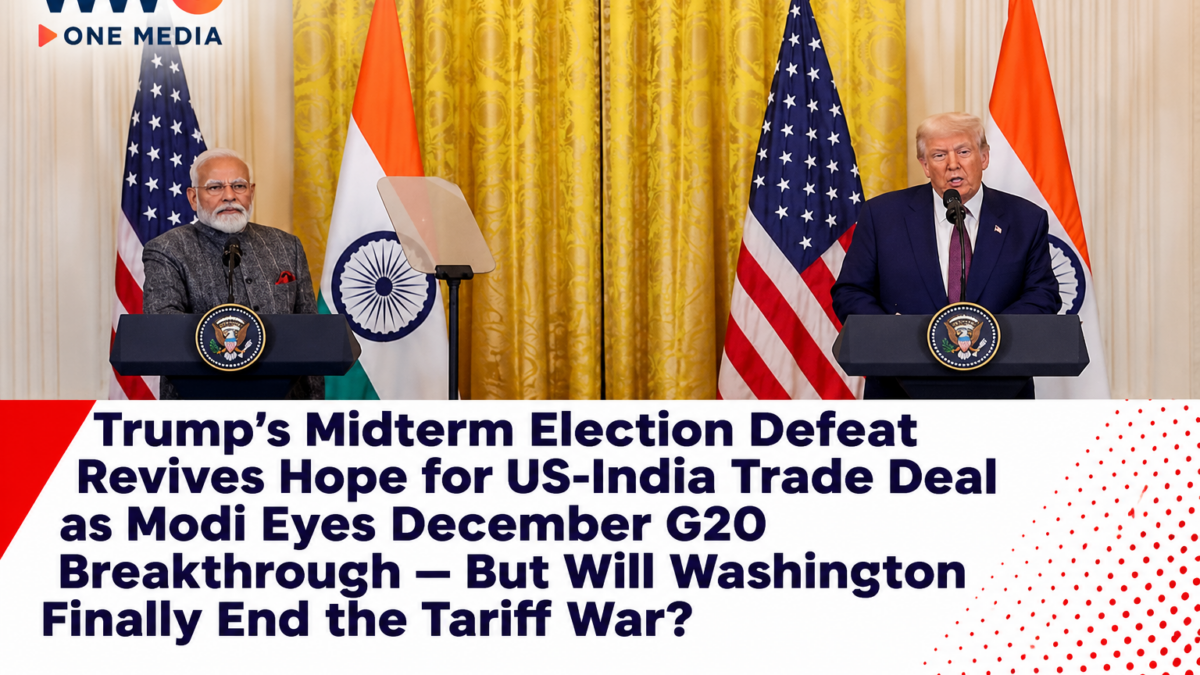
US President Donald Trump’s stunning setback in the November midterm elections may have unexpectedly opened the door to one of the biggest trade agreements of his second presidency, as Washington and New Delhi move closer to concluding a long-delayed deal that could reshape economic relations between the United States and India.
After months of tariff disputes, stalled negotiations and disagreements over Russian oil, trade experts believe Trump now has a powerful political incentive to secure an agreement with Indian Prime Minister Narendra Modi before the end of 2026.
The reason is straightforward: American voters have grown increasingly frustrated with the cost of living, while Trump’s aggressive import tariffs have become a central target of his political opponents.
According to CNBC’s November 12 report, analysts believe the Republican Party’s losses in the November 3 midterm elections could encourage Trump to pursue an international trade breakthrough that he can present as a major economic achievement.
A US-India trade deal is emerging as one of the leading possibilities.
With the G20 Leaders’ Summit scheduled for December 14–15 in Miami, the two governments have a high-profile diplomatic opportunity to conclude the first phase of their agreement.
But serious questions remain over tariffs, agricultural protections, Russian oil purchases and the precise commitments each country must make.
The emerging opportunity comes after Washington and New Delhi spent much of 2026 attempting to turn an earlier trade framework into a legally and commercially workable agreement.
As previously reported by WWC ONE MEDIA in its examination of Trump’s decision to ease threatened Russian-oil penalties on India, the relationship has already experienced substantial diplomatic strain.
Now, Trump’s domestic political difficulties could become an unexpected catalyst for an international agreement.
Trump’s Midterm Defeat Changes the Political Calculation
The November 3 US midterm elections delivered a major blow to Trump’s Republican Party.
Democrats gained control of both chambers of Congress, dramatically changing the political environment facing the White House.
The results reflected widespread concern about household expenses, inflation and the broader affordability of everyday goods.
Trump’s tariff policies have become an especially contentious issue because tariffs generally increase costs for American businesses importing products from overseas.
Those costs can then be passed on to consumers through higher retail prices.
Although the precise economic burden varies depending on the product, exchange rates and how companies respond, the overall effect of broad import tariffs can include higher consumer prices.
The Tax Foundation estimated that US tariffs increased the average American household’s federal tax burden by approximately $820 in 2026, compared with about $1,000 in 2025.
These are estimates of the tax burden associated with tariffs, not direct bills sent to individual households.
The political implications are significant.
With Democrats preparing to exercise greater congressional oversight, the Trump administration may face increased scrutiny over the costs and effectiveness of its trade strategy.
Ronak D. Desai, a visiting fellow at Stanford University’s Hoover Institution, told CNBC that the election results strengthened the argument for Trump to secure an international trade agreement.
Such a deal could provide the White House with an opportunity to emphasize economic cooperation and improved market access.
India, one of the world’s largest economies, offers a potentially valuable diplomatic and commercial achievement.
However, analysts’ expectations should not be confused with a confirmed decision by the White House.
Trump has not announced that the election results caused him to accelerate negotiations with India.
Trump-Modi Trade Agreement Could Be Signed in December
Attention is increasingly turning toward December’s G20 Leaders’ Summit.
The international gathering is scheduled for December 14–15 at Trump National Doral in Miami, Florida.
The event will bring together leaders from major global economies, creating an opportunity for bilateral meetings and potential trade announcements.
CNBC reported that some trade specialists believe Trump and Modi could use the occasion to formalize the agreement.
Mark Linscott, a former assistant US trade representative and senior adviser at the US-India Strategic Partnership Forum, told CNBC that negotiations were already substantially advanced.
He suggested that both governments appeared to have a shared understanding that an agreement should be concluded during a December meeting.
Another analyst, Aryan D’Rozario of the Center for Strategic and International Studies, said the G20 gathering would provide a suitable setting for finalizing the arrangement.
But those assessments remain forecasts.
Neither government has confirmed a signing ceremony, and the exact contents of the final agreement remain subject to negotiation.
Reuters reported on November 10 that Indian and American officials were still working to finalize the first phase of their bilateral trade arrangement.
US officials visited India earlier in November, with discussions covering customs procedures and trade facilitation.
The continuing negotiations indicate that meaningful progress has been made, even though a complete agreement remains unfinished.
For both countries, a successful December announcement could help reduce uncertainty that has affected businesses for months.
How US Tariffs on Indian Goods Became a Major Dispute
The current negotiations follow one of the most turbulent periods in recent US-India trade relations.
In 2025, Washington imposed substantial tariffs on Indian exports, including an additional penalty linked to New Delhi’s purchases of Russian crude oil.
At one point, some Indian products faced combined US tariffs of up to 50%.
The duties placed significant pressure on export-oriented Indian industries, including textiles, apparel, chemicals and other manufactured goods.
Trump argued that higher tariffs were necessary to address trade imbalances and pressure India to change its energy-purchasing decisions.
New Delhi maintained that its trade and energy policies were based on domestic economic requirements.
The dispute also complicated the broader strategic relationship between Washington and New Delhi.
Both countries have emphasized cooperation in defense, technology, investment and the Indo-Pacific region.
However, their commercial differences demonstrated that strategic alignment does not automatically guarantee agreement on economic policy.
In February 2026, Trump and Modi announced a framework intended to reduce tariffs and strengthen bilateral commerce.
The arrangement initially contemplated lowering US tariffs on many Indian products to approximately 18%.
It also included commitments to expand Indian purchases of American goods.
Nevertheless, the framework did not resolve every outstanding issue.
Further complications emerged after the US Supreme Court invalidated Trump’s use of emergency economic powers to impose sweeping tariffs.
The ruling changed the legal framework surrounding the administration’s trade policy and increased uncertainty over the final duties that would apply.
A separate 10% baseline tariff subsequently became an important point of reference in negotiations, although actual tariff treatment varies across products and legal authorities.
India has since sought greater predictability and more favorable market access for its exporters.
That is one of the key reasons the bilateral agreement remains unfinished.
India’s $500 Billion US Purchasing Commitment Remains a Major Issue
The trade framework announced earlier this year included an ambitious commitment for India to increase purchases of American goods.
Trump said the arrangement envisioned approximately $500 billion in US purchases over five years.
The proposed purchases would cover sectors including energy, aircraft, defense equipment, telecommunications technology and other industrial products.
For Washington, the commitment could support American exporters and provide a politically significant argument for the trade agreement.
For New Delhi, expanded access to US products could deepen economic cooperation and help diversify supply chains.
But the $500 billion figure requires careful interpretation.
It is a stated multiyear purchasing objective associated with the proposed framework, not proof that India has already spent that amount.
The final timetable, commercial contracts and legal commitments remain crucial.
Purchasing commitments also do not necessarily translate into government expenditures alone.
Private businesses, airlines, energy companies and other commercial purchasers may account for significant portions of the proposed trade.
The real economic effects will depend on which transactions proceed and whether companies find the terms commercially attractive.
India Refuses to Sacrifice Its Farmers for a Trade Deal
Agriculture remains among the most politically sensitive issues in the negotiations.
India has consistently sought to protect domestic farmers from sudden exposure to foreign competition.
The country’s agricultural sector supports millions of households and plays a major role in rural employment and food security.
American negotiators have pushed for greater access to India’s market for agricultural and food products.
The February framework included possible tariff reductions on selected American exports, while preserving protections for sensitive Indian agricultural categories.
Products such as rice, wheat, dairy and certain other farm commodities have remained politically difficult.
Indian Commerce and Industry Minister Piyush Goyal has repeatedly emphasized that the government will not compromise essential farmer interests.
He has argued that a trade agreement should create opportunities for Indian businesses without undermining vulnerable domestic industries.
Farm organizations, however, have expressed concerns that tariff concessions could expose farmers to competition from highly productive American agricultural suppliers.
These disagreements illustrate the tension between expanding international trade and protecting domestic constituencies.
For Modi, an agreement that appears to weaken agricultural protections could produce significant political opposition.
For Trump, a deal that provides insufficient access for American farmers could be difficult to portray as a major commercial victory.
The final outcome will depend on whether negotiators can develop exemptions, phased reductions or other arrangements acceptable to both sides.
Russian Oil Remains a Major Obstacle
Energy policy is another sensitive part of the negotiations.
India has become one of the world’s largest purchasers of Russian crude oil, particularly since Moscow’s full-scale invasion of Ukraine in 2022.
Discounted Russian supplies have helped Indian refiners manage import costs.
Washington has argued that continued purchases provide revenue to Moscow and weaken efforts to pressure Russia over its war in Ukraine.
India has defended its energy decisions, emphasizing the importance of affordable fuel for its population and economy.
The disagreement previously led Washington to impose additional tariffs linked to Russian oil purchases.
In September, the US Congress approved legislation authorizing further penalties against countries conducting substantial energy trade with Russia.
However, the legislation did not automatically impose the maximum threatened tariff on India.
The president retained authority to grant exemptions or waivers under specified circumstances.
In October, Trump approved relief from certain threatened restrictions, reducing one immediate source of pressure on India.
As WWC ONE MEDIA previously reported in its coverage of India’s response to potential 100% tariffs on Russian-oil buyers, New Delhi has maintained that energy security must remain central to its economic decisions.
The waiver improved the negotiating environment but did not resolve the fundamental disagreement over India’s relationship with Russian energy suppliers.
Global oil-market volatility has further complicated the issue.
If India reduces discounted Russian oil purchases, replacing those barrels with more expensive supplies could increase import costs.
At the same time, a durable agreement with Washington could strengthen economic and strategic cooperation.
Both governments therefore face competing priorities.
Indian Exporters Are Already Changing Their Business Strategies
For Indian manufacturers, the prolonged trade dispute has produced real commercial consequences.
Reuters reported on November 11 that Indian garment exporters were increasingly diversifying away from the United States after earlier tariff increases disrupted orders and squeezed profit margins.
Some manufacturers have redirected sales toward Europe, Britain and domestic customers.
Orient Craft, an Indian apparel exporter, reduced the US share of its revenue from approximately 84% to less than 10%.
Another manufacturer, Gokaldas Exports, has outlined plans to increase the proportion of sales generated in Europe while reducing its dependence on American customers.
Industry figures cited by Reuters showed that Indian exports of textiles, apparel and home furnishings to the US declined 9.8% during April–August, while shipments to other destinations rose 3.7%.
The trend demonstrates that international companies cannot indefinitely postpone commercial decisions while governments negotiate.
When tariffs become unpredictable, businesses may diversify customers, relocate production or renegotiate supply contracts.
A US-India trade agreement could help restore confidence.
However, exporters that have already invested in new markets may not immediately reverse those decisions.
Diversification can provide long-term benefits by reducing dependence on a single destination.
For India’s manufacturers, a trade deal would therefore offer an opportunity to improve market access rather than a guarantee that lost orders will return automatically.
Why the Supreme Court Ruling Makes Negotiations More Complicated
The US Supreme Court’s decision invalidating Trump’s broad emergency-powers tariffs has changed the negotiating landscape.
Before the ruling, Washington had relied on those duties as a major source of pressure on trading partners.
Once that legal authority was restricted, countries negotiating with the United States gained an opportunity to reassess the concessions they were prepared to make.
India has sought more favorable tariff treatment that would provide a competitive advantage relative to other exporters.
But US officials continue to have other legal mechanisms available for trade enforcement.
These include targeted investigations, product-specific duties and certain tariff powers authorized by federal law.
A bilateral agreement could therefore provide greater certainty, but it would not necessarily eliminate every possible future trade dispute.
The central question is whether both governments can agree on tariff commitments that are commercially meaningful and legally sustainable.
India wants predictable access to the world’s largest consumer market.
Washington wants concessions that demonstrate the economic benefits of its trade strategy.
Those interests overlap, but they are not identical.
Could Trump’s Defeat Actually Help India Secure Better Terms?
The unexpected political dimension of the negotiations is now attracting significant attention.
Trump’s party suffered substantial losses in the midterm elections, increasing pressure on the administration to respond to concerns about living costs.
A trade deal with India could offer an opportunity to emphasize international economic cooperation without requiring a major new spending program.
Unlike legislation requiring approval from both chambers of Congress, some trade-related agreements can be advanced using existing executive authority.
However, the legal scope of any such arrangement matters.
Major changes requiring new statutory authority would still involve Congress.
Analysts therefore believe the administration could favor an agreement structured around measures that can be implemented through existing powers.
From India’s perspective, the political shift could improve its bargaining position.
Washington may now have a stronger incentive to secure an announcement before the end of the year.
Nevertheless, that does not mean Trump will necessarily accept India’s preferred terms.
The administration could continue pressing for market-access concessions, Russian oil reductions and larger purchases of American goods.
A breakthrough will depend on negotiated compromises rather than political momentum alone.
India Has Other Trade Options Beyond Washington
India’s negotiating position is also shaped by its expanding international commercial relationships.
New Delhi has been pursuing trade agreements with several major economies as part of efforts to diversify export markets and strengthen investment.
Earlier in 2026, India reached a major trade agreement with the European Union.
It has also developed agreements involving Britain and other trading partners.
These relationships provide Indian exporters with opportunities beyond the United States.
At the same time, India has taken cautious steps toward improving economic relations with China.
As WWC ONE MEDIA reported on the Modi-Xi diplomatic reset, New Delhi has been trying to improve regional economic cooperation while protecting its strategic interests.
The different relationships are not interchangeable.
The United States remains a vital market for Indian services, manufactured goods and technology-related business.
China is a major supplier of industrial inputs and equipment.
Europe offers additional opportunities for exporters seeking to reduce reliance on the American market.
India’s objective is to benefit from those relationships without becoming excessively dependent on any single trading partner.
A successful US-India agreement would therefore form part of a broader diversification strategy.
What the Trade Deal Could Mean for Asian Businesses
The outcome will have implications beyond the United States and India.
Asian manufacturers compete across many of the same export industries, including textiles, electronics, engineering products and consumer goods.
A preferential tariff arrangement could affect the competitiveness of Indian exports relative to products manufactured elsewhere.
Countries such as Vietnam, Bangladesh, Indonesia and the Philippines could therefore monitor the agreement closely.
However, the effects would vary by industry and product.
A change in tariffs on Indian apparel would not necessarily have the same implications for semiconductor exports or business-process outsourcing.
The precise tariff schedule, product exemptions and implementation dates will matter more than the overall political announcement.
For international investors, an agreement could reduce uncertainty around Indian manufacturing and US market access.
But tariff relief alone cannot resolve broader challenges involving infrastructure, labor availability, logistics and industrial competitiveness.
As WWC ONE MEDIA previously examined in its coverage of the World Trade Organization’s warnings about global trade fragmentation, uncertainty over tariffs and trade rules can affect investment decisions across the international economy.
For Asia, the central question is whether bilateral agreements will reduce trade tensions or simply create a more complicated system of country-specific arrangements.
December G20 Summit Could Become the Decisive Moment
The approaching G20 Leaders’ Summit provides an important diplomatic deadline.
The meeting is scheduled for December 14–15, 2026, in Miami.
Analysts believe Trump and Modi could use the gathering to announce or formalize the first phase of their bilateral trade agreement.
But negotiations still face several practical challenges.
Officials must settle outstanding tariff questions, clarify market-access commitments and determine which measures can be implemented under existing legal authorities.
They must also address concerns involving agricultural products, Russian oil and commercial purchasing commitments.
A political announcement would not necessarily mean every tariff change takes effect immediately.
Implementation could require subsequent legal documents, customs instructions and regulatory procedures.
That distinction will be particularly important for exporters making pricing and investment decisions.
For now, the strongest evidence of progress is that negotiations continue and both governments have expressed an interest in reaching an agreement.
The remaining uncertainty concerns whether they can translate that interest into final terms.
The Bigger Picture: Trump Needs a Win, but India Wants a Fair Deal
The US-India trade negotiations have entered a politically significant phase.
Trump faces a more challenging domestic environment after the Republican Party’s midterm election losses.
Modi wants to strengthen India’s export competitiveness while protecting farmers and preserving flexibility over energy purchases.
Both leaders have reasons to seek a breakthrough.
The United States could gain expanded opportunities for exporters and greater economic cooperation with a major Asian partner.
India could secure more predictable access to the American market and reduce the uncertainty that has affected manufacturers.
Yet significant differences remain over the distribution of benefits and the commitments required.
The February trade framework demonstrated that the governments could identify common objectives.
The months of subsequent negotiations have demonstrated how difficult it is to turn political promises into a lasting economic agreement.
The December summit may provide an opportunity to close that gap.
For Trump, a US-India deal could offer a valuable foreign-policy and economic achievement following a difficult election. For Modi, it could provide relief from trade uncertainty and strengthen India’s position in global manufacturing.
But with the G20 summit approaching and critical tariff disputes still unresolved, will Trump and Modi finally deliver a historic trade agreement — or will another last-minute disagreement leave businesses waiting for a deal that always seems just out of reach?