JACKSON, Mississippi — November 12, 2026
A political earthquake has shaken one of America’s most traditionally Republican states.
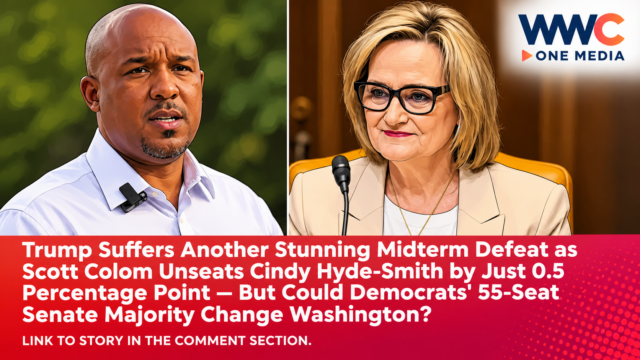
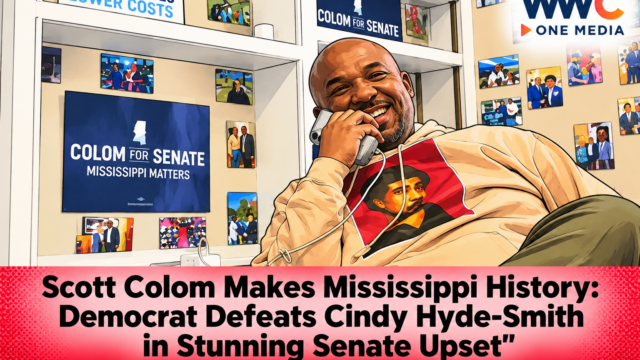
Democrat Scott Colom has defeated Republican incumbent Sen. Cindy Hyde-Smith in Mississippi’s closely watched 2026 Senate race, delivering an extraordinary upset and making history as the state’s first Black US senator since the Reconstruction era.
The Associated Press declared Colom the winner on Wednesday, November 11, after days of ballot counting pushed his lead beyond the narrow margin recorded on election night.
The final AP update placed Colom ahead by 4,669 votes out of 962,237 counted, representing approximately 0.5 percentage points.
Hyde-Smith subsequently called Colom to concede and publicly congratulated him on his victory.
For Mississippi, the result represents a historic political turning point. For Democrats, it delivers another major Senate gain in a midterm election that has already dramatically changed the balance of power in Washington.
The victory also raises a bigger question: How did a Democratic prosecutor manage to defeat a Republican incumbent in a state that President Donald Trump carried by more than 20 percentage points in 2024?
Scott Colom Makes Mississippi History After Stunning Election Upset
Colom, 43, is a local prosecutor who built his campaign around economic concerns, healthcare, representation and the need for a senator who understands the everyday struggles of Mississippi residents.
His victory is historic because Mississippi has not sent a Black senator to Washington since the Reconstruction era following the Civil War.
During that period, Hiram Revels and Blanche K. Bruce served as US senators from Mississippi. Both were elected by the state legislature during Reconstruction.
Colom’s victory marks a new chapter in that history, with voters directly electing a Black candidate to represent the state in the US Senate.
His campaign emphasized the importance of representing all Mississippians, regardless of political affiliation, race or economic background.
He also drew attention to the state’s civil rights history, including the legacy of Medgar Evers, the Mississippi civil rights leader assassinated in 1963.
Colom’s message focused on the possibility of building a political coalition that could reach beyond traditional Democratic strongholds.
The Associated Press described his victory as a seismic shift in a state where white conservatives have dominated statewide politics for generations.
How Colom Overcame a Republican Stronghold
Mississippi has long been considered difficult territory for Democratic candidates seeking statewide office.
Trump carried the state by approximately 23 percentage points in the 2024 presidential election.
Hyde-Smith also entered the contest with the advantages of incumbency, strong Republican support and a political environment that initially appeared favorable to her reelection.
However, several factors gradually changed the dynamics of the race.
Colom invested heavily in grassroots campaigning, meeting voters at town halls, public housing communities, local festivals and small businesses.
He also sought to connect with people who were not necessarily traditional Democratic voters.
One of his more unconventional campaign strategies involved approaching people waiting outside a Trump rally in Corinth, Mississippi, in late October.
Instead of avoiding the Republican gathering, Colom introduced himself, asked voters about their concerns and discussed his priorities.
The approach reflected his effort to present himself as a candidate willing to listen to people across political divisions.
National Democratic figures also joined the campaign, including former President Bill Clinton, former Vice President Kamala Harris and Democratic senators Raphael Warnock and Cory Booker.
Their involvement helped bring additional attention and resources to a race that many political observers initially considered a long shot.
The Viral Beef Price Advertisement That Put Hyde-Smith Under Pressure
One of the most memorable moments of the campaign involved an advertisement criticizing Hyde-Smith’s response to concerns about rising beef prices.
During an earlier discussion about expensive beef, the Republican senator suggested that consumers had other protein options.
Colom’s campaign turned the comment into a widely circulated political advertisement.
The commercial showed people reacting with disbelief to the suggestion that consumers could simply choose another protein.
Its punchline was direct: Instead of choosing another protein, voters could choose another senator.
The advertisement became one of Colom’s most recognizable campaign moments.
It also helped transform a complicated economic issue into a simple message that voters could easily understand.
The criticism resonated in a state where food prices, household expenses and affordability were major concerns.
The Washington Post’s reporting highlighted the advertisement as one of the campaign’s most widely circulated moments.
The incident became an example of how a relatively small campaign could use creative political messaging to challenge a better-known incumbent.
Economic Frustration Helped Turn the Race Into a Democratic Opportunity
Colom’s victory cannot be explained by one advertisement or one campaign appearance.
His campaign unfolded during a difficult economic and political period for the country.
Voters were increasingly concerned about affordability, rising household costs and the consequences of the Trump administration’s policies.
Reuters reported that Colom criticized the administration’s tariffs and its war against Iran, arguing that those policies had contributed to economic pressures, including higher fuel costs.
He also campaigned on healthcare and the need for stronger economic opportunities across Mississippi.
The state has significant economic challenges, particularly in rural communities where residents face persistent problems involving poverty, healthcare access and employment.
Colom sought to connect those local concerns with broader national debates.
His strategy was to make the election about everyday economic pressures rather than simply a contest between two political parties.
The approach appears to have helped him attract support beyond the state’s traditional Democratic voting base.
Why the Final Vote Count Took More Than a Week
The election-night results initially showed an extraordinarily close contest.
Following the final election-night update from Pike County, Colom led Hyde-Smith by just 43 votes.
That margin was too narrow for the Associated Press to immediately declare a winner.
Election officials then spent several days reviewing outstanding absentee and provisional ballots.
In Mississippi, provisional ballots are commonly called affidavit ballots.
They can be cast by voters whose eligibility or registration information requires additional verification before their votes can be counted.
The review process can involve checking voter registration records, confirming eligibility and determining whether the ballots satisfy the applicable requirements.
As counties completed their reviews, updated results increasingly favored Colom.
The AP reported that he won all 12 county vote updates released on Wednesday, November 11.
One particularly important update came from Jackson County, which added 2,173 votes to its reported total.
That update increased Colom’s advantage to 4,669 votes out of 962,237 counted.
The AP concluded that Hyde-Smith no longer had a realistic path to overtake him through the remaining updates and called the race shortly before 6 p.m. Eastern time.
The Associated Press estimated that fewer than 12,000 votes remained for county officials to review before the certification deadline.
Not all those outstanding ballots were guaranteed to be accepted.
Controversy Over Mississippi’s Inactive Voter Registrations
The unusually close election also drew attention to Mississippi’s voter registration system.
Axios reported that more than 230,000 Mississippi voters were listed as inactive ahead of the 2026 midterm elections.
That represented an increase from approximately 166,000 during the 2024 election, according to the data cited in its reporting.
Voters placed on inactive status were not automatically removed from the registration rolls.
However, some had to cast affidavit ballots, which required additional review before their votes could be included in the final count.
The issue became particularly controversial because the state had previously used outside data to help identify possible address changes.
Mississippi Secretary of State Michael Watson’s office had entered into a $50,000 agreement with credit reporting company Experian to obtain supplemental address information.
Election experts raised questions about the reliability of third-party data when used to identify voters who may have moved.
Experian told Axios that its earlier service was not designed to validate voter records or make decisions about registration status.
The company also said it had not provided services to Mississippi since early 2025.
The available reporting does not establish that the voter-roll process changed the outcome of the Senate race.
However, the controversy highlights why voter registration procedures and the treatment of provisional ballots became important issues during the extended count.
Cindy Hyde-Smith Concedes After Days of Uncertainty
After the Associated Press declared Colom the winner, Hyde-Smith released a video statement acknowledging her defeat.
The Republican senator thanked supporters, volunteers, donors and staff members who had worked on her campaign.
She also said she respected the decision of Mississippi voters and congratulated Colom on his victory.
Hyde-Smith had represented Mississippi in the Senate since 2018, when she was appointed to fill a vacancy.
She subsequently won a special election and secured a full term in 2020.
During her time in Washington, she became known as a strong conservative ally of Trump.
Her defeat ends a Senate career that began with her appointment and continued through two election victories.
The concession also removed much of the immediate uncertainty surrounding the outcome.
However, the state still must complete its official certification process.
Mississippi’s scheduled certification date is December 3.
The AP’s projection and Hyde-Smith’s concession are major developments, but the result should not be described as formally certified until the state completes that process.
A Previous Biden Judicial Nomination Adds Another Chapter to Their Political Rivalry
Colom and Hyde-Smith had a political history that extended beyond the 2026 election.
During Joe Biden’s presidency, Colom was nominated to become a federal district judge for the Northern District of Mississippi.
His nomination received support from Mississippi’s senior Republican senator, Roger Wicker, as well as former Republican governor Haley Barbour.
However, Hyde-Smith used the Senate’s informal blue-slip tradition to block the nomination.
The blue-slip process gives home-state senators an opportunity to express support or opposition to federal judicial nominees from their state.
Although the practice is not a constitutional requirement, it can give senators substantial influence over the nomination process.
Hyde-Smith’s opposition prevented Colom’s nomination from advancing.
Reuters reported that the disagreement was connected to Hyde-Smith’s objections to Colom’s position on transgender issues.
The earlier confrontation added another layer to their political relationship.
Four years later, Colom defeated Hyde-Smith in the same state’s Senate race.
The outcome has therefore transformed a previous political setback for Colom into one of the most significant victories of his career.
What Colom’s Victory Means for the Democratic Senate Majority
The Mississippi result has consequences far beyond the state’s borders.
With Colom’s victory, Democrats are set to enter the new Congress with at least 55 Senate seats.
The party had already secured control of the Senate and House of Representatives in the November 3 midterm elections.
The Mississippi win increases the size of its incoming Senate majority.
Alaska’s Senate contest remains unresolved, meaning the final number of Democratic seats could increase further if Democrat Mary Peltola defeats Republican incumbent Dan Sullivan.
According to the Associated Press, the Mississippi victory represents a net gain of eight Senate seats for Democrats.
That is the party’s largest midterm Senate gain since 1986, when Democrats also gained eight seats during Ronald Reagan’s second presidential term.
The additional seats could give Democratic leaders greater flexibility in organizing the chamber, managing committee assignments and advancing their legislative priorities.
However, a larger majority does not mean Democrats can automatically pass every proposal.
Legislation still faces Senate procedural requirements, potential Republican opposition and the possibility of a presidential veto.
Nevertheless, the political balance in Washington has changed significantly.
Could Mississippi Signal a Bigger Political Shift in the American South?
Colom’s victory has revived a debate about the future of Democratic politics in traditionally Republican states.
For years, Mississippi has been viewed as one of the strongest Republican states in the country.
The result demonstrates that even deeply conservative states can produce competitive statewide elections under the right political conditions.
Colom’s campaign benefited from strong support in heavily Democratic areas, particularly the Jackson region and the Mississippi Delta.
The Associated Press reported that he received more than 67% of the vote in those areas.
But his performance also showed that he could remain competitive in regions where Republicans traditionally perform better.
The result does not mean Mississippi has suddenly become a reliably Democratic state.
Republicans continue to hold considerable political power across the state.
However, the election has demonstrated that economic concerns, campaign strategy, voter mobilization and candidate credibility can create opportunities even in places where one party has historically dominated.
For Democrats, the victory could become an important example as they look for additional opportunities across the South.
What Happens Next?
Colom’s victory has been called by the Associated Press, and Hyde-Smith has conceded.
The next step is the completion of Mississippi’s official election certification process.
The state is scheduled to certify the results on December 3.
Mississippi does not have an automatic recount process for US Senate elections simply because the margin is close.
A candidate seeking a review would need to pursue legal action and persuade a court to order an appropriate review.
The AP reported that Hyde-Smith’s concession followed the projection of Colom as the winner.
With the result moving toward certification, attention will now shift to Colom’s transition to the Senate and the priorities he intends to pursue when the new Congress convenes in January 2027.
He has promised to represent all Mississippians, including those who supported his opponent.
His victory also means that a new generation of Mississippi political leadership will have an opportunity to influence national debates over healthcare, economic policy, voting rights and federal spending.
The Bigger Question: Can Scott Colom Turn a Historic Victory Into Lasting Change?
Scott Colom’s victory is more than a change in Mississippi’s Senate representation.
It is a historic electoral breakthrough in a state whose political history has been deeply shaped by racial divisions, conservative dominance and the legacy of the civil rights movement.
His campaign demonstrated how grassroots organizing, economic messaging and an appeal to voters beyond traditional party boundaries can produce an unexpected result.
For Republicans, Hyde-Smith’s defeat raises difficult questions about the party’s ability to defend traditionally safe seats during an unfavorable national political environment.
For Democrats, the victory strengthens an already historic midterm performance and provides another opportunity to expand their influence in Washington.
But winning an election and delivering results are two different challenges.
Colom will now face the responsibility of representing a state with significant economic and social problems while navigating a sharply divided national political environment.
Mississippi has made history by electing Scott Colom, but the real test begins when he takes his seat in Washington. Can the Democrat turn this extraordinary upset into meaningful change for the state — or will the political divisions that shaped his victory become his biggest challenge in the Senate?