JACKSON, MISSISSIPPI / WASHINGTON, D.C. — November 12, 2026 | WWC ONE MEDIA | US Politics, 2026 Midterm Elections and World News
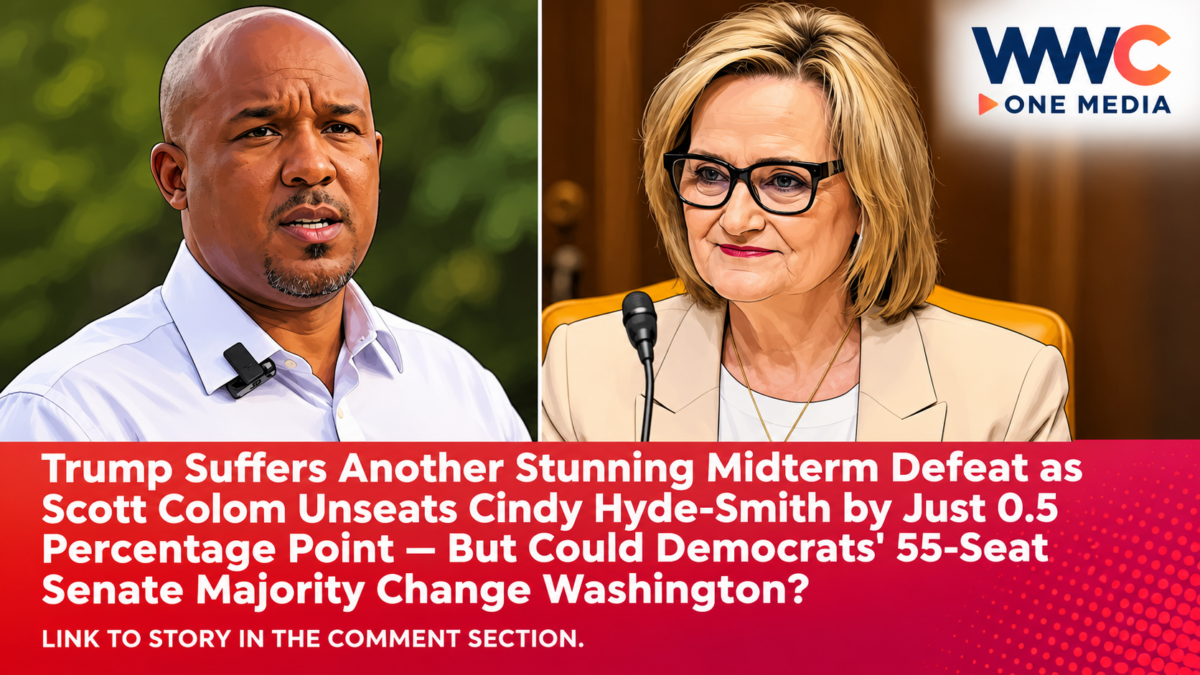
President Donald Trump’s Republican Party has suffered another stunning political defeat after Democrat Scott Colom unseated incumbent Senator Cindy Hyde-Smith in Mississippi, winning a historic election in a state that Trump carried by nearly 23 percentage points just two years ago.
The extraordinary victory marks the first time Mississippi voters have elected a Democrat to the US Senate since 1982, ending a 44-year drought for the party in one of America’s most reliably Republican states.
But Colom’s victory carries an even greater historical significance.
The 43-year-old district attorney is set to become Mississippi’s first Black US senator since the Reconstruction era following the American Civil War, a milestone that comes more than 140 years after the state last elected a Black senator.
The Associated Press declared Colom the winner on Wednesday, November 11, following more than a week of closely contested ballot counting.
CNN, NBC News, CBS News and other major outlets also projected his victory.
With approximately 99% of the expected vote reported, Colom held 49.2% against Hyde-Smith’s 48.7%, a lead of roughly 4,600 votes out of more than 960,000 cast.
Hyde-Smith subsequently conceded the race.
According to CNBC’s November 11 coverage, the result represents another major setback for Republicans following the November 3 midterm elections, which delivered Democratic control of both chambers of Congress.
Colom’s victory also gives Democrats their eighth Republican-held Senate seat pickup of the election cycle, lifting their projected majority to at least 55 seats.
As previously examined by WWC ONE MEDIA in its coverage of Democrats seizing control of Congress, the results have dramatically changed the balance of political power in Washington.
But the Mississippi upset raises a question that could shape the 2028 presidential election.
If Democrats can win a Senate seat in a state Trump carried overwhelmingly, how secure are the Republican Party’s traditional strongholds?
Scott Colom Makes History as Mississippi Elects Its First Black Senator Since Reconstruction
Colom’s election represents a landmark moment in Mississippi’s political history.
The state has a long and complicated history involving slavery, racial segregation, voting restrictions and the struggle for civil rights.
During Reconstruction, Black Americans briefly gained greater political representation following the abolition of slavery.
Hiram Revels became the first Black member of the US Senate in 1870, representing Mississippi.
Blanche K. Bruce was subsequently elected to the Senate in 1874 and served from 1875 until 1881.
After Reconstruction, political systems involving segregation and voter suppression severely restricted Black political participation across the South.
Mississippi did not elect another Black US senator for more than a century.
Colom’s victory therefore represents a historic breakthrough.
He is set to become the state’s first Black senator since Bruce and the first Black candidate to win a statewide federal election in Mississippi through the modern popular-vote system.
The political significance extends beyond racial representation.
Colom also defeated a sitting Republican senator in a state where the GOP has dominated federal elections for decades.
His victory suggests that changing political conditions, strong local campaigns and voter concerns about national policy can produce unexpected results even in traditionally conservative states.
But one election does not establish a permanent political realignment.
Whether Democrats can sustain their gains will depend on future turnout, candidate recruitment and voter priorities.
Mississippi Election Results: A Race Decided by Fewer Than 5,000 Votes
The Mississippi Senate contest was among the closest and most closely watched races of the 2026 midterm elections.
Election Day on November 3 ended without a clear winner.
Colom and Hyde-Smith were separated by an extremely narrow margin as election officials continued processing outstanding ballots.
According to the Associated Press, Colom’s lead stood at just 43 votes after the final election-night update.
The race remained unresolved for more than a week as election workers reviewed provisional ballots, also known in Mississippi as affidavit ballots, and completed additional county-level counting procedures.
Those ballots proved decisive.
As more counties reported updated results, Colom’s advantage widened.
On November 11, the Associated Press determined that the remaining votes were insufficient to reverse his lead and declared him the winner.
At the time of the call, he was ahead by approximately 4,600 votes.
The reported results were:
- Scott Colom, Democrat: 49.2%
- Cindy Hyde-Smith, Republican: 48.7%
- Other candidates, including independent Ty Pinkins: Approximately 2.1% combined
These figures represent the reported count at the time of the race call, not the final certified results.
Hyde-Smith subsequently congratulated Colom and conceded the election.
Her concession marked the political conclusion of one of the most surprising contests of the year.
However, Mississippi election officials must still complete the formal certification process under state law.
Who Is Scott Colom, the Democrat Who Defeated Cindy Hyde-Smith?
Colom is a Mississippi prosecutor who built his political career outside the traditional national spotlight.
Before his Senate campaign, he served as district attorney for Mississippi’s 16th Circuit Court District, covering several counties in the northern part of the state.
He was elected district attorney in 2015 and developed a reputation for emphasizing criminal justice, community engagement and public accountability.
Colom entered the Senate race as a relatively unfamiliar candidate to many national voters.
He faced a difficult challenge.
Mississippi had consistently supported Republican presidential candidates, and Hyde-Smith entered the election with the advantages of incumbency and established political connections.
But Colom attempted to build support through a campaign focused on everyday economic concerns.
He emphasized the cost of groceries, healthcare access, struggling rural communities and the need for stronger political representation.
Rather than making the election solely a referendum on Trump, Colom sought to connect national policy decisions with the daily challenges facing Mississippi households.
His campaign relied heavily on local engagement.
He visited small businesses, attended community gatherings and met voters across different parts of the state.
The approach proved competitive in a political environment where economic dissatisfaction had become increasingly important.
Colom also received support from prominent Democrats, including former President Bill Clinton and former Vice President Kamala Harris.
However, the contribution of those endorsements to the final outcome cannot be measured precisely.
His victory reflected a combination of local campaigning, voter turnout and broader national political conditions.
Cindy Hyde-Smith’s Defeat Ends an Eight-Year Senate Tenure
Hyde-Smith, 67, had represented Mississippi in the Senate since 2018.
She was appointed to the chamber after Republican Senator Thad Cochran retired because of health concerns.
Hyde-Smith subsequently won the 2018 special election, becoming the first woman elected to represent Mississippi in the US Congress.
She won a full six-year term in 2020.
Throughout her Senate career, Hyde-Smith maintained close ties to the Republican Party and supported many of Trump’s policies.
Her 2026 campaign emphasized conservative priorities, agricultural issues and support for the president’s agenda.
Trump personally visited Mississippi during the final stages of the campaign, urging voters to reelect her.
Yet the Republican incumbent struggled to overcome the changing national political environment.
Democrats emphasized rising living costs, healthcare concerns and dissatisfaction with federal policies.
One campaign controversy attracted particular attention.
Hyde-Smith had suggested consumers consider alternative proteins amid higher beef prices.
Colom’s campaign used the remarks to criticize what it portrayed as an inadequate response to household financial pressures.
The advertisement became part of a broader argument over whether Republican officials understood the economic struggles facing ordinary families.
Still, the election result cannot be attributed to that advertisement alone.
The narrow margin reflects a complicated mix of local, economic and national factors.
Trump Won Mississippi by Nearly 23 Points in 2024 — So What Changed?
One of the most remarkable aspects of Colom’s victory is the scale of the political shift relative to Mississippi’s recent presidential voting patterns.
In the 2024 presidential election, Donald Trump defeated Kamala Harris in Mississippi by approximately 23 percentage points.
The state was not widely viewed as a likely Democratic Senate pickup heading into the 2026 election.
Indeed, major election forecasters generally considered the contest favorable to Republicans.
Yet Colom managed to defeat the incumbent by approximately half a percentage point.
That difference highlights the extent to which voter behavior can change between presidential and midterm elections.
Several possible factors contributed.
Economic concerns played an important role.
Inflation, grocery prices, fuel costs and healthcare expenses remained significant issues for households.
The ongoing conflict involving Iran also increased scrutiny of the Trump administration’s foreign policy and its domestic economic consequences.
Meanwhile, Democratic campaigns emphasized local candidates and voter mobilization.
However, analysts should avoid assuming that every voter who supported Trump in 2024 switched to Colom in 2026.
Midterm electorates can differ substantially from presidential electorates.
Changes in turnout, independent voter preferences and third-party support can produce different outcomes without representing a permanent transformation of party loyalties.
The result nevertheless demonstrates that Republican dominance in Mississippi is not electorally guaranteed.
Democrats Gain Their Eighth Senate Pickup and Strengthen Their Majority
Colom’s victory has important consequences for the balance of power in Washington.
Following the November 3 midterm elections, Democrats had already secured enough seats to regain control of the US Senate.
The Mississippi result adds another Republican-held seat to their projected majority.
According to CBS News, Colom’s victory represents the Democrats’ eighth Senate pickup during the 2026 election cycle.
The party is now projected to hold at least 55 seats when the new Congress convenes in January 2027.
The final balance could change as outstanding races are resolved.
The strengthened majority would give Democrats greater control over Senate leadership, committees and the confirmation process for federal appointments.
It could also make it more difficult for Trump to secure approval for certain nominees.
The Senate has authority to confirm federal judges, Cabinet officials and other senior executive-branch appointments.
A Democratic majority could reject nominees it opposes.
It would also gain the ability to launch committee investigations and scrutinize administration policies.
As WWC ONE MEDIA previously reported in its analysis of Democrats winning at least 54 Senate seats and the implications for Trump’s Supreme Court legacy, the new majority could significantly constrain the president’s judicial appointment strategy.
But control of 55 Senate seats does not give Democrats unlimited legislative power.
Many bills remain subject to the Senate’s 60-vote cloture requirement.
Trump also retains his constitutional veto authority.
Overriding a presidential veto generally requires a two-thirds majority in both chambers.
The new political environment will therefore involve negotiations, institutional checks and potentially significant conflict between the White House and Congress.
Mississippi’s Upset Adds to Democrats’ Breakthrough Across the South
Colom’s victory is part of a broader pattern of Democratic gains in traditionally Republican areas.
The 2026 midterm elections produced surprising results across several Southern states.
Democrats won important contests in Texas, Georgia, North Carolina and South Carolina.
In Georgia, Democratic Senator Jon Ossoff secured reelection, while former Atlanta Mayor Keisha Lance Bottoms won the governorship.
These victories occurred in a region where Republicans have held significant political advantages for decades.
The results have prompted debate over whether the traditional political map is changing.
For Democrats, the victories suggest opportunities to compete more aggressively in states previously considered out of reach.
For Republicans, they raise questions about voter dissatisfaction, candidate strategy and the party’s ability to defend its traditional base.
As examined by WWC ONE MEDIA in its coverage of Democratic breakthroughs across Texas, Georgia and Mississippi, the party now faces the challenge of turning unexpected midterm success into a durable electoral coalition.
But the political future remains uncertain.
States that supported Democrats in 2026 may vote differently in 2028, when turnout, candidates and national issues could change.
Mississippi’s narrow result provides evidence that the state can be competitive, not proof that it has permanently become Democratic.
How Ballot Counting Became Central to the Mississippi Senate Race
The prolonged vote-counting process became one of the most closely scrutinized aspects of the election.
Following November 3, both campaigns monitored outstanding provisional ballots and county-level election procedures.
The candidates disagreed over aspects of the ballot-counting process while the result remained uncertain.
Reuters reported on November 6 that the treatment of remaining ballots had become a major issue in the contest.
As additional votes were reviewed, Colom’s margin expanded.
The Associated Press eventually concluded that his advantage could no longer be overcome by the remaining ballots.
The extended count demonstrates why close elections can take days to resolve.
Election officials must verify voter eligibility, assess provisional ballots and complete legally required procedures.
A delay does not, by itself, establish wrongdoing.
Nor does a close initial result necessarily indicate that the eventual winner has lost support.
In this case, the additional counting increased Colom’s advantage.
The result also illustrates the importance of distinguishing projected winners from formally certified election results.
Major news organizations can declare a winner based on vote totals and the remaining ballots, while state officials subsequently complete certification.
What Scott Colom’s Victory Means for Trump’s Final Two Years
The political consequences extend well beyond Mississippi.
Donald Trump now faces the prospect of spending the final two years of his presidency with Democrats controlling both chambers of Congress.
That would mark a dramatic change from the unified Republican control that supported much of his earlier legislative agenda.
Democrats will have greater authority to investigate executive-branch decisions and challenge administration proposals.
They could also place additional scrutiny on trade policy, government spending, immigration enforcement, national security and foreign affairs.
However, the president will continue exercising executive powers within constitutional and statutory limits.
The result is likely to be a divided-government environment in which major legislative changes become more difficult.
The next Congress will also have to address important fiscal issues.
Government funding, national debt, defense spending and economic policy may become areas of intense negotiation.
The composition of the Senate will matter because even narrow differences in party control can influence committee leadership, nomination votes and the scheduling of legislation.
Colom’s victory adds another Democratic senator to that institutional balance.
Could the Mississippi Result Influence the 2028 Presidential Election?
Although the 2026 midterms have transformed Congress, the implications for the 2028 presidential election remain uncertain.
Democrats may interpret their Southern victories as evidence that they can compete in states long considered Republican territory.
But sustaining that momentum will require an effective organization and policies that appeal to a broad range of voters.
Republicans, meanwhile, have time to reassess their campaign strategy.
The party could focus on rebuilding support among voters concerned about affordability, government performance and foreign policy.
It may also attempt to regain the enthusiasm of voters who participated in the 2024 presidential election but did not vote in 2026.
For both parties, Mississippi offers an important lesson.
Political advantages can weaken when voter concerns change and campaigns fail to respond.
But one close election cannot establish a lasting trend.
The outcome may encourage Democrats to invest more heavily in Southern campaigns while pushing Republicans to defend states they previously considered secure.
The next two years will help determine whether Colom’s victory represents the beginning of a larger political shift or an extraordinary result produced by unusual circumstances.
What Happens Next?
The immediate next step is formal certification of Mississippi’s election results.
Colom is the projected winner, and Hyde-Smith has conceded.
Once the state completes its official procedures, the transition toward the next Senate term can proceed.
The incoming Congress is scheduled to convene on January 3, 2027.
Democrats will then assume control of Senate committees and leadership positions, subject to the chamber’s organizational procedures.
The party will also need to settle internal leadership debates and establish its legislative priorities.
As WWC ONE MEDIA reported in its analysis of Bernie Sanders’ opposition to Chuck Schumer’s continued leadership, the election victory has not eliminated disagreements within the Democratic caucus.
Those internal disputes could influence how aggressively the party challenges the Trump administration.
Colom will also face the challenge of representing Mississippi in a closely divided national political environment.
His campaign emphasized affordability, healthcare and the needs of local communities.
Voters will eventually judge his performance against those promises.
The Bigger Picture: A Historic Victory With National Consequences
Scott Colom’s Mississippi Senate victory represents one of the most extraordinary political developments of the 2026 midterm elections.
A 43-year-old Democratic prosecutor has defeated an incumbent Republican senator in a state Donald Trump won by nearly 23 percentage points just two years earlier.
The victory ends a 44-year gap since Mississippi last elected a Democrat to the US Senate.
It also marks the election of the state’s first Black senator since Reconstruction.
And it strengthens the Democratic majority that will take control of Congress in January 2027.
Yet the election raises questions that extend beyond one Senate seat.
Republicans must determine why a traditionally reliable state became competitive.
Democrats must prove that their victories can translate into effective governance.
And both parties must confront the economic and political concerns influencing voters across the country.
For Scott Colom, the victory is a historic personal and political achievement. For Mississippi, it marks a significant moment in the state’s electoral history. For Washington, it adds another obstacle to President Trump’s legislative agenda.
But as Democrats celebrate their eighth Senate pickup and Republicans confront unexpected defeats across the South, could Mississippi’s stunning political upset signal the beginning of a lasting shift in American politics — or will the GOP reclaim its traditional strongholds before 2028?