NEW YORK / LAGOS — October 31, 2026
What should have been a landmark Wall Street debut for one of Africa’s largest financial technology companies has turned into an unexpected stock market mystery.
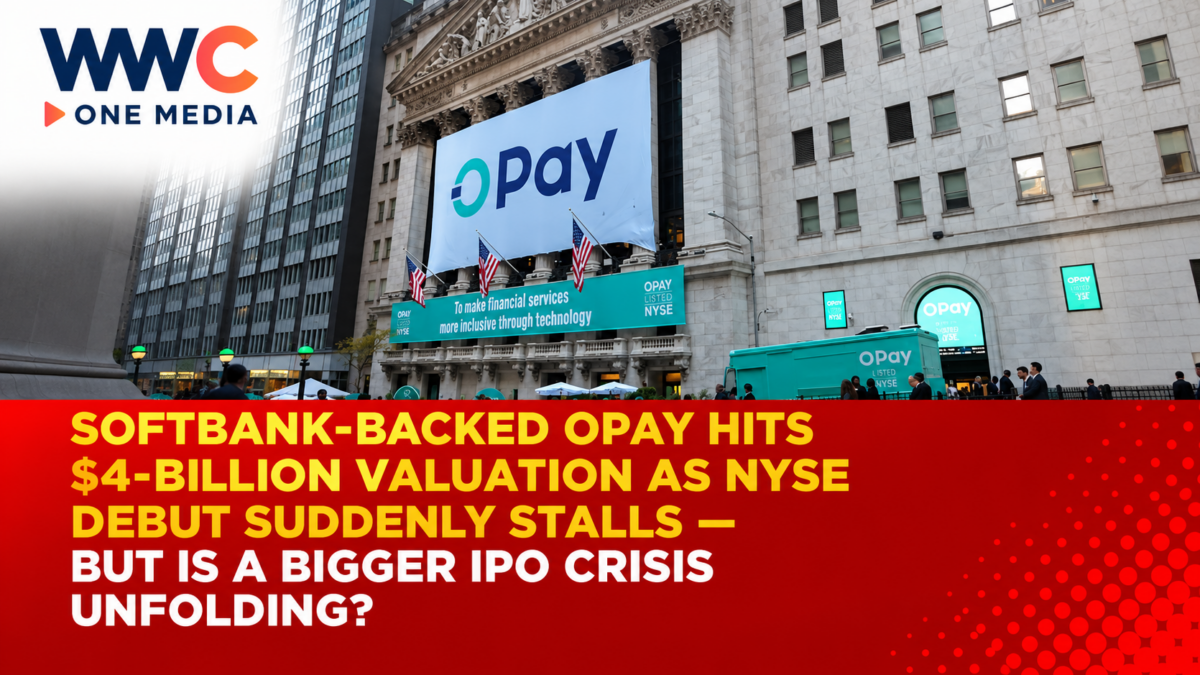
SoftBank-backed digital payments giant OPay raised $304 million in its US initial public offering, securing an estimated $4 billion valuation — only for its shares to fail to begin trading on the New York Stock Exchange as scheduled on Friday, October 30.
The unusual development stunned observers of the African fintech industry, which had been anticipating a major international listing for a company serving more than 50 million users across emerging markets.
According to Bloomberg, the New York Stock Exchange reported a trading halt with news pending, although no completed trades appeared on the exchange’s message feed.
The situation became even more striking because OPay executives had already participated in the exchange’s opening-bell ceremony.
Earlier in the session, indications suggested that the company’s American depositary shares could open below their $19 IPO price.
By approximately 3:30 p.m. New York time, the NYSE had reported a halt, leaving investors without an official explanation for why trading had not commenced.
The disruption comes during a difficult period for global equity markets, with rising volatility, a technology stock selloff and renewed concerns about corporate valuations affecting investor sentiment.
But the bigger question is whether OPay’s delayed market debut represents a temporary listing disruption — or an early warning that investor confidence in newly listed technology companies is weakening.
OPay Raises $304 Million at the Bottom of Its IPO Price Range
OPay’s initial public offering was officially priced at $19 per American depositary share, the lowest price within its proposed range of $19 to $21.
The company offered 16 million ADSs.
That places the transaction’s gross proceeds at approximately $304 million before underwriting discounts, commissions and other offering expenses.
The pricing gave OPay an estimated equity valuation of approximately $4 billion.
The company also granted its underwriters a 30-day option to purchase up to 2.4 million additional American depositary shares.
If exercised in full at the IPO price, the option could increase gross offering proceeds by another $45.6 million, bringing the maximum to approximately $349.6 million.
However, the additional amount is conditional and should not be treated as money already raised.
OPay’s official announcement said the offering was expected to close on November 2, 2026, subject to customary closing conditions.
The planned listing was scheduled for the New York Stock Exchange under the ticker symbol OPAY.
The Securities and Exchange Commission declared the company’s registration statement effective on October 29.
These developments indicated that the offering had advanced through important regulatory and pricing stages.
What followed was far less routine.
NYSE Trading Halt Leaves Investors Searching for Answers
According to Bloomberg reporting subsequently detailed by Nigerian business publication Nairametrics, OPay’s shares did not begin trading during their scheduled first session on October 30.
The exchange’s message feed indicated that trading had been halted pending news.
However, there were no completed trades reported.
That distinction is essential.
A stock can experience a trading halt after investors have already bought and sold shares.
In OPay’s case, the reported halt occurred without an initial public-market trade being executed.
The situation therefore should not be described as a share-price collapse.
Instead, the shares failed to commence trading after the company had announced its offering price and participated in the exchange’s opening-bell activities.
Bloomberg reported that, as of approximately 2 p.m. New York time, OPay’s ADSs were indicated to open between $16.25 and $16.75.
Those indications were below the $19 IPO price.
At $16.25, the indicated opening level would have represented a discount of approximately 14.5% to the offering price.
At $16.75, the indicated discount would have been approximately 11.8%.
But these were indicative prices, not executed trades or official opening quotations.
The absence of completed transactions means the company did not establish an actual first-day market price in the reported session.
By the October 30 reporting cutoff, no official reason had been publicly established for the trading disruption.
Was OPay’s IPO Canceled?
The available reporting does not establish that OPay’s entire offering was formally canceled.
The company’s official pricing announcement confirmed the terms of its offering and its planned November 2 closing.
Bloomberg established that the scheduled NYSE trading debut did not take place.
Separately, specialist publication IPOScoop reported, citing market sources, that the IPO had been postponed indefinitely and that clients at a major firm had received notification of a withdrawal.
However, that claim had not been confirmed through a subsequent public announcement from OPay or the NYSE in the primary materials reviewed.
It would therefore be premature to report a completed cancellation as an established fact.
The distinction matters for investors.
A priced IPO, an exchange trading commencement and an offering closing are separate events.
The company may announce an offering price before its securities actually begin trading, while final settlement and closing depend on the transaction’s conditions.
Until OPay or the relevant market authorities provide further clarification, the most accurate description is that the shares failed to begin trading on their expected debut date, with the exchange indicating a halt pending news.
Who Owns OPay, and Why Is SoftBank Involved?
OPay launched in Nigeria in 2018 and has developed into a major provider of digital financial services in emerging markets.
The business was founded by Chinese technology entrepreneur Yahui Zhou, who is also associated with Beijing Kunlun Tech.
The platform provides services including digital payments, money transfers, savings, credit and merchant transactions.
OPay operates across markets including Nigeria, Egypt, Pakistan and Indonesia.
Its business model focuses partly on consumers and businesses that face barriers to conventional banking services.
In many emerging markets, mobile technology has enabled financial companies to reach customers who previously depended heavily on cash or had limited access to bank branches.
OPay has positioned itself within this expanding digital financial ecosystem.
Japanese investment group SoftBank is among the company’s prominent backers.
According to Reuters, SoftBank entities held approximately 6.6% of OPay before the IPO.
The company previously raised $400 million in a 2021 funding round that valued it at around $2 billion.
The new approximately $4 billion IPO valuation suggests that the company’s assessed equity value has doubled since that earlier financing.
However, it does not establish that shareholders have realized equivalent investment returns.
More Than 50 Million Users: The Business Behind the IPO
OPay’s scale is an important part of its investment appeal.
According to its official IPO announcement, the company serves more than 50 million users across its operating markets.
Reuters reported approximately 50 million monthly active users as of July 31, 2026.
Nairametrics also highlighted figures showing rapid growth in OPay’s transaction activity.
The company reportedly processed approximately $358 billion in gross transaction value during 2025, compared with $166.2 billion in the preceding year.
That represents growth of approximately 115%.
Gross transaction value measures the monetary value of payments and other transactions processed through a platform.
It is not equivalent to company revenue or profit.
A payments provider may process hundreds of billions of dollars while earning only a fraction of that amount in fees and other income.
Nairametrics additionally reported growth in OPay’s monthly active users from approximately 25.1 million to 39.3 million across the relevant annual comparison periods.
These operating figures point to substantial adoption of the company’s digital financial services.
Nevertheless, investors evaluating OPay must also examine profitability, transaction margins, customer acquisition costs, regulatory compliance and lending risks.
Large transaction volumes and millions of users are indicators of scale, but they do not independently establish long-term financial sustainability.
Why Africa’s Fintech Industry Is Watching Closely
OPay’s attempted New York listing has wider significance for African technology companies seeking international investment.
Nigeria is one of Africa’s largest markets for financial technology.
Digital payment services have grown rapidly as consumers and businesses increasingly use smartphones and electronic payment channels.
Fintech platforms can improve access to financial services, particularly in areas where conventional banking infrastructure is limited.
For companies operating in these markets, international public listings can provide access to larger pools of capital and potentially improve global visibility.
However, listing in the United States also exposes businesses to international market volatility, disclosure requirements and institutional investor scrutiny.
A successful OPay debut could have encouraged greater attention toward other African fintech firms considering international capital-market transactions.
Conversely, the unexpected trading disruption creates uncertainty over the immediate prospects for the company’s own offering.
That does not necessarily indicate a broader loss of confidence in African fintech businesses.
The specific reason for OPay’s delayed trading remains unconfirmed.
GCash’s Philippine IPO Offers an Important Comparison
OPay’s experience comes shortly after another major digital payments company completed a landmark public offering in Southeast Asia.
GCash operator Mynt Inc. raised approximately ₱60.9 billion through its October 2026 Philippine stock market debut, including its overallotment component.
The listing demonstrated significant investor interest in a financial technology platform serving a large consumer market.
WWC ONE MEDIA examined the transaction in GCash’s Record ₱60.9-Billion IPO Draws BlackRock, Citadel and Global Investors — But the Real Test for Philippine Tech Begins Now.
The two companies operate in different markets and have different financial structures.
Nevertheless, both represent the growing importance of digital financial services in countries where mobile wallets and cashless payment systems have become essential to everyday commerce.
The GCash listing also illustrates that completing an IPO does not eliminate subsequent market risk.
In another report, Globe CEO and GCash Directors Bet ₱77 Million on Landmark IPO Before Share Price Drops — But a Sudden Rebound Changes the Story, WWC ONE MEDIA examined how investor enthusiasm can be followed by volatile trading.
For OPay investors, the immediate challenge is more fundamental: the company’s shares must first begin trading before the market can establish their value through actual transactions.
Could Nigeria Get Its Own OPay Listing?
OPay has also considered making its shares accessible to investors in Nigeria.
According to Nairametrics, the company’s board and shareholders approved a proposed secondary listing on the Nigerian Exchange Limited.
The potential arrangement would allow Nigerian investors to participate in the company’s public-market ownership while its primary listing would remain in the United States.
However, the Nigerian listing is a proposal rather than a completed transaction.
Its execution may depend on regulatory approvals, market conditions and the status of the US offering.
Such an approach could help connect a major Nigerian financial services business more directly with domestic capital markets.
But the October 30 disruption introduces fresh uncertainty about the near-term listing timetable.
A New Test for Digital Banking and Fintech Valuations
The global fintech industry has attracted significant investor attention as cashless payments, online lending and digital banking expand.
But the financial performance of these businesses varies considerably.
Some companies benefit from large customer bases and rapidly increasing transaction activity.
Others face high operating expenses, regulatory requirements or credit risks associated with consumer lending.
Investors must therefore distinguish business growth from sustainable profitability.
The Philippine market is experiencing similar questions as digital financial services companies explore new expansion and funding opportunities.
WWC ONE MEDIA recently reported on After GCash’s ₱60.9-Billion IPO, Pangilinan Eyes Maya Listing in 2027 — But Will Wall Street or Filipino Investors Get the Bigger Opportunity?.
The report explores the possibility of another major Southeast Asian fintech listing following GCash’s market debut.
Together, these developments show how financial technology companies are increasingly seeking public-market financing.
However, their ability to attract investment will depend on more than their number of users.
Financial transparency, governance, profitability and investor confidence will remain essential.
Global IPO Markets Face Renewed Volatility
OPay’s attempted trading debut occurred during a difficult session for US technology stocks.
The Nasdaq 100 Index fell approximately 3.5% on October 30, according to Bloomberg-related market reporting.
Investors were increasingly concerned about the cost of artificial intelligence investment and the sustainability of technology-sector valuations.
That market environment presents challenges for companies seeking to go public.
New listings generally depend on sufficient investor demand to support their offering price and establish orderly secondary-market trading.
If investors become more cautious, companies may lower their IPO pricing expectations, delay offerings or reassess their fundraising strategies.
OPay’s decision to price at the bottom of its proposed range indicates that the final offer price was at the lower end of its disclosed expectations.
It does not, by itself, establish inadequate demand or explain why trading failed to start.
The broader market context is illustrated by WWC ONE MEDIA’s report, Hong Kong Sees $765-Million IPO Rush as Chinese Chip Suppliers Race to Raise Cash — But Can AI Stocks Survive the Market Selloff?.
Although the Hong Kong offerings concern a different market, the report highlights the tension between companies seeking fresh capital and investors becoming more selective about new share offerings.
That tension is increasingly visible across global equity markets.
SoftBank’s Expanding IPO Exposure Adds Another Dimension
SoftBank’s involvement in OPay also links the transaction to a wider international investment strategy.
The Japanese technology investment group has backed companies operating in artificial intelligence, digital infrastructure, financial technology and other growth industries.
Its investments include businesses seeking access to public capital markets.
WWC ONE MEDIA previously covered another SoftBank-linked offering in SoftBank’s SB Energy Is Offering Japan $500 Million of Its U.S. IPO — But Its Biggest AI Bet Hasn’t Started Operating Yet.
The two businesses differ substantially.
SB Energy is associated with large-scale energy and AI infrastructure investment, while OPay operates digital financial services.
However, both illustrate how international investors seek exposure to businesses positioned within expanding technology-related markets.
For SoftBank and other OPay shareholders, the company’s future value will depend on its operational performance and the eventual success of its public listing.
What Happens Next for OPay?
The next developments could determine whether the October 30 disruption becomes a brief interruption or a more significant setback.
The first question is whether OPay and the New York Stock Exchange issue an official explanation for the failure to begin trading.
The second concerns the status of the offering’s planned November 2 closing.
The third is whether OPay’s American depositary shares receive a revised trading commencement date.
Investors will also be watching whether the original $19 offering price and transaction structure remain unchanged.
Any future changes should be verified through official company announcements, stock exchange notices or regulatory filings.
Until those disclosures are available, speculation about regulatory problems, underwriting failures or other potential explanations should not be presented as established fact.
There is also no verified completed trading price from the reported October 30 session.
The Bigger Question: Has Wall Street Become Too Cautious About Fintech IPOs?
OPay entered the US public markets with a compelling growth story.
The company operates across several emerging economies, processes large volumes of transactions and serves tens of millions of customers.
Its reported $4 billion valuation also places it among the more prominent fintech businesses associated with Africa’s digital financial expansion.
The $304 million offering was intended to give the company additional capital and greater exposure to international investors.
Instead, its scheduled market debut produced an unusual absence of trading.
That event does not automatically invalidate OPay’s business model or mean its IPO has permanently failed.
But it demonstrates that a successful fundraising announcement is not necessarily the same thing as a completed and functioning public-market debut.
For investors, the episode raises questions about transaction execution, market transparency and the risks associated with new listings.
The Bottom Line
OPay’s $304 million US IPO marks an important financing milestone for a major emerging-market digital payments company.
Its approximately $4 billion valuation reflects investor interest in the expanding fintech sector.
Yet the October 30 failure to begin trading on the NYSE has overshadowed what was expected to be a celebratory listing.
The company priced 16 million American depositary shares at $19 each, but the exchange reported a halt pending news before any completed trades appeared.
The official reason remains unconfirmed in the reporting reviewed.
As investors await answers, one question now dominates OPay’s Wall Street debut: Will the Nigerian fintech giant overcome an extraordinary opening-day setback — or could the unexplained trading disruption become a warning sign for the next wave of international technology IPOs?