
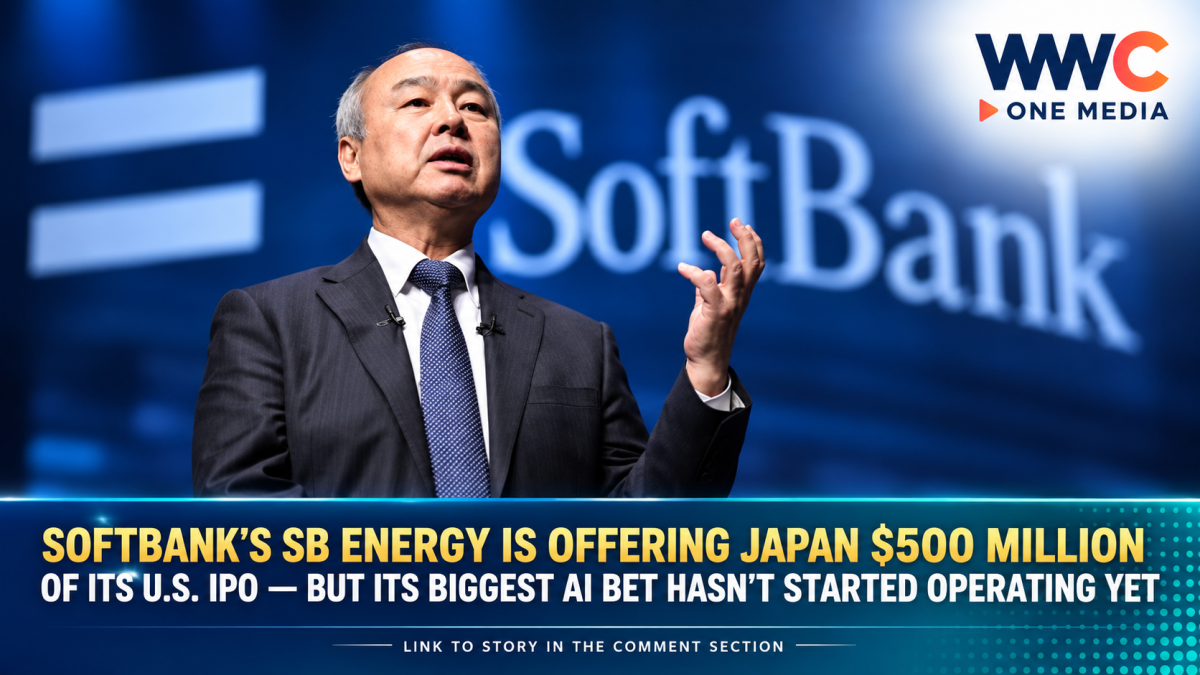
TOKYO — SoftBank-backed SB Energy is opening a potentially $500 million door for Japanese investors into one of the year’s most ambitious artificial-intelligence infrastructure bets — a company promising enormous future data-center revenue even though none of its planned data centers is operating yet.
SB Energy plans to issue up to $500 million in new shares to Japanese investors as part of its upcoming U.S. initial public offering, according to a filing disclosed Tuesday.
The company said proceeds from the Japanese share sale will be used for general corporate purposes, including developing data centers, electricity generation and associated infrastructure. The final size and pricing of the broader U.S. IPO have not yet been disclosed.
Reuters previously reported that SoftBank could seek a valuation of more than $50 billion for the company.
That would transform what began as a renewable-energy developer into one of the highest-profile public-market bets on an increasingly important question:
Who will build the enormous amount of power and physical infrastructure required for the AI boom?
This is no longer simply an energy company
SB Energy was founded in 2019 and built its business around large-scale renewable-energy projects, including solar generation and battery storage.
But its strategy has changed dramatically as artificial intelligence has created unprecedented demand for electricity, land, cooling systems and computing facilities.
In its prospectus, SB Energy describes itself as an integrated data-center and power-infrastructure company designed for the AI era.
The company currently has about 8.8 gigawatts of data-center capacity contracted or under construction, according to its IPO filing.
SoftBank and OpenAI are customers at three planned data-center campuses, while Nvidia has become both an investor and a strategically important partner.
That combination explains why the IPO is drawing far more attention than a conventional energy listing.
Investors are not simply buying into solar farms.
They are being asked to finance part of the physical foundation beneath the global AI industry.
Nvidia is putting $1.5 billion behind the company
SB Energy’s prospectus says chip giant Nvidia has committed $1.5 billion through a private placement at the IPO price.
OpenAI, meanwhile, has received warrants valued at roughly $5.5 billion, according to the prospectus.
The relationship goes well beyond financial backing.
In August, Nvidia formally announced a partnership with SB Energy surrounding the enormous PORTS-Pike Technology Campus in Pike County, Ohio.
The project is being designed to host Nvidia computing infrastructure, with OpenAI as the customer under a 20-year lease.
Nvidia said the initial deployment is designed for 4.25 gigawatts of IT capacity, with the opportunity to expand farther. SB Energy and SoftBank plan at least 10 gigawatts of new power generation to support up to 8 gigawatts of AI-computing capacity at the site.
The first phases are expected to come online beginning in 2028.
That date is critical to understanding both the potential and the risk.
The project’s enormous computing capacity may eventually generate vast revenue.
But investors buying shares today are largely betting on infrastructure that still has to be financed, permitted, built, powered and brought online.
A $439 billion backlog sounds enormous — because it is
SB Energy told investors it has a backlog worth roughly $439 billion.
At first glance, that figure helps explain why a valuation above $50 billion is even being discussed.
Long-term leases with AI companies offer the prospect of enormous future cash flows if the campuses are successfully completed.
But there is an important catch.
Much of that money is expected far into the future.
Wall Street Journal analysis of the IPO documents estimated that about 82% of the company’s anticipated revenue pipeline would not arrive for at least eight years.
The newspaper also noted that none of SB Energy’s three planned data centers was operational when the IPO filing was made.
That creates an unusual investment proposition.
The backlog is massive.
The immediate data-center revenue is not.
Revenue is growing — but losses are even bigger
SB Energy reported $138.7 million in revenue for the first six months of 2026, up 66.4% from $83.3 million during the same period a year earlier.
But its net loss widened dramatically to approximately $3.21 billion, compared with $215.5 million in the first half of 2025.
Those losses reflect, in part, the enormous capital requirements involved in turning the company into a global-scale AI infrastructure developer.
Data centers at this level require more than buildings.
They need power plants, substations, transmission infrastructure, cooling, fiber connectivity, financing, land and years of construction.
The company therefore faces a financial profile familiar to major infrastructure projects: spend enormous sums now in exchange for the possibility of long-term revenue later.
OpenAI is both the opportunity and one of the biggest risks
Perhaps the most important disclosure in SB Energy’s filing is its dependence on OpenAI.
The company says it is “substantially dependent” on the ChatGPT developer, which acts as both a tenant and an equity investor.
OpenAI and SoftBank are expected to provide much of SB Energy’s near-term data-center lease revenue.
That gives SB Energy something many young infrastructure companies would envy: long-term commitments from some of the world’s biggest technology names.
But concentration creates risk.
If OpenAI delays expansion, changes its infrastructure strategy or experiences financial difficulties, the effect could ripple through SB Energy’s construction plans and financing.
Reuters Breakingviews argued that the company’s dependence on OpenAI, SoftBank and related-party transactions warrants particular scrutiny, especially because so much of the promised revenue remains years away.
The Financial Times has raised a broader issue confronting the entire data-center boom: mega-projects routinely face delays, cost overruns, grid-connection problems, regulatory obstacles and local opposition.
SB Energy will have to prove it can avoid those problems at unprecedented scale.
Why Japanese investors matter
The decision to reserve up to $500 million of new shares for investors in Japan is also strategically significant.
SoftBank remains one of Japan’s most recognizable technology-investment groups, and founder Masayoshi Son has increasingly centered the company’s future around artificial intelligence.
Giving Japanese investors direct access to the SB Energy offering could allow SoftBank to tap domestic enthusiasm for globally prominent AI investments while broadening the shareholder base.
It would also follow a notable precedent.
According to Reuters, Japanese investors obtained approximately $2.2 billion worth of shares in SpaceX’s June IPO, demonstrating strong domestic demand for high-profile U.S. technology listings.
SB Energy’s Japanese allocation is smaller, but it potentially gives investors another way to participate in the AI boom without directly buying a model developer or semiconductor maker.
This time, the bet is on the electricity, buildings and infrastructure underneath the technology.
SB Energy plans a Nasdaq listing
SoftBank officially announced on September 2 that SB Energy had publicly filed its registration statement with the U.S. Securities and Exchange Commission.
The company has applied to trade on both the Nasdaq Global Select Market and Nasdaq Texas under the ticker symbol “SBE.”
SoftBank said the number of shares and price range had not yet been determined.
The underwriting group reflects the potential scale of the offering.
JPMorgan, Goldman Sachs, Morgan Stanley, Citigroup and Mizuho are among the joint lead book-running managers.
Reuters has previously reported that the listing could value SB Energy at more than $50 billion, although the final valuation will depend on pricing and investor demand.
Until the offering terms are formally set, that valuation should be treated as a target rather than an established market value.
The IPO arrives at a sensitive moment for AI stocks
Timing could become one of the most important variables.
AI infrastructure has attracted extraordinary amounts of capital as Microsoft, Meta, Google, Amazon, OpenAI and others race to secure computing capacity.
S&P Global Ratings estimates infrastructure spending by the world’s largest hyperscalers could exceed $1.3 trillion by 2027, according to Reuters.
But enthusiasm is increasingly being accompanied by harder questions.
How much AI computing capacity will ultimately be needed?
Can power grids support it?
Will current chip architectures still dominate when today’s data centers finally open?
And can operators generate enough revenue to justify the enormous capital being committed today?
The questions are especially relevant for SB Energy because many of its projects will not begin operating for years.
Technology can change much faster than power stations and data centers can be built.
That is what makes this IPO different
The simplest version of the story is that SB Energy wants to sell $500 million of shares to Japanese investors.
But that understates what investors are actually being offered.
They are being invited into a giant, long-duration wager involving SoftBank capital, Nvidia chips, OpenAI demand, massive power generation and data centers that could shape the next phase of artificial intelligence.
The opportunity is clear.
AI systems require enormous computing capacity.
Computing capacity requires enormous amounts of electricity.
And companies capable of delivering both power and data-center infrastructure could occupy one of the most valuable bottlenecks in the AI economy.
But the risks are equally clear.
SB Energy has billions of dollars in losses, no operating data centers yet, heavy reliance on a small number of powerful partners and hundreds of billions of dollars of projected business that must still be converted into functioning projects and actual cash flow.
That leaves Japanese investors facing a much bigger question than whether $500 million worth of shares will sell.
SB Energy already has SoftBank, Nvidia and OpenAI behind it. Now it must prove that hundreds of billions of dollars in AI promises can survive the hardest part of the story — actually building them.



Leave a Reply