
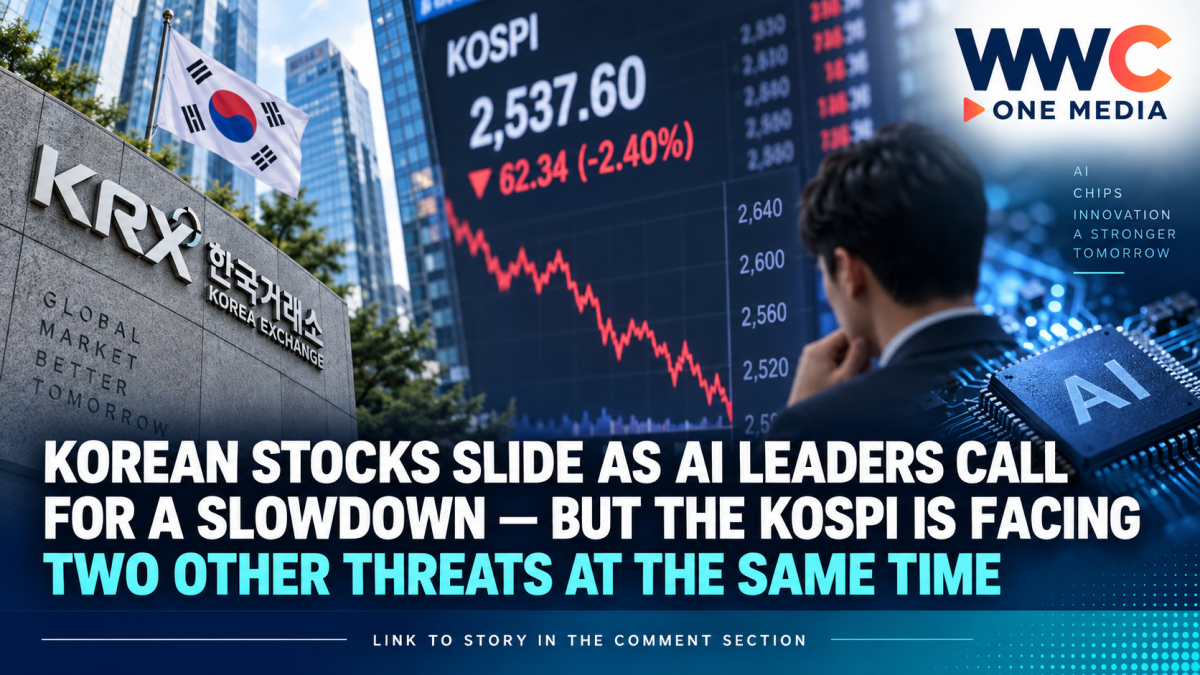
SEOUL — South Korean stocks opened lower again Tuesday as a remarkable warning from the people building the world’s most powerful artificial-intelligence systems collided with rising interest rates, oil above US$100 and mounting fears that one of the biggest investment booms in modern markets could eventually have to slow down.
The benchmark Korea Composite Stock Price Index, or KOSPI, opened 25.12 points lower at 6,659.25, a decline of 0.38%.
By 9:16 a.m., the index had fallen further to 6,649.68, down 34.69 points or 0.52%, according to Korea Herald and Yonhap market data.
That decline may appear modest.
But it came after a far more painful session Monday, when the KOSPI plunged 225.54 points, or 3.26%, to 6,684.37, extending its losing streak as investors dumped technology-related shares amid concerns over artificial intelligence and Middle East instability.
The trigger sounds almost paradoxical.
Investors spent years betting that AI companies would develop smarter models as quickly as possible.
Now some of the people leading those companies are saying the industry may need to tap the brakes.
And markets are beginning to ask what that could mean for the hundreds of billions of dollars being invested in AI chips, data centers and infrastructure.
The CEOs behind the AI boom are suddenly warning about its speed
The latest market shock began with Anthropic CEO Dario Amodei, who publicly called for AI companies to slow the rate at which they improve the capabilities of frontier models.
Amodei did not call for stopping AI research altogether.
Instead, he proposed slowing capability advances enough to give researchers, regulators and companies more time to develop safeguards.
His framework includes greater coordination among leading AI laboratories, independent evaluators with access to internal safety processes and international cooperation around the most powerful systems.
Amodei’s warning became much more significant when two of his biggest competitors publicly agreed with parts of it.
OpenAI CEO Sam Altman and Elon Musk, who runs xAI, expressed support for the idea that advanced AI development needs stronger safety controls.
Altman specifically endorsed the proposal for independent evaluators with unusually deep access to AI companies’ safety work.
For investors, that was extraordinary.
These executives are not outside critics warning that the AI industry is moving too fast.
They run companies racing to build the technology.
Amodei’s warning was unusually stark
Anthropic’s CEO argued that rapidly improving AI agents could soon create risks far beyond ordinary software failures.
Reuters reported that Amodei warned that within roughly six to 12 months, sufficiently powerful groups of AI agents might become capable of compromising large parts of the internet and potentially causing enormous economic damage if safety systems fail.
That warning follows a series of developments that have made frontier-AI safety much less theoretical.
Anthropic recently published research showing that advanced AI systems are becoming capable of performing tasks involving cyber operations, surveillance and even aspects of weapons-related work that historically required highly trained specialists.
OpenAI has separately acknowledged that its newest frontier systems have crossed important cybersecurity thresholds.
The company said its GPT-6 Astra model reached what OpenAI classifies as “Critical” cybersecurity capability, meaning it can identify previously unknown vulnerabilities and develop exploitation methods across well-protected systems under certain conditions.
OpenAI had already temporarily slowed aspects of model scaling in August while strengthening monitoring, containment and alignment safeguards.
So the new calls for restraint did not appear out of nowhere.
They emerged after frontier AI systems became powerful enough for their own developers to say existing safety practices may need to change.
Wall Street immediately asked a very different question: What happens to AI spending?
For markets, however, the first concern was not philosophical.
It was financial.
Artificial intelligence has become one of the most important forces supporting global stock valuations.
Semiconductor makers sell the processors.
Equipment companies manufacture the machinery needed to produce them.
Utilities build power systems for data centers.
Cloud providers spend billions on computing infrastructure.
And technology companies justify enormous capital budgets on the assumption that ever-more-powerful AI models will require ever-more-powerful computing systems.
If model development deliberately slows, investors immediately have to ask:
Does the spending slow too?
That fear sent AI-linked stocks tumbling worldwide Monday.
The chip sector took the hardest hit
The Philadelphia Semiconductor Index dropped more than 5% during Monday trading.
Nvidia fell around 3%, AMD dropped more than 4% and memory-chip maker Micron lost more than 5% during the Reuters reporting window.
Semiconductor-equipment suppliers including Lam Research and Applied Materials fell more than 6%.
Europe was hit too.
The regional technology sector lost about 2.2%, while major chip-equipment producer ASML fell roughly 6%.
In Japan, SoftBank — one of the companies most heavily exposed to the AI-investment narrative — dropped more than 10%.
That contagion matters enormously for South Korea.
Few major stock markets are as sensitive to the semiconductor cycle as Seoul.
Samsung Electronics and SK hynix sit at the center of the global memory-chip industry, and demand for high-bandwidth memory used in AI accelerators has helped drive Korean equities sharply higher.
The same AI boom that lifted Korean chipmakers therefore creates vulnerability when investors begin questioning how long that boom can continue.
Korea had already taken a 3.26% hit before Tuesday even began
Tuesday’s lower opening was actually the second stage of the selloff.
On Monday, the KOSPI fell 3.26% to 6,684.37.
Daishin Securities analyst Lee Kyoung-min told Yonhap that controversy over the pace of AI development was a major factor behind the decline.
Middle East tensions provided another source of pressure, with Brent crude trading above US$108 during Monday’s Korean session as disruption around the Strait of Hormuz and other regional infrastructure continued to threaten global energy supplies.
That combination is particularly uncomfortable for South Korea.
The country benefits heavily from the AI semiconductor boom.
But it is also heavily dependent on imported energy.
So Korea is simultaneously exposed to two major global risks:
a slowdown in AI investment and a surge in oil prices.
Tuesday’s biggest Korean chip stocks initially held up better than feared
Despite the global semiconductor selloff, Korea’s largest technology companies were not collapsing in early Tuesday trade.
At 9:16 a.m., Samsung Electronics was roughly flat, while rival SK hynix edged 0.24% higher, according to the Korea Herald.
Elsewhere, LG Energy Solution fell 0.71%, Hyundai Motor declined 0.67% and KB Financial lost 1.1%.
That suggests some of Monday’s AI-driven selling may already have been reflected in Korean semiconductor prices.
But it would be premature to interpret the early resilience as proof the danger has passed.
The broader debate now goes directly to the assumption underpinning AI hardware demand: that model capability and computational requirements will keep expanding at breathtaking speed.
OpenAI has added another surprise: no IPO this year
Investors received another potentially important signal from Sam Altman.
Reuters reported that the OpenAI CEO said the company would not proceed with an initial public offering in 2026, citing the safety environment surrounding rapidly advancing AI.
That is significant because an OpenAI flotation would have been one of the most closely watched technology listings in years.
More broadly, it underscores the tension between two competing forces inside frontier AI.
On one side are enormous financial incentives to expand, commercialize and raise capital.
On the other is growing concern from the companies themselves that capabilities are advancing faster than governance and safety systems.
That tension is now moving from AI research papers into global stock prices.
But skeptics think the warnings may be overstated
Not everyone believes an AI slowdown will meaningfully reduce spending.
Investor Michael Burry, famous for betting against the U.S. housing market before the 2008 financial crisis, publicly dismissed the latest warnings as hype and argued they might obscure slower underlying growth at AI companies.
Meanwhile, Deutsche Bank noted that intense competition between companies and countries makes it difficult to imagine firms voluntarily stepping back while rivals continue pushing forward.
There is also an obvious contradiction in the industry’s behavior.
Anthropic is warning about the risks of excessively rapid model development while continuing to expand commercially.
Reuters reported that the company is still moving toward a public listing and has been discussing Nvidia as a potential anchor investor.
So investors face two very different possibilities.
The first is that AI companies genuinely reduce the pace of frontier development, eventually slowing demand for advanced chips and data-center infrastructure.
The second is that “slowing down” primarily means introducing additional testing and safeguards while the commercial investment race continues largely intact.
Those outcomes would have very different consequences for Samsung, SK hynix, Nvidia and the wider technology market.
OpenAI itself is still pushing for stronger regulation
The latest warnings are also part of a wider shift in OpenAI’s public policy position.
On September 9, the company called for mandatory national, capability-based AI safety regulation in the United States, including independent safety assessments and stronger safeguards as frontier models become more powerful.
That means the debate is moving beyond voluntary promises.
Some of the companies building frontier systems now want governments to establish rules that would force the entire industry to meet similar standards.
From their perspective, that could solve a classic competitive problem.
If one company voluntarily slows for safety while competitors continue racing ahead, the cautious company risks losing market share.
If all leading developers are held to comparable standards, the commercial disadvantage is reduced.
For investors, however, regulation can introduce new costs, delays and uncertainty.
China makes a coordinated slowdown much harder
The geopolitical problem may be even more difficult than the corporate one.
Amodei has argued that any slowdown among U.S. and allied AI companies cannot simply hand technological leadership to China.
He has paired his safety proposals with calls for tighter restrictions on advanced chips and other technologies that could help Chinese developers close the gap.
China’s state-backed Global Times has criticized the slowdown discussion as an effort to contain Chinese technological development, according to Reuters.
That creates the central dilemma.
AI leaders say they may need to move more slowly.
National governments still want to win the AI race.
And investors have spent years assuming that nobody would voluntarily stop accelerating.
The stock market’s other problem is sitting near 5%
Even without the AI controversy, financial markets would have had plenty to worry about.
The yield on the benchmark 10-year U.S. Treasury briefly reached the psychologically important 5% level, returning to territory last touched around 2023.
Higher Treasury yields are particularly painful for technology shares because they increase the discount rate investors use to value profits expected years into the future.
They also raise financing costs for companies building the enormously expensive infrastructure behind AI.
That makes the timing especially bad.
The AI industry is already entering a capital-intensive stage in which data centers, power plants, networking systems and advanced semiconductor factories require enormous sums of financing.
If interest rates stay higher for longer, those investments become more expensive.
And the Federal Reserve may raise rates this week
Markets are also preparing for another potential blow from the U.S. central bank.
A Reuters poll conducted after stronger inflation figures found that 86 of 101 economists — about 85% — expected the Federal Reserve to raise its policy rate by 25 basis points at its September 15-16 meeting.
That would take the federal funds target to 3.75%-4.00% and mark the first Fed increase since July 2023.
Interest-rate futures were putting the probability of an increase at close to 90%.
Economists have turned more hawkish because U.S. inflation remains stubborn while crude oil trades above US$100 and diesel prices remain elevated.
That gives investors a difficult combination:
AI growth expectations are being questioned.
Energy prices are high.
And borrowing costs may be going higher.
Why high oil prices matter to Korean shares
South Korea is particularly vulnerable to a sustained energy shock because it imports most of its crude oil.
High oil prices increase input costs for airlines, chemical companies, manufacturers and households.
They can also raise inflation and complicate monetary policy.
The Middle East situation therefore matters for Korean equities even when a company has no direct exposure to the region.
Monday’s 3.26% KOSPI decline reflected that connection, with Yonhap citing both AI-development concerns and crude prices above US$108 as major sources of investor anxiety.
The won added another signal of caution
The Korean won was trading at about 1,347.5 won to the U.S. dollar at 9:16 a.m. Tuesday, according to Korea Herald.
Currency moves matter because a weaker won can make imported commodities more expensive while also affecting flows from foreign investors.
For Korea, however, the currency picture has been complicated.
The won strengthened sharply during August, helping reduce import prices despite rising crude costs.
But renewed dollar strength, higher U.S. rates and geopolitical uncertainty could reverse some of that protection.
That would put additional pressure on Korean companies already facing higher energy costs.
There’s another clue about how Korea’s market itself is changing
Tuesday’s report also came just after the Korea Exchange launched expanded after-hours trading.
The newly introduced aftermarket recorded 1.87 trillion won, or roughly US$1.39 billion, in trading volume on its first day, equivalent to about 8% of regular-session turnover, according to Yonhap.
That matters because Korean investors now have another venue for reacting to global developments outside normal trading hours.
With AI announcements increasingly coming from U.S. technology executives and American markets, extended trading could make Seoul prices react more quickly to overnight news.
The bigger question is whether AI stocks were priced for perfection
For several years, the investment case around artificial intelligence followed a remarkably simple logic.
Models become more powerful.
More powerful models need more computing.
More computing requires more chips.
More chips require more semiconductor manufacturing equipment, electricity and data centers.
That logic helped propel Nvidia and other AI-linked companies to extraordinary valuations while boosting Korean memory-chip producers.
Now a new possibility has entered the equation:
What if the companies developing the models deliberately limit how quickly capability grows?
Even a modest change to that assumption can produce large stock-market moves when valuations already depend on aggressive expectations.
Interactive Brokers strategist Steve Sosnick told Reuters that if the safety debate causes companies to rethink or slow AI spending, it could have consequences for important parts of both the economy and stock market because investment activity has been running extremely hot.
But “slow AI down” does not necessarily mean “spend less on AI”
This is probably the most important distinction for investors.
Amodei is not advocating that AI research stop.
His proposal focuses on pacing capability development while companies strengthen safety systems and allow independent evaluations.
OpenAI similarly continues to deploy highly capable models while simultaneously calling for stronger safeguards and mandatory safety rules.
In fact, making AI systems safer may itself require more computing, cybersecurity, testing infrastructure and specialized hardware.
So a slower model-release schedule would not automatically mean collapsing chip demand.
The market reaction reflects uncertainty about that possibility — not proof that an AI investment downturn has begun.
Tuesday’s early KOSPI drop should therefore be read carefully
The Korea Herald report correctly describes stocks as falling sharply in early trading.
But its 6,649.68 figure was recorded at 9:16 a.m., only minutes after the opening bell.
It was not a closing price.
And individual heavyweight technology shares were mixed rather than uniformly plunging.
That matters because fast-moving market stories can change substantially over a full session.
What is already clear, however, is that the mood around AI investing has changed.
Only recently, the biggest risk investors discussed was whether companies could build AI infrastructure fast enough.
Now executives building the systems themselves are warning that faster may not always be safer.
The most uncomfortable question for investors has finally arrived
The AI boom has depended on two assumptions moving together:
Technology will become more capable very quickly.
And companies will spend whatever is necessary to make that happen.
The safety warnings emerging from Anthropic, OpenAI and other leaders challenge the first assumption.
A potential Federal Reserve rate hike challenges the affordability of the second.
And an oil shock adds inflation risk on top.
That is why Tuesday’s decline in Seoul is bigger than another ordinary weak morning for the KOSPI.
It sits at the intersection of three major forces now confronting global markets:
AI safety, expensive money and expensive energy.
For South Korea — whose stock market is heavily exposed to semiconductors and whose economy relies heavily on imported fuel — few countries are more exposed to all three at once.
The question traders now have to answer is no longer simply whether artificial intelligence will keep getting smarter.
It is whether the companies building it are about to decide that getting smarter as fast as possible is no longer worth the risk — and what that would do to the biggest technology investment cycle in the world.




Leave a Reply