WASHINGTON, D.C. — October 31, 2026
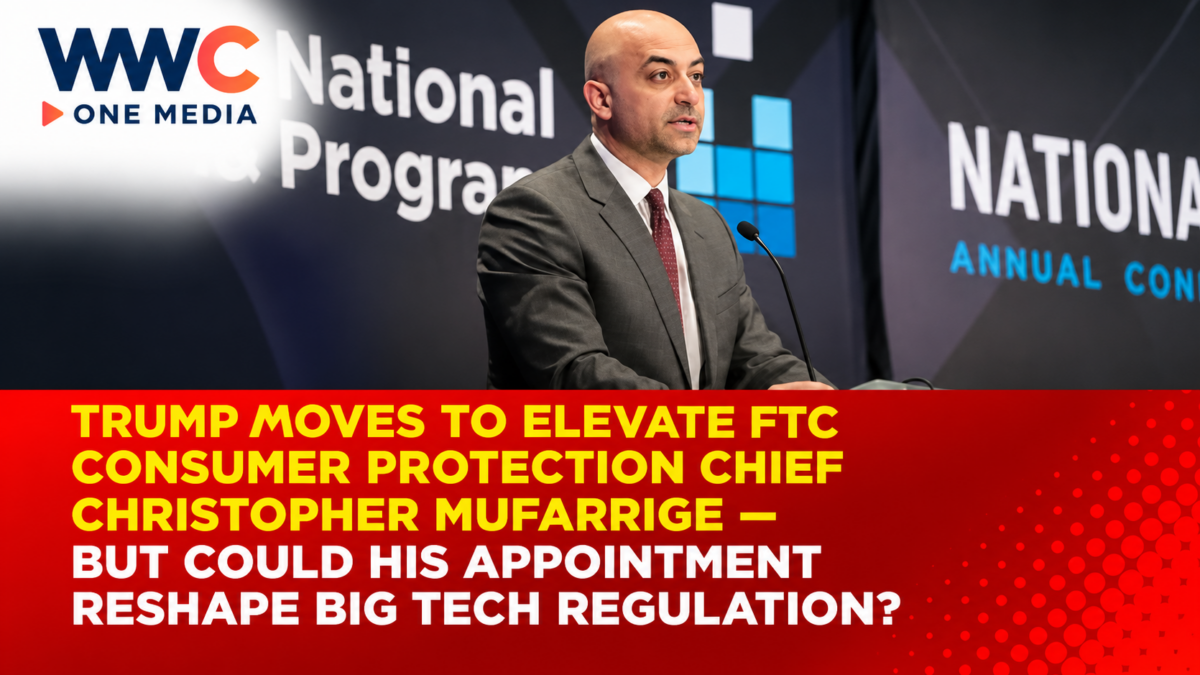
President Donald Trump’s administration is preparing another significant change at one of America’s most powerful regulatory agencies, with the White House reportedly planning to nominate consumer protection official Christopher Mufarrige to a vacant seat on the Federal Trade Commission (FTC).
The potential appointment could strengthen the administration’s influence over an agency responsible for policing corporate misconduct, preventing deceptive business practices and enforcing federal competition laws.
According to Bloomberg’s October 30 report, citing people familiar with the administration’s plans, Mufarrige is being considered for a Republican commissioner position on the five-member FTC.
He currently heads the agency’s Bureau of Consumer Protection, where he oversees work involving online fraud, misleading advertising, unfair billing practices, financial scams and consumer privacy.
If formally nominated and confirmed by the US Senate, he would serve alongside FTC Chairman Andrew Ferguson and Commissioner Mark Meador.
The reported decision follows the withdrawal of an earlier nominee and comes during a period of controversy over the FTC’s leadership, independence and enforcement priorities.
For technology giants, financial institutions, retailers and digital platforms, the possible appointment raises an important question:
Will Mufarrige’s elevation bring tougher action against online scams and deceptive business practices — or further strengthen the Trump administration’s control over America’s competition watchdog?
White House Plans to Fill Vacant FTC Commissioner Seat
Bloomberg reported that the White House is preparing to nominate Mufarrige to one of the FTC’s vacant commissioner positions.
The administration previously nominated WeatherTech chief executive David MacNeil in January 2026, but MacNeil subsequently withdrew from consideration.
Mufarrige has emerged as the administration’s reported new choice for the Republican vacancy.
However, no formal presidential announcement had been confirmed in the reporting reviewed as of October 31.
A White House official emphasized that personnel decisions are not final until publicly announced by the president.
Mufarrige declined to comment on the reported plans.
If the nomination proceeds, it would need Senate confirmation before Mufarrige could assume the commissioner position.
The distinction between leading an FTC bureau and serving as a commissioner is important.
As bureau director, Mufarrige supervises staff and consumer protection enforcement operations.
As a commissioner, he would have a direct vote on agency decisions, including enforcement matters, competition policy and proposed regulatory measures.
That would significantly expand his authority within the agency.
Who Is Christopher Mufarrige?
Christopher Mufarrige is a consumer protection attorney with experience in financial regulation, federal enforcement and government policy.
In February 2025, FTC Chairman Andrew Ferguson appointed him director of the Bureau of Consumer Protection.
Before that appointment, Mufarrige worked as chief of staff and attorney adviser to former FTC Commissioner Melissa Holyoak.
He also served during Trump’s first administration as a senior adviser at the Consumer Financial Protection Bureau (CFPB).
His responsibilities there included advising senior officials on enforcement matters, rulemaking and examinations involving major banks and nonbank financial institutions.
Mufarrige previously worked in private legal practice and as an in-house attorney.
He also taught financial services and consumer protection at George Mason University’s Antonin Scalia Law School.
According to his official FTC biography, Mufarrige earned his law degree from George Mason University, a master’s degree in economics from the same institution and a bachelor’s degree in economics from Texas Christian University.
His professional background combines consumer financial regulation with the legal and economic issues surrounding market conduct.
That experience makes him a potentially influential figure in determining how the FTC approaches deceptive advertising, unfair commercial practices and technology-related consumer protection.
FTC Leadership Has Become Increasingly Controversial
Mufarrige’s possible promotion comes as the FTC continues operating with fewer commissioners than its statutory structure provides.
The commission is designed to have five members, with no more than three belonging to the same political party.
Historically, that structure has incorporated both Republican and Democratic perspectives into major enforcement and policy decisions.
However, the agency has been operating with only two sitting Republican commissioners: Chairman Ferguson and Mark Meador.
Trump’s removal of two Democratic commissioners in 2025 became part of a broader dispute over presidential power and the independence of federal regulatory bodies.
The controversy raised questions about the ability of independent commissions to operate without direct political pressure.
Under the current arrangement, a disagreement between Ferguson and Meador can produce a deadlock.
A third Republican commissioner could reduce that risk by creating a two-to-one majority on matters where the commissioners disagree.
But such a change would not restore the FTC’s traditional bipartisan membership.
For critics, that creates concerns about the agency’s political balance.
For supporters of the administration, additional commissioners could improve decision-making and reduce delays in enforcement proceedings.
The central issue is whether a more unified commission will translate into stronger consumer protection, different regulatory priorities or greater executive influence.
Why the FTC Matters to Facebook, Google, Amazon and Other Technology Giants
The Federal Trade Commission is one of the US government’s principal agencies responsible for protecting consumers and promoting competition.
Its enforcement authority covers a wide range of industries, including technology, retail, healthcare, financial services and online advertising.
The FTC can investigate deceptive practices, challenge certain anticompetitive conduct and pursue enforcement actions within its statutory authority.
For technology companies, FTC decisions can influence how platforms operate, collect information, advertise products and compete with other businesses.
The commission has historically played an important role in disputes involving major digital platforms, mergers and data privacy.
Mufarrige’s background in consumer protection suggests that online deception, misleading advertising and fraud could remain important priorities if he becomes a commissioner.
However, the exact competition policies he would support as a voting commissioner cannot be established solely from his current responsibilities.
Regulatory decisions would also depend on the facts of individual cases and applicable law.
Online Scams Have Become a Major FTC Priority
One of the most significant issues under Mufarrige’s leadership has been the growth of online scams.
Fraudsters increasingly use social media, search advertising and digital marketplaces to target consumers.
In September 2026, Mufarrige and FTC Chairman Ferguson publicly urged major technology platforms to take greater responsibility for addressing scams that reach consumers through their services.
The agency has expressed particular concern about impersonation fraud, where criminals pretend to represent legitimate companies, government agencies or trusted individuals.
According to FTC data cited in Mufarrige’s September 29 speech, Americans reported nearly $3.5 billion in losses involving impersonation scams during 2025.
The true financial impact could be considerably larger because many victims do not report incidents.
Mufarrige has argued that enforcement should examine not only the criminals behind fraudulent schemes but also the digital systems that can facilitate their activities.
That approach could have consequences for advertising platforms and online businesses that profit from commercial listings.
However, the FTC must establish a legally supportable basis before holding any company responsible for violations.
The presence of fraudulent advertisements on a platform does not automatically establish that the platform itself violated federal law.
Could Meta, Google and Other Platforms Face Greater Scrutiny?
The FTC’s focus on online fraud creates potential regulatory exposure for companies operating major digital advertising networks.
Platforms such as Facebook, Instagram, Google and other online services provide advertising tools used by millions of legitimate businesses.
But criminals can also attempt to exploit advertising systems to distribute deceptive promotions, impersonate trusted organizations or obtain sensitive information.
Mufarrige has publicly emphasized the importance of examining how major platforms respond to these risks.
In a September 2026 speech, he discussed the possibility of updating federal rules related to impersonation scams to address the role of digital marketplaces.
Such a development could increase expectations surrounding advertiser verification, fraud detection and complaint handling.
However, the FTC has not established that every large technology platform is legally responsible for every fraudulent advertisement appearing on its services.
New rules would also require appropriate administrative and legal procedures.
The broader pressure on technology companies is already visible internationally.
WWC ONE MEDIA recently examined the issue in Meta Faces EU and UK Antitrust Showdown Over New AI Content Rules — But Could Regulators Block Its October 30 Deadline?.
That report explored complaints concerning Meta’s commercial terms, artificial intelligence and the rights of digital publishers.
Although the European proceedings are separate from the FTC’s work, both demonstrate how regulators are increasingly examining the commercial power and responsibilities of major technology platforms.
Consumer Protection Enforcement Has Already Targeted Major Companies
Mufarrige’s tenure has included enforcement involving businesses accused of misleading consumers.
The FTC has pursued matters involving subscription practices, pricing disclosures, online purchases and financial transactions.
A July 2026 Guardian investigation reported that the agency had reached settlements involving companies such as Amazon, StubHub, Instacart and Shutterstock over alleged deceptive commercial practices.
These matters involve different legal claims and should not be treated as evidence of identical wrongdoing.
They nevertheless illustrate the breadth of the agency’s consumer protection mandate.
One recurring enforcement issue concerns subscription services.
Consumers may be offered attractive introductory prices but later encounter unexpected charges or complicated cancellation processes.
The FTC has also examined potentially misleading ticket fees and commercial practices that obscure the true cost of goods and services.
The underlying regulatory principle is that businesses should provide truthful information and avoid unlawful conduct that harms consumers.
Mufarrige has presented his enforcement philosophy as one focused on consumer choice, truthful markets and legal accountability.
Retail Pricing Technology Could Become Another Regulatory Flashpoint
The FTC’s consumer protection responsibilities extend beyond online scams.
The agency has also examined how emerging retail technologies might influence prices and consumer information.
Digital shelf labels, algorithmic pricing systems and personalized marketing have created new questions about transparency.
These technologies can improve efficiency and reduce pricing errors.
But they can also raise concerns when businesses collect extensive consumer data or use information in ways customers do not understand.
WWC ONE MEDIA previously covered these developments in Walmart Turns Digital Shelf Labels Into Light-Up Shopping Guides as Retail Tech Race Accelerates.
The report examined Walmart’s use of digital shelf technology and the regulatory debate surrounding personalized pricing.
It also distinguished the ability to update prices electronically from the separate practice of using individual consumer data to set personalized prices.
For the FTC, such distinctions are important.
New technology is not automatically deceptive or unlawful.
The legal question is whether a company’s actual conduct violates consumer protection or competition laws.
A commissioner with Mufarrige’s background could influence how the agency evaluates these evolving commercial practices.
AI Partnerships and Mergers Remain a Major Competition Issue
Beyond consumer fraud, the FTC also plays an important role in US antitrust enforcement.
The technology industry’s rapid expansion has created increasingly complex relationships involving artificial intelligence developers, cloud service providers, semiconductor companies and major investors.
Some partnerships involve large equity investments.
Others include intellectual property licensing, exclusive computing arrangements or the recruitment of specialized personnel.
Such transactions can raise questions about competition, market access and control over strategically important technologies.
WWC ONE MEDIA examined a related issue in Nvidia’s Reported $17B Groq Deal Is Under DOJ Scrutiny — But the Bigger Question Is Whether It Was Really an Acquisition.
That report concerned a Justice Department investigation rather than an FTC enforcement decision.
It nevertheless highlights how US competition authorities are examining unconventional business arrangements in the AI sector.
If confirmed as a commissioner, Mufarrige could participate in future FTC decisions involving mergers, competitive practices and technology markets.
His precise approach to these issues remains to be established.
Mufarrige Has Signaled a Different Approach From the Biden-Era FTC
The FTC’s current leadership has criticized aspects of the agency’s regulatory approach under former Chair Lina Khan.
During the Biden administration, the FTC became known for ambitious competition enforcement and efforts to challenge the market power of major technology corporations.
The Trump administration has emphasized a different approach, placing greater focus on selected consumer fraud issues and criticizing regulatory policies it considers excessively expansive.
In a March 2026 interview with Recorded Future News, Mufarrige described an approach that focused on enforcing existing consumer protection laws rather than using regulation to restructure entire markets.
That distinction does not mean the agency intends to abandon enforcement against large businesses.
Indeed, the FTC has continued pursuing cases involving major corporations.
However, it suggests a different philosophy concerning when government intervention is appropriate.
Mufarrige’s possible elevation could therefore strengthen the influence of officials who favor a narrower interpretation of some regulatory powers while remaining willing to pursue fraud and deceptive conduct.
Whether that produces more aggressive or less aggressive enforcement overall will depend on the specific legal issues involved.
Children’s Online Safety Could Remain a Priority
Mufarrige has also identified children’s online privacy and safety as important consumer protection concerns.
The increasing use of smartphones, social media and artificial intelligence has created new questions about how young people interact with digital services.
Regulators are examining age verification, the handling of children’s personal information and potentially harmful online commercial practices.
The Children’s Online Privacy Protection Act and related FTC rules provide important safeguards for certain data collection practices involving children.
The agency’s work in this area intersects with a broader debate over how governments should regulate rapidly advancing technology.
WWC ONE MEDIA explored that debate in Frances Haugen Warns AI Self-Regulation Will Fail Unless Big Tech Accepts Real Independent Oversight.
The report examined concerns that technology companies cannot rely entirely on voluntary commitments to address risks arising from artificial intelligence.
Although Haugen’s comments concern a broader set of technology governance issues, they provide context for the growing demand for independent oversight.
If Mufarrige joins the FTC commission, children’s online safety and consumer privacy could remain prominent subjects in his work.
Could the Nomination Change the FTC’s Independence?
The reported nomination comes amid continuing debate about the legal status of independent federal agencies.
The FTC was established as a multimember commission with staggered terms and statutory limits on partisan representation.
These features were intended to provide continuity and reduce the possibility that regulatory policy would change entirely with every presidential administration.
However, the removal of Democratic commissioners and disputes over presidential authority have raised questions about the independence of such agencies.
The legal controversy involves the relationship between executive power and statutory protections governing commissioner removal.
Critics argue that a commission composed only of members aligned with the president could weaken bipartisan oversight.
Supporters contend that elected administrations should have meaningful authority over the executive branch’s regulatory priorities.
Mufarrige’s nomination would not, by itself, settle that constitutional debate.
But it could have practical consequences for the commission’s voting balance and the direction of future regulatory policy.
What Would Senate Confirmation Involve?
A presidential nomination is only one step in appointing an FTC commissioner.
The White House would first need to formally submit Mufarrige’s nomination.
The Senate Commerce, Science, and Transportation Committee could then evaluate his qualifications, legal views and approach to enforcement.
Senators may question nominees about antitrust policy, consumer fraud, data privacy, artificial intelligence and the independence of federal regulatory agencies.
The committee could subsequently vote on whether to advance the nomination.
Final confirmation would require Senate approval.
No confirmed hearing date or vote schedule has been established for Mufarrige’s potential nomination.
Until the formal process takes place, he remains director of the Bureau of Consumer Protection rather than a voting FTC commissioner.
What the Appointment Could Mean for Businesses and Consumers
For American businesses, an additional FTC commissioner could affect the speed and outcome of certain agency decisions.
Companies involved in mergers, digital advertising, retail, online subscriptions and financial services may pay particular attention to the FTC’s leadership.
A three-member Republican commission could reduce the risk of evenly divided votes between the existing two commissioners.
However, that does not mean every future decision would be unanimous.
Commissioners may disagree about legal interpretation, evidentiary standards or enforcement priorities even when they belong to the same political party.
For consumers, the more immediate question is whether the agency will be able to deter scams, improve commercial transparency and obtain remedies when businesses violate the law.
An effective consumer protection system depends on more than commission membership.
Staffing, resources, legal authority, investigative capabilities and cooperation with other enforcement agencies also matter.
The FTC has faced scrutiny over workforce reductions and institutional capacity.
Those challenges could continue regardless of whether Mufarrige receives Senate confirmation.
Why the Philippines and Asian Digital Businesses Should Pay Attention
Although the Federal Trade Commission primarily enforces US law, its decisions can influence business practices across international markets.
Global companies frequently operate digital advertising, payment and subscription services in multiple jurisdictions.
When major technology platforms adjust their practices in response to US enforcement, similar changes may eventually affect services used elsewhere.
For Philippine businesses relying on Facebook, Instagram, Google and online marketplaces, developments involving advertising transparency and fraud prevention are particularly relevant.
The rise of impersonation scams and misleading promotions is a cross-border challenge.
However, a future FTC appointment would not automatically change Philippine law or create new legal obligations for every business operating in Asia.
Any international consequences would depend on specific regulatory actions and how companies choose to implement them.
The Bigger Question: Will the FTC Become More Aggressive or More Politically Aligned?
Christopher Mufarrige’s potential appointment represents more than an ordinary personnel change.
It could elevate an official with direct experience in consumer enforcement to a position where he can vote on the FTC’s broader policy direction.
His record suggests a strong interest in combating fraud, addressing deceptive marketing and protecting consumers from unlawful business practices.
His public comments also indicate skepticism toward regulatory approaches that go beyond what he considers the agency’s proper legal mandate.
Those positions could shape future decisions involving online platforms and commercial conduct.
But the eventual outcome remains uncertain.
The White House has not formally finalized the nomination, and Senate confirmation would be required.
Even if appointed, Mufarrige would operate within the commission’s statutory powers and applicable judicial constraints.
The Bottom Line
The White House’s reported plan to nominate Christopher Mufarrige to the Federal Trade Commission could strengthen President Trump’s influence over US consumer protection and competition policy.
Mufarrige already leads the FTC’s Bureau of Consumer Protection and has experience involving financial regulation, fraud enforcement, deceptive advertising and online safety.
If confirmed, he would become a third Republican commissioner alongside Chairman Andrew Ferguson and Commissioner Mark Meador.
The appointment could reduce voting deadlocks while raising renewed questions about the agency’s partisan composition and independence.
As Washington weighs another major regulatory appointment, the critical question is whether Mufarrige’s elevation will deliver stronger protection against digital fraud — or accelerate a broader transformation of how the US government regulates Big Tech and corporate America.