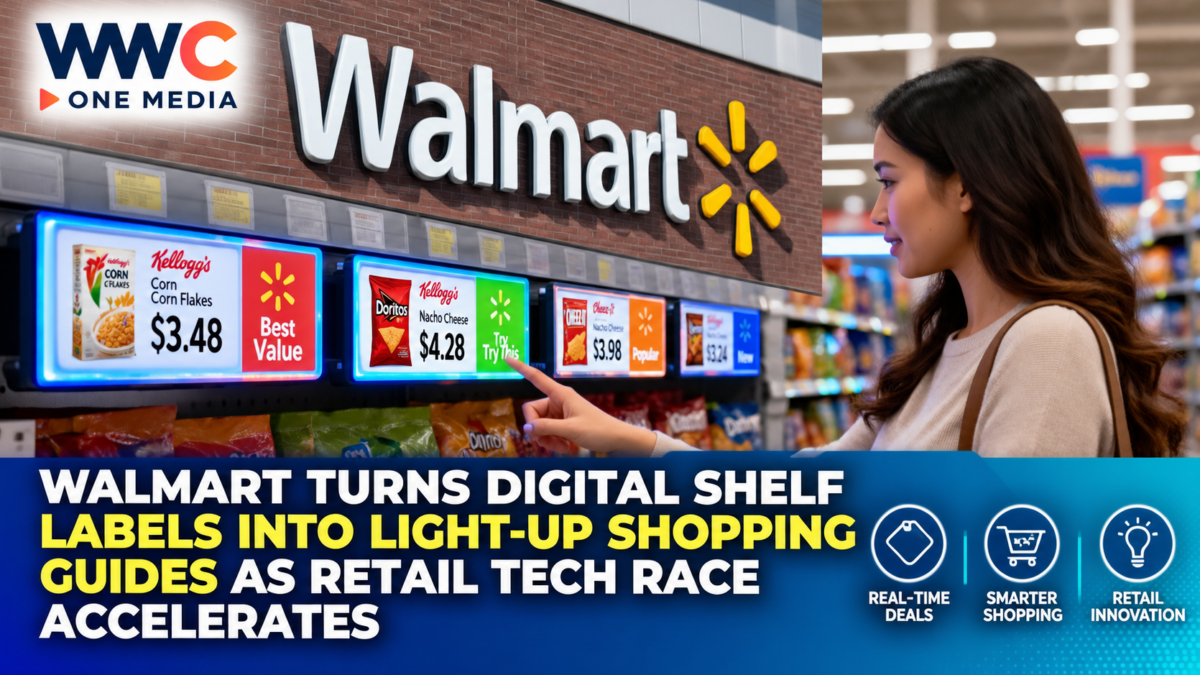
BENTONVILLE — Walmart is turning one of the most ordinary objects inside a supermarket into a digital navigation system, rolling out light-up shelf labels that can guide shoppers directly to products while helping employees restock shelves and fulfill online orders faster.
The retailer’s new Shop to Light feature lets customers search for an item inside the Walmart app, walk to the correct aisle and activate a flashing LED on the digital shelf label beneath the product.
Instead of scanning through dozens of nearly identical jars, boxes or bottles, the customer can simply look for the blinking light.
Walmart says shoppers have already triggered the feature roughly 5 million times since a limited rollout began this summer.
And the same shelf-label technology is doing more than helping customers find peanut butter.
Walmart employees are also using related tools called:
Pick to Light
and
Stock to Light
to locate merchandise more quickly when fulfilling online orders or replenishing shelves.
The retailer says all three tools are expected to reach stores companywide before the holiday shopping season.
THE SHELF LABEL IS BECOMING MORE THAN A PRICE TAG
Digital shelf labels originally replaced traditional paper price tags.
Each label contains a small electronic display showing the product’s price.
Walmart can update approved prices electronically instead of sending employees through aisles manually replacing thousands of pieces of paper.
But the company has now added another function.
The labels contain LED lights.
Those LEDs can flash when a shopper or employee is looking for a particular product.
That turns a basic price display into a physical navigation system inside one of the world’s largest retail networks.
HERE’S HOW “SHOP TO LIGHT” WORKS
Imagine a shopper needs a particular jar of peanut butter.
The shelf might contain:
Different brands
Different sizes
Crunchy and smooth varieties
Low-sugar versions
and
Organic products.
Finding one exact item can take time.
Under Shop to Light, the customer searches for the product inside the Walmart app.
The app guides the shopper toward the correct aisle.
Once there, the shopper activates the feature.
The digital shelf label directly beneath the selected product starts flashing.
That lets the customer identify the item almost immediately.
SPICES MAY BE ONE OF THE BEST EXAMPLES
Walmart itself points to the spice aisle as an obvious use case.
A typical spice section may contain dozens—or hundreds—of similarly shaped jars arranged closely together.
Finding:
Cumin
Paprika
Coriander
or
A specific spice brand
can take longer than expected.
A flashing shelf label removes much of that visual searching.
The feature may sound simple.
That simplicity is exactly the point.
Walmart says the best retail technology often eliminates small frustrations rather than dramatically changing how people shop.
SHOP TO LIGHT HAS ALREADY BEEN USED ABOUT 5 MILLION TIMES
The early usage numbers suggest customers are actually using the tool.
Since Walmart started expanding Shop to Light this summer, shoppers have triggered approximately:
5 million shelf-label flashes.
Greg Cathey, Walmart’s senior vice president of digital transformation, told CNBC that both customers and employees had been asking for this type of functionality.
The underlying goal is time.
Walmart wants shoppers spending less time searching.
And it wants employees spending less time walking through aisles looking for products.
EMPLOYEES GET “PICK TO LIGHT”
The same technology is particularly important for Walmart’s rapidly growing pickup and delivery business.
Employees filling online orders may need to collect dozens of different products for several customers at once.
Every second spent searching matters.
With Pick to Light, the Walmart employee’s device can activate the LED below the item needed for the order.
The employee sees the flashing label, grabs the product and moves on.
Multiply that time saving across:
Thousands of employees
Thousands of stores
and
Millions of online orders
and even a few seconds per item can become a significant operational improvement.
STOCK TO LIGHT HELPS RESTOCKING
The third tool, Stock to Light, applies the same concept in reverse.
Employees bringing merchandise onto the sales floor can activate shelf LEDs to identify where products belong.
That is particularly helpful when packaging looks similar.
Without guidance, an associate may have to:
read labels,
check aisle-location numbers,
compare nearby products
or repeatedly consult a handheld device.
The LED provides a direct visual signal.
Walmart says the system reduces backtracking and helps get merchandise onto shelves faster.
WALMART STORES CAN CARRY MORE THAN 120,000 PRODUCTS
Scale is what makes the technology interesting.
Walmart previously said a typical store can carry more than:
120,000 different products.
Every product requires:
a shelf location,
a price,
inventory tracking
and sometimes repeated replenishment throughout the day.
Thousands of prices can also change each week because of:
Rollbacks
Markdowns
New inventory
Seasonality
and
Cost changes.
At that scale, small operational inefficiencies become expensive.
PRICE CHANGES THAT TOOK TWO DAYS CAN NOW TAKE MINUTES
When Walmart first began expanding digital shelf labels, one of the biggest promised benefits was labor savings.
Previously, employees physically printed and replaced paper shelf tags.
Walmart said a large batch of price changes could take associates roughly:
two days
to complete manually.
With digital shelf labels, the same work can potentially be completed in:
minutes.
That does not mean prices automatically change themselves.
Walmart says an employee still reviews and approves price changes through its centralized pricing system.
But the physical task of walking aisle by aisle replacing paper disappears.
DIGITAL LABELS HAVE ALREADY SPREAD ACROSS MOST WALMART STORES
Walmart initially announced in 2024 that it planned to expand digital shelf labels to 2,300 U.S. stores by 2026.
Earlier this year, roughly 2,300 locations were already using them.
The rollout has since accelerated.
By October, digital labels had reportedly reached more than 4,300 Walmart locations.
That puts the technology inside most of the retailer’s U.S. store network.
The next step is using those labels for more than displaying prices.
THE TIMING IS IMPORTANT: HOLIDAY SHOPPING IS COMING
Walmart wants the light-up tools broadly deployed before the holiday season.
That is strategically important.
Holiday shopping creates some of the heaviest store traffic of the year.
Customers are looking for:
Food
Gifts
Toys
Electronics
Decorations
and seasonal products.
At the same time, Walmart employees are fulfilling an enormous number of:
Pickup orders
Delivery orders
and
Restocking tasks.
Anything that reduces search time can become particularly valuable during November and December.
BUT DIGITAL PRICE TAGS HAVE CREATED A DIFFERENT FEAR
The rapid adoption of digital shelf labels has generated consumer concerns.
If a retailer can change thousands of prices almost instantly, some shoppers worry companies could use the technology for:
Surge pricing
Time-of-day pricing
or
Personalized pricing.
That would mean prices potentially changing depending on demand—or even depending on who the customer is.
The debate has intensified as artificial intelligence and customer-data analytics become more sophisticated.
WALMART SAYS IT DOES NOT DO THAT
Walmart has responded unusually directly.
The company says:
all customers inside a store see the same price.
Its shelf labels do not contain:
Cameras
Microphones
or
Facial-recognition technology.
They do not identify shoppers.
They do not collect customer information.
And Walmart says the labels themselves do not decide when prices rise or fall.
They simply display prices already approved through the retailer’s centralized pricing process.
CEO JOHN FURNER: “WE PRICE THE PRODUCT, NOT THE PERSON”
Walmart CEO John Furner recently addressed those concerns in a letter to customers.
His message was direct:
“We price the product, not the person.”
Walmart says it will not use information such as:
A shopper’s income
Purchase history
or
Perceived willingness to pay
to determine what that person is charged.
The company says doing so would conflict with its longstanding Every Day Low Price strategy.
WALMART SAYS PRICE CHANGES USUALLY HAPPEN OUTSIDE SHOPPING HOURS
Another safeguard the company emphasizes is timing.
Walmart says approved digital shelf-label price changes are generally made outside normal shopping hours.
The goal is to keep prices stable while customers are inside the store.
That means a shopper should not see a price change simply because:
the store becomes crowded,
demand suddenly increases,
or someone else stands in front of the product.
Walmart says the same shelf price is displayed for everyone inside a given location.
THE FTC IS WATCHING PERSONALIZED PRICING ACROSS RETAIL
The issue extends beyond Walmart.
The U.S. Federal Trade Commission has proposed requiring companies to provide clearer disclosure when they use personal information to customize prices.
Regulators have become increasingly interested in so-called surveillance pricing.
That term refers to companies using information about consumers—such as:
Location
Browsing history
Shopping habits
or other personal data
to determine individualized prices or offers.
The FTC’s concern is that shoppers may believe a displayed price is universal when it could actually be tailored to them.
WALMART’S TECHNOLOGY IS DIFFERENT FROM PERSONALIZED PRICING
This is why the distinction matters.
Digital shelf labels make rapid price changes technically easier.
But the ability to change a price quickly is not the same thing as actually charging different people different prices.
Walmart says its DSL system does not perform personalized or surveillance pricing.
It is essentially a digital display connected to a centralized pricing system.
The controversy therefore involves what retailers could theoretically do with digital infrastructure, not necessarily what Walmart says it is currently doing.
RESEARCH HAS NOT FOUND A SURGE-PRICING EFFECT FROM DIGITAL LABELS
Consumer concerns remain real, but academic research has added useful context.
A study examining several years of grocery-store pricing before and after digital shelf-label adoption found little evidence that the technology led to widespread surge pricing.
Researchers instead found discounts became somewhat more common after the transition.
That does not prove every retailer will use digital labels the same way.
But it challenges the assumption that electronic price tags automatically produce aggressive dynamic pricing.
DIGITAL LABELS CAN ALSO REDUCE PRICING ERRORS
There is another consumer advantage.
Traditional paper labels can become outdated.
A retailer may update the price in its computer system but fail to replace the physical shelf label quickly enough.
That creates an irritating situation:
the shelf says one price,
but the checkout system charges another.
Digital labels allow the shelf and central pricing system to remain more closely synchronized.
Walmart says reducing those mismatches is one of the reasons it is expanding the technology.
PAPER WASTE ALSO FALLS
There is a sustainability angle.
Large stores historically print enormous numbers of shelf labels.
Some are used only briefly before being replaced again.
Digital shelf displays reduce that recurring paper consumption.
They do require electronic hardware and batteries, meaning they are not environmentally impact-free.
But they eliminate a continuous stream of printed paper tags.
THE BIGGER BENEFIT MAY BE LABOR PRODUCTIVITY
For Walmart, however, the biggest financial payoff is likely employee productivity.
Changing shelf labels manually is repetitive labor.
So is searching for where one box belongs on a shelf.
So is walking through an aisle looking for one exact product inside an online order.
Digital shelf labels automate or simplify all three.
The technology therefore lets Walmart redirect employee hours toward:
Customer service
Stocking
Cleaning
Online order fulfillment
and other tasks.
That matters because Walmart is the largest private employer in the United States.
Even tiny productivity gains across such a huge workforce can translate into substantial savings.
THIS IS PART OF WALMART’S LARGER AUTOMATION STRATEGY
Walmart is automating many pieces of its retail operation.
The company already uses sophisticated technology across:
Distribution centers
Inventory forecasting
E-commerce
Advertising
Delivery
and
Store operations.
It has also expanded the use of artificial intelligence through tools such as its shopping assistant Sparky.
The company increasingly wants its physical stores to operate like digitally connected fulfillment hubs rather than traditional supermarkets.
STORES ARE BECOMING MINI FULFILLMENT CENTERS
This is particularly important because Walmart’s stores now serve two different kinds of customers simultaneously.
One customer physically walks through the store.
Another places an order through the app and expects an employee to collect the products.
That means shelves need to work for both:
human shoppers
and
digital fulfillment employees.
The same light-up label can serve each one.
A customer sees the flashing LED and finds ketchup.
Five minutes later, an associate sees another flashing LED while assembling a delivery order.
That dual use makes the infrastructure more valuable.
WALMART IS COMPETING WITH AMAZON ON SPEED
Amazon changed consumer expectations around convenience.
Customers increasingly expect products to be:
Easy to find
Available immediately
and
Delivered quickly.
Walmart’s biggest competitive advantage against Amazon is its enormous physical store network.
Most Americans live relatively close to a Walmart.
That gives the retailer thousands of potential local fulfillment centers.
But making that network work efficiently requires technology that connects:
the app,
inventory,
employees
and shelves.
Shop to Light is one small piece of that larger strategy.
ONLINE SHOPPING IS STILL GROWING
The rollout comes as U.S. shoppers continue shifting more purchases online.
Adobe Analytics expects U.S. online holiday sales to increase about 6.7% in 2026.
Consumers are also becoming increasingly price-sensitive because household expenses remain elevated.
That makes Walmart’s combination of:
low prices
physical stores
pickup
and
delivery
particularly important.
The company is trying to make all four channels feel like one system.
PRIVATE-LABEL PRODUCTS ARE BECOMING MORE IMPORTANT TOO
Walmart’s shelves themselves are changing.
Its private-label brands have grown as inflation and affordability concerns push shoppers toward less expensive alternatives.
Walmart recently began redesigning packaging for its massive Great Value brand, which includes roughly:
10,000 products.
Private brands now account for about one-quarter of Walmart U.S. sales.
As those product ranges expand, making individual items easier to locate becomes even more useful.
THE TECHNOLOGY SOUNDS SIMPLE BECAUSE IT IS
There is something notable about Walmart’s latest innovation.
It is not a humanoid robot.
It is not an autonomous shopping cart.
It is not an augmented-reality headset.
It is a small flashing light.
But that may be why it works.
Retail operates on enormous scale.
A technology does not need to save an hour.
Saving:
five seconds
ten seconds
or
thirty seconds
thousands of times per day can become more valuable than a futuristic system that customers rarely use.
THE REAL TEST WILL BE WHETHER CUSTOMERS OPEN THE APP
For Shop to Light, there is one obvious limitation.
Customers need to use Walmart’s app.
A shopper who simply walks inside without opening the application will not receive the same personalized navigation help.
That makes the feature another incentive for Walmart to push customers toward its digital ecosystem.
Once shoppers use the app regularly, Walmart can also offer:
Shopping lists
Pickup and delivery
Walmart+
Digital payments
and
Personalized recommendations.
So helping someone find a jar of peanut butter can ultimately support a much bigger customer relationship.
THE BIGGER STORY: WALMART IS TURNING THE PHYSICAL SHELF INTO DIGITAL INFRASTRUCTURE
For decades, the supermarket shelf was essentially static.
Products sat on it.
A paper label displayed the price.
Walmart is turning that shelf into a connected endpoint.
It can now:
Display centrally approved prices
Flash when a customer needs help
Guide employees filling online orders
and
Show workers exactly where new inventory belongs.
That may look like a small technological upgrade.
At Walmart’s scale, it is not.
The retailer carries more than 120,000 items inside some stores and handles millions of physical and digital transactions.
Every minute removed from a repetitive task can be multiplied across thousands of stores.
But the rollout also creates a new responsibility.
Digital labels make retail pricing much faster and more flexible than paper ever allowed.
Walmart insists it will use that flexibility to improve accuracy and efficiency—not to charge customers differently based on who they are.
So the biggest question surrounding the flashing shelf label is not whether it can help shoppers find an item.
It already can.
The bigger question is whether Walmart can convince customers that a shelf capable of changing instantly will still remain predictable enough for them to trust.