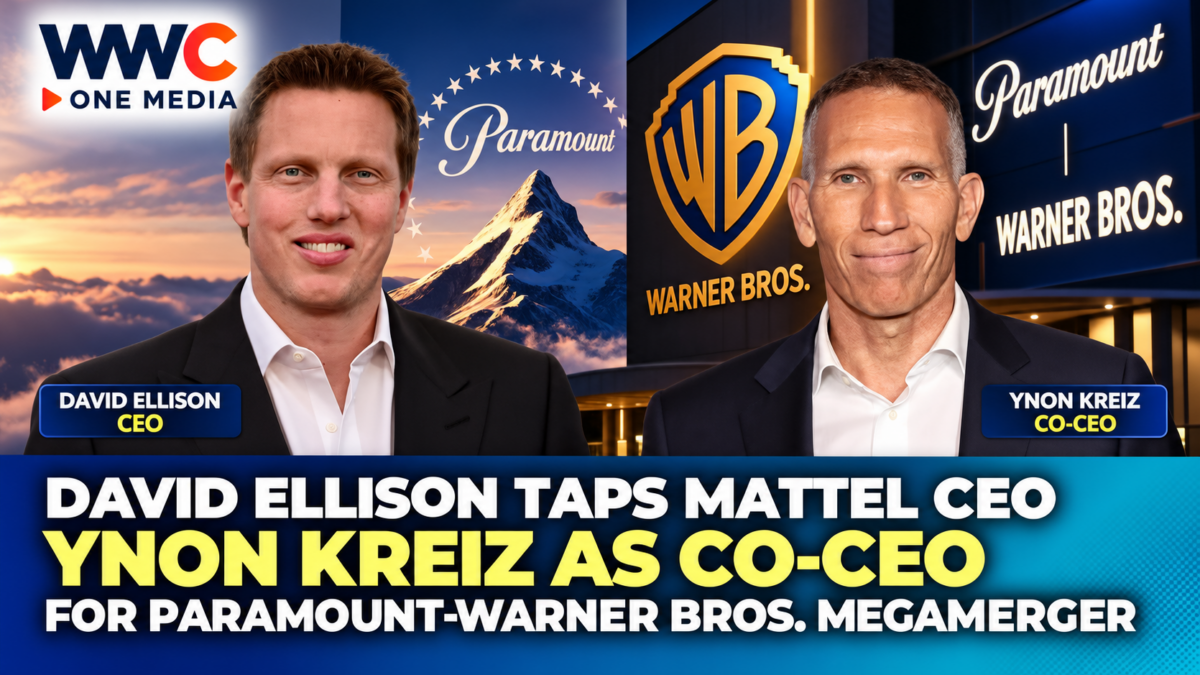
LOS ANGELES — David Ellison is bringing in one of Hollywood’s most experienced corporate turnaround executives to help run the massive Paramount-Warner Bros. Discovery combination, naming outgoing Mattel CEO Ynon Kreiz as co-CEO just days before one of the largest media mergers in history is expected to close.
Kreiz will join Ellison at the top of the combined entertainment company, taking responsibility for much of the day-to-day operation and integration of businesses spanning:
Paramount Pictures
Warner Bros.
HBO and HBO Max
Paramount+
CBS
CNN
Nickelodeon
MTV
and dozens of other film, television and media assets.
The transaction carries an enterprise value of roughly $110 billion, including debt, according to Reuters.
A U.S. federal judge cleared the companies to proceed on September 30 after approving a settlement with 12 states that had challenged the deal on antitrust grounds.
The merger is expected to close on October 6.
And the new parent company has already been given a name:
Skydance.
ELLISON WILL NOT RUN THE NEW MEDIA GIANT ALONE
Ellison will remain one of the most powerful figures in the organization.
But the appointment of Kreiz makes clear that the new Skydance will not be managed as a one-man operation.
Reuters reported that Ellison is expected to focus heavily on:
Creative direction
Technology
Long-term strategy
and
Major corporate decisions.
Kreiz, meanwhile, will focus more directly on:
Daily operations
Cost management
Corporate integration
and
Execution.
That division of responsibility could become essential.
Merging Paramount and Warner Bros. Discovery means combining thousands of employees, multiple streaming platforms, global studios, news operations and extensive cable-TV businesses.
The challenge is far larger than simply putting two companies under one logo.
WHY YNON KREIZ?
Kreiz brings a résumé spanning television, digital media, toys and entertainment.
Before Mattel, he served as CEO of companies including:
Endemol Group
and
Maker Studios.
Disney acquired Maker Studios in 2014.
Kreiz became Mattel CEO in 2018, taking charge of a company that was struggling with declining sales, debt and questions about whether traditional toy brands could remain relevant in a digital entertainment economy.
His strategy centered on turning Mattel from primarily a toy manufacturer into a broader intellectual-property company.
That philosophy now fits unusually well with the new Skydance.
BARBIE BECAME THE PROOF OF CONCEPT
The clearest example of Kreiz’s strategy was Barbie.
Instead of viewing Barbie simply as a doll brand, Mattel treated it as entertainment intellectual property.
The 2023 Warner Bros. film became a global box-office phenomenon and demonstrated how an established consumer brand could generate revenue across:
Movies
Merchandise
Licensing
Fashion
and
Experiences.
That approach helped change how investors thought about Mattel.
The company increasingly promoted itself not only as a manufacturer of toys, but as the owner of potentially valuable entertainment franchises.
Kreiz will now help manage a company that owns one of the largest collections of entertainment IP on the planet.
HE WILL NOW HAVE MUCH BIGGER FRANCHISES TO MANAGE
The combined Paramount-Warner company will control an extraordinary portfolio.
Warner brings franchises and brands including:
Harry Potter
DC
Batman
Superman
Game of Thrones
and
The Lord of the Rings film universe.
Paramount brings:
Mission: Impossible
Top Gun
Star Trek
Transformers
Sonic the Hedgehog
Yellowstone
and Nickelodeon properties.
The strategic challenge is turning those franchises into long-term businesses across:
Film
Streaming
Television
Video games
Consumer products
Licensing
and potentially
Live experiences.
That makes Kreiz’s Mattel experience especially relevant.
THIS IS ALSO A COST-CUTTING JOB
Kreiz is not joining merely to develop franchises.
He is also known for cost discipline.
Reuters described his appointment as a signal that the combined company intends to operate as a leaner business capable of extracting more profit from its content and brands.
That will be critical because the merger carries an enormous financial burden.
The new Skydance is expected to carry roughly:
$80 billion in debt.
Management is targeting more than:
$6 billion in cost savings and synergies.
Those two numbers may define the company’s first several years.
The new leadership team has to integrate two sprawling media companies while simultaneously reducing costs enough to make the balance sheet manageable.
$6 BILLION IN SAVINGS WILL NOT COME EASILY
The companies have identified billions of dollars in overlapping expenses.
Potential savings could involve:
Corporate functions
Technology platforms
Real estate
Advertising systems
Distribution
Marketing
and other back-office operations.
But cost savings at this scale typically have human consequences.
Large media mergers often result in:
Layoffs
Management changes
Department consolidation
and
Reduced spending in overlapping areas.
That means employees across both companies will be watching Kreiz particularly closely.
His job is partly to make the new company more efficient.
The unanswered question is where those efficiencies will come from.
STREAMING MAY BE THE BIGGEST STRATEGIC DECISION
The merged company will own two major streaming services:
HBO Max
and
Paramount+.
That immediately raises one of the biggest unresolved questions in Hollywood:
Do both survive independently?
The companies have not yet announced a final long-term structure.
Maintaining two separate services preserves existing brands.
But it also means maintaining two technology platforms, two marketing operations and separate subscriber-acquisition strategies.
Combining them could reduce duplication.
But it also risks confusing subscribers and damaging brands that already have distinct identities.
The decision could eventually determine whether the merger creates meaningful streaming scale.
HBO MAX BRINGS PRESTIGE — PARAMOUNT+ BRINGS DIFFERENT STRENGTHS
HBO remains one of television’s strongest premium brands.
Its programming history includes:
Game of Thrones
The Last of Us
Succession
and
The White Lotus.
Paramount+ has built a different content mix around:
CBS programming
NFL and sports rights
Star Trek
Taylor Sheridan series
and
Nickelodeon content.
Together, they create a broader catalog.
But simply owning more shows does not guarantee better economics.
Streaming profitability depends on:
Subscriber growth
Churn
Advertising
Content spending
and
Pricing.
Kreiz and Ellison will have to decide how those pieces fit together.
NETFLIX STILL SETS THE SCALE BENCHMARK
The entire consolidation strategy is partly a response to Netflix.
Netflix built a global direct-to-consumer business with hundreds of millions of subscribers.
Traditional studios spent years trying to replicate that model.
But launching separate streaming platforms required massive spending.
Many legacy media companies eventually discovered that competing independently against Netflix, Amazon, Apple and Disney was far more expensive than expected.
The Paramount-Warner merger is one answer to that problem:
get bigger.
The combined company will have significantly more content, subscribers and advertising inventory.
Whether that produces better returns is the much harder question.
CO-CEOS ARE UNUSUAL — AND SOMETIMES DIFFICULT
The co-CEO structure itself is a major corporate experiment.
Two chief executives can bring complementary strengths.
But they can also create uncertainty over who has final authority.
Reuters Breakingviews noted that shared CEO structures have a mixed record because disagreements or blurred responsibilities can slow decisions.
That risk matters especially during an integration this complicated.
Employees need to know:
Who controls budgets?
Who approves strategy?
Who decides executive appointments?
Who has the final word when Ellison and Kreiz disagree?
The clearer that division becomes, the easier the integration may be.
ELLISON BRINGS CREATIVE AND TECHNOLOGY AMBITION
Ellison has repeatedly emphasized technology as central to his media strategy.
His original Skydance company invested heavily in:
Film
Television
Animation
Gaming
and advanced production technology.
He has also spoken about integrating artificial intelligence and modern software systems into large media businesses.
That could become a major focus after the merger.
Large legacy studios often operate with old technology infrastructure created through decades of acquisitions.
Combining Paramount and Warner creates an opportunity to rebuild some of those systems.
But replacing legacy technology inside a company this large is expensive and risky.
KREIZ BRINGS A VERY DIFFERENT OPERATING STYLE
Kreiz’s background is more heavily associated with:
Turnarounds
Operational discipline
Global brands
and
Franchise monetization.
That creates a potentially complementary partnership.
Ellison can push creative and technological ambition.
Kreiz can focus on making the economics work.
That appears to be the logic behind the co-CEO structure.
The biggest challenge is keeping those priorities aligned.
Creative companies need investment.
Highly leveraged companies need discipline.
The new Skydance requires both.
KREIZ IS LEAVING MATTEL IMMEDIATELY
Kreiz’s departure creates a major leadership transition at Mattel.
He is stepping down after more than eight years leading the toy company.
Former Condé Nast CEO Roger Lynch has been selected to succeed him.
Lynch has extensive media experience, including leadership roles at:
Condé Nast
Pandora
and
Sling TV.
His appointment is another example of how entertainment, media and consumer brands increasingly overlap.
Mattel is trying to behave more like an entertainment company.
Meanwhile, Kreiz is moving into one of the biggest entertainment companies in the world.
KREIZ’S MATTEL RECORD IS NOT PERFECT
His tenure should not be viewed only through the success of Barbie.
Mattel shares rose only modestly over his time as CEO and significantly underperformed the broader U.S. stock market.
The company also faced:
Tariff pressures
Uneven toy demand
Activist investor pressure
and
Mixed results from its entertainment strategy.
Some Mattel franchises translated successfully to screens.
Others did not.
That mixed track record matters because the same basic challenge will exist at Skydance:
owning famous intellectual property does not automatically mean audiences will pay to see every new adaptation.
THE NEW COMPANY WILL HAVE PLENTY OF OLD PROBLEMS
Warner Bros. Discovery enters the combination with years of restructuring behind it.
The company has dealt with:
Cable-TV decline
Streaming losses
Heavy debt
and repeated corporate mergers.
Paramount has faced similar pressures.
Its traditional television networks have suffered from shrinking cable audiences.
Advertising has shifted toward digital platforms.
Movie economics have become less predictable.
And streaming required enormous investment.
Putting the two companies together creates scale.
But it also combines many of the same structural problems.
CABLE NETWORKS WILL BE ONE OF THE TOUGHEST ISSUES
The combined company owns major cable assets including:
CNN
TNT
TBS
MTV
Comedy Central
and others.
Traditional cable television continues losing subscribers as households move toward streaming.
Those networks still generate valuable cash.
But their long-term economics are declining.
That creates a difficult balance.
Management needs to extract cash from cable while investing aggressively enough in streaming and digital products to build the future.
That transition is one of the central challenges facing the new co-CEOs.
CNN AND CBS ADD ANOTHER LAYER OF COMPLEXITY
The merger also brings together two major American news organizations:
CNN
and
CBS News.
The antitrust settlement includes an independent News Editorial Independence Board designed to oversee protections involving the two organizations.
This adds an additional governance responsibility that does not exist in a normal entertainment merger.
News organizations depend heavily on editorial credibility and independence.
That means cost-cutting and integration decisions affecting those businesses will attract particular scrutiny.
THE JUDGE IMPOSED CONDITIONS ON THE DEAL
A federal judge approved the settlement that cleared the merger to proceed.
The agreement includes commitments involving:
At least 30 U.S. theatrical film releases annually for five years
and
Hundreds of millions of dollars in additional domestic production investment.
The deal also includes worker-related and news-governance commitments.
Those conditions reflect concerns that combining two major Hollywood studios could reduce:
Competition
Film production
and
Employment.
The merged company will therefore begin operations with significant legal obligations attached.
WARNER AND PARAMOUNT WILL KEEP THEIR STUDIO NAMES
Ellison has already clarified one important branding question.
The combined corporate parent will be called Skydance.
But the Warner Bros. and Paramount studio brands will remain.
That means moviegoers will continue to see:
the Warner shield
and
the Paramount mountain.
Skydance will sit above them as the corporate parent.
The approach allows Ellison to create a new corporate identity without discarding two of Hollywood’s most valuable brand names.
THE NEW STOCK TICKER WILL BE “SKYD”
The combined company is also expected to shift its Class B shares to the New York Stock Exchange.
The planned ticker is:
SKYD.
That symbol will mark the transformation of Skydance from a relatively young production company into a media conglomerate controlling two of Hollywood’s most historic studios.
It is one of the more dramatic corporate expansions the industry has seen.
WARNER’S HISTORY SHOWS HOW HARD MEDIA MERGERS CAN BE
Warner Bros. has repeatedly moved through giant corporate combinations.
It merged with Time.
Time Warner later merged with AOL.
AT&T acquired Time Warner.
AT&T eventually separated the media assets and merged them with Discovery.
Now Warner Bros. Discovery is being acquired again.
Many of those transactions promised:
Synergies
Scale
and
Strategic transformation.
Several later had to be partially or completely unwound.
That history makes investors skeptical whenever a new media megamerger promises enormous efficiencies.
THIS DEAL HAS A BIGGER DEBT PROBLEM THAN MOST
Debt raises the stakes.
With roughly $80 billion expected across the combined structure, management cannot simply spend without discipline.
Interest payments compete directly with money available for:
Movies
Television
Sports rights
Technology
and
Marketing.
If earnings disappoint, debt can quickly become a constraint.
That is one reason Kreiz’s reputation as an operator and cost manager may have mattered so much to Ellison.
FRANCHISES COULD BECOME THE CENTER OF THE STRATEGY
Kreiz’s Mattel playbook provides a clue about where the new company could go.
Rather than treating a franchise as a single movie or television show, management may increasingly view each major brand as an ecosystem.
Harry Potter could generate:
Movies
Series
Games
Consumer products
and experiences.
DC can span:
Cinema
Television
Gaming
and merchandise.
Paramount properties such as Star Trek and Transformers can follow the same model.
That strategy resembles what Disney has done for decades.
Kreiz understands that playbook extremely well.
THE BIGGER STORY: ELLISON IS BUILDING A MEDIA EMPIRE — BUT KREIZ MAY HAVE TO MAKE THE NUMBERS WORK
The appointment of Ynon Kreiz reveals what David Ellison believes the new Skydance needs most.
It needs creative ambition.
It needs technology.
It needs powerful franchises.
But it also needs someone capable of taking two huge legacy companies and turning them into one functioning business.
That is where Kreiz comes in.
He helped transform Mattel from a struggling toy company into a business increasingly focused on intellectual property and entertainment.
Now he faces a much larger assignment.
The combined Skydance will own some of the most recognizable media brands on Earth.
But it will also inherit:
around $80 billion in debt,
declining cable businesses,
two streaming platforms,
overlapping corporate structures,
and
a promised $6 billion-plus cost-savings target.
Ellison may be building one of Hollywood’s biggest empires.
Kreiz’s job may ultimately be harder:
proving that all those famous brands can actually make more money together than they did apart.