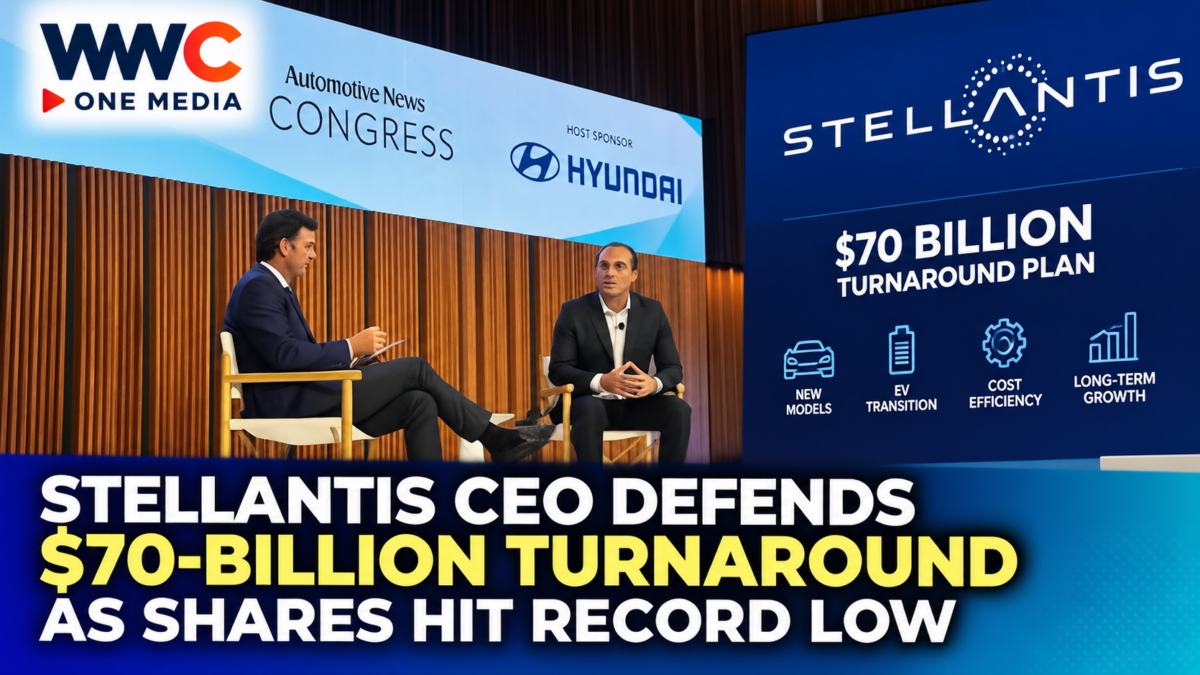
DETROIT — Stellantis CEO Antonio Filosa is refusing to retreat from the automaker’s ambitious turnaround targets even as the company’s U.S.-listed shares sink to record lows, arguing that a multibillion-dollar product offensive and radical manufacturing reset can restore the owner of Jeep, Ram, Dodge, Fiat and Peugeot to profitable growth.
Filosa reconfirmed Stellantis’ 2026 financial guidance during an Automotive News event in Detroit, saying the company remains committed to delivering:
Mid-single-digit percentage growth in net revenue
and
A low-single-digit adjusted operating income margin.
He also reaffirmed the company’s longer-term cash targets:
Positive industrial free cash flow in 2027
and
More than €3 billion in free cash flow in 2028.
Those promises are becoming increasingly important because investors have grown deeply skeptical.
Stellantis’ U.S.-listed shares closed at approximately $4.43 on September 29, an all-time low, after losing close to 60% of their value during 2026.
The market is essentially asking one question:
Can Stellantis prove its turnaround is real before investors lose even more patience?
THE COMPANY IS TRYING TO RECOVER FROM A DISASTROUS 2025
The scale of Stellantis’ current challenge becomes clearer when looking at last year.
For full-year 2025, Stellantis reported:
€153.5 billion in net revenue
down about 2% from 2024.
But the much more dramatic number was the bottom line.
The company posted a:
€22.3 billion net loss.
That was driven largely by €25.4 billion in unusual charges connected to the company’s strategic reset.
Adjusted operating income swung to a loss of:
€842 million
while the adjusted operating margin fell to:
negative 0.5%.
Industrial free cash flow was:
negative €4.5 billion.
For an automaker that had once generated some of the strongest margins in the global industry, the reversal was severe.
STELLANTIS SAYS IT MISJUDGED HOW FAST EVs WOULD TAKE OVER
Filosa has been unusually direct about one of the company’s biggest strategic mistakes.
Stellantis said its 2025 results reflected the cost of overestimating the pace of the energy transition.
Like many automakers, Stellantis had prepared for battery-electric vehicles to take market share rapidly.
But consumer demand developed more slowly and unevenly than expected.
That left the company dealing with:
Expensive EV investments
Products that did not always match customer demand
Underused factories
and
Gaps in affordable gasoline and hybrid vehicles.
Filosa’s response has been to put what Stellantis calls “freedom of choice” back at the center of the company.
That means offering customers:
Gasoline vehicles
Hybrids
Plug-in hybrids
and
Full EVs
rather than betting almost entirely on one propulsion technology.
THE TURNAROUND HAS A NAME: FASTLANE 2030
In May, Stellantis unveiled its new five-year strategy:
FaSTLAne 2030.
The plan calls for more than:
€60 billion in investment through 2030.
At current exchange rates, that is roughly:
$70 billion.
Stellantis plans to use the money for:
New products
Technology
Powertrains
Factory modernization
Partnerships
and
Brand rebuilding.
The company says roughly 60 new models are expected during the plan period.
That is an enormous product offensive designed to repair one of Stellantis’ biggest recent weaknesses:
customers simply did not always have enough competitive new vehicles to choose from.
NORTH AMERICA IS THE CENTER OF THE RECOVERY PLAN
The biggest priority is North America.
That is because the region historically generated some of Stellantis’ strongest profits through brands including:
Jeep
Ram
Dodge
and
Chrysler.
But sales fell sharply in recent years after the company pushed vehicle prices higher, reduced incentives and allowed product portfolios to age.
Under FaSTLAne 2030, Stellantis wants North American revenue to rise around:
25%.
It is targeting an adjusted operating margin of:
8% to 10%.
The company plans to expand market coverage by approximately:
50%.
That includes:
11 all-new vehicles
and
35% more volume.
MORE AFFORDABLE VEHICLES ARE COMING
One of Stellantis’ most important changes is price.
For years, brands such as Jeep and Ram pushed toward increasingly expensive vehicles.
That strategy helped margins when demand was strong.
But eventually it pushed some buyers out of showrooms.
Filosa’s new plan includes:
seven new products priced below $40,000
and
two models priced below $30,000
in North America.
That is a major strategic reversal.
Instead of concentrating heavily on high-margin premium trucks and SUVs, Stellantis is trying to rebuild the lower end of its customer funnel.
THE COMPANY IS PUTTING MOST OF ITS BRAND MONEY INTO NORTH AMERICA
Stellantis plans to invest roughly:
€36 billion
across brands and products under FaSTLAne 2030.
About:
60% of that spending
will go to North America.
That reflects both opportunity and desperation.
North America remains one of the world’s most profitable auto markets.
But Stellantis has lost ground there.
The company needs Jeep and Ram to recover if the broader corporate turnaround is going to work.
JEEP NEEDS A PRODUCT COMEBACK
Jeep remains one of Stellantis’ most recognizable global brands.
But its U.S. lineup has faced pressure from:
Toyota
Ford
Honda
Hyundai
and
Subaru.
Some Jeep products have also been criticized for becoming too expensive relative to competitors.
Stellantis is therefore trying to widen the lineup and restore clearer price points.
The company is also expanding propulsion options.
That includes gasoline-powered models, hybrids and electric vehicles depending on market demand.
RAM IS JUST AS IMPORTANT
Ram is another profit engine.
Full-size pickups produce enormous profits when demand is strong.
But Ram faced product and powertrain disruptions during Stellantis’ earlier transition away from some traditional engines.
The company has since moved to bring more customer choice back.
That includes a renewed emphasis on powerful combustion engines alongside newer electrified options.
Filosa’s broader philosophy is that customers—not corporate targets—should determine which technologies succeed.
THE COMPANY IS NOT ABANDONING ELECTRIC VEHICLES
The strategic reset should not be interpreted as Stellantis walking away from EVs.
It is still investing heavily in:
Battery-electric vehicles
Battery production
Charging technology
and
Software.
The difference is that EVs are now one part of the portfolio rather than the only expected destination.
That shift mirrors what is happening across the global auto industry.
Ford and GM have also adjusted EV investment plans after U.S. electric-vehicle growth failed to meet earlier forecasts.
At the same time, Europe and China continue moving toward electrification more rapidly.
Stellantis therefore needs different strategies in different regions.
THAT IS WHY FILOSA IS GIVING REGIONS MORE CONTROL
One of the central principles of FaSTLAne 2030 is regional empowerment.
The old model attempted to gain maximum global efficiency through standardized platforms and centralized decision-making.
Filosa wants local teams to respond faster to local customers.
A buyer in:
Michigan
does not necessarily want the same vehicle as someone in:
Paris
São Paulo
or
Shanghai.
Stellantis therefore wants each region to decide which models, prices and powertrains make the most sense while still using the group’s global platforms.
PRODUCT DEVELOPMENT IS BEING CUT TO 24 MONTHS
Speed is another major priority.
Stellantis says vehicle-development cycles can currently take as long as:
40 months.
Under FaSTLAne 2030, it wants to reduce that to roughly:
24 months.
That is a huge change for a traditional automaker.
Chinese manufacturers such as BYD, Geely and Chery have forced legacy automakers to rethink development speed.
Some Chinese companies can bring heavily updated vehicles to market in less than two years.
Traditional Western automakers cannot compete effectively if product cycles take nearly twice as long.
CHINESE COMPETITION IS NOW A GLOBAL PROBLEM
Stellantis faces Chinese automakers not only in China.
Brands including BYD, Geely and Chery are expanding aggressively across:
Europe
Latin America
Southeast Asia
The Middle East
and other markets.
They frequently offer:
Lower prices
Advanced infotainment
Electric powertrains
and
Rapid product updates.
That has put pressure on European manufacturers including Stellantis, Volkswagen and Renault.
Stellantis needs its new strategy to make the organization faster and cheaper.
THE COMPANY MAY EVEN BUILD CARS FOR OTHER AUTOMAKERS
One of the most unusual pieces of FaSTLAne 2030 involves unused factories.
Instead of leaving capacity idle, Stellantis is exploring partnerships that could allow other manufacturers to use its plants.
Reuters reported that the company could potentially offer contract manufacturing to outside automakers, including Chinese companies in Europe and groups such as Jaguar Land Rover in the United States.
That represents a major shift in thinking.
Factories that once produced only Stellantis vehicles could eventually become manufacturing assets generating revenue from competitors.
FACTORY UTILIZATION HAS BECOME A BIG PROBLEM
Automotive plants are extremely expensive.
A factory with low utilization still carries:
Labor costs
Maintenance
Utilities
Depreciation
and
Fixed overhead.
That means an underused plant can destroy profitability.
Stellantis wants its factories operating much closer to their full capacity.
In Europe, capacity utilization is targeted to rise from roughly:
60%
to
80% by 2030.
The United States has a similar target of about:
80%.
EUROPEAN CAPACITY COULD FALL BY MORE THAN 800,000 VEHICLES
Stellantis also plans to reduce European manufacturing capacity by more than:
800,000 vehicles.
Rather than simply shutting everything down, the company wants to:
Repurpose plants
Use partnerships
and
Share manufacturing capacity.
Facilities in France and Spain are among those affected by the restructuring.
The goal is to preserve employment where possible while eliminating costly unused capacity.
Whether Stellantis can do that without politically difficult factory closures remains a major challenge.
EUROPE IS AN ESPECIALLY HARD MARKET
The European auto industry is under pressure from several directions.
Consumers are buying fewer vehicles than before the pandemic.
Electric-vehicle regulations require enormous investment.
Chinese competitors are gaining market share.
And manufacturing costs remain high.
Stellantis wants European revenue to rise around:
15%
by 2030.
But its target adjusted operating margin in the region is only:
3% to 5%.
That is much lower than the company hopes to achieve in North America.
The difference shows how difficult Europe has become.
THE COMPANY IS ALSO FACING BATTERY SUPPLY PROBLEMS
The turnaround is not happening smoothly.
Stellantis recently announced temporary production suspensions at three French factories.
At its Sochaux and Rennes plants, the company cited shortages of long-range EV batteries supplied by Automotive Cells Company, its battery joint venture with Mercedes-Benz and TotalEnergies.
Production at several plants is expected to pause during October.
The disruption comes at a frustrating time.
High fuel prices have recently boosted European demand for electric vehicles, meaning Stellantis needs more battery-powered models just as its battery supply chain is struggling.
THE U.S. EV MARKET IS MOVING THE OTHER WAY
The U.S. market presents almost the opposite problem.
Electric-vehicle demand weakened after federal incentives were reduced or eliminated.
Traditional automakers have therefore scaled back EV plans.
Recent industry data show U.S. electric-vehicle sales falling while demand for:
Hybrids
Gasoline vehicles
and
Affordable cars
remains relatively stronger.
That validates part of Filosa’s powertrain-flexibility strategy.
But it also shows why managing a global automaker is so difficult.
Europe may need more EV capacity at the exact moment North America wants fewer EVs.
TRUMP-ERA FUEL ECONOMY CHANGES COULD SAVE STELLANTIS BILLIONS
Regulatory changes in the United States could also provide financial relief.
The U.S. government recently finalized less stringent vehicle fuel-economy rules.
Federal estimates suggest Stellantis could save approximately:
$6.6 billion through 2031
in technology costs compared with the previous regulatory trajectory.
That reduces some pressure to push consumers into EVs faster than demand supports.
But there is also a strategic risk.
If global markets eventually move toward EVs faster again, automakers that reduce investment too aggressively could find themselves behind.
SECOND-QUARTER RESULTS DID SHOW REAL IMPROVEMENT
There are signs Filosa can point to.
In the second quarter of 2026, Stellantis reported net revenue of:
€43.5 billion
up:
13% year over year.
Adjusted operating income rose to:
€773 million
from only €213 million a year earlier.
The adjusted operating margin improved to:
1.8%
from:
0.6%.
Industrial free cash flow improved dramatically to:
positive €1 billion
for the quarter.
Those numbers remain far below Stellantis’ historical profitability.
But they demonstrate that the company is moving in the right direction.
FIRST-HALF CASH FLOW WAS STILL NEGATIVE
The turnaround is far from complete.
For the first six months of 2026, industrial free cash flow remained approximately:
negative €921 million.
That is much better than the roughly:
negative €3 billion
recorded during the same period a year earlier.
But investors ultimately need the number to become sustainably positive.
This is why Filosa’s 2027 target matters so much.
STELLANTIS WANTS MORE THAN €3 BILLION IN FREE CASH FLOW BY 2028
Filosa reconfirmed the goal of generating more than:
€3 billion
in industrial free cash flow by 2028.
Compared with the:
€4.5 billion cash outflow in 2025,
that would represent a swing of more than:
€7.5 billion.
That is one of the clearest numerical measures of whether the turnaround succeeds.
Revenue can rise.
Margins can improve.
But cash ultimately determines whether Stellantis can:
Invest
Pay debt
Resume dividends
and
Reward shareholders.
THE DIVIDEND WAS ALREADY SUSPENDED
The financial strain became clear earlier this year when Stellantis suspended its 2026 annual dividend.
The company also authorized up to:
€5 billion
of non-convertible subordinated perpetual hybrid bonds.
Those moves were designed to preserve liquidity during the turnaround.
At the end of 2025, industrial available liquidity remained strong at approximately:
€46 billion.
That gives Stellantis financial breathing room.
But investors do not want the company simply surviving on liquidity.
They want profitability restored.
STELLANTIS IS NOT PLANNING TO KILL MOST OF ITS 14 BRANDS
The group owns an unusually large portfolio, including:
Jeep
Ram
Dodge
Chrysler
Fiat
Alfa Romeo
Maserati
Peugeot
Citroën
Opel
Vauxhall
Lancia
DS Automobiles
and
Abarth.
Some investors have questioned whether Stellantis needs so many brands.
Filosa has resisted the idea of simply eliminating large numbers of them.
Instead, the company says it will sharpen brand management and allocate money more selectively.
Around 70% of product and brand investment will be concentrated on:
Jeep
Ram
Peugeot
Fiat
and commercial-vehicle business Pro One.
That makes the hierarchy clear even if weaker brands remain alive.
MASERATI REMAINS ONE OF THE BIG QUESTIONS
Maserati is among the brands under the most pressure.
Luxury demand has weakened in some markets, and the Italian marque has struggled with low volumes and an aging product lineup.
Stellantis has repeatedly said it wants to preserve its brands.
But capital discipline means each one will increasingly need to justify future investment.
A turnaround plan can keep 14 names alive on paper.
The harder challenge is making all 14 commercially relevant.
U.S. MARKET SHARE PRESSURE IS NOT GOING AWAY
Stellantis is also competing in a U.S. auto market increasingly dominated by Asian manufacturers.
Recent third-quarter data showed:
General Motors sales down 5.5%
while
Toyota moved much closer to GM’s U.S. sales lead.
The Detroit Three—GM, Ford and Stellantis—now hold roughly:
36% of the U.S. market combined.
Asian automakers are expected to account for more than half.
Toyota and Honda are benefiting particularly from strong hybrid lineups.
That is another reason Stellantis needs competitive new products quickly.
STELLANTIS SALES WERE ROUGHLY FLAT IN Q3
Recent U.S. sales data suggest the company has at least stabilized after earlier declines.
Reuters reported Stellantis’ third-quarter U.S. sales were approximately flat year over year.
That may not sound impressive.
But after repeated market-share losses, simply stopping the decline is an important first step.
The next phase is rebuilding volume without returning to the extreme discounting that can destroy margins.
AFFORDABILITY MAY BE THE INDUSTRY’S BIGGEST PROBLEM
Stellantis’ new lower-priced products are arriving at an important moment.
Average U.S. new-vehicle transaction prices recently exceeded:
$50,000.
That is increasingly unaffordable for many households.
Automakers spent years prioritizing expensive trucks, SUVs and luxury trims because they generated higher margins.
Now the industry is discovering there is not an unlimited supply of customers who can afford them.
Stellantis’ decision to add several models below $40,000 and two below $30,000 directly addresses that problem.
THE STOCK PRICE SHOWS INVESTORS ARE NOT CONVINCED YET
Despite improving operational numbers, the market remains deeply skeptical.
Stellantis shares reaching an all-time low reflects concerns about:
Execution
Cash generation
Brand weakness
Chinese competition
European overcapacity
and
whether the product turnaround will arrive quickly enough.
Filosa can reaffirm guidance.
But eventually, investors need evidence.
The next several quarters will determine whether the recovery is becoming visible in:
Sales
Margins
and
Cash flow.
THE BIGGER STORY: STELLANTIS DOES NOT NEED ANOTHER PLAN — IT NEEDS EXECUTION
The auto industry is full of turnaround presentations.
Stellantis now has one of the biggest.
More than €60 billion of investment.
Around 60 new models.
Faster 24-month development cycles.
More affordable vehicles.
Higher factory utilization.
A renewed focus on Jeep, Ram, Peugeot and Fiat.
And a return to positive cash flow.
On paper, the strategy addresses many of the problems that pushed Stellantis into crisis.
But the company’s own history shows why investors remain cautious.
The previous strategy also looked compelling until customers stopped buying enough vehicles.
That means Antonio Filosa’s challenge is no longer convincing Wall Street that Stellantis understands what went wrong.
The company has already acknowledged that.
The real test is whether Stellantis can get the right cars into showrooms, at the right prices, before competitors take even more market share.
Stellantis has committed roughly $70 billion to its comeback — but with the stock at record lows, investors are now waiting to see whether the turnaround can produce something more valuable than another promise.