
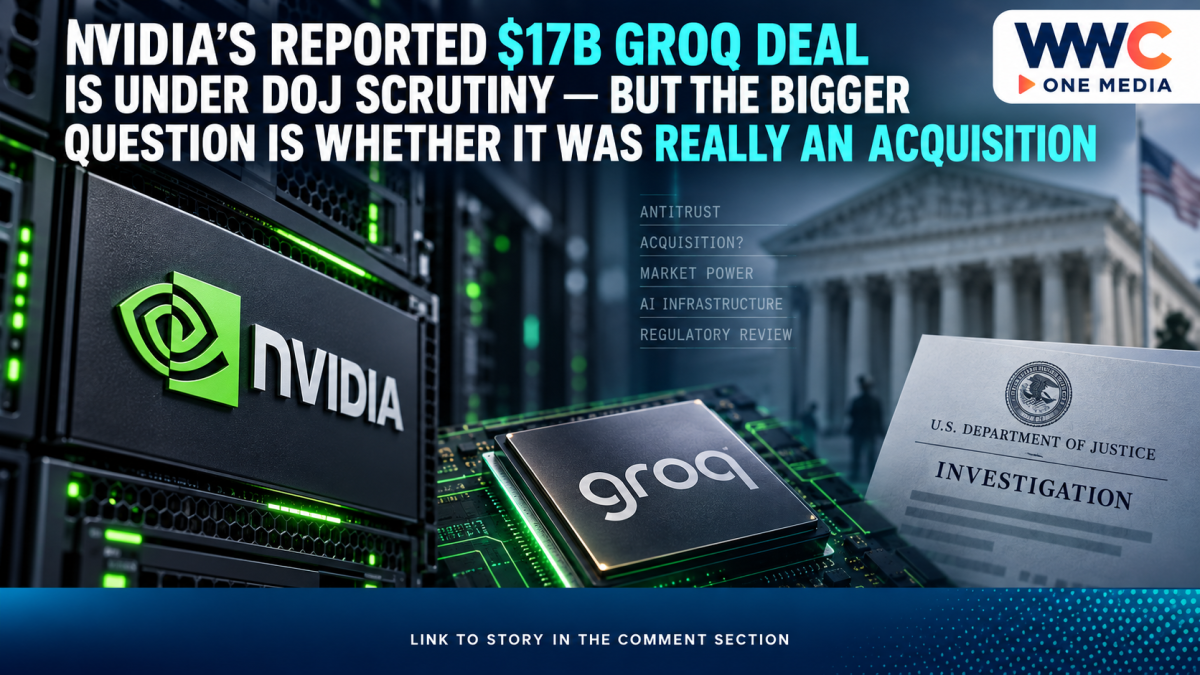
WASHINGTON — Nvidia’s aggressive expansion across the artificial-intelligence industry is facing a new test in Washington after the U.S. Justice Department reportedly opened an antitrust investigation into the chip giant’s unusual licensing arrangement with AI startup Groq.
The inquiry centers on a deceptively simple question:
Was Nvidia’s deal really just a technology license and hiring arrangement — or was it structured that way to achieve much of what an acquisition would accomplish without going through the same regulatory review?
The Justice Department is investigating whether Nvidia tried to avoid antitrust scrutiny when it struck the Groq agreement in December 2025, The New York Times reported, citing people familiar with the matter. Reuters said it had not independently verified the Times report.
According to the report, the Justice Department began examining the transaction shortly after it was announced and later sent Nvidia a formal demand for information about the deal.
No finding of wrongdoing has been announced.
But for Nvidia, the investigation could become an important test of a dealmaking strategy increasingly used across Silicon Valley.
What exactly did Nvidia get from Groq?
When the companies announced their agreement on December 24, 2025, Groq described it as a “non-exclusive” technology licensing deal.
Under the arrangement, Nvidia obtained rights to use Groq’s AI inference technology.
At the same time, some of Groq’s most important people moved to Nvidia.
Those included Groq founder Jonathan Ross, President Sunny Madra, and other members of the company’s engineering organization. Groq said it would remain an independent company and that GroqCloud would continue operating.
That combination — valuable intellectual property plus top executives and engineers — is exactly why the transaction attracted attention almost immediately.
Reuters noted at the time that similar arrangements had become increasingly common among major technology companies: instead of buying an AI startup outright, a larger company pays for technology rights while recruiting its founders and key employees.
The startup technically survives.
But much of the technology and talent that made it strategically valuable can move to the larger company.
Was it $17 billion or $20 billion?
This is one area where reports need to be handled carefully.
The latest New York Times account, as reported by Reuters and CNA, puts Nvidia’s Groq transaction at $17 billion.
However, when the deal was announced in December, CNBC reported that Nvidia was paying around $20 billion in cash in connection with Groq’s assets.
Reuters at the time emphasized that neither Nvidia nor Groq disclosed the transaction’s financial terms, and Groq specifically said the company itself was not being acquired.
TechCrunch likewise reported that Nvidia told it the transaction was not an acquisition of Groq, despite the $20 billion figure being circulated.
For that reason, the safest formulation is:
The Groq transaction has been reported at between $17 billion and $20 billion, but Nvidia and Groq did not publicly confirm the price when the deal was announced.
That difference matters because the scale of the transaction is one reason regulators are likely interested in how it was classified.
Why Groq mattered so much to Nvidia
Groq was not simply another small AI startup.
It was building technology aimed directly at one of the fastest-growing areas of artificial intelligence: inference.
Training is the computational process used to build an AI model.
Inference is what happens afterward, when a trained model actually responds to users — answering questions, generating images, writing code or carrying out AI-agent tasks.
Nvidia dominates the market for AI training hardware, but the inference market has attracted more challengers, including AMD, Cerebras and Groq.
Groq developed processors it calls Language Processing Units, or LPUs, designed specifically for fast AI inference.
Instead of depending heavily on external high-bandwidth memory, Groq designed its architecture around large amounts of on-chip SRAM. The approach can reduce memory bottlenecks and deliver extremely low latency for certain AI workloads, although it can also impose limitations on the size of models that can be served.
That made Groq strategically important.
As AI moves from simply training giant models toward serving billions of real-time queries, inference could become an even larger part of overall AI infrastructure spending.
And Nvidia clearly does not intend to surrender that market.
Groq was valued at just $6.9 billion before the Nvidia deal
The reported transaction price is especially striking when compared with Groq’s valuation shortly before the agreement.
In September 2025, Groq raised $750 million at a $6.9 billion valuation, more than double its $2.8 billion valuation from the previous year.
The startup said at the time that its technology was being used by more than two million developers.
Only about three months later, Nvidia secured rights to its technology and recruited some of its most important executives.
That rapid sequence helps explain why regulators may want to understand precisely what Nvidia was buying — and what Groq retained.
The antitrust issue goes beyond Nvidia
The investigation could have consequences far outside the Nvidia-Groq deal.
Large technology companies have increasingly pursued arrangements sometimes described as “acqui-hires,” “reverse acqui-hires” or “not-an-acquisition” deals.
The structure varies, but the basic formula is similar:
A large company licenses technology, pays substantial amounts of money and recruits a startup’s founders or key researchers while leaving the legal shell of the startup independent.
Microsoft used a comparable structure involving Inflection AI, while Amazon hired executives from Adept AI. Other major AI partnerships have also raised questions about whether traditional merger-review rules adequately capture the way control, technology and talent move between companies.
Regulators have already signaled that they are paying attention to unconventional AI partnerships.
The U.S. Federal Trade Commission previously launched a broad inquiry into major AI investments and partnerships involving Microsoft, OpenAI, Amazon, Anthropic and Google. The FTC said such arrangements could affect access to critical inputs including computing resources, technical information and engineering talent.
That makes the Nvidia-Groq investigation potentially important beyond this single transaction.
If regulators conclude that certain licensing-and-hiring deals function economically like acquisitions, future Big Tech transactions could face substantially closer review.
What could happen to Nvidia?
According to the New York Times report cited by Reuters, the Justice Department could potentially impose financial penalties if investigators determine Nvidia improperly handled the transaction.
However, the report said regulators would probably not force the Groq arrangement to be unwound.
That outcome is far from certain.
The investigation remains just that — an investigation — and no enforcement action has been announced.
Nvidia, Groq and the Justice Department did not immediately respond to Reuters’ requests for comment when the story was published.
Nvidia’s dealmaking spree is getting much bigger
The Groq investigation arrives at a particularly important moment for Nvidia.
Just days before the probe became public, Nvidia announced an agreement to buy Hugging Face for $12.93 billion, one of the largest acquisitions in the company’s history.
Nvidia plans to pay approximately $11.9 billion to Hugging Face investors, with as much as another $1 billion reserved in equity-based incentives for employees joining Nvidia.
CEO Jensen Huang said Hugging Face would remain an open platform and would continue supporting different models, chips and cloud services.
Still, some developers and analysts have raised concerns that Nvidia’s expanding influence could eventually favor its own hardware across the AI ecosystem.
There is currently no indication that the reported Groq DOJ investigation extends to the Hugging Face transaction.
But together, the deals demonstrate how Nvidia is increasingly using the extraordinary profits generated by the AI boom to expand beyond GPUs into software, developer platforms, inference technology and AI infrastructure.
The bigger battle is over control of AI inference
The Justice Department’s investigation may ultimately come down to transaction law.
But the commercial stakes are much larger.
Nvidia built its extraordinary market position largely by becoming the dominant supplier of processors used to train increasingly powerful AI models.
The next battle is about what happens after those models are trained.
Every ChatGPT response, enterprise AI assistant, autonomous agent and generative application requires inference.
If that market grows as rapidly as technology companies expect, controlling the infrastructure used for inference could be worth hundreds of billions of dollars.
Groq was one of the startups attempting to challenge Nvidia in precisely that area.
Then Nvidia licensed its technology and hired its founder.
Whether that was simply an innovative commercial partnership or something regulators believe should have been treated more like an acquisition is now reportedly under examination in Washington.
And the answer could shape not only Nvidia’s next deal — but how every major technology company is allowed to buy its way deeper into the AI race.




Leave a Reply