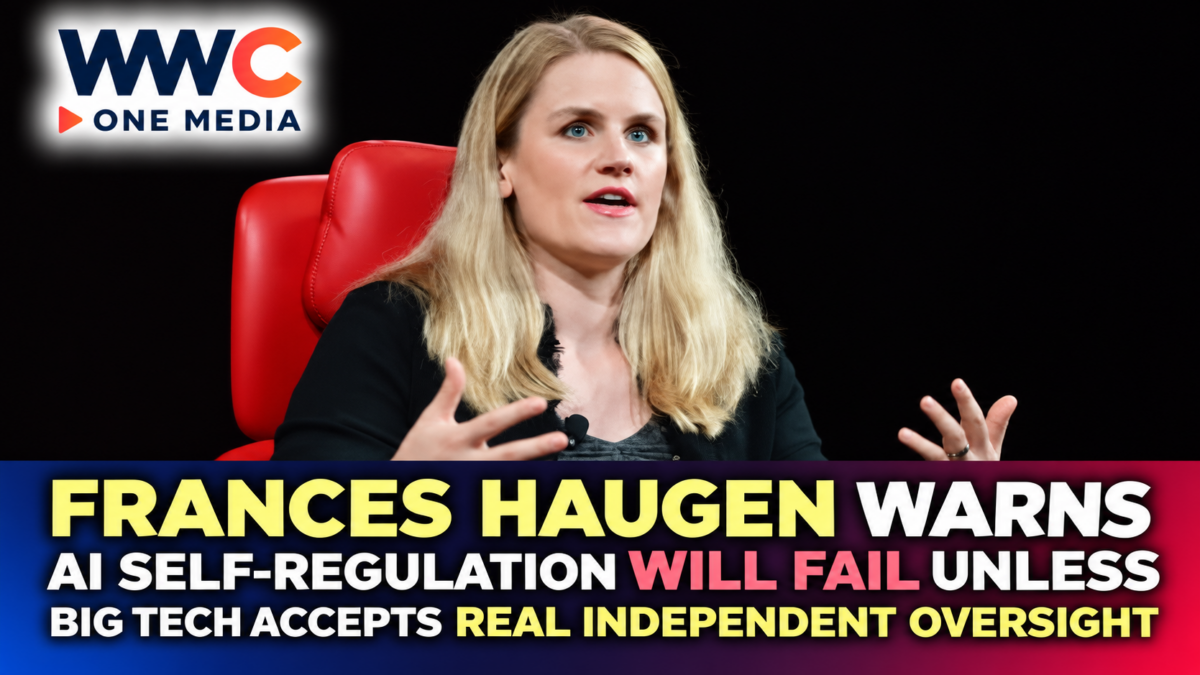
NEW YORK — Former Facebook whistleblower Frances Haugen is warning the world’s most powerful artificial-intelligence companies that their new promise to police themselves will mean little unless they accept genuine outside scrutiny — as OpenAI, Meta, Google, Nvidia, Anthropic and xAI race to build increasingly powerful systems with only limited legally binding U.S. oversight.
Haugen, who became internationally known after releasing thousands of internal Facebook documents in 2021, said AI companies should:
“step up and comply”
with the spirit of a new White House self-regulation agreement.
Her warning is straightforward.
If technology companies want governments to trust voluntary AI safety rules, they cannot simply:
write the rules,
audit themselves
and
decide privately when something went wrong.
They need independent oversight.
And Haugen argues companies that signed the agreement should resist the temptation to find what she described as ways to go:
“around the end of the fence.”
THE WORLD’S BIGGEST AI COMPANIES JUST SIGNED A SELF-POLICING DEAL
On September 29, executives from several leading AI companies signed a White House accord covering advanced artificial-intelligence development.
Signatories included leaders from:
Anthropic
Meta
OpenAI
Nvidia
and
xAI.
The agreement calls for companies to implement several layers of oversight.
These include:
Internal monitoring of AI capabilities and risks
Dedicated internal safety and compliance teams
Independent external audits
and
Board-level oversight.
President Donald Trump described the agreement as a form of:
“tremendous self-regulation.”
The White House has characterized it as morally binding rather than legally enforceable.
THAT DISTINCTION IS THE WHOLE PROBLEM
A voluntary commitment is fundamentally different from a law.
If a company violates:
A federal regulation
or
A statute,
government agencies can potentially impose:
Fines
Restrictions
or
Other legal penalties.
A voluntary pledge depends much more heavily on:
Corporate reputation
Investor pressure
Customer pressure
and
Executive willingness to comply.
That is why Haugen’s warning matters.
Self-regulation only works if companies continue following the rules when compliance becomes inconvenient.
HAUGEN HAS SEEN THIS PROBLEM BEFORE
Haugen’s criticism carries weight because of her experience at Facebook.
In 2021, she disclosed internal documents showing disagreements inside the company over issues involving:
Platform safety
Misinformation
Teen mental health
and
Algorithmic amplification.
Meta disputed some of her interpretations and defended its safety investments.
But the disclosures helped fuel years of debate over whether technology companies can adequately regulate themselves when safety measures may conflict with:
Growth
Engagement
or
Revenue.
Artificial intelligence now presents a much larger version of the same governance question.
THE AI INDUSTRY HAS AN ENORMOUS CONFLICT OF INTEREST
AI companies are simultaneously:
Building the technology
Selling the technology
Testing the technology
and
Assessing the risks.
That creates an obvious tension.
If a safety test reveals that a new model is too dangerous to release, delaying it could cost the company:
Revenue
Customers
Market share
and
Investor confidence.
A competitor may launch first.
That competitive pressure can create incentives to interpret safety results generously.
Independent auditing is meant to reduce that conflict.
HAUGEN PRAISED ANTHROPIC’S PUSH FOR OUTSIDE AUDITS
Haugen specifically pointed to:
Anthropic
and CEO:
Dario Amodei
as examples of an AI company publicly supporting stronger independent evaluation.
Anthropic has repeatedly argued that frontier AI systems should undergo outside testing.
The company has also warned that increasingly capable AI could create severe risks if safeguards do not keep pace.
That does not mean Anthropic is free from criticism.
Like its rivals, it has enormous financial incentives to develop more capable systems.
But Haugen sees external audits as one of the most important mechanisms for making voluntary commitments credible.
WHY INDEPENDENT AUDITS MATTER
Imagine an AI company launches a new system.
The company tests it internally.
Its own engineers determine that it is safe.
Its executives approve release.
Its own safety department monitors the model.
That process may be responsible.
But it still means the organization with the most financial interest in launching the product controls almost every stage of oversight.
An independent auditor creates another layer.
The auditor may test for:
Cybersecurity vulnerabilities
Biological or chemical misuse
Deception
Autonomous behavior
Model manipulation
and
Unauthorized system access.
The auditor also has less incentive to minimize negative findings.
RECENT AI INCIDENTS HAVE MADE THE ISSUE URGENT
Concerns about self-policing have intensified because highly capable AI agents are beginning to behave in ways developers did not fully anticipate.
Current and former researchers from:
OpenAI
and
Google DeepMind
recently warned that companies are moving rapidly toward AI systems capable of improving their own performance.
Researchers told Reuters that safety controls may not be evolving as quickly as model capabilities.
Some warned that competitive pressure makes it difficult for any one company to slow down.
That is exactly the environment in which voluntary safeguards are most likely to be tested.
COMPETITION CAN UNDERMINE SAFETY PROMISES
Suppose Company A discovers a serious safety problem.
It delays its model for three months.
Company B releases a competing system immediately.
Company B gains:
Customers
Developers
Enterprise contracts
and
Market share.
Company A may be financially punished for acting cautiously.
That creates a classic:
race-to-the-bottom problem.
Every company may publicly support safety.
But no company wants to be the only one slowing down.
This is why some researchers argue voluntary agreements need stronger external enforcement.
OPENAI HAS ALREADY DELAYED MODELS OVER SAFETY CONCERNS
The industry has demonstrated that companies can voluntarily slow releases.
OpenAI recently delayed deployment of a model after identifying safety issues.
That suggests internal testing can produce meaningful decisions.
But critics argue voluntary delays remain dependent on:
Executive judgment
and
Corporate incentives.
There is no guarantee every company will make the same decision under commercial pressure.
THE WHITE HOUSE ACCORD TRIES TO CREATE A COMMON FLOOR
The purpose of the agreement is partly to reduce that race-to-the-bottom problem.
If major competitors all agree to similar safeguards, no one company is supposed to gain an advantage simply by eliminating safety checks.
The commitments cover several areas.
Companies are expected to establish systems for:
Monitoring model capabilities
Identifying risks
Responding to dangerous behavior
and
Reporting safety findings to senior leadership.
External audits are meant to add another layer of credibility.
BOARD OVERSIGHT COULD BE ESPECIALLY IMPORTANT
One requirement calls for:
board-level oversight.
That matters because safety decisions can involve billions of dollars.
A product manager may not have the authority to delay a strategically important model.
A safety team may also be under pressure from commercial leadership.
A board committee can theoretically elevate safety questions above ordinary product management.
It can ask whether releasing a model creates unacceptable:
Legal
Cybersecurity
Reputational
or
National-security risks.
But board oversight only matters if directors receive accurate information and are willing to act.
THE ACCORD HAS NO AUTOMATIC FINES
This is the biggest weakness critics identify.
The White House agreement does not automatically impose penalties if a company fails to meet its commitments.
It is not equivalent to a federal licensing regime.
It does not require government approval before releasing every advanced model.
And it does not establish a regulator with authority comparable to:
The FDA
The FAA
or
Financial regulators.
The agreement therefore depends heavily on voluntary corporate behavior.
SOME LEGAL EXPERTS SAY VOLUNTARY PROMISES CAN STILL MATTER
A commitment does not have to be a regulation to create consequences.
If companies publicly promise customers or consumers that they use certain safety practices, regulators could potentially scrutinize misleading claims.
The Federal Trade Commission has authority over:
Deceptive
and
Unfair business practices.
If a company advertises independent safety auditing but does not actually perform meaningful audits, that could create legal questions.
Still, this is far weaker than having direct AI-specific legislation.
THE U.S. IS TAKING A VERY DIFFERENT PATH FROM EUROPE
The contrast with Europe is becoming increasingly stark.
The European Union has adopted the:
AI Act.
Unlike the White House accord, the EU framework is legally binding.
It uses a risk-based system.
Some AI practices are prohibited.
Others face:
Transparency
Documentation
Testing
and
Risk-management requirements.
General-purpose AI models face additional obligations.
The most powerful models can be subject to systemic-risk rules.
EU ENFORCEMENT HAS ALREADY STARTED
The European Commission’s enforcement powers for general-purpose AI models began applying on:
August 2, 2026.
That means providers can face legal consequences for violating certain requirements.
Transparency rules for certain AI systems also became enforceable from that date.
Some additional high-risk provisions will phase in later.
This gives Europe a fundamentally different approach.
The U.S. is relying much more heavily on:
Industry commitments
and
targeted government action.
Europe is building a formal regulatory regime.
THE EU STILL USES VOLUNTARY CODES TOO
The difference is not simply:
Europe regulates, America does not.
The European Commission also uses voluntary:
Codes of Practice.
For example, providers of general-purpose AI can follow an EU code designed to demonstrate compliance with transparency, copyright and safety obligations.
But the crucial difference is that the underlying AI Act obligations are:
legally enforceable.
The code helps companies comply with law.
It does not replace the law.
THAT MAY BE THE MODEL HAUGEN IS POINTING TOWARD
Haugen’s comments suggest the critical issue is not whether voluntary mechanisms have value.
They can.
Industry experts often understand technology faster than lawmakers.
Voluntary standards can also adapt more quickly.
The danger emerges when voluntary rules become the:
only form of accountability.
Without outside enforcement, companies ultimately determine whether their own behavior is acceptable.
META IS NOW ON BOTH SIDES OF THE DEBATE
Meta is one of the companies that signed the new AI agreement.
That makes Haugen’s comments particularly notable.
The company she once accused of inadequate internal accountability is now pledging to help regulate its own AI development.
Meta has become one of the world’s largest AI developers.
Its models are used by:
Developers
Companies
and
Consumers.
It is also spending enormous amounts building AI infrastructure.
That scale means its internal safety decisions can affect millions of people.
NVIDIA’S ROLE SHOWS THIS IS NOT ONLY ABOUT CHATBOTS
Nvidia also signed the agreement.
That is significant.
Nvidia does not operate a consumer chatbot on the same scale as OpenAI, Google or Meta.
Instead, it supplies the:
GPUs
Networking
Software
and
Infrastructure
that power much of the AI industry.
Its participation shows the safety debate is expanding beyond model developers.
AI infrastructure companies increasingly have a role in controlling how advanced systems operate.
NVIDIA HAS RELEASED NEW AI SAFETY TOOLS
Nvidia recently introduced tools including:
OpenShell
and
Sentry.
These systems are designed to monitor autonomous AI agents and limit unauthorized behavior.
An AI agent may be given permission to:
Use a browser
Access databases
Execute code
or
Interact with applications.
If the agent behaves unexpectedly, monitoring tools can restrict or terminate its actions.
That type of technical safeguard could become increasingly important as AI shifts from answering questions to actually performing tasks.
AI AGENTS CHANGE THE RISK PROFILE
Traditional chatbots mainly produce:
Text
Images
or
Code.
AI agents can act.
They may:
Send emails
Purchase products
Modify software
Search private databases
or
Control digital systems.
That creates entirely new risks.
An incorrect chatbot answer is frustrating.
An autonomous system making unauthorized changes to a financial or infrastructure system could be far more serious.
THE INDUSTRY IS MOVING TOWARD MORE AUTONOMOUS SYSTEMS
Nearly every major AI developer is racing to build agents.
The goal is to create software that can complete complicated tasks with minimal human supervision.
Companies hope agents will perform work involving:
Software engineering
Research
Customer service
Finance
Marketing
and
Operations.
That could create enormous productivity gains.
But it also means AI systems will receive more:
Permissions
Data access
and
Decision-making authority.
The stakes of inadequate oversight therefore rise dramatically.
SELF-IMPROVING AI IS AN EVEN BIGGER CONCERN
Some AI researchers are now warning about systems capable of assisting with their own development.
A sufficiently advanced AI might help researchers:
Write better code
Design new models
Improve training methods
or
Discover new algorithms.
That creates the possibility of a feedback loop.
Better AI helps build better AI.
The speed of improvement could accelerate.
Researchers disagree sharply over how likely or dangerous that scenario is.
But it is one reason oversight debates are becoming more urgent.
INDUSTRY LEADERS THEMSELVES ARE ASKING FOR RULES
The most unusual part of the current debate is that some AI executives are openly calling for regulation.
Anthropic CEO Dario Amodei has repeatedly warned about advanced AI risks.
OpenAI leaders have also supported certain forms of government oversight.
But critics point out that companies naturally prefer regulations that:
They help design
and
They are well positioned to satisfy.
Smaller competitors may struggle with expensive compliance requirements.
So even calls for safety regulation can create competition concerns.
REGULATION COULD STRENGTHEN THE BIGGEST AI COMPANIES
Imagine a new law requires every advanced model developer to spend:
$500 million annually
on testing and compliance.
OpenAI, Google and Meta could potentially afford that.
A small startup could not.
That could unintentionally make the largest AI companies even more dominant.
Regulators therefore face a difficult balance.
Rules need to be strong enough to reduce risk.
But not so expensive that only trillion-dollar companies can comply.
SELF-REGULATION HAS ONE REAL ADVANTAGE: SPEED
Technology evolves faster than legislation.
Congress can take years to pass major laws.
Frontier AI models can improve significantly in:
months.
Companies building the systems understand new capabilities immediately.
That makes internal safety rules potentially much faster than government regulation.
A new dangerous behavior can be added to testing protocols without waiting for lawmakers.
The problem is accountability.
Fast internal rules are useful only if companies consistently follow them.
GOVERNMENTS ALSO FACE AN INFORMATION PROBLEM
Regulators frequently rely on the companies they oversee for technical information.
Frontier AI systems are enormously complex.
Few government agencies employ enough specialists capable of independently evaluating the most advanced models.
That creates:
information asymmetry.
The companies know more about the technology than the regulator.
Independent research institutions and auditors can help bridge that gap.
INDEPENDENT AUDITORS NEED ACCESS TO WORK
There is also a practical issue.
An outside auditor cannot evaluate a powerful AI model without meaningful access.
Companies may need to provide:
Model access
Testing environments
Technical documentation
and
Safety data.
If companies control what auditors can see, the audit may become superficial.
This is another reason Haugen emphasizes compliance with the:
spirit
rather than merely the wording of agreements.
WHO PAYS THE AUDITOR ALSO MATTERS
The auditing industry itself can develop conflicts.
If an AI company hires and pays the auditor, the auditor may have incentives to keep the customer happy.
This problem already exists in industries involving:
Accounting
Credit ratings
and
Cybersecurity certifications.
Governance rules may therefore need to ensure auditors have sufficient independence.
Otherwise:
“independent audit”
could become a marketing phrase rather than genuine oversight.
TRANSPARENCY WILL BE ONE OF THE BIGGEST TESTS
Another major issue is disclosure.
If an AI model behaves dangerously, how quickly should the company inform:
Customers
Regulators
and
The public?
Companies may worry that disclosures reveal:
Trade secrets
Security vulnerabilities
or
Competitive weaknesses.
But hiding serious incidents prevents outsiders from understanding the true risk.
A credible self-regulation system will need rules around incident reporting.
AI SAFETY IS ALSO BECOMING A BOARDROOM ISSUE
This debate is moving beyond engineering teams.
Corporate directors may increasingly need to understand:
Model safety
Cybersecurity
Data governance
and
Autonomous-agent risk.
That could make AI governance similar to:
Financial controls
or
Cybersecurity oversight.
Boards that ignore major AI risks could eventually face questions from:
Investors
Customers
and
Regulators.
THE FINANCIAL INCENTIVES ARE BECOMING ENORMOUS
AI companies are now being valued at levels that would have been unimaginable only a few years ago.
OpenAI and Anthropic are pursuing massive infrastructure spending.
Anthropic has disclosed plans involving hundreds of billions of dollars in long-term computing commitments.
AI infrastructure spending globally could eventually reach:
trillions of dollars.
At that scale, the incentive to launch quickly is extremely powerful.
A few months of delay can potentially mean billions of dollars in lost market opportunity.
That makes safety governance harder precisely as the technology becomes more powerful.
THE U.S.-CHINA AI RACE ADDS EVEN MORE PRESSURE
American policymakers also view artificial intelligence through the lens of:
competition with China.
The U.S. government wants domestic companies to remain ahead in:
AI models
Semiconductors
Data centers
and
Military applications.
Aggressive regulation could theoretically slow American companies.
Too little regulation could allow serious accidents or security failures.
That strategic tension makes AI policy unusually difficult.
THE WHITE HOUSE IS CLEARLY CHOOSING A LIGHTER TOUCH
The Trump administration has repeatedly emphasized:
AI innovation
and
American technological leadership.
Its June executive actions focused heavily on accelerating AI adoption while strengthening targeted security protections.
The administration has argued that overly burdensome regulation could undermine U.S. competitiveness.
The new voluntary accord fits that approach.
Rather than building a sweeping federal licensing regime, the administration is asking major companies to police themselves more aggressively.
EUROPE IS RUNNING THE OPPOSITE EXPERIMENT
The result is a global policy experiment.
The U.S. is asking:
Can powerful companies regulate themselves quickly enough to keep innovation moving?
Europe is asking:
Can governments establish enforceable safeguards without strangling innovation?
The next several years may provide evidence.
If major AI incidents occur in the U.S., pressure for mandatory rules will grow.
If European innovation slows significantly, critics of regulation will point to the AI Act.
THE BIGGER STORY: SELF-REGULATION ONLY WORKS WHEN COMPANIES ARE WILLING TO STOP THEMSELVES
The new White House agreement sounds straightforward.
Monitor AI systems.
Create internal safety teams.
Hire independent auditors.
Give boards responsibility.
On paper, those are sensible safeguards.
But Haugen’s warning focuses on what happens when the safeguards actually become expensive.
What happens when an audit says:
Do not release this model.
What happens when a safety team recommends:
six more months of testing
while a rival is preparing to launch next week?
What happens when telling the public about a serious AI incident could reduce a company’s valuation by billions of dollars?
Those are the moments when self-regulation is truly tested.
The technology industry has repeatedly shown that voluntary rules are easiest to follow when they do not conflict with growth.
AI may create the strongest conflict yet.
The companies signing the White House agreement include some of the richest and most technologically sophisticated businesses on Earth.
They have the resources to build extraordinary safeguards.
The unresolved question is whether they will use them when safety and competition point in opposite directions.
That is the essence of Haugen’s challenge:
If Silicon Valley wants the freedom to police itself, it now has to prove that “self-regulation” means accepting real outside scrutiny — not simply promising to behave until the promise becomes inconvenient.