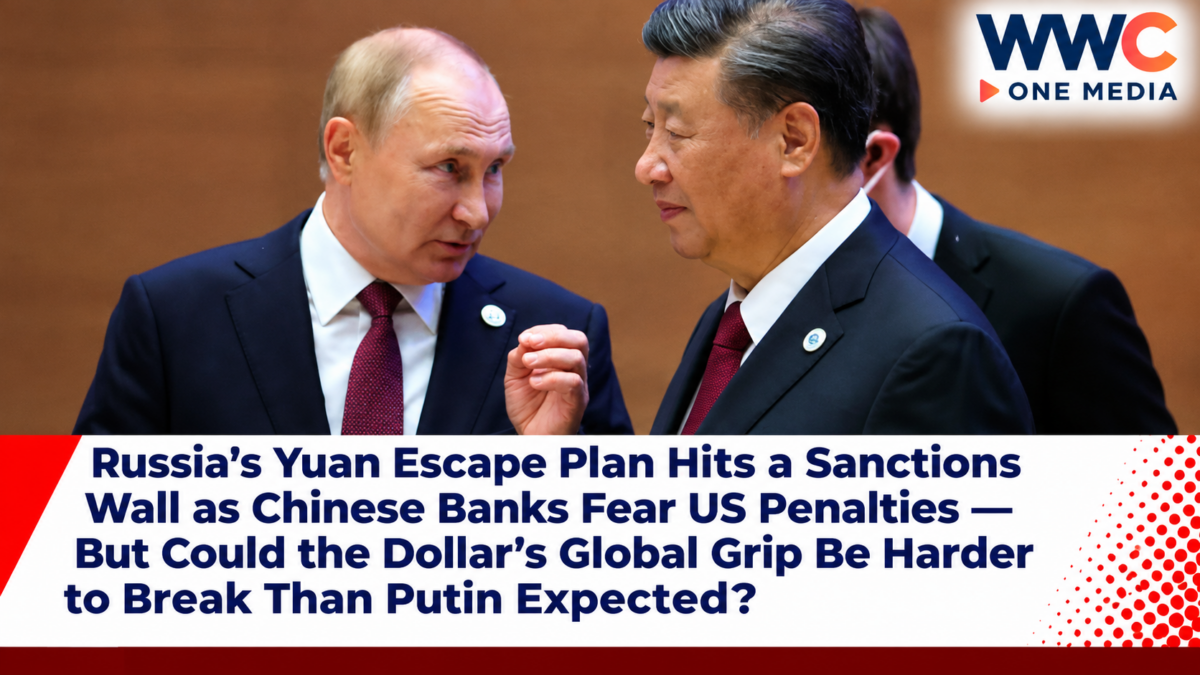
MOSCOW, RUSSIA / BEIJING, CHINA — November 11, 2026 — Russia’s ambitious effort to escape the dominance of the US dollar by embracing China’s yuan is encountering a major financial obstacle: the Chinese banks needed to make the strategy work remain deeply concerned about American sanctions.
For years, Moscow has promoted the yuan as a way to keep international trade flowing after Western governments restricted Russian banks and companies over the invasion of Ukraine.
The strategy transformed how Russia conducts business with China, its most important trading partner.
Dollar and euro transactions declined sharply, while payments in yuan and rubles became the dominant method of settling bilateral trade.
But new reporting and financial research show that the transition has created vulnerabilities of its own.
Chinese banks are subjecting Russia-related transactions to stringent scrutiny, international payment routes have become more complicated, and Russian financial institutions have repeatedly experienced shortages of yuan liquidity.
According to Bloomberg’s November 11 report, Russia’s effort to replace dollar dependence with the Chinese currency is being undermined by the very sanctions it was meant to escape.
The warning comes as Russia continues relying heavily on China for trade, technology and energy revenue.
Yet the economic relationship is increasingly exposing Moscow to decisions made by Chinese financial institutions and regulators.
The critical question is whether Russia has genuinely escaped the dollar-based financial system—or merely exchanged one form of dependence for another.
Russia’s De-Dollarization Strategy Runs Into a New Problem
Russia began accelerating its shift away from the dollar after Western governments imposed sweeping sanctions following its full-scale invasion of Ukraine in February 2022.
The restrictions affected major Russian banks, financial institutions, companies and individuals.
Some Russian lenders lost access to important international payment services.
Western authorities also immobilized substantial Russian central-bank assets.
The objective was to limit Moscow’s access to international finance and increase the economic cost of continuing the war.
Russia responded by redirecting trade toward countries willing to maintain commercial relationships, particularly China and India.
Moscow also increased its use of the yuan and ruble in cross-border payments.
The strategy achieved meaningful results.
By May 2026, Russian officials said practically all settlements in bilateral trade with China were being conducted in local currencies.
That represented a substantial departure from the previous reliance on the dollar.
But changing the currency used on an invoice does not automatically remove the international banking system from the transaction.
Companies still require financial institutions willing and able to transfer money, settle obligations and manage compliance risks.
That is where Russia’s strategy is encountering resistance.
Chinese Banks Fear Losing Access to the US Financial System
One of the biggest obstacles is the threat of secondary sanctions.
Unlike measures imposed directly on designated Russian entities, secondary sanctions can expose certain foreign institutions to penalties for facilitating prohibited transactions.
Chinese banks therefore face a difficult commercial calculation.
They want to serve customers involved in trade with Russia.
But they must also protect their access to major international currencies, correspondent banking relationships and overseas financial markets.
For large lenders, the consequences of violating US restrictions could outweigh the profits from individual Russia-related transactions.
This has encouraged more extensive screening and compliance checks.
In June 2026, South China Morning Post reported that Chinese banks were increasingly relying on complicated payment routes and intermediary institutions.
Alexander Vedyakhin, first deputy chairman of Russia’s Sberbank, described repeated gaps in the cross-border payment infrastructure.
He said transactions had become more complicated as banks added intermediaries, some of which rejected payments.
The result is a striking contradiction.
Russia can negotiate contracts in yuan while still struggling to complete payments through the financial institutions necessary to process them.
Why the Yuan Has Not Fully Replaced the Dollar
The yuan has become far more important to Russia’s economy.
But its international role remains different from that of the US dollar.
The dollar benefits from extensive global banking networks, deep financial markets and broad use in international trade and investment.
China’s currency is subject to capital controls and restrictions on its convertibility.
These measures give Beijing considerable influence over how yuan funds move between domestic and international markets.
A Russian company receiving yuan from a Chinese customer may be able to use that currency to purchase Chinese goods.
But using those funds elsewhere can be more complicated.
A November 2026 analysis in The Diplomat argued that yuan-based trade can help sanctioned economies reduce their direct exposure to the dollar while leaving them dependent on China’s financial infrastructure.
That limits the currency’s usefulness as a universal replacement for the dollar.
For Russia, the problem is not simply obtaining yuan.
It is obtaining enough accessible yuan, through reliable financial institutions, when payments must be made.
Yuan Liquidity Shortages Create New Financial Risks
Russia’s dependence on the yuan has also generated liquidity problems.
In March 2026, yuan swap rates in Russia surged above 40%, according to Reuters.
The spike reflected strong demand for the currency alongside limited available liquidity.
Russian banks had extended yuan-denominated financing, while inflows of the currency were constrained by weaker oil-related earnings earlier in the year.
When customers withdrew or needed yuan, some financial institutions had to obtain additional funds through short-term markets.
The resulting pressure pushed borrowing costs sharply higher.
In April, Bank of Russia Governor Elvira Nabiullina said the central bank was considering requiring commercial banks to maintain separate mandatory yuan reserves.
The proposal was intended to reduce the likelihood of further liquidity shortages.
It also highlighted a serious vulnerability.
Russia had embraced the yuan as a relatively practical alternative to Western currencies.
But that did not guarantee that yuan funding would remain consistently available or affordable.
The reserve proposal was under consideration at the time of Reuters’ April report; its announcement should not be confused with confirmation that every planned requirement had entered into force.
Research Shows the Yuan’s Share of Russian Trade Has Retreated
A study published by the Swedish Institute of International Affairs provides additional perspective.
The research found that the yuan’s share of Russia’s total foreign trade rose from approximately 2% in 2022 to a peak of around 40% in early 2024.
By 2025, the estimated share had fallen to approximately 30%, partly because of stronger US sanctions pressure.
That does not mean the yuan had returned to its prewar position.
A share near 30% remains dramatically higher than before Russia’s invasion of Ukraine.
But the retreat suggests that the currency’s rapid expansion encountered practical limits.
The study also found that the yuan and ruble together accounted for approximately 95% of bilateral Russia–China settlements, according to Russian officials.
These figures measure different things.
The yuan’s share of all Russian foreign trade is not equivalent to the combined yuan-and-ruble share of transactions specifically involving China.
Treating them as interchangeable would distort the findings.
The more accurate conclusion is that local-currency trade between Moscow and Beijing remains widespread, even as sanctions and banking restrictions constrain the yuan’s broader expansion.
Russia’s $240 Billion China Trade Relationship Is Still Growing
The financial difficulties have not brought trade between Russia and China to a halt.
China remains one of Russia’s most important commercial partners.
Bilateral trade has been worth approximately $240 billion annually in recent reporting.
Russian exports include crude oil, natural gas and other commodities.
Chinese companies supply Russia with vehicles, machinery, electronics and industrial goods.
The latest customs figures demonstrate that commercial activity remains substantial.
Reuters reported on November 10 that China’s exports to Russia totaled 75.7 billion yuan in October, an increase of 25.2% from a year earlier.
However, the growth rate slowed from 44.1% in September.
Chinese imports from Russia reached 112.44 billion yuan, up 43.9% year over year.
That produced a Chinese trade deficit with Russia of approximately 36.74 billion yuan for the month.
These figures show that bilateral trade continues despite payment complications.
They also illustrate why the relationship remains important for both governments.
Russia needs markets for its energy exports.
China benefits from access to Russian raw materials and a substantial market for manufactured goods.
But continued trade does not mean every commercial transaction is processed smoothly.
Smaller Chinese Banks Face Increasing Scrutiny
As major Chinese lenders became more cautious, businesses connected to sanctioned markets explored alternative banking channels.
Some transactions have involved smaller regional institutions and intermediary companies.
However, these arrangements can attract scrutiny from sanctions authorities.
The Wall Street Journal reported in November that Zhejiang Chouzhou Commercial Bank had appeared in financial records associated with Russian and Iranian transaction networks.
The reporting involved alleged sanctions-related payment arrangements and documents reviewed by journalists.
The bank disputed aspects of the allegations and said it complied with applicable laws.
The available evidence did not establish that the institution knowingly processed every transaction attributed to the networks or that all attempted payments were completed.
The case nevertheless illustrates the broader challenge.
Using a smaller financial institution does not automatically eliminate sanctions exposure.
Banks must still consider applicable restrictions, transaction counterparties and their connections to international finance.
For companies, arrangements relying on intermediary institutions may also create delays, additional costs and uncertainty.
US Sanctions Are Increasing Pressure on Russia’s Trading Partners
Washington has continued seeking ways to constrain Russia’s access to international revenue.
The pressure extends beyond Russian banks and businesses.
Foreign companies and governments that maintain commercial relationships with Moscow can face additional scrutiny, particularly when transactions involve designated entities or restricted sectors.
In related reporting, WWC ONE MEDIA examined the September 2026 expansion of US sanctions authority over Russian energy and the possibility of tariffs reaching major foreign buyers.
That development illustrates how Washington’s economic strategy can influence commercial decisions made outside Russia.
However, the existence of authority to impose penalties does not mean every foreign company or country has automatically been sanctioned.
Actual legal obligations and potential penalties depend on the specific measures and transactions involved.
For Chinese banks, uncertainty over future restrictions can be sufficient to encourage a cautious approach.
Lenders may decline transactions even when the exact legal risks are not publicly established.
This is one reason international financial sanctions can influence trade beyond the institutions directly named in official restrictions.
India Also Faces Difficult Choices Over Russian Energy
China is not the only major economy balancing commercial ties with Russia against American pressure.
India has become a major buyer of Russian crude oil since the beginning of the Ukraine war.
Discounted supplies have helped Indian refiners meet energy demand while diversifying sources of imported petroleum.
But additional US restrictions threaten to complicate those arrangements.
As WWC ONE MEDIA reported on India’s response to proposed penalties on countries purchasing Russian oil, New Delhi has emphasized energy security as a central consideration in its trade decisions.
For India and China, Russian oil purchases involve more than geopolitics.
They affect refinery economics, energy availability, transportation and domestic prices.
But the risks differ according to each country’s payment systems, banking relationships and exposure to Western markets.
Russia’s experience with the yuan illustrates why changing settlement currencies does not necessarily eliminate those risks.
Russia’s Shadow Fleet Reveals Another Side of the Sanctions Battle
Financial restrictions are only one part of the economic pressure confronting Moscow.
Western governments have also targeted vessels and companies associated with Russian oil exports.
These measures have contributed to complicated shipping arrangements and rising compliance costs.
The issue has become especially important amid disruption to global oil transportation.
That separate development highlights the difficult balance between restricting sanctioned trade and maintaining functioning global energy markets.
An authorized vessel transaction does not automatically remove all restrictions on the cargo it may transport.
Similarly, a yuan-denominated payment does not automatically make an otherwise prohibited transaction permissible.
Sanctions compliance depends on the parties, activities and rules involved, not simply the currency used.
For Moscow, this means changing the financial architecture surrounding trade is only part of the challenge.
Could Russia Eventually Return to Dollar-Based Transactions?
An unexpected possibility emerged earlier in 2026.
In February, Bloomberg reported that an internal Kremlin document had considered the potential for renewed US dollar settlement as part of a wider improvement in relations between Russia and the United States.
The proposal reportedly formed part of discussions about possible cooperation in energy, critical materials and other industries.
However, this was not evidence that Russia had already restored unrestricted access to dollar-based international payments.
Such a shift would require significant changes to applicable sanctions and banking arrangements.
It would also raise political questions about Moscow’s relationship with Beijing.
Russia has invested heavily in expanding financial ties with China.
Returning to the dollar could improve access to certain international markets if restrictions were lifted.
But it might reduce the importance of financial arrangements developed with Chinese partners.
The reported proposal suggests that Moscow’s approach to currency settlement may be more pragmatic than its public opposition to dollar dominance sometimes implies.
The Kremlin has strong incentives to preserve payment channels that work, regardless of the currency involved.
Is the US Dollar Really Losing Its Dominance?
Russia’s experience offers a broader lesson about international finance.
Countries can reduce their use of the dollar in bilateral trade without creating a complete replacement for the dollar-based financial system.
The dollar remains deeply embedded in international banking, foreign-exchange markets, global borrowing and reserve management.
China’s yuan has expanded its international role, particularly in trade involving countries seeking alternatives to Western financial channels.
But widespread use requires more than trade agreements.
It depends on liquidity, reliable financial institutions, convertibility and the confidence of businesses using the currency.
A research paper published by the Centre for Economic Policy Research in October examined the effects of financial sanctions on international payment networks.
Its authors found that sanctions had reduced targeted banks’ access to major-currency networks and encouraged some institutions to turn toward alternative payment channels, particularly those involving the yuan.
However, the study concluded that the wider movement away from the dollar remained limited.
This helps explain why Russia’s experience is attracting attention beyond Moscow.
The issue is not whether the yuan can be used for international transactions.
It clearly can.
The question is whether it can provide the same global financial flexibility as the dollar.
China Gains Influence as Russia Becomes More Dependent
The financial difficulties also reveal an increasingly unequal relationship between Moscow and Beijing.
Russia needs access to China’s market, banking services and industrial products.
China benefits from Russian energy and commercial opportunities but maintains broader relationships with the global economy.
That difference gives Chinese institutions reasons to protect their international financial access.
If a Russian transaction threatens those relationships, a Chinese bank may choose not to process it.
Russia cannot necessarily compel the bank to accept the payment.
China’s authorities also maintain control over the international movement of yuan funds.
This means Moscow’s effort to escape Western financial influence may increase its dependence on Chinese policy decisions.
That is a significant geopolitical trade-off.
De-dollarization can reduce certain vulnerabilities while introducing different ones.
A currency strategy intended to strengthen financial sovereignty may leave Russia dependent on the preferences of another major power.
What the Financial Pressure Means for Russia’s Economy
Payment difficulties can affect businesses in several ways.
Importers may face longer settlement periods or require additional financial intermediaries.
Exporters may have difficulty receiving payments promptly.
Companies may incur higher financing costs or maintain larger cash buffers to manage uncertainty.
Banks may need to secure additional liquidity.
These problems do not automatically prevent international trade.
But they can make routine transactions more expensive and less predictable.
For Russia, the pressures are arriving amid the substantial economic cost of the ongoing war in Ukraine.
The European Union and other Western governments have continued expanding sanctions affecting energy, finance and technology.
As WWC ONE MEDIA reported during the International Monetary Fund’s October meetings, where geopolitical tensions and Russia’s financial isolation were among the issues highlighted, Russia’s economic relations remain deeply affected by the conflict.
However, the existence of significant sanctions pressure does not mean the Russian economy has completely collapsed.
Moscow continues trading internationally, earning revenue and operating a domestic banking system.
The question is how costly those adaptations become over time.
What This Means for the Philippines and Asian Financial Markets
The Russia–China currency dispute is relevant to the wider Asian region because it demonstrates the importance of international payment infrastructure.
Asian businesses conduct trade through a variety of currencies, including the US dollar, Chinese yuan and domestic currencies.
Reliable cross-border settlement is essential for importers, exporters, banks and investors.
When sanctions or compliance restrictions interfere with payments, companies may face additional documentation requirements, delays and financing costs.
The Philippines is not directly involved in Russia’s yuan-liquidity problem.
Nor is there evidence that ordinary Philippine banking transactions have been disrupted by the specific Russia–China payment issues described in the reporting.
However, the broader lesson applies to all businesses engaged in international trade.
Currency choice is only one component of financial risk.
Companies must also consider banking access, regulatory requirements, exchange-rate movements and counterparty reliability.
For developing economies, maintaining diverse and stable international financial relationships can help reduce exposure to disruptions.
What Happens Next for Russia’s Yuan Strategy?
Several developments will determine whether Moscow can stabilize its currency-payment arrangements.
First, Russian banks will need to manage their yuan liquidity more effectively.
Second, Chinese institutions will continue evaluating the sanctions risks associated with Russia-related transactions.
Third, trade and energy flows will influence the volume of yuan entering the Russian financial system.
Fourth, any changes in US sanctions could affect the willingness of international banks to provide payment services.
Fifth, China’s financial regulations will continue influencing how freely yuan funds can move across borders.
Finally, developments in the Ukraine conflict and negotiations involving Russia, the United States and Europe may influence the overall sanctions environment.
A reduction in payment problems would strengthen Moscow’s existing currency arrangements.
Further restrictions, however, could make the system more expensive and fragmented.
The Bigger Picture: Russia Escaped the Dollar, But Not the Power of US Sanctions
Russia’s experiment with the yuan has produced both achievements and setbacks.
Moscow has dramatically reduced its direct reliance on the dollar in bilateral trade with China.
Local-currency transactions now account for the overwhelming majority of payments between the two countries.
But the shift has not removed the influence of the United States from international finance.
Chinese banks remain cautious about sanctions.
Cross-border transactions can be delayed or rejected.
Yuan liquidity has periodically become expensive.
And China’s currency controls limit how freely funds can be moved into other markets.
For Moscow, the result is an uncomfortable realization.
Replacing the dollar in trade contracts is easier than replacing the financial institutions, global networks and market liquidity that support international commerce.
For Beijing, the challenge is maintaining trade with Russia without exposing its own banks to unacceptable financial risks.
And for the world economy, Russia’s experience provides a real-world test of how far de-dollarization can advance under heavy sanctions.
Russia spent years promoting the Chinese yuan as its escape route from Western financial pressure. But as Chinese banks tighten controls and Moscow faces recurring shortages of yuan liquidity, has Vladimir Putin found a genuine alternative to the US dollar—or merely discovered that changing currencies cannot escape Washington’s influence over global finance?