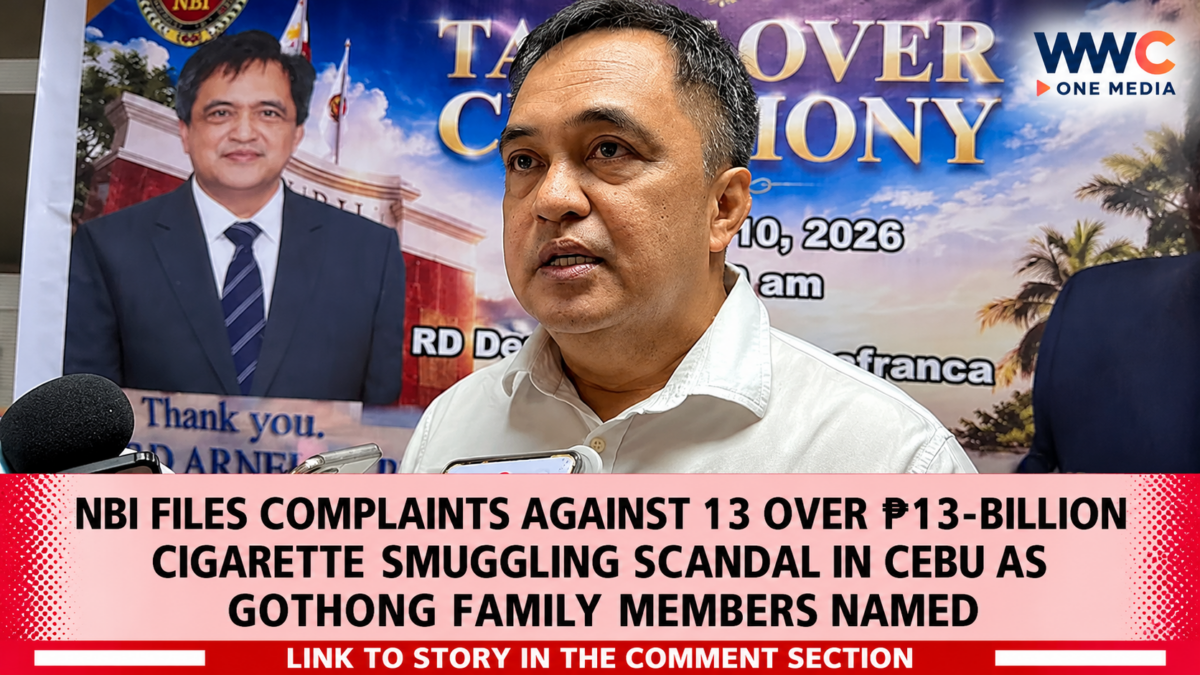
The National Bureau of Investigation (NBI) has filed criminal complaints against 13 individuals over an alleged ₱13-billion cigarette smuggling operation involving 59 shipping containers seized in Cebu, putting a major spotlight on the country’s fight against large-scale agricultural economic sabotage.
The complaints, filed before the Department of Justice (DOJ) on November 9, 2026, involve alleged violations of Republic Act No. 12022, or the Anti-Agricultural Economic Sabotage Act. Among those named are members of the prominent Gothong family, corporate personnel and individuals allegedly involved in arranging the transportation and movement of the shipments.
The investigation centres on 59 containers of foreign cigarettes confiscated at a private port in Mandaue City, Cebu. Authorities have traced the shipments to China, with investigators examining how the goods entered the country, passed through port facilities and were allegedly moved towards other destinations for distribution.
The estimated value of the seized cigarettes has reached ₱13 billion, based on the Bureau of Internal Revenue’s assessment.
The case has now moved beyond the initial seizure. Investigators are attempting to establish who organised the operation, who facilitated the shipments and whether individuals connected to the movement of the containers knowingly participated in the alleged illegal trade.
13 Individuals Named as NBI Pursues the Alleged Smuggling Network
According to SunStar Cebu and The Freeman, the 13 respondents include several members of the Gothong family, corporate employees, alleged shipment facilitators and individuals associated with companies listed as consignees.
The Freeman identified the following individuals among those named in the complaints:
- Calvin Boniface Gothong
- Clement Bryan Gothong
- Liza Gothong
- Chad Benedict Gothong
- Lili Gothong
- Karen Joy Betasolo
- Rose Marie Trilles
- Jomar Demos
- James Gabriel Verallo
- Henry Lim Co
- Ted Lim Chan
Two other individuals were reportedly listed as unidentified respondents.
The NBI Cebu District Office, under outgoing director Arnel Pura, played a significant role in building the case. Investigators gathered witness affidavits, shipping and tracking records, corporate documents and other evidence to establish the alleged connections between individuals and the movement of the seized containers.
Pura said one of the individuals, James Gabriel Verallo, was allegedly identified as a facilitator who dealt with a trucking company to arrange the transportation of containers to Gothong Wharf.
However, the trucking company owner reportedly told investigators that the company was simply carrying out its regular business operations.
Investigators also examined corporate ownership information obtained from the Department of Trade and Industry and the Bureau of Internal Revenue to identify individuals connected to companies listed as shipment consignees.
Authorities have yet to establish whether all the registered consignees correspond to legitimate operating businesses or whether some may have been fictitious entities.
These allegations remain subject to the DOJ’s preliminary investigation. Being named in a complaint does not establish criminal guilt. The Freeman+1
How 59 Containers of Cigarettes Worth ₱13 Billion Were Seized
The case originated from enforcement operations conducted in June and July 2026, when authorities discovered large shipments of foreign cigarettes at facilities linked to private wharves.
The NBI’s investigation focused on 59 containers confiscated at Gothong Wharf in Mandaue City.
NBI Director Melvin Matibag said intelligence information indicated that the cigarettes were transferred from larger vessels to smaller domestic boats before being brought to a private port in Cebu.
From there, investigators believed the shipments were moved through other ports, including Manila’s North Harbor, for possible distribution across the country.
The Philippine Star reported that the cigarettes carried different brand names with European-sounding labels, although investigators traced the shipments to China.
The estimated value also increased substantially during the investigation. Initial reports placed the seized goods at approximately ₱3 billion, but the BIR’s assessment raised the figure to around ₱13 billion.
That valuation makes the case one of the major cigarette-smuggling investigations reported in the country this year. Philstar+1
NBI Says Investigation Targets More Than Truck Drivers and Cargo Handlers
One significant aspect of the case is the NBI’s effort to examine the alleged organisers and facilitators behind the shipments rather than limiting the investigation to people physically transporting the goods.
NBI Director Matibag said the government wanted to hold individuals higher up in the alleged operation accountable.
The investigation is looking at the movement of the containers, the role of port facilities, the companies listed as consignees and the individuals who allegedly arranged transportation.
Matibag also said authorities were looking into possible involvement by law enforcement personnel. However, no law enforcement officials had been included among the 13 respondents in the complaints described in the reports.
This distinction is important because investigators have not yet publicly established the complete structure of the alleged network or how long it may have operated.
The NBI is also examining whether additional shipments may have entered the country undetected before the June seizure.
Gothong Companies Respond to the Allegations
The complaints have prompted responses from companies associated with the Gothong shipping and logistics group.
Gothong Southern Shipping Lines Inc. said it was not currently the subject of an investigation concerning the reported transportation of foreign cigarettes.
The company said it respects due process and the authorities’ responsibility to establish the facts. It also reaffirmed its commitment to transparent and lawful trade.
Meanwhile, Carlos A. Gothong Lines Inc. said it had not received formal notice of the complaints and maintained that it had unwittingly transported sealed containers in its capacity as a domestic common carrier.
These statements are important because the investigation involves allegations concerning the movement of cargo through port and transport facilities. The presence of containers at a facility, or their transportation by a carrier, does not automatically prove that every company involved knew the contents were allegedly illegal.
The NBI and prosecutors will need to establish the specific involvement, knowledge and responsibilities of each respondent.
The companies’ responses also underline why the case must proceed through the proper legal process rather than treating allegations as established findings. SunStar Publishing Inc.+1
What Is the Anti-Agricultural Economic Sabotage Act?
The complaints were filed under Republic Act No. 12022, known as the Anti-Agricultural Economic Sabotage Act, which was signed into law in September 2024.
The legislation strengthens the government’s response to large-scale agricultural smuggling and related economic offences. Its coverage includes tobacco products such as cigarettes.
The law is intended to address organised smuggling activities that undermine legitimate businesses, disrupt markets and deprive the government of taxes and other revenues.
In the Cebu case, the NBI is pursuing allegations involving the importation, handling and transportation of large quantities of cigarettes that authorities say entered the country illegally.
The law provides severe penalties for qualifying agricultural economic sabotage offences. However, the applicable charges, potential penalties and liability of each respondent will depend on the evidence and findings of the DOJ and, if the case proceeds, the courts.
The complaints are not yet convictions, and the respondents retain their right to due process and the presumption of innocence.
Government Could Have Lost Billions in Tax Revenue
Beyond the value of the confiscated cigarettes, the alleged operation raises serious questions about lost government revenue.
NBI officials have estimated that the potential tax losses could reach approximately ₱6.5 billion, roughly half of the reported ₱13-billion value of the seized goods.
Illicit cigarette trading can deprive the government of excise taxes and other applicable duties. It can also place legitimate manufacturers, distributors and retailers at a disadvantage because illegal operators may avoid costs that lawful businesses are required to pay.
The impact goes beyond government collections. Tobacco excise taxes help finance public programmes, including health-related spending under the Universal Health Care framework.
The Philippine Information Agency has previously reported that illegal tobacco operations have been linked to tax evasion and wider criminal activities, including concerns involving human trafficking in some manufacturing operations.
WWC ONE MEDIA has also examined the regional scale of the problem in Philippines and Southern Malaysia Emerge as Key Hubs for Illicit Tobacco Networks.
The report discussed how criminal networks exploit maritime routes and differences in tax and customs systems to move illicit tobacco products across Southeast Asia.
Cebu Smuggling Case Reflects a Wider Nationwide Crackdown
The ₱13-billion Cebu investigation is not an isolated enforcement operation.
In September 2026, authorities reported the seizure of approximately ₱960 million worth of suspected smuggled cigarettes carried by 15 trucks across parts of Central Luzon.
Investigators were also trying to identify the people who financed and organised the shipments rather than focusing only on the drivers and individuals caught transporting the products.
WWC ONE MEDIA previously covered the operation in 15 Trucks, ₱960M in Suspected Smuggled Cigarettes Seized in Central Luzon.
Another major discovery occurred in Palauig, Zambales, where authorities reportedly found four containers believed to contain smuggled cigarettes at a controversial pier.
The discovery raised questions about the use of private coastal facilities and the monitoring of suspicious cargo movements.
That case was examined in ₱146-M Smuggling Bust Rocks Zambales as Authorities Investigate a Controversial Pier.
Meanwhile, the Bureau of Customs announced a separate June 2026 operation involving 23 containers of illicit cigarettes valued at approximately ₱1.716 billion. The shipment was linked to movements between private wharves in Cebu and Manila, with some containers initially declared as consumer goods.
The operation involved the BOC, NBI, BIR and Philippine Coast Guard. Bureau of Customs+2
These separate cases point to a recurring enforcement challenge: identifying the people who finance, organise and profit from illegal tobacco shipments moving through the country’s ports, warehouses and road networks.
The 59 Containers Remain Under Customs Custody
According to The Freeman, the 59 seized containers remained at the port under 24-hour security provided by the Bureau of Customs.
The BOC reportedly requested that the containers be transferred to its own port area to reduce the burden on personnel assigned to guard the shipments.
Their continued custody is important because the cigarettes and associated shipping records may serve as evidence during the preliminary investigation and any subsequent court proceedings.
The DOJ will evaluate the complaints and supporting documents to determine whether there is sufficient basis to proceed against the respondents.
The investigation may also lead to further inquiries into the ownership of the consignee companies, the origin of the shipments and the possible involvement of other individuals.
The Bigger Question Is Who Controlled the Alleged ₱13-Billion Operation
The NBI’s filing of complaints against 13 individuals marks a significant development in the investigation, but it does not close the case.
Authorities still need to establish how the shipments were organised, who financed the operation, who controlled the cargo and whether other individuals or entities played a role in moving the cigarettes across the country.
For Cebu, the case has placed private port operations and cargo monitoring under renewed scrutiny. For the national government, it represents another test of its ability to disrupt large-scale smuggling networks and protect billions of pesos in potential tax revenue.
The 59 containers may have been seized, but the investigation is now focused on the people and businesses allegedly connected to their movement.
The decisive question is whether prosecutors can turn the NBI’s evidence into a case that identifies and holds the actual organisers accountable—without compromising the rights of those who have been accused.