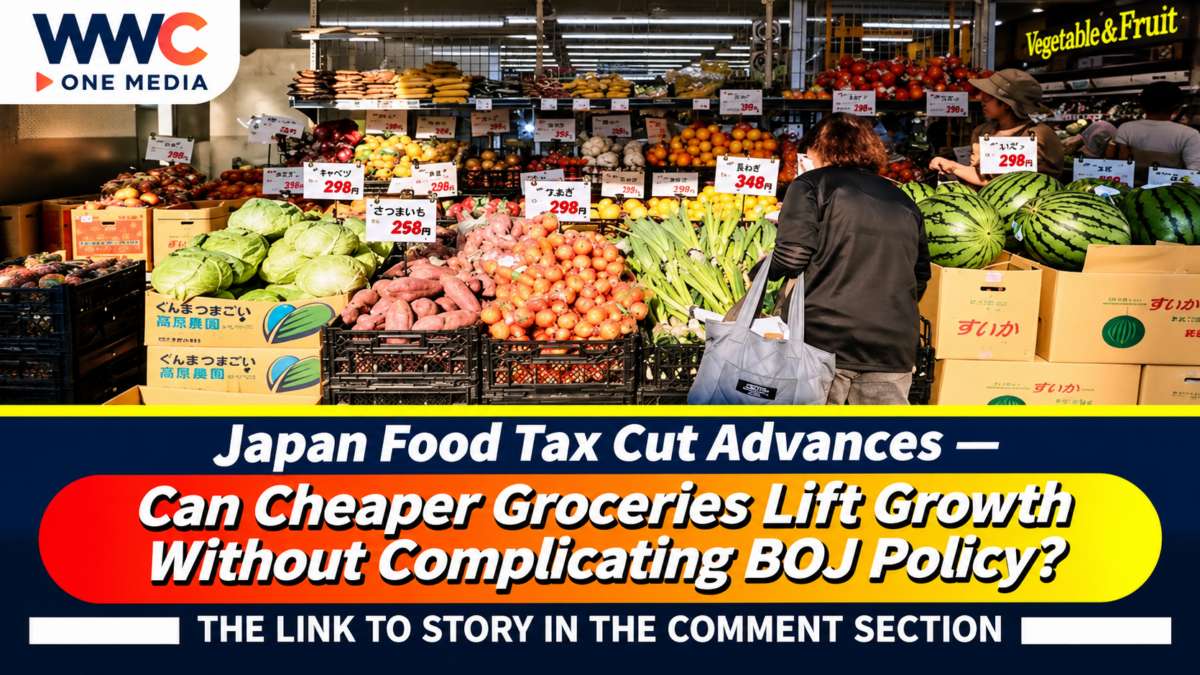
Japan’s plan to reduce the consumption tax on eligible food and beverages from 8% to 1% moved closer to implementation after the lower house approved the government bill on Nov. 6, 2026. The upper house was still considering the measure in the latest parliamentary record reviewed on Nov. 18, making its proposed April 2027 start a policy target rather than an accomplished tax change.
The economic question is larger than the price printed on a supermarket receipt. Lower taxation may leave households with more spending power, but the eventual benefit depends on retailer pricing, consumer behaviour and how the government finances the lost revenue. They also matter to the Bank of Japan (BOJ).
Japan food tax cut: what the bill actually changes
Japan’s Ministry of Finance identifies an existing 8% reduced consumption-tax rate for eligible food and beverages and a 10% standard rate. The reduced category excludes alcoholic drinks and restaurant dining.
The government’s proposal would temporarily set the applicable food rate at 1% for two years beginning in April 2027. The government calls it transitional relief.
A plan announced by the Cabinet is not the same as an enacted law. The House of Representatives’ legislative register shows the bill was submitted on Oct. 9, approved in the lower house on Nov. 6 and referred to an upper-house special committee on Nov. 11. Final approval is not recorded.
WWC has previously examined the parliamentary obstacles facing Japan’s food-tax proposal. The latest confirmed development is progress through one chamber, not completion of the full legislative process.
Will the full tax reduction reach shoppers?
The distinction between a tax-rate reduction and a retail-price reduction is important. Businesses set pretax prices, and the amount paid by a shopper can also change with wholesale costs, wages, rents and competition.
In an Oct. 14 parliamentary exchange, Finance Minister Satsuki Katayama acknowledged that factors beyond consumption tax affect retail prices. She said the government had not produced a numerical estimate of the policy’s consumption stimulus, because stimulating consumption was not its direct purpose.
The finance minister identified an estimated annual revenue reduction of ¥4.3 trillion for the national and local governments combined if the eligible rate fell from 8% to 1%. That is a fiscal estimate in parliamentary testimony, not a guarantee that households will receive identical savings or spend every yen saved.
Analysis: Groceries are recurring essentials, so a lower tax can support purchasing power if retailers pass through savings. Households might save the difference instead. Claims about a guaranteed surge in consumption would go beyond the official evidence.
The growth argument meets a cautious economic backdrop
Japan’s Cabinet Office released its first preliminary gross domestic product estimate for the July–September quarter on Nov. 16. The timing places the tax debate against a recent assessment of economic momentum, but a GDP release does not isolate the future effect of a tax policy that has not yet taken effect.
The BOJ’s October economic outlook anticipated moderate growth while identifying uncertain influences on prices and activity. Its monetary-policy role is different from the government’s decision on taxation: the government proposes fiscal relief, while the central bank assesses conditions for price stability.
In a published Nov. 7 speech, BOJ Governor Kazuo Ueda discussed the longer-term imbalance between domestic saving and investment. That speech is not evidence that he made a particular claim on Nov. 18 about the proposed food-tax reduction.
The latest exact remarks attributed to Ueda on Nov. 18 were not independently confirmed in an authenticated primary transcript for this article. Accordingly, the growth effect is assessed here from the government’s tax plan, the parliamentary evidence and the central bank’s published outlook—not presented as a verbatim quotation from the governor.
Why inflation and interest rates complicate the picture
Reducing a consumption-tax rate can mechanically lower the tax-inclusive price of eligible goods if their pretax prices remain unchanged. That would be different from a sustained reduction in the underlying rate at which businesses raise prices.
The BOJ’s objective of price stability requires it to distinguish one-off changes in administered or tax-inclusive prices from broader price and wage trends. A temporary tax adjustment can affect measured inflation while leaving other pressures, including imported costs and service prices, in place.
An eventual improvement in real purchasing power could also influence demand. Its size would depend on the prices actually charged and on how households allocate any savings. Neither the direction of the next BOJ policy-rate move nor the magnitude of a growth boost follows automatically from the tax proposal.
WWC’s earlier analysis of Japanese household-spending pressures offers context for why disposable income matters. Actual consumption and price data will be needed.
Who pays for the relief, and what happens to businesses?
Cutting a tax also reduces government revenue unless another measure offsets the loss. That makes the proposal a budget question as well as a household question, particularly because national and local governments both receive portions of consumption-tax revenue.
The Oct. 14 parliamentary record includes questions about effects on restaurants, food producers and smaller businesses. The government discussed potential support measures and the challenge of ensuring that tax changes are reflected fairly in consumer prices.
Different treatment of groceries and dining may alter purchasing, while businesses face system changes.
WWC has also explored the funding and bond-market questions surrounding the proposed tax reduction. Those financing issues remain distinct from the question of whether shoppers actually pay less at checkout.
What happens next
The next legal milestone is upper-house consideration and any final enactment and promulgation. Until that happens, businesses and households should treat the proposed 1% rate and April 2027 launch as conditional.
If enacted, the meaningful economic tests will be actual shelf prices, household spending, tax receipts and updated BOJ assessments of underlying inflation. Those data will show more than any simple promise that cheaper groceries necessarily produce stronger economic growth.
FAQ
Is Japan’s food consumption tax already 1%?
No. The published existing reduced rate for eligible food and drinks is 8%. The proposed 1% rate had passed the lower house but had not completed the upper-house process in the legislative record reviewed.
When would Japan’s proposed food tax cut start?
The government’s proposal identifies April 2027 and a temporary two-year period. Implementation depends on completion of the legislative process.
Would restaurant meals also be taxed at 1%?
The current reduced-rate framework generally excludes restaurant dining. The proposed change concerns eligible food and beverages, not an across-the-board reduction in the standard 10% rate.
Would cheaper food automatically lift Japan’s GDP?
No. The effect depends on retailers’ prices, consumer choices and other economic conditions. The finance minister told parliament that no numerical consumption-stimulus estimate had been prepared.