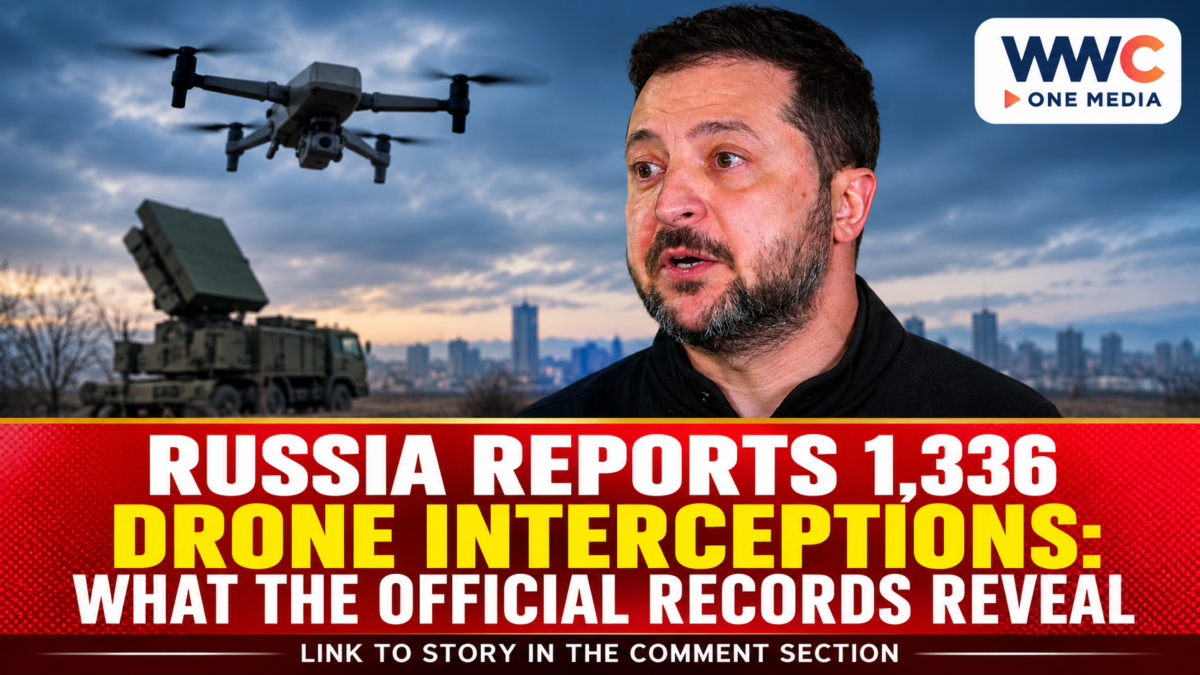
Russia’s Defence Ministry reported that its air-defence forces intercepted and destroyed 1,336 Ukrainian fixed-wing drones overnight into Monday, November 16, across multiple Russian regions and surrounding waters. Moscow Mayor Sergey Sobyanin separately reported that approximately 600 drones had headed towards the Moscow region during a 15-hour period, with 191 neutralised as they approached the capital.
The announcements provide a substantial picture of the scale of the aerial activity claimed by Russian authorities. However, the figures remain official Russian accounts, not independently verified totals of drones launched or destroyed.
The distinction matters because interception figures describe what authorities say their defence systems engaged. They do not, by themselves, establish the total number of aircraft launched, the number that reached their targets or the full extent of any damage.
Russian Drone Interceptions Cover Multiple Regions
The Russian Defence Ministry’s November 16 announcement identified 15 regional jurisdictions and two maritime areas where it said its air-defence forces had intercepted and destroyed drones.
The locations named were Tver, Belgorod, Bryansk, Kursk, Kaluga, Tula, Ryazan, Oryol, Voronezh, Vladimir, Smolensk, Nizhny Novgorod and Rostov regions, together with Krasnodar Territory, Crimea and the Moscow region.
The ministry also included the waters of the Sea of Azov and the Black Sea.
Its statement specifically described the aircraft as fixed-wing unmanned aerial vehicles.
The announcement did not provide a region-by-region breakdown of all 1,336 interceptions. It also did not publish a corresponding total for drones launched during the reported operation.
That limits what can be concluded from the headline number.
The figure establishes the scale of the ministry’s reported defensive activity, but it does not independently demonstrate the effectiveness of every interception or establish whether any aircraft reached intended targets.
Moscow Reports a Separate Account of the Aerial Activity
The capital’s figures provide another part of the official account.
In a public message on November 16, Sobyanin said approximately 600 unmanned aerial vehicles had travelled towards the Moscow region between 5 p.m. on November 15 and 8 a.m. on November 16.
He added that most had been destroyed by defence systems at distant approaches.
The mayor specifically reported that 191 drones had been neutralised while approaching Moscow.
These figures should be read within their stated geographical and reporting scope.
The approximately 600 drones refer to activity directed towards the wider Moscow region, while the 191 figure refers to those neutralised on approach to the capital.
The 191 should not be treated as an additional number on top of the 600. Nor should the Moscow figures be added to the Defence Ministry’s nationwide total without a clear accounting of the reporting periods and geographical overlap.
For readers, that distinction is important when comparing figures released by different authorities.
What the Numbers Do — and Do Not — Establish
Large interception totals can attract attention because they suggest sustained pressure on air-defence networks across a wide geographical area.
But a reported interception is not the same as an independently documented launch, impact or confirmed destruction.
The Russian Defence Ministry’s statement does not disclose the technical evidence behind the 1,336 figure, the individual engagement records or a detailed assessment of the operation’s results.
It also does not provide a complete account of civilian casualties, infrastructure damage or economic disruption associated with the reported activity.
Those omissions should not be filled with estimates or details taken from unverified accounts.
WWC ONE MEDIA has previously examined the expanding use of long-range drones in its coverage of Russia’s reported 92 drone interceptions over the Leningrad region and a separate drone incident involving the Ust-Luga oil export hub.
Those earlier incidents provide context for the continuing importance of air defence and infrastructure security. They are separate events and should not be confused with the November 16 announcement.
A Wider Drone Campaign Continues to Shape the War
Long-range unmanned aircraft have become an important feature of the Russia-Ukraine conflict.
Their use places pressure on military installations, logistics networks, industrial facilities and air-defence systems far from the front line.
For Russia, the reported activity across numerous regions highlights the geographical challenge of protecting a large national territory.
For Ukraine, long-range drone operations form part of its broader military campaign against Russian targets. However, the November 16 Russian announcement alone does not establish the number of Ukrainian aircraft launched or the operational objectives behind each reported flight.
The wider conflict has also involved sustained Russian aerial attacks against Ukrainian territory.
WWC has previously examined the challenges facing Ukraine’s air-defence network and its ability to protect major cities.
A separate report on an earlier large-scale drone operation involving Moscow also illustrates why the reporting periods and geographical coverage behind military figures must be carefully distinguished.
The operational significance of the latest announcement cannot be determined from the interception total alone. Further information about the aircraft involved, their intended targets and the consequences of the operation would be necessary for a fuller assessment.
Why Independent Verification Matters
Military announcements are important primary records of what governments say happened. They are not automatically independent confirmation of every operational detail.
In an active conflict, access to engagement data, physical evidence and affected locations can be limited.
The same caution applies to statements released by either side.
A responsible assessment must distinguish between a government claim, an independently corroborated event and an analysis based on available evidence.
For the November 16 announcement, the Russian Defence Ministry’s published figure is clear. Independent confirmation of the full 1,336 total is not established by the available public record.
That does not make the announcement irrelevant. It means the figure must be presented with the correct attribution.
What Happens Next
Further official updates may clarify whether Russian authorities will release additional information about the reported interceptions, including regional breakdowns, damage assessments or further operational details.
The Moscow mayor’s separate figures may also be followed by additional information about the security situation around the capital.
For now, the key development is the scale of the activity claimed by Russia and the number of geographical areas included in its announcement.
Whether subsequent information confirms the full scale of the reported interceptions remains an important question.
The November 16 figures should therefore be treated as an official Russian account pending independent verification.
Frequently Asked Questions
1. How many Ukrainian drones did Russia say it intercepted?
Russia’s Defence Ministry reported intercepting and destroying 1,336 fixed-wing Ukrainian drones overnight into November 16, 2026.
2. Which Russian areas were included in the announcement?
The announcement named 15 regional jurisdictions, including the Moscow region, Krasnodar Territory and Crimea, as well as the Sea of Azov and Black Sea.
3. How many drones were reported near Moscow?
Moscow Mayor Sergey Sobyanin said approximately 600 drones headed towards the Moscow region between November 15 and November 16. He reported that 191 were neutralised on approach to the capital.
4. Has the figure of 1,336 been independently verified?
The full figure has not been independently established by the available public record. It should be attributed to the Russian Defence Ministry.
5. Does the interception figure reveal how many drones Ukraine launched?
No. The published announcement provides the Russian military’s claimed interception total, not a verified total of drones launched by Ukraine.