MOSCOW, RUSSIA / KYIV, UKRAINE / MANILA, PHILIPPINES — November 11, 2026 | WWC ONE MEDIA | World News, Russia-Ukraine War, Global Oil Markets and European Security
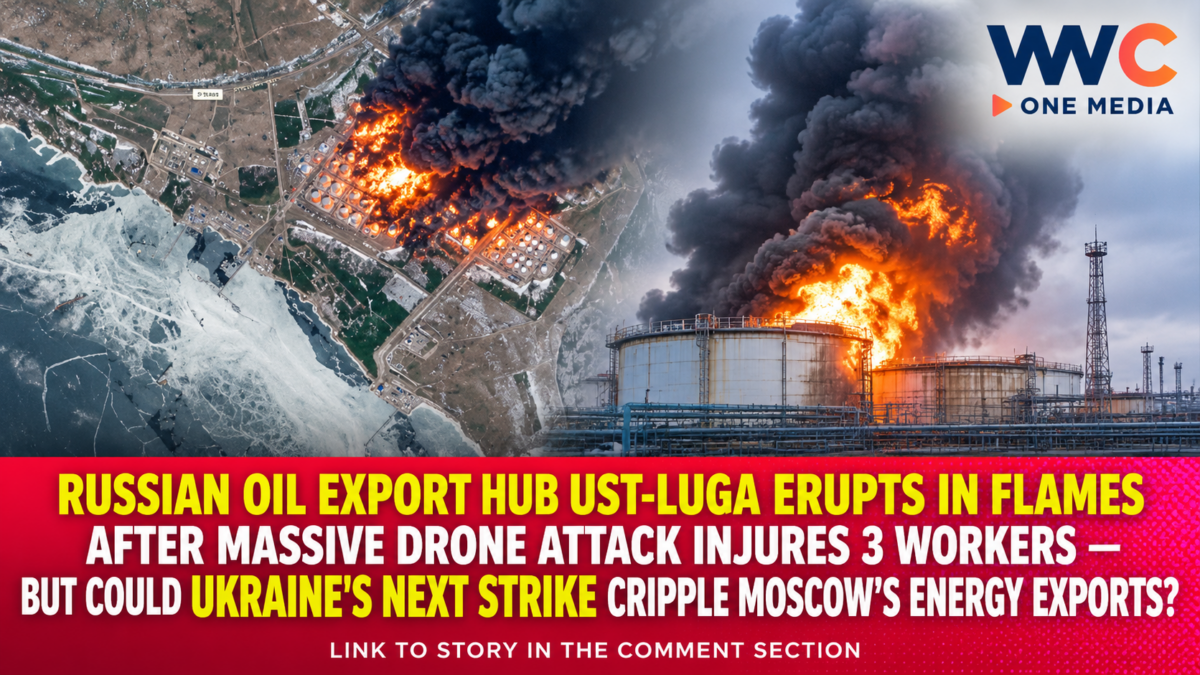
A massive overnight drone attack struck Russia’s strategically important Baltic Sea port of Ust-Luga on Wednesday, sparking a fire, injuring three workers and reportedly disrupting a local power facility as the war between Russia and Ukraine continued to spread beyond the front lines.
The attack targeted an area essential to Moscow’s international commodity trade, raising fresh concerns about the security of Russia’s oil-export infrastructure and the potential consequences for global energy markets.
Leningrad regional Governor Aleksandr Drozdenko reported that three workers were injured and that Russian air defenses had intercepted 150 drones over the region.
The governor also said a power facility was knocked out during the attack.
His account was reported by Reuters on November 11, although the news agency said it could not independently verify the claims.
Emergency crews were deployed to respond to the fire at Ust-Luga, one of Russia’s most important Baltic export hubs.
The incident triggered additional security precautions across Northern Europe.
Estonia, Latvia and Lithuania issued warnings about possible drone threats, while neighboring Finland temporarily restricted certain airspace and maritime activities.
The escalation came at an especially sensitive moment, with Russian and Ukrainian representatives meeting in Abu Dhabi for renewed US-mediated peace talks.
As diplomats search for a way to end the conflict, attacks on oil facilities and transport infrastructure are continuing. Could the latest fire at Ust-Luga increase pressure on Moscow—or will the widening drone war make a peace agreement even harder to achieve?
Drone Attack Sparks Fire at Russia’s Ust-Luga Port
The overnight attack occurred in Russia’s northwestern Leningrad region, which surrounds St. Petersburg and contains several major export facilities.
According to Governor Drozdenko, drones struck the Ust-Luga port area, starting a fire and injuring three workers.
He also reported an interruption involving a power facility.
Emergency responders worked to contain the blaze.
However, Russian authorities had not provided a comprehensive, independently verified assessment of the damaged infrastructure in the reporting available on November 11.
It remained unclear which specific port installations had been affected.
There was also no independently confirmed estimate of how much oil or other cargo capacity had been taken offline.
That distinction matters because a fire somewhere within a large port does not necessarily mean every terminal has stopped operating.
Ust-Luga contains multiple facilities handling different types of cargo.
The commercial consequences depend on whether loading equipment, storage facilities, pipelines or power systems suffered lasting damage.
Russia Claims 150 Drones Were Shot Down
The regional governor’s account described an exceptionally large aerial attack.
Initial reports cited different numbers of drones intercepted over Leningrad.
Some early updates referred to 92 drones, while others reported 146.
A later Reuters report cited the governor’s updated figure of 150.
These figures represent evolving official claims about the same period of attacks.
They should not be added together.
Reuters stated that the interception figures could not immediately be independently verified.
Likewise, the reported number of drones destroyed does not necessarily establish how many drones were originally launched or how many reached their targets.
The incident nevertheless illustrates the increasing geographic reach and intensity of the drone campaign inside Russia.
That October incident was separate from the November 11 Ust-Luga attack.
Together, the reports show the recurring threats facing Russia’s northwestern energy infrastructure.
Why Ust-Luga Is One of Russia’s Most Important Ports
Ust-Luga is a major Baltic Sea gateway for Russian commodity exports.
The port handles crude oil, refined petroleum products, grain and other cargo.
Its location provides access to international shipping routes connecting the Baltic with other markets.
The broader region also contains other important ports, including Primorsk and Vysotsk.
Russian energy companies rely on these facilities to transport products to international buyers.
Previous attacks have demonstrated the economic importance of the corridor.
Reuters reported in March that Ust-Luga handled approximately 700,000 barrels per day of oil exports at the time.
The port also shipped approximately 32.9 million metric tons of petroleum products during 2025, according to figures cited by Reuters.
Those historical figures provide context for the port’s importance.
They are not measurements of cargo lost during the November attack.
No verified report established that the November 11 fire had eliminated the port’s full handling capacity.
Ukraine’s Drone Campaign Is Increasing Pressure on Russian Energy Infrastructure
Ukraine has increasingly targeted oil refineries, storage facilities and export infrastructure inside Russia.
Kyiv’s stated objective is to weaken the energy revenues and industrial capabilities supporting Moscow’s war effort.
Oil-related infrastructure is economically important because petroleum exports generate revenue for Russia while domestic refining supports transportation, industry and military logistics.
Repeated attacks can increase maintenance costs, disrupt refinery operations and force companies to divert resources toward repairs and security.
However, the effectiveness of individual strikes varies.
A fire can damage a facility without permanently disabling it.
Some operations may resume quickly, while more extensive damage can require prolonged repairs.
In related reporting, WWC ONE MEDIA examined Russia’s growing fuel shortages and the challenge of maintaining domestic gasoline supplies after repeated Ukrainian strikes on refineries and petroleum facilities.
The previous fuel shortages provide important context for the latest attack.
But they do not establish that November’s Ust-Luga incident caused a new nationwide shortage.
That would require additional evidence about actual production and export disruptions.
Previous Attacks Have Already Interrupted Baltic Oil Shipments
Ust-Luga has experienced multiple attacks during 2026.
In March, Reuters reported that drone strikes damaged facilities at Ust-Luga and nearby Primorsk, contributing to temporary interruptions in oil and petroleum-product loadings.
In September, Ukraine said its forces had struck a Novatek oil-processing facility at Ust-Luga.
Bloomberg reported that the facility produced products including naphtha, jet fuel, marine fuel and gasoil.
The September operation was a separate incident, and Ukraine’s assessment of equipment damage could not be independently verified in full.
These earlier attacks demonstrate that the region has repeatedly faced threats to its petroleum infrastructure.
But reporting about previous shutdowns or damage should not be attributed automatically to the latest attack.
As of November 11, the extent of any interruption to cargo handling after Wednesday’s fire remained uncertain.
Baltic Countries Issue Drone Warnings as Conflict Raises Regional Security Concerns
The attack also affected security precautions in neighboring countries.
Estonia issued potential air-threat alerts in several southern and eastern regions.
Residents were warned to seek shelter if they observed drones.
Estonian public broadcaster ERR reported that the warnings were lifted early Wednesday morning.
Latvia and Lithuania also issued alerts.
NATO air-defense aircraft were activated in response to the regional threat, according to Reuters.
Finland adopted temporary precautions affecting airspace and maritime activity in the eastern Gulf of Finland.
These developments illustrate how drone operations close to international borders can create security concerns beyond Russia and Ukraine.
However, alerts and temporary restrictions do not automatically mean a NATO country has been deliberately attacked.
The origin, flight paths and intentions of individual drones may require further investigation.
For European governments, preventing accidental escalation remains an important priority.
The Drone Attack Comes During Renewed Russia-Ukraine Peace Talks
The latest fighting coincided with renewed diplomatic efforts.
Russian and Ukrainian delegations began US-mediated discussions in Abu Dhabi on November 10.
The talks represented the first major direct negotiations between the sides in approximately nine months.
The discussions involved humanitarian issues, prisoner exchanges and potential security arrangements.
But major differences remain over territory, sovereignty and Ukraine’s long-term security.
In related coverage, WWC ONE MEDIA examined the renewed negotiations between Russian and Ukrainian representatives in Abu Dhabi and the major obstacles standing in the way of a lasting peace agreement.
The negotiations did not stop military operations.
Russian forces continued attacking targets in Ukraine, while drone strikes were reported across several Russian regions.
That creates a difficult environment for diplomacy.
Each side may view military operations as a way of strengthening its negotiating position.
At the same time, attacks that cause casualties or damage important infrastructure can increase public pressure and political distrust.
The November 11 Ust-Luga incident underscores that talks have not yet produced a comprehensive ceasefire.
Russia and Ukraine Are Both Targeting Energy Infrastructure
The attacks on Russian petroleum facilities are taking place alongside continued Russian strikes against Ukraine’s electricity network.
Russian missiles and drones have damaged Ukrainian energy infrastructure during the war, creating disruptions to electricity and heating supplies.
Ukraine has also targeted Russian oil-processing and storage facilities.
Both campaigns have economic and humanitarian implications.
For Ukraine, attacks on electricity infrastructure can interrupt essential services and create risks for civilians, particularly during colder months.
For Russia, refinery and export-terminal disruptions can reduce fuel availability and complicate commodity shipments.
In previous reporting, WWC ONE MEDIA examined Russian attacks that left hundreds of thousands of Ukrainians without electricity while Ukraine continued striking Russian refining infrastructure.
That earlier episode is distinct from Wednesday’s attack.
It demonstrates why energy facilities remain a significant point of contention in negotiations over potential limitations on military strikes.
Russian Fuel Shortages Have Already Created International Trade Questions
Repeated attacks on Russian refineries have contributed to pressure on the country’s domestic supply of refined petroleum products.
Despite being one of the world’s major oil producers, Russia has faced difficulties maintaining normal fuel availability in certain regions.
That has increased attention on purchases of refined products from overseas suppliers.
In related coverage, WWC ONE MEDIA examined South Korean petroleum-product shipments to Russia during a period when Ukrainian drone attacks had disrupted Russian refining operations.
The report described approximately 176,000 metric tons of petroleum products shipped from South Korean ports during July and August, according to Ukrainian sanctions officials and shipping analysis.
The shipments raised questions about sanctions enforcement, trade restrictions and Russia’s ability to compensate for domestic refining disruptions.
However, those historical fuel shipments should not be presented as a direct consequence of the November 11 Ust-Luga attack.
They illustrate the wider economic consequences of prolonged pressure on energy infrastructure.
Could the Attack Affect Global Oil Prices?
Ust-Luga’s importance as a commodity-export hub makes the latest incident relevant to international energy markets.
If a major oil-export terminal experiences prolonged disruption, exporters may need to delay shipments or arrange alternative logistics.
That can affect transportation costs and the availability of certain petroleum products.
But the scale of any impact depends on the actual facilities damaged.
A limited fire that is quickly contained may have a much smaller effect than an extended suspension of cargo loadings.
As of the latest reporting, no verified estimate established how many barrels of oil or tons of refined products were prevented from leaving Ust-Luga because of Wednesday’s attack.
At the same time, international oil prices were being influenced by developments in the Middle East.
Reuters reported that Brent crude rebounded on November 11 as attacks on shipping in the Strait of Hormuz complicated expectations surrounding US-Iran peace efforts.
The oil-market response therefore cannot responsibly be attributed entirely to the Ust-Luga attack.
Global prices reflect multiple factors, including supply, demand, shipping conditions, inventories and geopolitical developments.
What the Incident Could Mean for Philippine Fuel Prices
The Philippines imports substantial quantities of petroleum products and is exposed to international fuel-market developments.
Major disruptions affecting oil-export infrastructure can influence global market sentiment.
However, a fire at a Russian port does not automatically result in higher Philippine pump prices.
Domestic fuel prices depend on several factors, including international product benchmarks, exchange rates, supply arrangements and local operating costs.
The effects of any Russian export disruption would also depend on its duration and scale.
At present, the available reports do not establish that the November 11 attack has caused a specific increase in Philippine gasoline or diesel prices.
Motorists should therefore avoid treating speculative price forecasts as confirmed increases.
For Philippine businesses, the broader concern is the continued vulnerability of global energy transportation networks during periods of geopolitical conflict.
Five Questions That Will Determine the Impact of the Ust-Luga Attack
1. Which facilities were damaged?
Authorities reported a fire in the port area, but a complete independently verified damage assessment was not available.
2. Were oil shipments interrupted?
There was no confirmed comprehensive estimate of cargo or export losses from Wednesday’s incident.
3. How quickly can affected infrastructure be restored?
Repair timelines will depend on the actual equipment and facilities involved.
4. Will regional drone threats continue?
Additional aerial activity near Baltic borders could lead to further security alerts and transportation restrictions.
5. Will the escalation affect peace negotiations?
The attack coincided with renewed diplomatic discussions, but its direct influence on the negotiations remains uncertain.
The Bottom Line: Ust-Luga Is Burning as the War Reaches Deeper Into Russia’s Economy
The November 11 drone attack on Ust-Luga represents another serious security incident affecting Russia’s strategically important energy-export infrastructure.
Regional authorities reported three injured workers, a fire in the port area and a disruption involving a power facility.
The governor also claimed that 150 drones were intercepted over Leningrad.
Reuters and AFP reported the developments but could not independently verify the full scale of the attack.
The incident triggered security precautions across several neighboring European countries.
It also occurred during renewed US-mediated negotiations between Moscow and Kyiv.
The commercial consequences remain uncertain.
Ust-Luga is an important gateway for Russian petroleum and commodity shipments, but authorities have not established the extent of any sustained interruption to export operations.
For Russia, the recurring attacks raise questions about protecting critical infrastructure while managing the economic pressures of war.
For Ukraine, long-range operations are part of a broader effort to increase the cost of Moscow’s military campaign.
For neighboring countries, the expanding drone threat creates additional security and transport risks.
A drone attack has set fire to Russia’s Ust-Luga port, injured three workers and triggered warnings across the Baltic region while Moscow and Kyiv attempt to negotiate peace. But if attacks on critical energy infrastructure continue, could the next strike inflict a much greater economic blow—or will the escalating drone war make a diplomatic breakthrough even more difficult?