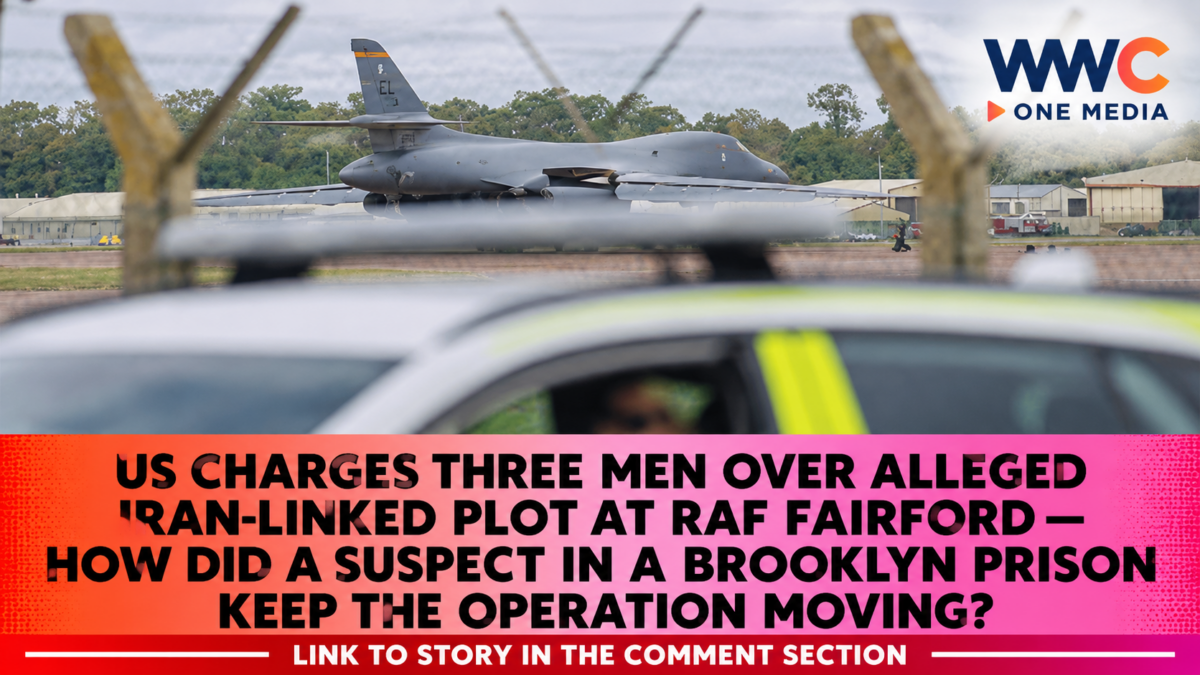
US federal prosecutors have charged three men accused of helping coordinate nearly 20 terrorist attacks and attempted attacks across Europe and the United States, including an alleged September 2026 plot targeting a British air base used by American military aircraft and personnel.
The eight-count superseding indictment, unsealed on November 10 in Manhattan federal court, names Mohammad Baqer Saad Dawood al-Saadi, a dual Iranian-Iraqi national; Mohsen Mohajeri, an Iranian national; and Mohammad Ali al-Hassani, an Iraqi national.
US authorities allege that the three men operated in support of Iran-aligned organisations, including Kata’ib Hizballah and Iran’s Islamic Revolutionary Guard Corps (IRGC), both designated foreign terrorist organisations by the United States.
The alleged target was Royal Air Force Fairford in Gloucestershire, southwestern England, a strategically important installation that has hosted US military aircraft, including long-range bombers.
The indictment describes an alleged operation involving suspicious vans, barrels of fuel, surveillance around the military installation and preparations for a potentially devastating attack.
One of the most striking allegations is that al-Saadi continued communicating with suspected co-conspirators even after being arrested and placed in a federal detention facility in New York.
Prosecutors say he used coded messages passed through family members to help coordinate activities outside prison.
The allegations have intensified concerns about the security of American military installations overseas and the possibility of Iran-linked networks operating through contacts in Europe.
Three Men Named in US Terrorism Indictment
The US Department of Justice identified the defendants as:
- Mohammad Baqer Saad Dawood al-Saadi, 32: A dual Iranian-Iraqi national who was already in US federal custody in New York.
- Mohsen Mohajeri, 48: An Iranian national who prosecutors say was involved in coordinating the alleged operations.
- Mohammad Ali al-Hassani, 35: An Iraqi national and former British citizen whom prosecutors accuse of directing preparations for the RAF Fairford operation.
Only al-Saadi was in US custody when the new indictment was announced. Mohajeri and al-Hassani were not reported to be in American custody.
The charges are contained in an eight-count superseding indictment, which expands the allegations against al-Saadi and adds the two other defendants to the case.
The indictment accuses the men of conspiring to provide material support to designated terrorist organisations, conspiring to commit acts of terrorism and participating in attacks or attempted attacks across several countries.
The Justice Department said the alleged network was connected to nearly 20 attacks and attempted attacks targeting Jewish communities and other interests in Europe and the United States.
These are prosecutorial allegations, not findings of guilt. All three defendants are presumed innocent unless proven guilty in court.
How the Alleged RAF Fairford Attack Was Supposed to Work
The most immediate concern in the indictment involves an alleged operation targeting RAF Fairford in September.
According to prosecutors, al-Hassani began directing preparations in August, allegedly paying individuals in the United Kingdom to conduct surveillance and arrange logistics around the military installation.
On August 22, an individual identified in the indictment as Individual-1 was allegedly paid to observe the perimeter of the base and send videos showing the surrounding area.
The indictment says al-Hassani subsequently received footage of the location.
In September, prosecutors allege that he tasked several individuals with obtaining vans, barrels of fuel and other materials needed for the operation.
The group allegedly researched chemical accelerants and purchased metallic objects that could potentially be used as shrapnel.
Investigators also allege that custom decals were ordered and attached to the vehicles to make them appear to belong to a fuel-delivery company or swimming-pool supply business.
The alleged purpose was to disguise the vans while they were being driven towards the military installation.
On September 26, al-Hassani allegedly directed individuals to drive three vans towards RAF Fairford.
At least two vehicles encountered security roadblocks and were unable to continue along their intended routes, according to the indictment.
Authorities in the United Kingdom recovered three white vans during the early hours of September 27 and arrested their occupants.
The discovery triggered a major security operation around the base.
The indictment describes the vehicles and materials as part of an alleged terrorist plot. It does not mean that an attack was successfully carried out or that the defendants had reached their intended target.
Alleged Coded Messages Were Sent From a Brooklyn Prison
Another particularly concerning part of the case involves al-Saadi’s alleged communications after his arrest.
Prosecutors say he continued attempting to coordinate with Mohajeri and al-Hassani while being held at the Metropolitan Detention Center in Brooklyn, New York.
According to the indictment, he communicated with his mother and sister in Iraq through monitored phone and video calls.
Investigators allege that he used the word “work” as coded language referring to terrorist activity and instructed family members to pass messages to associates.
In a July 30 call cited in the indictment, al-Saadi allegedly asked his sister what had happened to their previous “work” and whether it had been cancelled or merely paused.
The indictment says his sister replied that it had not been cancelled.
During another conversation on September 24, al-Saadi allegedly asked about al-Hassani and instructed relatives to provide him with money so the operation could proceed.
Three days later, authorities recovered the vans near RAF Fairford.
The alleged communications are central to the prosecution’s argument that the operation continued despite al-Saadi’s detention.
Court filings also describe restrictions placed on his calls after authorities raised concerns that he was using coded language.
Jewish Communities in Europe Were Also Allegedly Targeted
The RAF Fairford case is part of a wider investigation involving attacks and attempted attacks against Jewish communities and institutions.
The indictment alleges that the three defendants were involved in directing violence against targets in Europe and the United States.
One of the incidents described involved an alleged arson attack against a Jewish charitable organisation in London in April.
Prosecutors say the men watched the operation in real time through video footage projected onto a large screen.
The following day, another alleged attack targeted a synagogue in London.
The indictment says al-Hassani directed an individual involved in the operation, using language that prosecutors interpreted as an instruction to set the building on fire.
The alleged incidents form part of the broader case involving nearly 20 attacks and attempted attacks.
The investigation also connects al-Saadi to earlier allegations involving attacks against US, Israeli and Jewish interests.
In June, he pleaded not guilty to earlier terrorism charges and described himself as a “prisoner of war.”
His new indictment adds the alleged RAF Fairford operation and further charges against the three men.
Why RAF Fairford Is Strategically Important to the United States
RAF Fairford is a British-owned military installation in Gloucestershire that has long supported US Air Force operations in Europe.
It has been used by American strategic bombers, including B-1 aircraft, during military operations and deployments.
Its importance became especially visible during the 2026 conflict involving the United States, Israel and Iran, when American bombers were stationed at the base.
The September security incident raised questions about the vulnerability of facilities supporting American military operations outside the United States.
Following the incident, US bombers stationed at RAF Fairford were withdrawn and redeployed to the United States.
The development highlighted how a security threat against a relatively small number of military vehicles or personnel could have consequences for wider operational planning.
WWC ONE MEDIA previously reported on the September arrests near RAF Fairford, when British police launched a major security operation and evacuated homes as investigators examined three suspicious vans.
That earlier report covered the initial investigation before the new US indictment provided additional allegations about the suspected network, its financing and its preparations.
UK Authorities Also Investigated the Fairford Incident
The British investigation developed alongside the American prosecution.
Following the September 27 incident, several men were arrested in connection with the suspected plot near RAF Fairford.
British authorities later released the suspects on bail. Two individuals were subsequently re-arrested and charged under the UK’s National Security Act.
The charges involved allegations of assisting a foreign intelligence service and entering a prohibited place for a purpose prejudicial to the United Kingdom.
These British proceedings are separate from the US federal case against al-Saadi, Mohajeri and al-Hassani.
British officials have linked the suspected operation to Iran, while Tehran has denied involvement.
The new US indictment provides prosecutors’ account of how the alleged operation was coordinated, but the allegations still have to be tested through the legal process.
Iran-Linked Security Concerns Extend Beyond One British Air Base
The RAF Fairford case comes amid wider concerns about the security of US military installations and personnel overseas.
American bases in the Middle East have faced missile and drone threats during the conflict with Iran, while European facilities have also been subject to increased security attention.
The challenge is not limited to conventional military attacks. Intelligence gathering, sabotage, suspected surveillance and alleged terrorist operations can also threaten installations far from active battle zones.
WWC ONE MEDIA has examined the growing vulnerability of American military facilities in its report on US bases across the Middle East, Europe and the Pacific.
The report discusses how military installations are exposed to different forms of threats, from missile strikes and drones to sabotage and other disruptions.
Another report examined the reported movement of US aircraft and heightened security measures at British military installations following Iran-related threats.
These developments are separate from the alleged RAF Fairford conspiracy, but they illustrate the wider security environment facing American personnel and facilities.
What Charges Do the Three Men Face?
The superseding indictment contains eight counts.
The charges include:
- Conspiracy to provide material support to Kata’ib Hizballah.
- Conspiracy to provide material support to the IRGC.
- Conspiracy to provide material support for acts of terrorism.
- Providing material support for acts of terrorism.
- Attempted acts of terrorism transcending national boundaries.
- Conspiracy to bomb a place of public use.
- Attempted destruction of property by fire or explosives.
- Financing terrorism.
The potential penalties are severe.
Some counts carry maximum sentences of 15 or 20 years, while others carry a maximum of life imprisonment. The attempted destruction charge carries a minimum sentence of five years and a maximum of 20 years.
The actual penalties, if the defendants are convicted, would depend on the charges established in court and applicable sentencing rules.
The indictment itself does not establish guilt.
What Happens Next in the US Terrorism Case?
The prosecution now faces the task of proving its allegations through federal court proceedings.
Al-Saadi remains in US custody, while the locations and custody status of Mohajeri and al-Hassani remain important questions for investigators.
The case will also test the prosecution’s evidence concerning the alleged coded communications, financial transfers, surveillance activities and preparations involving the three vans.
For British authorities, the investigation raises continuing questions about the security of RAF Fairford and the wider network of military facilities used by American forces.
For the United States, the case is another major counterterrorism prosecution involving alleged foreign-linked operations against American and allied interests.
The allegations are especially serious because prosecutors claim that coordination continued even after one of the alleged organisers was arrested.
But the central question remains whether the evidence will establish the defendants’ individual roles and prove the conspiracy beyond a reasonable doubt.
The case could become one of the most significant recent investigations into alleged Iran-linked operations targeting Western military facilities and Jewish communities.
As the legal proceedings move forward, the focus will remain on the evidence, the defendants’ custody status and whether authorities can establish the full extent of the alleged international network.