
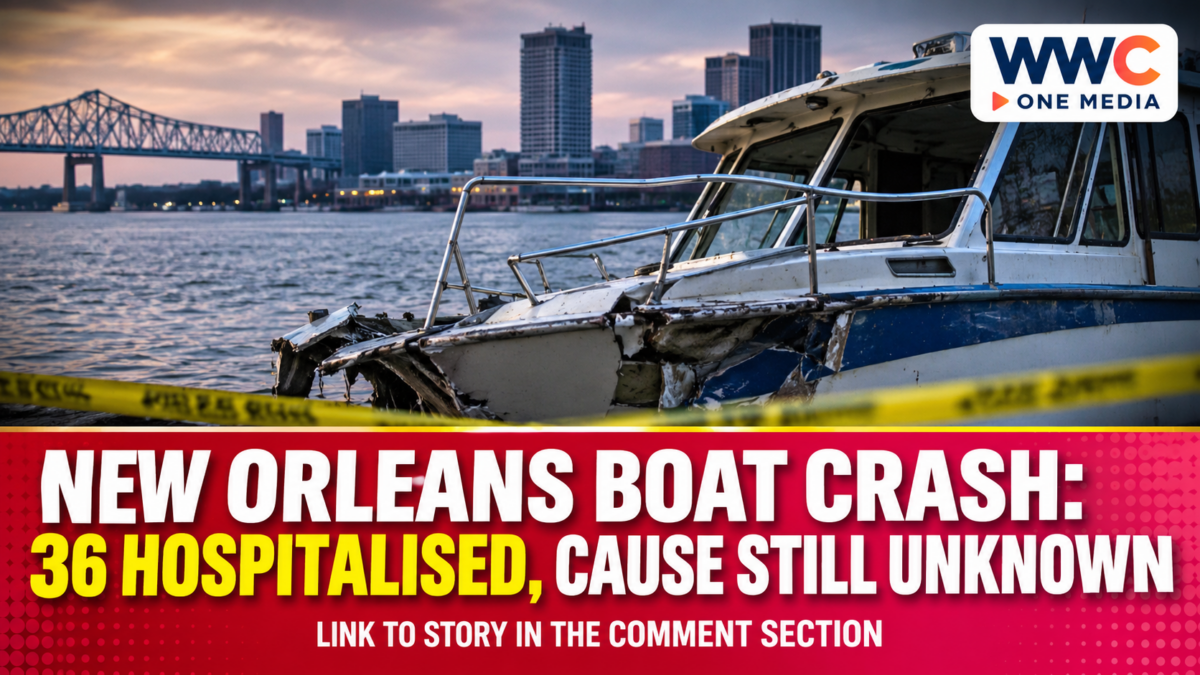
NEW ORLEANS, United States — Nov. 22, 2026. The Nov. 13 collision between the tanker Atlantic Asphalt and the docked riverboat American Heritage on the Lower Mississippi River is under federal investigation. The National Transportation Safety Board (NTSB) has confirmed that 36 people aboard the passenger vessel were hospitalised after the impact, but has not determined what caused it.
The accident raises a consequential question for a busy commercial waterway: how can a moving cargo vessel collide with a passenger boat already secured at a dock? The answer requires evidence about navigation, vessel movements and bridge operations, rather than conclusions drawn from images of the aftermath.
New Orleans Boat Crash: What the Official Record Confirms
The NTSB identifies the vessels as the Marshall Islands-flagged Atlantic Asphalt and the US-flagged American Heritage, operated by American Cruise Lines. The passenger vessel was docked at mile 96 of the Lower Mississippi River, south of New Orleans’ Crescent City Connection bridge.
Its federal case page records the collision at approximately 12:28 p.m. Central Standard Time on Nov. 13. It also records 190 people aboard the riverboat: 140 passengers and 50 crew members. Investigators say all passengers and crew of both vessels have been accounted for.
The same record states that 36 people were hospitalised following the collision. It reports no injuries to personnel aboard the tanker. Hospitalisation is not the same as a final count of all injuries, and the published record does not establish each patient’s medical condition or length of hospital stay.
The initial damage estimate is expected to exceed US$2 million. That is an early estimate, not a settled repair bill or a definitive assessment of the financial losses arising from the incident.
Why the Federal Investigation Matters
The US Coast Guard has classified the collision as a major marine casualty. The NTSB is leading the investigation and will determine the probable cause. Its public case identification is DCA27MM003, and the investigation remains ongoing.
This division of responsibilities matters because responding to an accident, documenting its consequences and establishing why it occurred are different tasks. The available case record supports a clear description of the collision. It does not yet establish negligence, an equipment failure or an unsafe navigational decision by either vessel.
An investigation may need to reconstruct the vessels’ positions and movements, the information available on their bridges, communications and local traffic conditions. Those are relevant questions to test, not findings that any particular system or person failed.
For a comparison of how safety and operating authority can become distinct questions after an incident, WWC previously examined the certification issues raised by the MV SL Halcon case. The Philippine regulatory framework described there does not govern this United States collision.
Why Being Docked Changes the Questions
A passenger boat moored at a riverfront berth is in a different operating position from a vessel navigating the channel. The official record establishes that American Heritage was docked when the collision occurred; it does not explain the sequence of manoeuvres that brought Atlantic Asphalt into contact with it.
That distinction narrows the questions investigators must answer without deciding responsibility in advance. They may have to establish the tanker’s approach, available clearance, any communications and the influence, if any, of river traffic or environmental conditions. None of those possible factors should be described as a confirmed cause today.
The Lower Mississippi has seen other serious vessel collisions. In a separate April 2025 incident near River Ridge, Louisiana, the tanker Isla de Bioko and the Ginny Stone tow collided. The NTSB later determined that hydrodynamic forces associated with a closely passing tow contributed to that earlier accident.
The earlier finding illustrates why maritime cases require technical reconstruction. It does not show that current, wake effects or the same chain of events caused the November 2026 collision.
What the Passenger Count Tells Us
The newly available figures provide a firmer basis for discussing the human impact than the preliminary numbers that circulated immediately after the accident. The confirmed count is 140 passengers and 50 crew aboard American Heritage, with everyone on both vessels accounted for.
For readers, the accounting figure and the hospitalisation figure answer separate questions. One establishes that the vessels’ passengers and crew have been located in the official accounting; the other establishes that 36 people required hospital care. Neither figure alone explains the severity of individual injuries or whether further treatment was needed.
Passenger accounting also matters in incidents involving fires or evacuation, although the causes and responses can differ substantially. WWC’s earlier coverage of the investigation into the MV June Aster ferry fire and the difficulties of accounting for people during a maritime emergency explored different incidents. Those reports should not be used to infer what happened on the Mississippi River.
What This Could Mean for River Transport
Analysis: The importance of the case goes beyond the physical damage to two vessels. Commercial navigation and passenger services can share constrained waterways, meaning that a navigational event involving one vessel can affect people who are not themselves travelling through the channel.
For operators, the eventual findings may offer lessons about navigation planning, bridge coordination, berth protection or other safeguards. Which lesson is relevant cannot be known until the evidence has been examined and the probable cause established.
The potential commercial consequences are also uncertain. An initial damage estimate says little about repair durations, insurance treatment, passenger claims or interruption to future itineraries. Those matters require separate records and should not be presented as quantified costs at this stage.
What Happens Next
The next significant milestone is an NTSB update that sets out verified evidence or a probable-cause determination. The agency’s case page remains marked ongoing as of Nov. 22, 2026, and its public summary does not identify a proven cause.
Until that changes, the defensible conclusion is limited but important: a tanker collided with a docked riverboat, 36 people were hospitalised, all aboard both vessels were accounted for, and federal investigators are examining why it happened. Assigning blame would get ahead of their findings.
Frequently Asked Questions
When did the New Orleans boat crash happen?
The NTSB records the collision on Nov. 13, 2026, at approximately 12:28 p.m. Central Standard Time.
Which vessels were involved?
The vessels were the tank ship Atlantic Asphalt and the American Cruise Lines riverboat American Heritage.
How many people were hospitalised?
The NTSB reports that 36 people aboard American Heritage were hospitalised. The case summary does not provide individual diagnoses.
Was the American Heritage moving when it was hit?
No. The NTSB says the passenger riverboat was docked at mile 96 of the Lower Mississippi River.
Has the cause of the collision been established?
No. The NTSB is leading an ongoing investigation and has not published a probable-cause determination for this case.










