
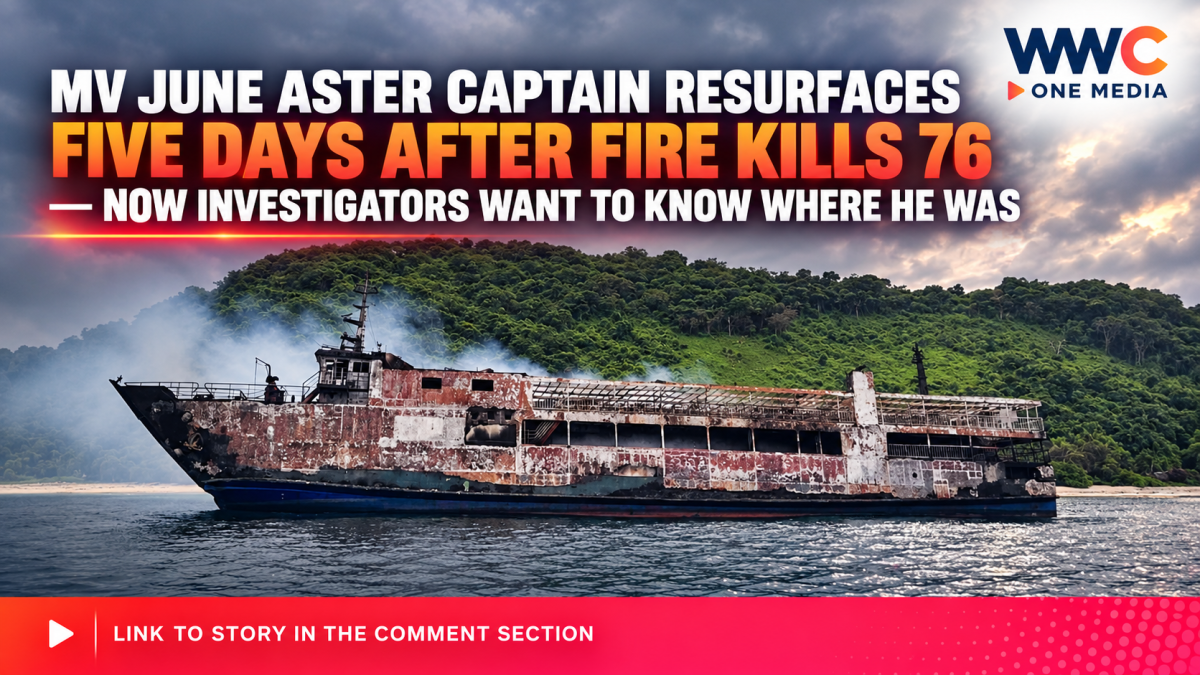
MANILA, Philippines — Five days after the MV June Aster became a burning wreck off Coron, Palawan, its captain has resurfaced alive — just as families of victims confront another painful reality: dozens of bodies are still waiting to be identified.
Captain Roel Sarmiento, who had been missing from the official list of survivors following the September 9 ferry disaster, voluntarily appeared at the Palawan office of Atienza Interisland Ferries Inc. on September 14, according to the Philippine Coast Guard.
He was accompanied by company representative Dindo Macalinao and was subsequently presented to authorities.
Investigators now want answers not only about what happened aboard the vessel before and during the fire, but also about where Sarmiento had been during the five days after the catastrophe.
His return changes one number in a tragedy whose scale is still being established.
The latest official tally accounts for 44 survivors, 76 recovered fatalities and 12 people still missing, for a total of 132 people believed to have actually been aboard the ferry. The original manifest listed 134, but authorities later confirmed that two listed passengers never boarded.
For dozens of families, however, knowing how many died is only the beginning.
Authorities have temporarily buried 41 unidentified victims at San Nicolas Public Cemetery in Coron while forensic teams conduct DNA testing on badly burned remains.
Captain’s appearance raises new questions
The Coast Guard initially received information that Sarmiento had survived and had gone with other crew members to the covered court in Barangay Turda.
Yet his name was absent from the official survivor list, and for several days authorities said they were trying to locate him.
PCG spokesperson Commodore Noemie Cayabyab said investigators intend to question the captain about both the fire and his whereabouts afterward.
The Coast Guard had earlier said the ship’s master carried significant responsibility during any emergency because the captain is expected to oversee emergency procedures, passenger evacuation and crew response.
Whether Sarmiento or any other individual will ultimately face criminal, administrative or civil liability remains undetermined. Investigations by maritime authorities are still underway, and no final finding of negligence has been announced.
That distinction matters.
The captain’s disappearance from the official survivor count prompted understandable questions, but his absence alone does not establish responsibility for the deaths.
Authorities must still reconstruct what happened inside the June Aster during the critical minutes when the fire spread.
Survivors say they heard an explosion — but the cause remains unknown
The MV June Aster left Baseco Port in Manila at 8:13 p.m. on September 8, bound for Coron.
It was nearing its destination the following evening when the Coast Guard received a distress report at around 6:45 p.m. on September 9.
Survivors interviewed after the disaster described hearing an explosion or explosions from around the cargo area, followed by smoke and flames that spread extremely quickly.
But investigators have not concluded that an explosion caused the fire, nor have they identified what may have ignited it.
The cargo hold contained several vehicles, including five motorcycles, an electric vehicle, a forklift and a pickup truck, according to documents submitted before departure.
That fact has drawn attention because of the reported origin of the smoke and flames.
It would nevertheless be premature to blame the electric vehicle, any other vehicle or a particular piece of cargo without forensic evidence.
MARINA and the Coast Guard are still investigating.
The ship was not overcrowded based on the manifest
Another significant finding so far is what investigators have not found.
The June Aster was certified to carry up to 333 people, including 306 passengers and 27 crew, according to Coast Guard information.
With roughly 132 people ultimately accounted for as having been aboard, the ferry was well below that stated passenger-and-crew capacity.
The vessel had also undergone a Vessel Safety Enforcement Inspection in March 2026 and, according to the Coast Guard, was found compliant in documentation, equipment and competency requirements.
It also passed a pre-departure inspection in Manila before the fatal voyage.
Those inspections do not rule out equipment failure, human error or other problems that may have developed later.
They do, however, mean investigators will have to explain how a vessel deemed compliant months earlier suffered a fire that ultimately became one of the Philippines’ deadliest recent maritime disasters.
Did the alarm sound?
Another unanswered question concerns what passengers were told when the emergency began.
Some survivors have told investigators that they did not remember hearing a fire alarm before the situation deteriorated.
The Coast Guard has said those accounts still need to be verified because survivors were under extreme stress and recollections could vary.
Under normal shipboard emergency procedures, an alarm would alert passengers and crew, followed by instructions from the captain and crew members directing evacuation and life-saving measures.
Investigators are therefore expected to examine whether the alarm system worked, what instructions were given, how quickly passengers were moved and whether escape routes remained usable.
The answers could prove central to determining why so many people apparently failed to get off the ferry.
Many victims were found inside the ship
The scale of the loss became apparent only after firefighters could finally enter the wreck.
Heavy smoke, extreme heat and continuing fire prevented rescue teams from safely boarding the vessel for almost 40 hours.
The Coast Guard formally declared the fire extinguished at around 10:15 a.m. on September 11.
Once teams gained access, they discovered charred remains in passenger accommodation and cabin areas.
Thirty bodies were initially retrieved.
Another 41 remains were subsequently recovered, pushing the death toll to 76 when combined with victims already found earlier in the response.
Forensic specialist Police Lt. Col. Richard Allan Mangalip said some victims had been found clustered together while others were discovered in different parts of the vessel. Many of the bodies were severely burned.
That condition has made conventional visual identification extremely difficult.
41 unidentified victims temporarily buried
Coron authorities faced an especially painful logistical problem after the remains were recovered.
With many victims too badly burned to identify immediately, the local government prepared a temporary burial site at San Nicolas Public Cemetery.
Forty-one unidentified bodies were temporarily interred while the identification process continued.
The temporary burial does not mean identification efforts have ended.
Authorities have been collecting DNA, dental and other forensic evidence so remains can eventually be matched with relatives.
Families have also been asked to provide information that could assist identification, including dental characteristics, jewelry and other distinguishing features.
DNA specimens are being sent to the Philippine National Police laboratory for comparison.
Officials have cautioned that definitive identification could take weeks or even months because of the condition and number of remains.
Teeth may provide the crucial DNA evidence
The government has brought additional forensic specialists into Palawan as pressure grows to identify victims as quickly as possible.
President Ferdinand Marcos Jr. ordered agencies to mobilize personnel, funding and technical resources for the identification effort.
Forensic teams have been extracting molar teeth from some remains because protected dental tissue may still contain DNA that can be analyzed even when a body has suffered extensive fire damage.
Additional forensic odontologists and specialists from Camp Crame have been sent to assist local teams.
The painstaking process is essential because returning the correct remains to each family is as important as speed.
A mistaken identification could deepen an already devastating tragedy.
Twelve people are still missing
Even with 76 bodies recovered, the accounting is not finished.
With Sarmiento now listed among the survivors, officials say 12 people remain unaccounted for.
The Coast Guard has completed searches of accessible passenger cabins and crew areas and has directed the vessel’s operator to obtain a professional salvor as operations move toward the next phase.
The burned ferry remains grounded off Coron.
Search and recovery teams must now determine whether any additional remains are inside areas of the vessel that could not be safely reached during the initial inspections or whether some missing passengers went overboard during the emergency.
Those possibilities make the final casualty count uncertain.
Questions also surround how passengers escaped
Survivors have described an extraordinarily rapid emergency.
Some reportedly jumped into the sea as the fire spread.
The Coast Guard said several survivors were recovered without life jackets, possibly because events unfolded so quickly that passengers fled before they could obtain flotation equipment.
Investigators are also examining survivor accounts concerning a tarpaulin that may have been lowered because of rain before the fire.
Officials have said they are looking into whether the covering affected an evacuation route, while stressing that no conclusion has yet been made that it trapped passengers.
Such details may eventually help explain the stark difference between those who escaped and the dozens found inside.
The weather had already disrupted the ferry’s schedule
The June Aster’s route had also been affected by bad weather in the days before the tragedy.
Philippine Ports Authority advisories listed June Aster services from Manila to Coron, El Nido and Liminangcong among sea trips canceled on September 5 and September 7 amid southwest monsoon conditions.
The fatal voyage departed the following night, September 8.
There is currently no official finding connecting those earlier cancellations to the fire.
Still, the timeline provides context for the vessel’s movements in the days before the disaster.
The shipping company has promised assistance
Atienza Interisland Ferries has said it is cooperating with investigators and promised transportation and burial assistance for victims.
A company representative said survivors were also being provided with immediate necessities including food and clothing.
The Coast Guard has said the company could ultimately face liability depending on what investigators establish about the actions of management and crew before, during and after the emergency.
But the degree — or existence — of any liability has yet to be determined.
MARINA is conducting a separate investigation.
Its inquiry is expected to look at vessel compliance and maritime-safety requirements alongside the Coast Guard’s examination of the emergency response.
One of the Philippines’ worst recent ferry disasters
The June Aster tragedy has again drawn attention to maritime safety in an archipelago where ferries remain essential for moving people and goods between islands.
Reuters described the fire as among the country’s deadliest maritime disasters in recent years.
The Philippines has a long history of catastrophic ferry accidents, although the circumstances vary widely.
The 1987 MV Doña Paz collision and sinking remains the world’s deadliest peacetime maritime disaster, with more than 4,000 deaths according to widely cited estimates.
That history is one reason every major Philippine ferry disaster quickly raises questions about inspections, emergency procedures, crew training and enforcement.
But the June Aster investigation must ultimately be based on evidence from this specific vessel — not assumptions drawn from previous tragedies.
The captain can now answer the question investigators were waiting to ask
For days, one of the most important witnesses to the disaster could not be officially accounted for.
That changed when Sarmiento walked into his company’s Palawan office on September 14.
His testimony could help investigators reconstruct the sequence of events: when the bridge first learned of the fire, whether alarms were activated, what evacuation instructions were issued, what the crew did, how the captain left the vessel — and why authorities did not obtain his statement for five days.
Those answers could become crucial in determining responsibility.
But even as the investigation moves forward, another process is unfolding more slowly.
Forty-one victims have been temporarily buried without confirmed names.
Twelve people are still missing.
Families are giving DNA samples and waiting for laboratory results that may take weeks or months.
And the burned June Aster remains off Coron, holding physical evidence investigators hope will explain how a ferry that passed safety inspections became a death trap within minutes.
The captain has resurfaced.
The full story of what happened aboard his ship has not.



Leave a Reply