
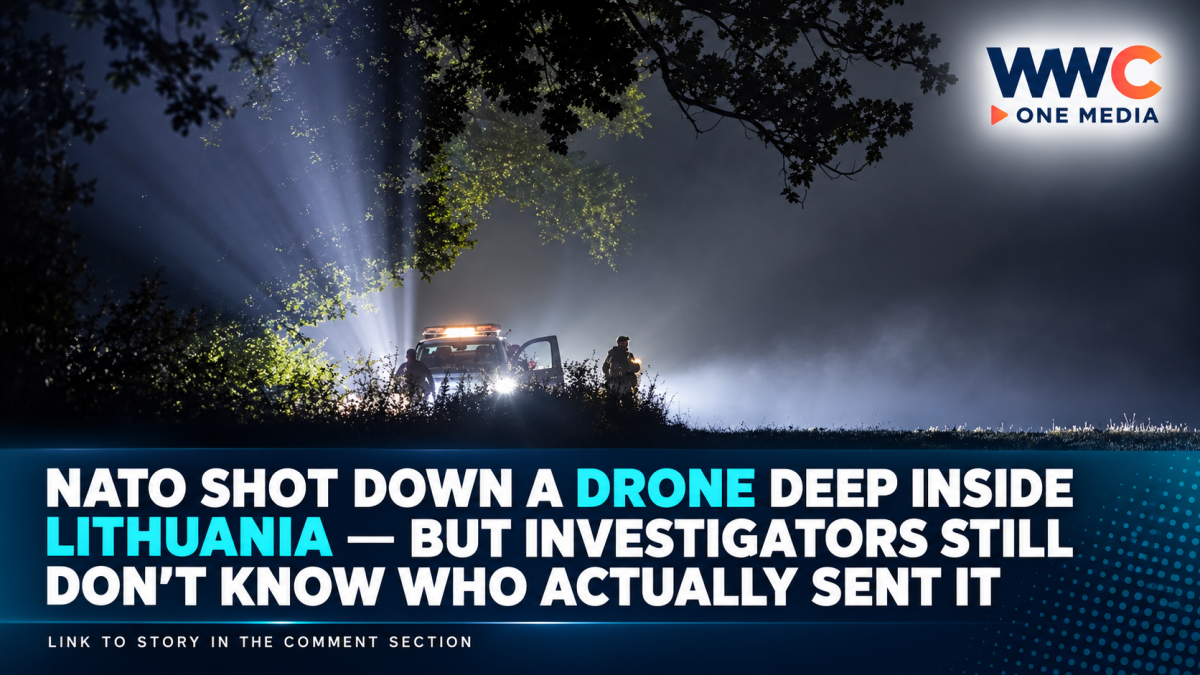
VILNIUS, Lithuania — A NATO fighter jet has shot down a drone that penetrated Lithuanian airspace from the direction of Belarus, marking a significant escalation in the alliance’s increasingly frequent encounters with unmanned aircraft along its eastern flank.
The unmanned aircraft entered Lithuania shortly after midnight on September 15, 2026, triggering air alerts around Vilnius and Kaunas before NATO fighters were scrambled.
It was ultimately destroyed near the village of Pratkūnai in Kaišiadorys district, roughly 80 kilometers from the Belarusian border and not far from Lithuania’s second-largest city, Kaunas.
Lithuanian President Gitanas Nausėda confirmed that NATO aircraft destroyed the drone and praised the alliance’s rapid response.
But one critical question remained unresolved after the wreckage fell into a rural area:
Whose drone was it?
Preliminary tracking indicated that the aircraft entered Lithuanian territory from neighboring Belarus.
Italian Defense Minister Guido Crosetto, whose country’s fighters are currently responsible for NATO’s Baltic air-policing mission from Lithuania, said the threat “most probably” came from Russia. Lithuanian officials, however, urged against a definitive conclusion until investigators determine the drone’s type, operator and flight path.
That distinction matters.
A drone crossing from Belarusian airspace does not automatically establish that Belarus launched it, nor does a suspected Russian design by itself prove that Moscow deliberately targeted Lithuania.
In a region increasingly saturated with Russian and Ukrainian unmanned aircraft, electronic warfare and long-range strikes, drones can also lose navigation, be diverted or travel far beyond their intended targets.
Italian Eurofighters were already waiting in Lithuania
The aircraft that responded were part of Italy’s current deployment to NATO’s Baltic Air Policing mission.
Italy took over the rotation at Lithuania’s Šiauliai Air Base on July 31, deploying four Eurofighter Typhoon fighters to protect Lithuanian, Latvian and Estonian airspace.
The mission is not new.
NATO has continuously protected the Baltic states’ skies since 2004, when Estonia, Latvia and Lithuania joined the alliance.
Because the three countries do not maintain the fighter-aircraft fleets needed to independently perform round-the-clock air policing, other NATO members rotate jets and crews through bases in the region.
Italian Eurofighters had already been scrambled several times during their current rotation.
On August 3, two Italian jets launched from Šiauliai to identify and intercept Russian military aircraft operating over international waters in the Baltic Sea.
The September incident was different.
This time, the unidentified aircraft was inside Lithuanian sovereign airspace.
And NATO fired.
The drone crossed deep into Lithuania
Initial radar tracking indicated the drone approached from Belarus and traveled westward.
Rather than falling immediately after crossing the frontier, it penetrated significantly farther into Lithuanian territory before being destroyed near Pratkūnai.
Lithuanian reporting placed the crash site about 82 kilometers from the Belarusian border.
That distance helps explain why authorities took the intrusion seriously.
The drone was no longer merely brushing against the border.
It had traveled toward Lithuania’s interior and into a region between the capital and Kaunas.
Air warnings were issued while NATO fighters moved to intercept the object.
No deaths or injuries were reported from the shoot-down.
Officials initially contradicted one another over whether it was armed
The first hours after the incident also demonstrated why early breaking-news reports require caution.
Lithuanian Defense Minister Robertas Kaunas initially said preliminary information suggested the drone probably did not contain explosives, while stressing that investigators had not finished examining the wreckage.
Shortly afterward, that assessment changed.
Kaunas said authorities had discovered an explosive device at the crash location, which specialists from Lithuania’s Aras police anti-terrorism unit neutralized.
That later finding substantially raised the significance of the incident.
But it still does not establish the drone’s intended target.
Whether the explosive was part of a strike drone, a decoy capable of carrying a payload or another type of unmanned aircraft remains part of the investigation.
Lithuanian officials have also said they have no confirmed evidence that nearby infrastructure was deliberately targeted.
Was it Russian?
That is where reporting becomes more complicated.
Reuters reported that the aircraft was being investigated as a suspected Russian Geran-type drone, and Crosetto said the threat most likely originated from Russia.
But Lithuania’s National Crisis Management Centre initially said only that the aircraft probably entered from Belarus and that its origin remained to be determined.
Those statements are not necessarily contradictory.
“Entered from Belarus” describes the drone’s flight path.
“Russian” would identify who manufactured, launched or operated it.
Investigators still need to establish that connection.
And recent history demonstrates why jumping directly from flight path to operator can be misleading.
Lithuania has seen Russian drones before
Lithuanian intelligence says two Russian Gerbera unmanned aircraft entered the country in July 2025.
One crashed on July 10.
Another crashed on July 28 and carried a high-explosive fragmentation charge.
Lithuania’s State Security Department later concluded that both aircraft had entered Lithuanian airspace accidentally, amid Russia’s expanding drone attacks on Ukraine.
The Gerbera is designed partly to resemble the larger Iranian-designed Shahed family of attack drones widely used by Russia.
Some variants serve as decoys intended to saturate air defenses, while others can carry reconnaissance equipment or explosive payloads.
After the July 2025 incursions, Lithuania formally asked NATO for additional air-defense capabilities.
That makes the September 2026 shoot-down part of an already established security problem rather than an isolated event.
But Ukrainian drones have crossed NATO borders too
Russia is not the only combatant whose drones have strayed into neighboring airspace.
In March 2026, Lithuania said a military drone that crashed on one of its frozen lakes had come from Ukraine and had apparently been intended for an attack on Russia’s Primorsk oil terminal before veering off course.
NATO fighters have also intercepted stray Ukrainian drones elsewhere in the Baltics.
Reuters reported that NATO aircraft shot down a Ukrainian drone over Estonia in May 2026 and others over Latvia in June and August.
Ukraine has blamed some navigation failures on Russian electronic-warfare systems that interfere with satellite guidance and communications.
That is technically plausible in the heavily contested electromagnetic environment around Russia, Belarus and the Baltic states, although each individual incident still requires investigation.
So one of the most important facts about the Lithuanian case is also one of the least satisfying:
the direction a drone arrives from does not necessarily reveal where it was originally launched or where it was supposed to go.
Lithuania had another drone alert just two days earlier — and it was birds
The level of nervousness surrounding Baltic airspace was illustrated by an incident only two days before the actual shoot-down.
On September 13, Lithuania briefly closed Vilnius Airport and NATO launched a fighter after radar operators detected what appeared to be possible drones.
The objects turned out to be a flock of birds.
The airport reopened about 38 minutes later after the fighter visually checked the area.
That false alarm shows how difficult the detection problem has become.
Small drones can have limited radar signatures.
Birds, weather and other airborne objects can sometimes produce similar tracks.
Defenders therefore have to make rapid judgments with incomplete information—while the cost of failing to react to a genuine explosive drone could be far higher than scrambling aircraft for something harmless.
Two days later, the threat was real enough to be destroyed.
Why NATO uses fighters for drones
Sending a multimillion-dollar combat aircraft after a relatively inexpensive drone may appear economically inefficient.
But air policing is built around response time and certainty.
NATO’s Combined Air Operations Centre in Uedem, Germany, can order fighters already on Quick Reaction Alert to launch when an unidentified aircraft creates a potential threat.
They can approach the target, identify it visually and, when authorized, destroy it.
The problem is cost.
A modern fighter flight can cost vastly more than the drone being intercepted, and air-to-air missiles can themselves cost hundreds of thousands or millions of dollars.
That is why NATO countries are rapidly investing in cheaper anti-drone weapons including electronic jammers, ground-based guns, interceptor drones and short-range missiles.
The Ukraine war has demonstrated that a defense system can lose economically even when it successfully destroys every incoming drone if it repeatedly uses weapons far more expensive than the targets.
The Baltic states are especially exposed
Lithuania’s geography makes its airspace particularly sensitive.
It borders both Belarus, a close Russian ally, and Russia’s Kaliningrad exclave.
Across the wider Baltic region, Russian military aircraft routinely fly between mainland Russia and Kaliningrad.
NATO says those aircraft sometimes operate near allied airspace without active transponders, flight plans or regular communication with civilian air-traffic controllers, prompting frequent interceptions by Baltic Air Policing jets.
The drone problem adds a new dimension.
Unlike a Russian military jet, which is relatively easy to track and usually flown by a pilot who wants to return home, an unmanned aircraft can be smaller, cheaper and expendable.
That can make intent much harder to determine.
A drone could be:
a deliberate attack,
a reconnaissance platform,
a decoy,
a navigation failure,
a jammed Ukrainian strike drone,
or a Russian weapon that wandered away from its planned route.
Defenders may have only minutes to make the distinction.
Drone production has exploded since the war began
Lithuanian intelligence has directly linked the growing number of airspace violations to the extraordinary expansion of drone warfare in Ukraine.
Lithuania’s State Security Department estimated that Russia increased production of some types of UAVs by two to ten times during 2025.
It said Russian long-range Geran-2 and Gerbera production reached approximately 5,000 to 6,000 units per month, while the scale of drone attacks on Ukraine increased dramatically.
The mathematical consequence is straightforward.
The more drones launched, the greater the number likely to malfunction, lose navigation or be redirected by electronic warfare.
That does not make unintended NATO airspace violations harmless.
It makes them more likely.
Lithuania’s shoot-down does not automatically trigger Article 5
The phrase “NATO shot down a drone” can make the incident sound as though the alliance has crossed immediately into collective war.
That is not how NATO’s treaty works.
Article 5 applies when an alliance member suffers an armed attack and the conditions for collective defense are judged to have been met.
NATO says whether an incident constitutes an armed attack must be assessed case by case.
A single drone entering allied airspace therefore does not mechanically trigger Article 5.
Intent, attribution, damage and circumstances matter.
Nor has Lithuania announced that it regards this incident as an Article 5 attack.
NATO also has Article 4, which allows members to request consultations whenever they believe their territorial integrity, political independence or security is threatened.
Neither mechanism is automatically activated simply because NATO fighters intercept an unidentified aircraft.
In this case, the alliance’s existing air-defense mission responded operationally before a larger political decision was required.
In one sense, the system worked exactly as designed
The security concern is obvious.
An unidentified drone entered a NATO country’s airspace carrying what Lithuanian authorities later said was an explosive device.
But the incident also demonstrated something NATO has spent years building.
Radar detected the object.
Authorities issued an alert.
Italian fighters stationed hundreds of kilometers from their home country launched from a Lithuanian base under NATO command.
The aircraft found the drone.
And it was destroyed before reaching farther into the country.
Lithuanian defense officials publicly highlighted that sequence as evidence that allied air defense could react quickly.
That does not mean the system is complete.
Lithuania has repeatedly asked for stronger ground-based air defenses and better counter-drone capabilities precisely because relying on fighters for every small unmanned aircraft is neither cheap nor ideal.
The shoot-down happened amid wider Baltic tensions
The Lithuania incident came amid several separate security events around northern Europe.
On roughly the same timeline, Denmark accused a Russian naval vessel of firing flares close to a Danish military surveillance helicopter operating over international waters.
Russia disputed Denmark’s characterization of the encounter and accused the Danish aircraft of dangerous maneuvering.
Poland also activated military aviation as Russian drones conducted strikes against Ukraine close to Polish territory.
These incidents are separate and should not automatically be treated as one coordinated operation.
European and NATO officials, however, are examining them within a broader environment of increased military activity, drone incursions, electronic warfare and infrastructure-security concerns around the Baltic.
The biggest risk may be miscalculation
The immediate danger from one drone is the explosive payload it may carry.
The larger strategic danger is what happens when nobody initially knows what that drone is doing.
Imagine the decision confronting air defenders:
An object crosses the border.
Its operator is unknown.
Its payload is unclear.
Its destination is unclear.
It may have malfunctioned.
It may have been electronically diverted.
Or it may be heading toward infrastructure or a city.
Waiting too long risks allowing an attack to succeed.
Acting too quickly can destroy an aircraft that never intended to attack NATO territory.
The September 15 incident shows why the Baltic air-defense problem is increasingly about decision time, not merely firepower.
NATO’s eastern flank has entered the drone era
When Baltic Air Policing began in 2004, its core job was relatively conventional: fighters would launch to identify aircraft that violated flight rules or approached NATO airspace without proper communication.
Twenty-two years later, the mission increasingly faces targets that can be far smaller, unmanned and much harder to interpret.
Italian Eurofighters can destroy them.
The more difficult challenge is determining what comes afterward.
Lithuanian investigators still have to establish exactly what was shot down near Pratkūnai.
They must reconstruct its flight path.
Analyze its components.
Identify the explosive device.
Determine whether navigation data survived.
And decide whether the aircraft was Russian, Ukrainian or connected to another operator.
Until that work is completed, the most dramatic interpretation—that Russia deliberately sent an explosive drone deep into NATO territory—remains unproven.
What is established is serious enough:
an unmanned aircraft entered NATO airspace from Belarus, traveled dozens of kilometers inside Lithuania and was destroyed by an allied fighter before coming down near Kaunas.
For NATO, the interception demonstrated readiness.
For Lithuania, it exposed the problem that readiness is now being tested with increasing frequency.
And for Europe, the unanswered question is no longer whether the drone war can cross national borders.
It already has.
The question is whether the next drone will be another accident—or something deliberately sent across the line.




Leave a Reply