
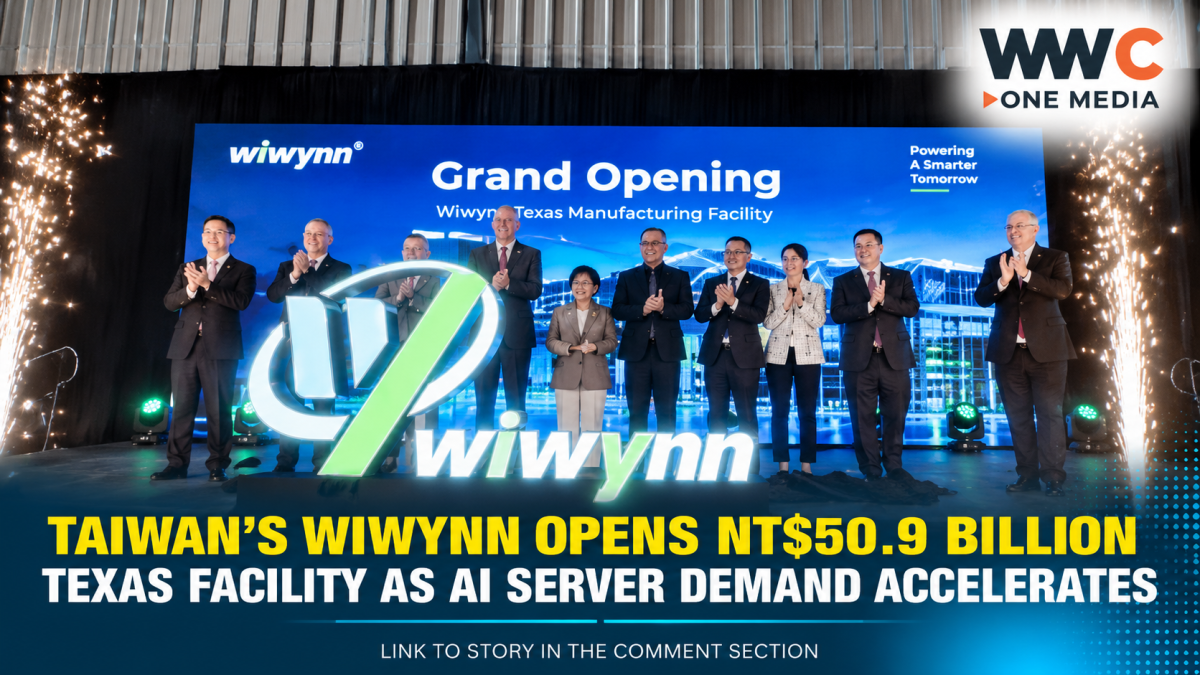
SOCORRO, TEXAS — Taiwan’s Wiwynn Corp. has officially opened its advanced manufacturing facility in Texas, marking a major expansion of the company’s U.S. production capacity as demand for artificial intelligence and cloud-computing infrastructure continues to grow.
Wiwynn said it has invested more than NT$50.9 billion (about US$1.6 billion) in the Texas operation in Socorro, near El Paso. The site is the Taiwanese server maker’s first U.S. manufacturing facility and is designed to produce and integrate advanced server systems and racks for data-center customers.
From Taiwan to the heart of America’s AI supply chain
The facility represents a significant step in Wiwynn’s strategy to bring more production closer to its U.S. customers.
The first building covers approximately 393,000 square feet, with shipments having begun in late 2025. A second building covering roughly 476,000 square feet is expected to begin production in the second quarter of 2027. The overall site is ultimately expected to exceed 1.7 million square feet.
Wiwynn President and CEO William Lin said the investment is intended to address rising demand from U.S. customers while strengthening the resilience of the company’s global supply chain.
Amazon partnership puts AI infrastructure in focus
The Texas expansion is closely connected to Wiwynn’s work with Amazon.
Amazon and Wiwynn announced earlier this month that the expanded operation is expected to create nearly 1,000 new advanced-manufacturing jobs by the end of 2027.
Employment at the facility is expected to exceed 2,500 workers next year, with the potential to reach about 4,000 employees when the site reaches full capacity.
Wiwynn manufactures and integrates server systems and racks used in Amazon’s data-center infrastructure, making the Texas facility part of a broader effort to expand U.S.-based production of hardware supporting cloud services and AI applications.
Why Texas?
The move comes as hyperscale cloud companies dramatically increase spending on computing infrastructure to support AI services.
Amazon said its Texas investments since 2010 have surpassed US$100 billion, while the company says it has more than 86,000 employees across the state.
For Wiwynn, establishing manufacturing capacity in the United States also reduces the distance between production and major customers while adding another location to its global manufacturing network.
The company says the investment will create opportunities across manufacturing, engineering, testing, automation, maintenance and supply-chain operations.
Taiwan’s role in the global AI hardware race
Wiwynn’s expansion highlights the increasingly international nature of the AI hardware supply chain.
Taiwan remains a major center for advanced electronics manufacturing, while companies such as Wiwynn are expanding production overseas to serve customers and markets closer to where AI infrastructure is being deployed.
The Texas facility therefore isn’t simply another factory opening. It represents a shift toward more geographically distributed AI-server manufacturing, with Taiwan-based technology companies increasingly building capacity in the United States.
Expansion comes amid Texas data-center scrutiny
The timing is notable because Texas is simultaneously dealing with growing concerns over the infrastructure demands of the data-center boom.
Reuters reported this week that Texas authorities are increasing scrutiny of data centers’ electricity and water consumption, as the state grapples with the rapid growth of AI-related infrastructure.
That broader debate could become increasingly important as more AI hardware and data-center projects are built across the state.
For Wiwynn, however, the Texas manufacturing operation is primarily focused on supplying the hardware that powers those expanding data-center networks.
With billions of dollars now committed and thousands of jobs potentially coming to the site, Wiwynn’s Texas expansion puts a major Taiwan-based AI hardware manufacturer directly inside one of the world’s fastest-growing technology markets. The bigger question is how far this U.S. manufacturing push will expand as global demand for AI infrastructure keeps climbing.



Leave a Reply