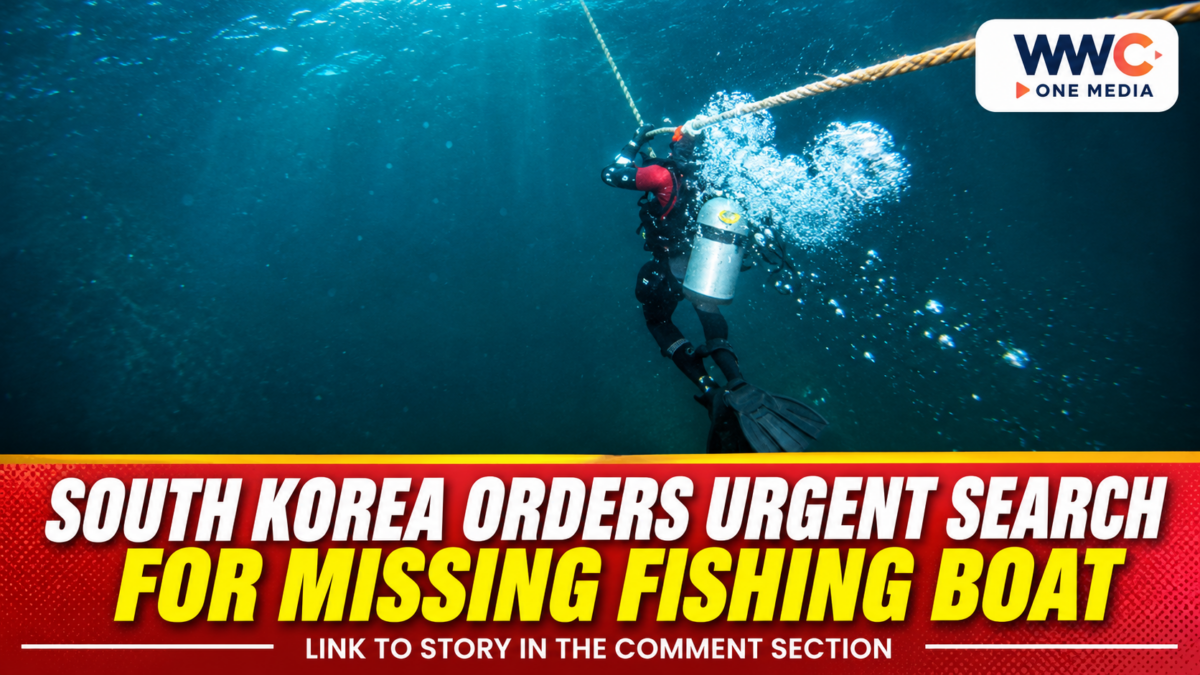
South Korea’s government ordered an urgent search for the fishing boat Haegwangho after its location could no longer be confirmed in waters off Taean, South Chungcheong Province, on Nov. 18, 2026. The vessel was listed as weighing 7.93 tonnes and carrying seven people.
An emergency directive issued by Prime Minister Han Seong-sook instructed the Ministry of Oceans and Fisheries and the Korea Coast Guard to coordinate with patrol vessels and nearby ships to take all possible measures to locate the missing boat.
The directive also called on the Defence Ministry and South Chungcheong Province to provide personnel and equipment needed for search-and-rescue operations.
Government calls for coordinated search
The emergency instruction placed responsibility on several government agencies rather than leaving the response to a single maritime unit.
The Korea Coast Guard and the Ministry of Oceans and Fisheries were directed to coordinate search efforts with vessels operating in the surrounding waters. Other agencies were asked to provide operational support.
This coordination matters in maritime emergencies because search operations can require different vessels, equipment and personnel. The directive specifically emphasised support for the field operation.
Responder safety included in emergency order
The Prime Minister’s Office also highlighted the risks associated with searching at night.
The directive warned of the possibility of secondary accidents during nighttime maritime operations and instructed authorities to pay particular attention to the safety of rescue personnel.
That instruction is significant because rescuers must manage their own exposure to dangerous conditions while attempting to locate a missing vessel and its occupants.
What happens next
The emergency directive establishes the government’s initial response and the agencies instructed to participate. It does not provide a final explanation for the vessel’s disappearance, confirm its location or establish the condition of the seven people aboard.
A separate official Coast Guard announcement confirming the wreck’s identity and the subsequent search operation is needed before those developments can be incorporated into a fully primary-record-verified report.
The distinction is important: an order to search is not proof that a vessel has been located, and the disappearance of a boat does not establish what happened to its crew.
Related WWC reporting
The wider issue of maritime search and rescue has also appeared in WWC coverage, including the search for missing fishermen in Batangas, the recovery of five missing Mindoro fishermen, and the search for missing journalists near Indonesia’s Anak Krakatau