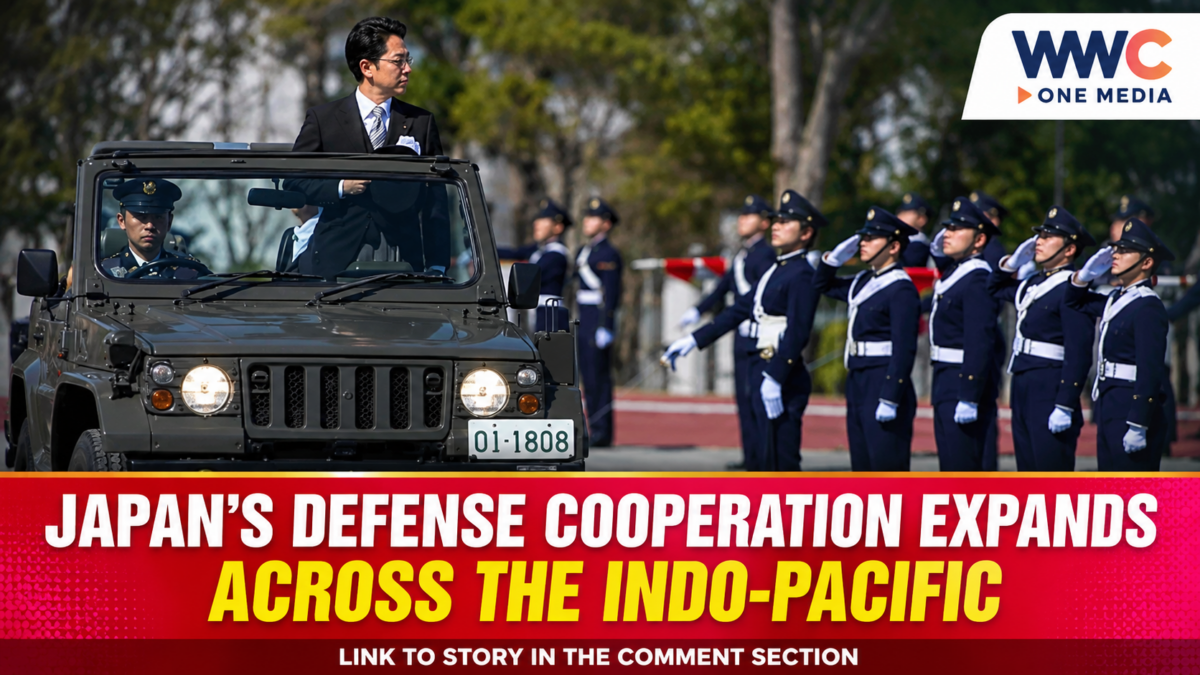
Japan is widening its defence partnerships across the Indo-Pacific, with recent agreements involving the Philippines, Australia, the United States and India adding practical military cooperation to its regional security agenda. Developments announced in October and November 2026 include expanded joint exercises, equipment support, logistics arrangements and plans for closer information-sharing.
For the Philippines, the shift is particularly significant: Japan’s latest commitments include a ¥4.3 billion security assistance project and discussions on transferring a decommissioned destroyer and a TC-90 aircraft. These are concrete steps, but they remain subject to government coordination, technical arrangements and implementation.
Japan’s defence strategy is moving beyond its traditional partnerships
Japan’s latest moves show that its security policy is increasingly built around cooperation with multiple partners rather than relying exclusively on its alliance with the United States.
The Japanese government’s Official Security Assistance (OSA) programme is one part of this approach. Unlike Official Development Assistance, which supports economic and social development, OSA provides equipment, supplies and infrastructure assistance to the armed forces and related organisations of partner countries.
Japan’s Foreign Ministry describes the programme as a way to strengthen partner countries’ security and deterrence capabilities. Its November 10 policy update also identifies the Indo-Pacific as a central priority. Ministry of Foreign Affairs of Japan
This distinction matters because security assistance can strengthen a country’s ability to monitor its territory, protect maritime routes and coordinate with other forces without necessarily involving the deployment of foreign combat troops.
For Japan, it also creates a way to support regional partners while pursuing its own security interests.
The Philippines receives a major security assistance package
One of the clearest examples is the ¥4.3 billion OSA project signed by Japanese Ambassador Katsuro Kitagawa and Philippine Foreign Secretary Maria Theresa Lazaro in Manila on Nov. 9, 2026.
The agreement covers Japan’s first defence equipment transfer project under the OSA programme. It includes a coastal radar system for the Philippine Navy and unmanned aerial vehicles for monitoring and surveillance by the Philippine Air Force. Ministry of Foreign Affairs of Japan
These capabilities address an important operational requirement: maritime domain awareness.
Radar systems and surveillance drones can help military authorities observe activity across maritime areas and improve the information available for operational decisions. Their effectiveness, however, depends on where they are deployed, how they are maintained and whether personnel can use the information they collect.
The project is particularly relevant to the Philippines because the country’s geography includes extensive coastlines, important sea lanes and waters that require sustained monitoring.
The assistance also fits into a wider relationship that already includes military access arrangements and logistical cooperation. WWC previously explained how the Philippines-Japan defence logistics agreement allows their armed forces to exchange supplies and services.
A destroyer transfer could deepen maritime cooperation
Another development involves discussions on transferring an Abukuma-class destroyer to the Philippine Navy.
During their Oct. 28 meeting, Japanese Defence Minister Koizumi Shinjiro and Philippine Secretary of National Defense Gilberto C. Teodoro, Jr. confirmed that their defence authorities had agreed to aim for the transfer of the first vessel at the earliest possible date following its expected decommissioning in the coming years.
The arrangement also includes education and training for Philippine Navy personnel before the transfer, alongside cooperation on maintenance and long-term support. Japan Ministry of Defense
This is an important qualification. The statement does not announce an immediate delivery. The vessel is expected to be transferred after decommissioning, and the governments still need to complete the necessary coordination.
The two countries also discussed the possible transfer of one TC-90 aircraft to the Philippines by the end of Japan’s fiscal year 2027. Details involving operations and maintenance remain subject to further discussions through their working group. Japan Ministry of Defense
For the Philippine Navy, a vessel transfer would involve more than receiving another ship. Training, maintenance, spare parts, operating costs and the availability of qualified personnel will determine how effectively the equipment can be used.
That is why the supporting arrangements are as important as the equipment itself.
Four countries plan closer military coordination
Japan’s regional defence engagement is also expanding through a four-country framework involving Australia, Japan, the Philippines and the United States.
Defence ministers from the four countries met in Cebu on Oct. 28, 2026, on the sidelines of the ASEAN Defence Ministers’ Meeting-Plus hosted by the Philippines. Their joint statement, released on Nov. 10, outlined plans to strengthen deterrence, interoperability and regional cooperation. Japan Ministry of Defense
Among the proposed initiatives is a Combined Coordination Center in the Philippines. The governments also committed to synchronising defence investments to support the Philippines in defending its archipelago.
Other priorities include more frequent and complex combined exercises, along with stronger ministerial and senior policy-level consultations.
The statement builds on activities such as Balikatan, Keen Sword and regular maritime cooperative activities.
For Manila, the proposed coordination centre could become an important mechanism for improving communication among participating countries. However, the public statement does not provide a final location, operating timetable, staffing structure or detailed funding arrangement.
These details will determine how the proposal moves from a political commitment to an operational capability.
The growing number of regional arrangements also reflects the importance of distinguishing between different partnerships. The Quad’s latest maritime surveillance and technology initiatives involve Japan, the United States, Australia and India, but the Quad is not a treaty-based military alliance with an automatic collective-defence obligation.
India and Japan expand military cooperation
Japan is pursuing similar practical arrangements with India, another major Indo-Pacific partner.
On Nov. 19, Japanese Defence Minister Koizumi and Indian Defence Minister Rajnath Singh met in Tokyo and issued a joint statement outlining several areas of cooperation.
One significant development was the signing of a Letter of Intent concerning the use of firing ranges in India. The arrangement would allow Japan Self-Defense Forces personnel to conduct live-fire training in India for the first time, including training involving surface-to-ship missiles.
The two governments agreed to accelerate coordination towards implementing the arrangement. Japan Ministry of Defense
Their discussions also covered maritime security, mine countermeasures, naval shipbuilding and information-sharing between the Japan Maritime Self-Defense Force and the Indian Navy.
The countries also welcomed the completion of the multilateral naval exercise Malabar 2026, involving Japan, the United States, India and Australia, and the Japan-India Maritime Exercise JAIMEX26.
The agreements demonstrate how Japan is extending military cooperation across different geographical areas and operational fields.
For a wider perspective on the American role in this network, WWC has also examined Japan’s financial support for hosting US forces. The US-Japan alliance remains a central part of the regional security structure, even as Tokyo develops additional partnerships.
What the expanding defence network means for the Philippines
Japan’s expanding security partnerships could offer the Philippines more opportunities for training, equipment assistance, maritime monitoring and operational coordination.
The benefits, however, will depend on implementation rather than the number of agreements announced.
The Philippine government must ensure that new equipment can be maintained, that personnel receive adequate training and that information-sharing arrangements protect sensitive military data.
The Oct. 28 bilateral statement specifically identified the need for an agreement on the protection of classified military information. Both governments committed to supporting negotiations on that framework. Japan Ministry of Defense
There are also broader questions about resources and priorities. New vessels, aircraft and surveillance systems require continuing funding for maintenance, fuel, personnel and upgrades.
For Japan, closer defence cooperation supports its stated objective of strengthening regional deterrence and maintaining a stable Indo-Pacific environment. For the Philippines, the opportunity is to improve its own capabilities while retaining control over national defence decisions.
The growing network does not automatically guarantee that regional disputes will be resolved or that military tensions will disappear. It does, however, create additional channels for communication and practical cooperation.
What happens next
The next stage will involve turning the announced commitments into operational arrangements.
For the Philippines, this means progressing with the radar and UAV assistance project, continuing discussions on the Abukuma-class destroyer and TC-90 aircraft, and developing the proposed Combined Coordination Center with Australia, Japan and the United States.
Japan and India must also advance the technical coordination required for live-fire training at Indian facilities.
The effectiveness of these initiatives will ultimately be measured by whether they improve surveillance, readiness, logistics and coordination without creating unnecessary operational or financial burdens.
Frequently Asked Questions
Why is Japan strengthening defence cooperation in the Indo-Pacific?
Japan says it wants to strengthen its own defence capabilities and improve the security and deterrence capabilities of partner countries to support regional peace and stability.
What military assistance is Japan providing to the Philippines?
A ¥4.3 billion OSA project includes a coastal radar system for the Philippine Navy and unmanned aerial vehicles for the Philippine Air Force.
Will Japan transfer a destroyer to the Philippine Navy?
The two governments have agreed to aim for the transfer of the first Abukuma-class destroyer after its expected decommissioning in the coming years. The transfer is not immediate and still requires government coordination.
What is the proposed Combined Coordination Center?
It is a planned facility in the Philippines under the Australia-Japan-Philippines-United States defence framework intended to strengthen coordination among the four countries.
Is Japan forming a new military alliance with the Philippines?
The latest agreements expand bilateral and multilateral defence cooperation, but they do not establish a new four-country collective-defence alliance.