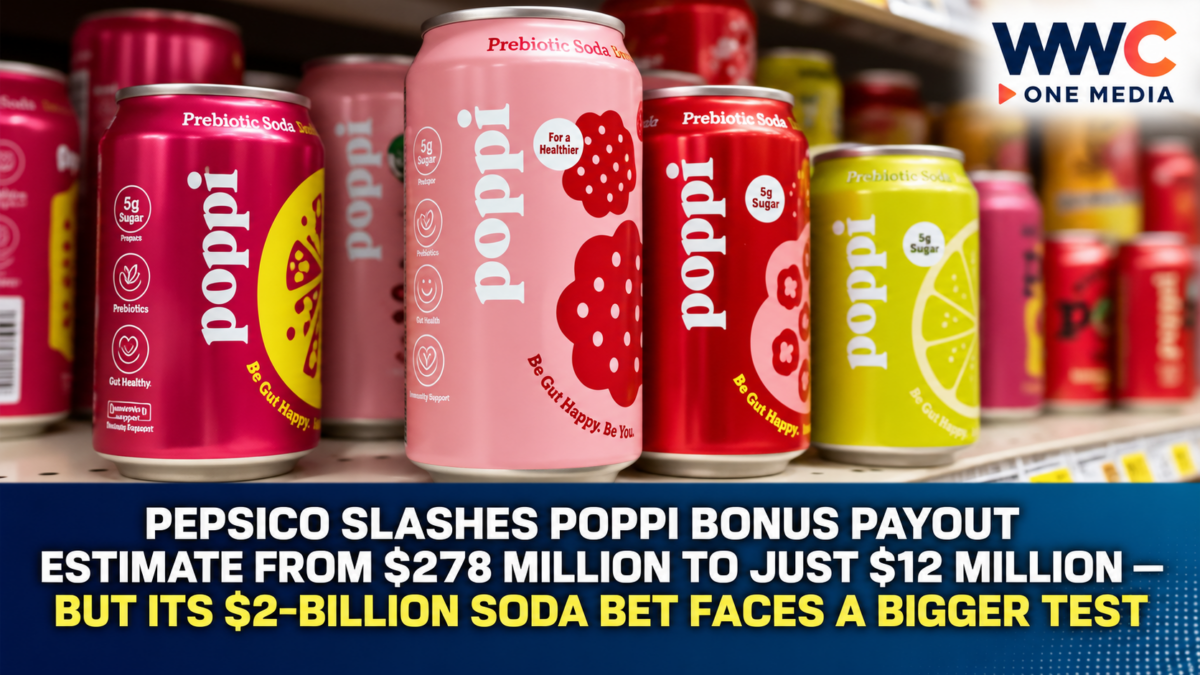
NEW YORK, United States — October 14, 2026 — PepsiCo’s multibillion-dollar bet on the future of healthier soft drinks is facing a major financial test after the food and beverage giant sharply reduced its estimate of an additional payment linked to its acquisition of prebiotic soda brand Poppi.
According to Bloomberg’s October 12 report, PepsiCo now estimates that the potential performance-based payment to Poppi’s former owners is worth just $12 million, down from $117 million in June and $278 million at the end of 2025.
The extraordinary reduction signals that the company has become substantially less confident that Poppi will meet the ambitious financial targets attached to its acquisition.
PepsiCo bought the trendy soda brand in May 2025 for approximately $1.9 billion in cash, with an additional payment of up to $300 million dependent on achieving certain undisclosed financial milestones by the third quarter of 2027.
The purchase was designed to help PepsiCo strengthen its position in a growing market for lower-sugar and functional beverages.
But the company’s traditional North American soda business has continued to struggle as consumers become more cautious about spending and increasingly explore alternatives to conventional soft drinks.
In its latest quarterly results, PepsiCo reported an approximately 2% decline in North American beverage volumes, despite better performance from energy drinks, hydration products and some newer brands.
The company also reduced its full-year profit-growth outlook amid higher costs and continuing pressure on its American operations.
Yet Poppi has not stopped growing.
PepsiCo says the brand recorded double-digit sales-volume growth in the third quarter and gained market share.
The problem is that growth may not be sufficient to achieve the demanding targets embedded in the acquisition agreement.
PepsiCo paid nearly $2 billion to secure a foothold in the next generation of soft drinks. But the bigger question is whether Poppi can deliver the financial returns investors expected — or whether the company’s most promising beverage acquisition will become another warning about the risks of buying fast-growing consumer trends at premium valuations.
PepsiCo Cuts Poppi’s Estimated Bonus Payment to $12 Million
The central development comes from PepsiCo’s latest regulatory disclosure.
The company revised the estimated fair value of its performance-based payment obligation related to Poppi.
The liability declined dramatically during 2026.
Poppi earnout valuation: How the estimate changed
| Reporting date | Estimated payment liability |
|---|---|
| December 27, 2025 | $278 million |
| June 13, 2026 | $117 million |
| September 5, 2026 | $12 million |
The latest estimate is approximately 95.7% below the December 2025 figure.
However, the decline does not mean Poppi’s sales collapsed by the same percentage.
It reflects PepsiCo’s updated assessment of the probability and value of future payments under the acquisition agreement.
A contingent payment is not guaranteed.
If Poppi fails to meet the contractual targets, the eventual payment may be substantially smaller than the maximum or could be zero.
If performance improves, the estimated liability could increase again.
The actual settlement remains dependent on the contract’s terms and future business performance.
What Is the $300-Million Poppi Earnout?
PepsiCo acquired Poppi on May 19, 2025.
The transaction involved approximately $1.9 billion in upfront cash consideration.
The company also agreed to pay up to $300 million if the brand achieved specified business objectives.
Such arrangements are known as earnouts.
They are common in acquisitions where a buyer and seller disagree about how quickly a business will grow.
Instead of paying the entire potential purchase price immediately, the buyer agrees to provide additional compensation if the business achieves agreed milestones.
For Poppi, the relevant targets include financial performance through the third quarter of 2027.
PepsiCo has not publicly disclosed all the underlying milestones.
Its filings explain that the estimated value depends on forecasts involving revenue and margins.
This means investors cannot determine the precise sales target Poppi must reach to receive the full $300 million.
But the sharp decline in the liability suggests that management’s current projections are substantially less optimistic about the likelihood or size of the payout.
Poppi Founders Face a Much Smaller Potential Windfall
Poppi was founded by Allison and Stephen Ellsworth.
The brand became known for its colorful packaging, lower-sugar drinks and social-media-driven marketing.
Its popularity helped attract PepsiCo’s attention.
The $300-million earnout represented an opportunity for the former owners and shareholders to receive additional compensation if the business delivered strong performance after the acquisition.
Bloomberg reported that the payment, if earned, would go to the selling shareholders, including the founders.
The $12-million estimate indicates that the anticipated additional payout has fallen dramatically.
However, the founders have not been ordered to repay the original acquisition proceeds.
The estimated reduction concerns a potential future bonus, not a reversal of the nearly $2-billion acquisition.
It is also not a final determination that no additional compensation will be paid.
The contractual measurement period continues into 2027.
PepsiCo Says Poppi Is Still Growing
Despite the disappointing earnout estimate, PepsiCo has rejected the implication that Poppi’s sales are collapsing.
A spokesperson told Bloomberg that the brand recorded double-digit volume growth during the third quarter.
Poppi also gained share in the carbonated soft-drink market.
These statements suggest that the brand continues attracting customers.
The distinction matters.
A fast-growing business can still underperform expectations if the acquisition price and performance targets assume even faster expansion.
For example, a brand growing at a double-digit rate may be commercially successful but still fall short of a specific revenue or profitability hurdle.
PepsiCo has not disclosed enough standalone financial data to calculate Poppi’s exact quarterly sales growth or operating margin.
Therefore, claims that the brand is losing money or has experienced a specific percentage decline in sales would go beyond the available evidence.
Why PepsiCo’s North American Soda Business Is Struggling
The Poppi development comes amid broader weakness in PepsiCo’s US beverage operations.
In the third quarter of 2026, North American beverage volume declined by approximately 2%.
Traditional carbonated soft drinks have been particularly weak.
Consumers are dealing with persistent price pressures, high borrowing costs and broader economic uncertainty.
Some shoppers are purchasing fewer beverages or shifting toward lower-priced alternatives.
Others are changing their consumption habits.
Demand for hydration products, energy drinks and beverages marketed around specific functional benefits has created new opportunities.
But those gains have not been sufficient to eliminate the weakness in PepsiCo’s traditional soda business.
Chief Executive Ramon Laguarta acknowledged during the company’s latest earnings discussion that management was dissatisfied with its soft-drink performance.
The company intends to accelerate measures to improve execution.
PepsiCo Reports $25.27 Billion in Revenue Despite US Weakness
PepsiCo’s broader financial results provide important context.
For its fiscal third quarter ended September 5, 2026, the company reported approximately $25.27 billion in net revenue.
That represented an increase of approximately 5.6% from a year earlier.
Net income attributable to PepsiCo rose to approximately $3.05 billion.
Reported diluted earnings per share reached $2.23, compared with $1.90 a year earlier.
These results demonstrate that PepsiCo remains profitable and has substantial international operations.
Growth outside North America helped offset weaker performance in its domestic food and beverage businesses.
The company nevertheless lowered its full-year profit-growth expectations.
This mixed picture is important.
PepsiCo is not facing corporate insolvency because of Poppi.
It is confronting a difficult operational turnaround in major product categories while trying to improve the return on recent acquisitions.
Distribution Changes May Have Hurt Poppi’s Momentum
One potential factor in Poppi’s slower-than-expected performance is its transition into PepsiCo’s distribution network.
PepsiCo acquired the brand partly because its enormous distribution system could help introduce Poppi to more retailers and consumers.
But integration can be disruptive.
Changing distributors may affect inventory availability, store relationships, delivery schedules and sales execution.
Laguarta said in July that Poppi had experienced some disruption from the transition during the first half of 2026.
He indicated that those problems had subsequently been addressed.
This explanation is important but does not fully account for the latest earnout revision.
The publicly available information does not establish exactly how much of the financial underperformance resulted from distribution changes versus consumer demand, promotional costs or other factors.
PepsiCo Is Spending Heavily to Promote Poppi
PepsiCo continues treating Poppi as an important growth opportunity.
The brand received exposure through one of the company’s Super Bowl advertisements earlier this year.
It has also entered promotional partnerships involving the Dallas Cowboys and the television series Love Island USA.
Such campaigns can support brand awareness, particularly among younger consumers.
However, marketing campaigns involve costs.
A business may increase its sales volume without meeting profitability targets if advertising, promotions, logistics and other expenses rise quickly.
That is one reason the earnout’s revenue and margin assumptions matter.
The company needs Poppi to generate sustainable growth rather than simply attract attention through expensive marketing.
A recognizable brand is valuable, but its long-term success ultimately depends on repeat purchasing and healthy unit economics.
New Poppi Lift and Poppi Chill Expand the Brand
PepsiCo is expanding Poppi beyond its original prebiotic soda lineup.
The company recently introduced two new products.
Poppi Lift is a caffeine-containing beverage with 70 milligrams of caffeine.
Poppi Chill contains magnesium and L-theanine and is marketed around relaxation.
The launches reflect the broader consumer shift toward beverages promoted for specific functions.
PepsiCo hopes to extend Poppi’s appeal across multiple drinking occasions.
However, marketing claims concerning relaxation, digestive health or other physiological benefits require careful scrutiny.
The presence of a particular ingredient does not guarantee a specific health outcome.
The new products also have not yet demonstrated that they will materially improve Poppi’s future profits.
They represent growth initiatives whose financial impact remains uncertain.
The Functional Soda Market Is Becoming More Competitive
Poppi’s category has attracted considerable attention.
Consumers are exploring products marketed as lower-sugar, prebiotic or otherwise functionally differentiated.
That has encouraged large beverage companies to make acquisitions and launch competing products.
Coca-Cola has introduced Simply Pop, while PepsiCo’s acquisition gave it a prominent position through Poppi.
Other beverage makers continue experimenting with formulations involving prebiotic fibers and reduced sugar.
But consumer trends can evolve quickly.
A product that becomes popular through social media may find it difficult to sustain rapid growth as competition increases.
Retail shelf space is limited.
Advertising costs can rise.
New entrants may also compete aggressively on pricing.
Poppi’s challenge is to remain distinctive after moving from a fast-growing independent brand into the portfolio of a multinational corporation.
Investors Question PepsiCo’s Acquisition Strategy
The revised earnout estimate may intensify scrutiny of PepsiCo’s acquisition decisions.
The company has invested heavily in businesses that offer alternatives to its traditional products.
Those investments reflect a reasonable strategic goal: adapting to changing consumer preferences.
However, paying a high price for a rapidly growing brand can create financial risk.
If sales or profits fall short of expectations, the return on the acquisition may be disappointing.
PepsiCo’s 2026 filing lists Poppi’s finalized acquisition-related purchase price at approximately $2.12 billion, including consideration valued at the acquisition date.
That accounting figure is different from the current $12-million estimate of the remaining contingent liability.
The latest decline in the estimated earnout should not be confused with a confirmed $266-million impairment of Poppi’s brand value.
It is a change in a contingent payment liability, which has its own accounting treatment.
Activist Investor Elliott Adds Pressure
PepsiCo’s management is also facing pressure from Elliott Investment Management.
Reuters reported that Elliott established an approximately $4-billion position in PepsiCo in 2025.
The activist investor has pushed the company to improve growth, profitability and shareholder returns.
PepsiCo has responded through measures including productivity initiatives and pricing changes.
The company has also experimented with lower prices on selected snack brands to attract cost-conscious consumers.
However, rising expenses for energy, aluminum, agricultural products and other inputs are complicating its turnaround.
PepsiCo must decide how much cost inflation to pass on through higher prices.
Higher prices may protect margins but could discourage purchasing.
Lower prices may encourage volume growth but put pressure on profitability.
The struggle illustrates why restoring earnings momentum remains difficult.
Weight-Loss Drugs Add Another Long-Term Uncertainty
PepsiCo’s challenges are also unfolding alongside growing interest in GLP-1 medications used to treat diabetes and obesity.
These medicines can reduce appetite in some patients.
Analysts are examining whether wider use could change demand for certain snacks and beverages.
Reuters identified the trend as one of the risks facing companies that sell sugary drinks and calorie-dense foods.
However, the precise long-term effect on PepsiCo’s sales remains uncertain.
Changes in consumer behavior are influenced by many factors, including income, product innovation, pricing and health preferences.
It would be inaccurate to conclude that GLP-1 medications caused Poppi’s earnout estimate to decline.
The more defensible observation is that the beverage industry is adjusting to several overlapping shifts in consumer preferences.
What Does This Mean for Coca-Cola and Other Rivals?
The challenges facing PepsiCo create opportunities and risks for competitors.
Coca-Cola remains a powerful global rival in traditional soft drinks.
Both companies are investing in lower-sugar products, hydration and alternative beverage categories.
PepsiCo also faces competition from Keurig Dr Pepper and other beverage groups.
A successful turnaround could help PepsiCo defend market share.
Continued weakness, however, might create openings for rival brands.
The battle is increasingly about much more than traditional cola.
Consumers now have access to energy drinks, functional sodas, sparkling water, sports beverages and numerous other options.
Success depends on understanding changing preferences while keeping products affordable and profitable.
Why This Matters for the Philippines and Asia
PepsiCo has a broad international business with products sold throughout Asia.
Its global strategy can influence product innovation, marketing investment and the types of beverages introduced into different markets.
The broader shift toward lower-sugar and functional drinks is relevant to consumers and beverage companies in Southeast Asia.
However, the October 12 Bloomberg report focuses on Poppi’s US performance and PepsiCo’s North American operations.
It does not establish that Poppi has announced a specific major expansion or factory investment in the Philippines.
Nor does the filing provide evidence that the earnout revision directly affects Philippine beverage prices.
For regional businesses, the larger lesson concerns consumer trends.
Brands that succeed through viral marketing still need sustainable demand, reliable distribution and sound profitability.
What Happens Next for Poppi?
Several developments will determine whether the acquisition can meet its original ambitions.
The 2027 earnout deadline: Poppi must meet the contractual milestones by the specified period to trigger additional compensation.
Future sales growth: Investors will look for evidence that double-digit volume growth is sustainable.
Profitability: Revenue alone will not establish whether the brand is meeting expectations.
New product launches: Poppi Lift and Poppi Chill will test demand for adjacent beverage categories.
Distribution performance: PepsiCo must demonstrate that its network can accelerate availability and repeat purchases.
North American soda turnaround: Improvements in Pepsi, Mountain Dew and other products could support the broader beverage division.
Consumer pricing: Inflation and purchasing power will influence the company’s ability to increase sales while protecting margins.
These indicators will help determine whether the decline in the earnout estimate is temporary or evidence of a more persistent mismatch between original expectations and actual performance.
The Bigger Question: Did PepsiCo Pay Too Much for a Viral Soda Brand?
PepsiCo’s acquisition of Poppi reflected a major strategic bet.
The company wanted to capture growth in beverages associated with lower sugar, functional ingredients and younger consumers.
Poppi had a compelling brand, energetic founders and strong digital marketing.
PepsiCo believed its distribution and financial resources could help the business scale even further.
But the latest accounting revision shows that the original performance assumptions are under pressure.
The expected value of a potential $300-million bonus has fallen to just $12 million.
That does not mean the business has collapsed.
Poppi continues posting volume growth and gaining market share, according to PepsiCo.
Yet the gap between growth and acquisition expectations is becoming difficult to ignore.
For PepsiCo, the challenge is demonstrating that Poppi can become a sustainably profitable major brand rather than simply a popular product from a particular consumer trend.
For investors, the story raises a broader question about how much established companies should pay to acquire fast-growing brands.
PepsiCo’s nearly $2-billion Poppi acquisition was designed to help transform its beverage business. But with the estimated bonus payout collapsing from $278 million to $12 million and North American soda volumes still shrinking, the bigger test is whether Poppi can deliver lasting profits — or whether the beverage giant has discovered that buying the next viral trend is much easier than turning it into a long-term winner.