WARSAW, Poland — October 31, 2026
Poland has been plunged into a dramatic constitutional confrontation after the disputed suspension of its top constitutional court officials triggered street protests, riot police deployments and accusations of an attempted political takeover.
The extraordinary showdown forced President Karol Nawrocki to abandon an official trip to Senegal and return to Warsaw as Prime Minister Donald Tusk’s government intensified its efforts to overhaul a judiciary it says was compromised by the former nationalist administration.
According to Bloomberg, Reuters and the Associated Press, the crisis escalated on Friday, October 30, when Constitutional Tribunal President Bogdan Święczkowski and his deputy, Bartłomiej Sochański, were suspended from their duties in a highly contested move.
Judge Anna Korwin-Piotrowska, whose own appointment has been disputed by the president and the tribunal’s existing leadership, announced that she would provisionally assume control of the court.
The move sparked immediate resistance from the opposition Law and Justice party, known as PiS.
Supporters gathered outside the tribunal in Warsaw, where police secured the building after some protesters breached security barriers and threw objects at officers.
Three people were detained.
The confrontation marks one of the most serious escalations in Poland’s long-running battle over judicial independence since Tusk’s pro-European coalition took power in December 2023.
But the bigger question now is whether Poland’s government is finally restoring an independent judiciary — or whether the struggle over constitutional authority could push the country into an even deeper political crisis.
Poland’s Constitutional Court Showdown Erupts as Top Judges Are Suspended
The crisis centers on Poland’s Constitutional Tribunal, an institution responsible for reviewing whether legislation and other legal measures comply with the country’s constitution.
On October 30, orders appeared on the tribunal’s official website indicating that its president, Bogdan Święczkowski, and deputy president, Bartłomiej Sochański, had been suspended.
The announcements were quickly disputed by the court’s existing leadership.
Judge Anna Korwin-Piotrowska said she had ordered the suspension and would provisionally assume leadership.
Polish Justice Minister Waldemar Żurek separately announced that he had requested the lifting of both officials’ judicial immunity as part of efforts to pursue potential criminal proceedings.
The alleged misconduct involves their refusal to allow certain judges chosen by the current parliamentary majority to assume their duties.
However, the legal basis for suspending the two court leaders remains controversial.
Some constitutional lawyers who previously criticized PiS-era judicial changes have also questioned whether the legal provision invoked can properly apply to members of the Constitutional Tribunal.
The distinction is significant.
Poland’s government argues that the existing leadership has obstructed the lawful functioning of the court.
The opposition argues that officials aligned with the government are attempting to displace legally appointed judges without proper constitutional authority.
The case therefore involves not only political disagreement but competing interpretations of who has the legal power to control the tribunal.
President Karol Nawrocki Turns His Plane Around as Crisis Escalates
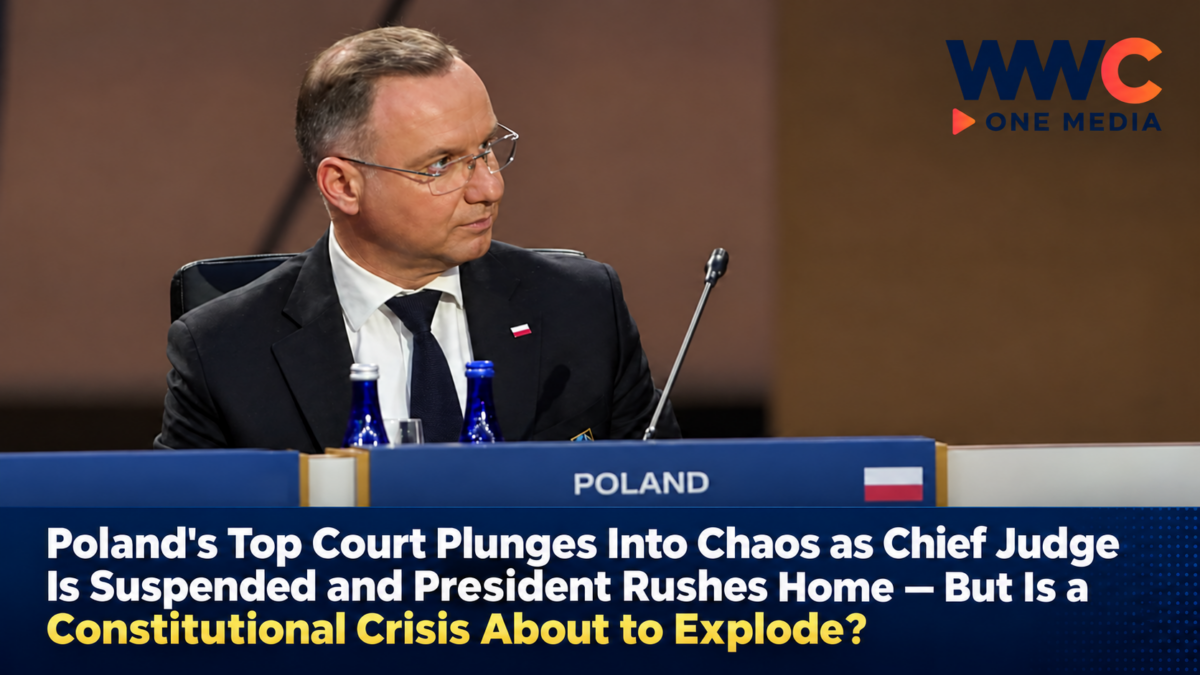
The events in Warsaw prompted a dramatic response from Polish President Karol Nawrocki.
Nawrocki was traveling to Senegal when news of the confrontation reached him.
He canceled the visit and ordered his aircraft to return to Poland.
In a public statement, the president said the gravity of the situation required his presence at home.
Nawrocki is politically aligned with the conservative Law and Justice camp, which governed Poland from 2015 to 2023.
His decision to return underlined how quickly the judicial dispute had developed into a confrontation between Poland’s most powerful political institutions.
The presidency and the government are already divided over judicial appointments, legislation and the proper limits of executive authority.
Nawrocki has opposed several attempts by Tusk’s governing coalition to restructure judicial institutions.
The October 30 escalation could further intensify that conflict.
Riot Police Surround the Court as Opposition Supporters Protest
As news of the suspensions spread, demonstrators gathered outside the Constitutional Tribunal in Warsaw.
Supporters of the Law and Justice party accused the government of attempting to seize control of the judiciary.
Prominent opposition politicians, including PiS leader Jarosław Kaczyński, appeared at the protest.
Some demonstrators attempted to cross security barriers surrounding the court.
Police reported that objects were thrown at officers and that three people were detained after incidents involving the perimeter fence.
Officers secured the area around the tribunal.
There were competing accounts of the precise extent of police activity inside the court complex.
Warsaw police said their deployment was connected to public safety concerns and threats to people at the site, rather than an order from the prime minister to seize the institution.
The protests reflected the depth of Poland’s political divisions.
For PiS supporters, the suspensions represented an attack on a constitutional institution.
For supporters of the government, the confrontation reflected the resistance of court officials associated with the previous administration to attempts to restore lawful judicial appointments.
Neither political interpretation should be confused with a final independent determination of the suspensions’ legality.
Donald Tusk Defends Decisive Action to Restore Judicial Independence
Prime Minister Donald Tusk has defended the broader effort to reform Poland’s judiciary.
His coalition came to power in 2023 promising to reverse changes introduced under the previous PiS-led government.
Those earlier changes attracted criticism from European Union institutions, European courts and judicial organizations concerned about political interference.
Tusk argues that restoring the rule of law requires correcting judicial appointments and institutional arrangements that undermined public confidence.
Following the October 30 developments, he described the reform process as difficult but necessary.
The government maintains that the tribunal’s current leadership has obstructed the entry of judges lawfully elected by parliament.
Its critics, however, question whether the administration’s methods are themselves compatible with judicial independence.
That creates a fundamental dilemma.
A government seeking to restore constitutional institutions must ensure that its chosen remedies also comply with the constitution.
Otherwise, the process may generate further disputes over institutional legitimacy.
Tusk’s leadership has already been tested by a series of national security and public safety challenges.
WWC ONE MEDIA previously reported on his response to violent incidents involving educational institutions in Poland’s School Attacks Leave One Dead as PM Blames Online Glorification of Violence.
That earlier report concerns a separate issue, but illustrates the range of security and governance pressures facing the Polish administration.
Why Poland’s Constitutional Tribunal Has Been at the Center of Political Conflict Since 2015
The origins of the current crisis extend more than a decade into Poland’s political history.
When Law and Justice came to power in 2015, it became involved in a dispute over appointments to the Constitutional Tribunal.
Judges were selected for positions that had already been filled through earlier parliamentary decisions.
The controversy developed into a broader confrontation over the independence of judicial institutions.
During PiS’s eight years in office, critics accused the party of increasing political influence over the judiciary through changes to judicial appointments, disciplinary procedures and institutional leadership.
Polish authorities under PiS argued that their reforms were intended to improve accountability and correct deficiencies in the judicial system.
European institutions challenged several of those measures.
The European Court of Justice issued rulings concerning Poland’s judicial arrangements, while the European Commission pursued enforcement action.
Poland also faced financial penalties and restrictions affecting access to European Union funding.
When Tusk returned as prime minister in December 2023, his coalition pledged to restore compliance with European judicial standards.
However, replacing disputed arrangements proved politically and legally complicated.
The president, parliament, Constitutional Tribunal and other judicial bodies have continued to disagree over appointments and institutional authority.
The October 30 confrontation represents the latest and most dramatic phase of that unresolved struggle.
A Battle Over Judicial Appointments Pushes the Court Toward Paralysis
The immediate dispute concerns the appointment and recognition of new Constitutional Tribunal judges.
Earlier in 2026, Poland’s parliamentary majority began filling vacancies on the tribunal’s 15-member bench.
According to Notes from Poland, parliament had selected eight new judges by October.
President Nawrocki refused to administer oaths to five of those appointees, citing concerns about their selection or qualifications.
The disputed appointees pursued alternative oath procedures and argued that they had been lawfully elected.
Święczkowski refused to permit them to take up their positions.
That refusal contributed to the current confrontation.
The government argues that the court’s leadership has prevented legally selected judges from carrying out their constitutional duties.
The president and opposition question whether those judges completed the appointment process required by law.
The dispute is complicated by the involvement of European human rights institutions, which have also addressed aspects of Poland’s judicial crisis.
As a result, the court has struggled to function normally.
The question is no longer simply who should occupy a vacant judicial position.
It is whether Poland’s political institutions can agree on which judges are legally entitled to exercise constitutional authority.
Justice Minister Seeks to Remove Judicial Immunity
Polish Justice Minister Waldemar Żurek has sought to lift the immunity of Święczkowski and Sochański.
The move is intended to permit potential criminal proceedings over alleged obstruction of judicial duties.
However, a request to remove immunity is not equivalent to a criminal conviction.
The two officials retain the right to contest allegations and the legal procedures used against them.
The dispute also raises questions about who has authority to consider immunity applications when the tribunal’s own leadership is contested.
Judge Anna Korwin-Piotrowska became a central figure in the confrontation after receiving documents from the justice ministry and announcing the suspensions.
Her ability to exercise judicial authority is itself challenged by the tribunal’s existing leadership and the president.
That makes the legal situation unusually complicated.
The parties disagree not only about the alleged misconduct but also about the legitimacy of the officials attempting to address it.
Opposition Accuses Tusk Government of a Constitutional Coup
The nationalist Law and Justice party has sharply condemned the suspensions.
Opposition politicians argue that the government is attempting to remove judicial officers through unlawful means.
Święczkowski and his supporters have characterized the intervention as an attempted coup against the Constitutional Tribunal.
Former Justice Minister Zbigniew Ziobro and other PiS figures have urged strong political resistance.
Such allegations are serious but remain political and legal claims rather than established findings.
The government rejects the characterization.
Tusk’s coalition insists that the confrontation is the result of years of judicial irregularities and resistance to reform.
The competing positions demonstrate how deeply distrust has become embedded in Polish politics.
One side views the court’s existing leadership as a symbol of judicial capture.
The other sees the government’s actions as evidence that the new administration is prepared to override constitutional limits.
Resolving that disagreement will require more than political declarations.
It will require legally credible procedures capable of restoring confidence in the tribunal’s independence.
Even Critics of PiS Question the Legal Basis for the Suspensions
One of the most significant aspects of the crisis is that criticism of the suspensions is not confined to Law and Justice supporters.
Polish constitutional law scholar Marcin Matczak, who has criticized earlier PiS judicial reforms, questioned the legal grounds for suspending Święczkowski.
According to Notes from Poland, the disputed procedure relied on a provision concerning ordinary courts.
Matczak argued that the same provision could not simply be applied to the Constitutional Tribunal.
This matters because it reveals a legal disagreement extending beyond party allegiance.
A government may have legitimate reasons to challenge controversial judicial appointments while still facing objections to its chosen method.
The credibility of Poland’s rule-of-law reforms could depend on whether the government can demonstrate that its actions comply with clear constitutional standards.
Without that legal clarity, the leadership dispute may produce competing claims to institutional authority rather than a functioning independent court.
European Union Faces Another Test Over Poland’s Rule of Law
The confrontation also has implications for Poland’s relationship with the European Union.
Poland is one of the EU’s largest member states and an important political and security partner.
The previous PiS government’s judicial reforms prompted extensive disputes with Brussels.
European institutions argued that certain changes undermined judicial independence and conflicted with EU legal requirements.
Tusk’s return to government improved relations with European leaders, partly because he promised to reverse controversial judicial measures.
However, the latest crisis creates a new challenge.
The EU has an interest in ensuring that Poland’s judicial system complies with European legal standards.
At the same time, officials must assess whether measures taken in the name of judicial restoration are themselves consistent with due process and institutional independence.
A further deterioration in Poland’s constitutional dispute could complicate domestic legislative reforms and relations with European institutions.
But the October 30 events do not automatically establish that new EU sanctions or funding restrictions will follow.
Any such action would require separate legal and political decisions.
Poland’s Strategic Importance Makes the Crisis Bigger Than Domestic Politics
Poland is a major member of both the European Union and NATO.
It plays an important role in European security, particularly following Russia’s full-scale invasion of Ukraine.
Warsaw has supported Kyiv through military assistance, logistics, diplomatic cooperation and defense initiatives.
Political instability in Poland therefore attracts attention from European allies.
WWC ONE MEDIA previously examined one aspect of Poland’s strategic role in Poland Joins Ukraine’s Missile Shield Coalition — But Europe’s Bigger Defense Plan Is Only Beginning.
The report covered Poland’s participation in a European missile-defense initiative connected to Ukraine.
That cooperation is separate from the Constitutional Tribunal dispute.
However, it illustrates why Poland’s political stability matters to broader European security planning.
A prolonged constitutional confrontation could consume government attention and complicate domestic policy decisions.
There is no confirmed indication, however, that the tribunal dispute has directly disrupted Poland’s NATO commitments or military assistance arrangements.
What Could Happen to Poland’s 2027 Parliamentary Election?
The timing is politically sensitive.
Poland is expected to hold parliamentary elections in 2027.
The governing coalition and the opposition are already preparing for an intense contest.
The Constitutional Tribunal can play an important role in reviewing legislation and resolving certain constitutional disputes.
A court whose leadership and membership remain contested may struggle to command public confidence.
That could become especially problematic if election-related laws, political appointments or other sensitive decisions reach the tribunal.
The risk is not necessarily that an election will be canceled.
Rather, the concern is that competing political factions may reject decisions issued by institutions they consider illegitimate.
That could deepen mistrust in Poland’s democratic system.
The coming months will test whether the government, presidency and judicial authorities can reach a lawful and sustainable arrangement.
Constitutional Court Conflicts Have Become a Wider Democratic Challenge
Poland is not the only country where court authority has become entangled with political disputes.
In Indonesia, legal challenges concerning eligibility for national office have placed the Constitutional Court at the center of political controversy.
WWC ONE MEDIA examined a separate Asian case in Indonesia Court to Rule on Bid to Annul Vice President Gibran’s Election Win.
The Indonesian dispute concerns a different constitution, legal system and set of political circumstances.
Nevertheless, it demonstrates how constitutional courts can become central to conflicts over electoral legitimacy and political power.
The issue is also familiar in the Philippines.
In Comelec Ready to Act if Supreme Court Intervenes in BSKE Postponement, WWC ONE MEDIA reported on the relationship between judicial review and election administration.
The comparison is not that these countries face identical constitutional crises.
Instead, the shared principle is that democratic institutions depend on public confidence that legal disputes are resolved through recognized judicial procedures rather than political force.
What Happens Next in Poland’s Constitutional Crisis?
Several questions remain unresolved after the October 30 confrontation.
The first concerns the legal status of Święczkowski and Sochański.
Their suspensions have been announced, but the validity and implementation of those decisions remain contested.
The second is whether Anna Korwin-Piotrowska can lawfully exercise the powers of tribunal president.
Her own judicial status has been challenged in the broader appointment dispute.
The third concerns the justice ministry’s efforts to remove judicial immunity.
Potential criminal proceedings would depend on the relevant legal requirements and the outcome of those requests.
The fourth involves President Nawrocki.
His decision to return immediately to Poland suggests that the presidency will take an active role in the political and constitutional response.
Finally, the government must determine whether its approach can restore a functioning tribunal without creating further uncertainty about judicial independence.
The participation of European institutions and legal authorities could influence future developments.
However, no lasting resolution had emerged by the time of the reporting reviewed.
The Bigger Question: Can Poland Restore Judicial Independence Without Deepening Its Constitutional Divide?
Poland’s confrontation illustrates one of the most difficult challenges facing democracies recovering from prolonged disputes over institutional independence.
When political parties disagree over the legitimacy of judicial appointments, every attempt to reform the courts can become another source of conflict.
Tusk’s government argues that decisive action is necessary to reverse the damage it attributes to the previous administration.
The opposition argues that constitutional procedures are being disregarded.
Independent legal experts have also questioned aspects of the government’s approach.
The credibility of any solution will depend on whether it can withstand legal scrutiny and secure confidence beyond one political camp.
For ordinary Polish citizens, the stakes include more than the careers of individual judges.
A functioning constitutional court is essential to the protection of legal rights, the review of government decisions and the stability of the constitutional system.
The Bottom Line
Poland’s Constitutional Tribunal has become the center of an extraordinary power struggle after its president and deputy were suspended in a disputed move.
The confrontation forced President Karol Nawrocki to abandon an overseas visit, brought riot police to the court and prompted protests by the nationalist opposition.
Prime Minister Donald Tusk insists that his government is restoring judicial independence.
Law and Justice politicians accuse the governing coalition of an unlawful takeover.
Meanwhile, legal experts are questioning whether the procedures used to suspend the court leaders have a valid constitutional basis.
With parliamentary elections approaching in 2027, Poland faces a difficult test of its democratic institutions.
As rival political camps battle over who has the authority to lead the country’s highest constitutional court, one question could define Poland’s political future: Will this confrontation finally restore the rule of law — or leave the country with a judiciary whose legitimacy neither side is willing to accept?