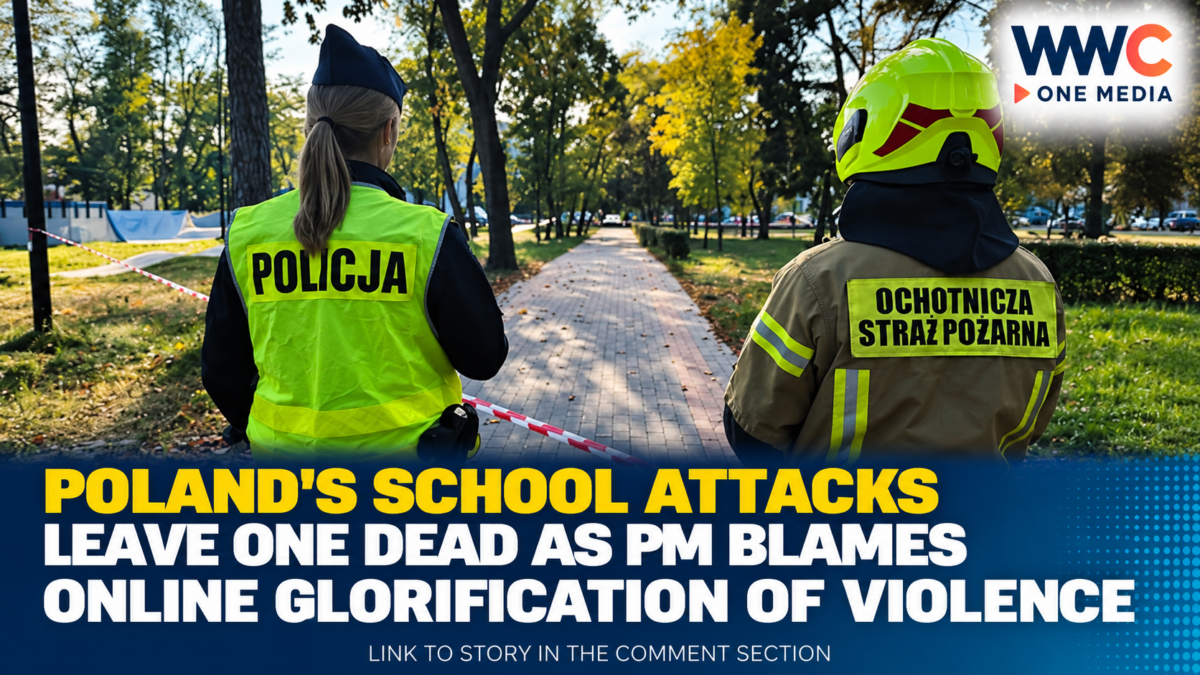
Polish Prime Minister Donald Tusk has warned that the growing glorification of violence online may be influencing young people, following three attacks at educational institutions within four days that left one person dead and several others injured.
Speaking on Sunday (Oct 11), Tusk said the incidents appeared to be spontaneous acts inspired by online activity rather than the work of a large, organised group.
“We are not dealing with any group organised on a big scale,” he said during a crisis meeting with government officials and security services.
His comments came as authorities intensified security checks at schools nationwide, amid growing concerns over violent online content, extremist imagery and the possibility of copycat attacks.
Three attacks in four days
The incidents took place in Poland’s central Mazovian province and the capital, Warsaw.
On Wednesday (Oct 7), a 19-year-old student attacked people at a vocational school in Ostrołęka with a machete, injuring several people. Authorities reported that 10 people, including the suspect, were injured.
The following day, a 15-year-old allegedly killed a school caretaker and wounded two teachers at his former school in Leszczydol-Nowiny.
On Saturday (Oct 10), a 21-year-old woman allegedly wounded three people at a post-secondary educational institution in Warsaw.
The attacks have shaken a country where such incidents are relatively rare, prompting concerns among parents, teachers and students.
Police step up school security checks
By Sunday morning, police had detained 117 people across Poland over alleged possession of knives or other dangerous weapons, as well as threats to attack schools or fellow students.
Authorities had also checked approximately 64,000 schools as part of efforts to prevent further incidents.
The operation followed widespread rumours of coordinated attacks on a day dubbed “Bloody Friday” in online discussions. Some schools temporarily suspended classes in response to the threats.
However, Polish officials said there was no verified evidence that the attacks were part of a coordinated operation or an online challenge.
The government has continued to urge vigilance while warning against rumours that could spread fear among students and families.
Tusk warns of online fascination with violence
Tusk said authorities had observed a rise in fascination with violence both in Poland and internationally.
He pointed to online searches involving Nazi material and mass killers who have become figures of admiration in certain online communities. He also raised concerns about young people encountering increasingly violent content through internet culture.
The prime minister described the incidents as examples of what authorities call “nihilistic violence” — violence that may be driven by hostility or a sense of meaninglessness rather than a clearly defined political objective.
Kacper Rekawek, a senior researcher at the International Centre for Counter-Terrorism in The Hague, told the Associated Press that one suspect appeared to have used imagery and aesthetics associated with Brenton Tarrant, the white supremacist responsible for the 2019 Christchurch mosque attacks in New Zealand, which killed 51 people.
The comparison has raised concerns about how perpetrators may imitate previous attackers, although investigators have not established that all three Polish incidents shared the same motive.
Parents and teachers urged to stay involved
Tusk said parents and teachers had an important role in understanding children’s online experiences and helping them recognise the consequences of glorifying violence.
Police checks were expected to continue into the following week as authorities sought to reassure schools and reduce the risk of further attacks.
The incidents have renewed debate over how schools, families, law enforcement agencies and online platforms should respond when violent ideologies or the celebration of mass attackers spread through digital communities.
For Poland, the immediate priority remains protecting students and staff while investigators establish the circumstances behind each attack. The broader challenge is determining how to address potentially dangerous online influences without treating unverified rumours as evidence of a coordinated threat.