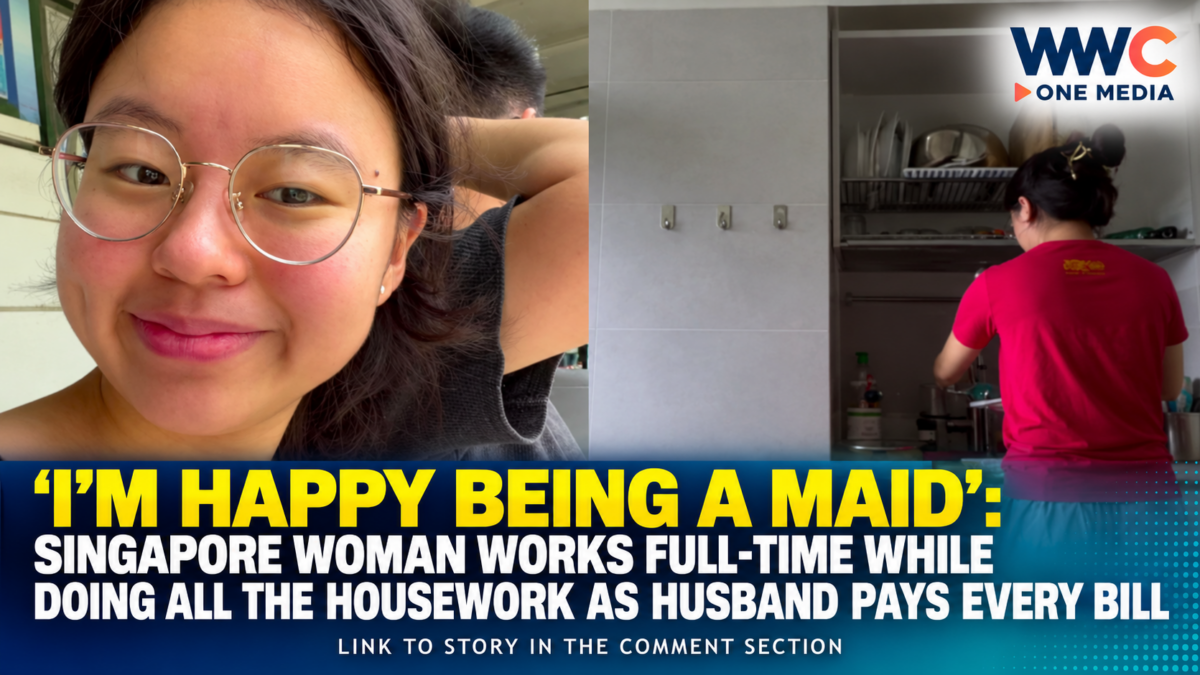
A Singapore woman has sparked an online debate after revealing that she handles 100% of the household chores while working full-time, while her husband covers all their expenses.
The woman, who goes by Teresa on TikTok, said she is perfectly content with the arrangement, despite her husband barely helping with domestic duties. Her candid account has drawn mixed reactions, with some questioning whether the division of labour is fair and others defending the couple’s right to decide what works for their marriage.
In a post shared on Oct 9, Teresa explained that her daily responsibilities include cooking, washing dishes, doing laundry and scrubbing the toilet.
She also said her husband has never picked up a broom or helped her wash the dishes.
“When he’s too lazy to get water, I’d happily get it for him,” she shared.
However, Teresa stressed that the arrangement goes beyond household chores: her husband pays for their utilities, groceries, travel and practically every bill. He has even offered to let her stop working if she wishes.
Husband Covers All Expenses, She Manages the Home
Teresa said her husband does not expect her to work and is willing to support her if she decides to quit her job.
She added that he refuses to let her repay him when he buys her expensive items. Despite being financially supported, she said she remains careful with money, considers $10 meals expensive and often purchases second-hand items.
For Teresa, the arrangement is also about how her husband shows affection and how she chooses to reciprocate.
She explained that her husband runs a business, manages workers, deals with customers and suppliers, and is also a full-time university student. His responsibilities, she said, mean his days can be more demanding than hers.
She occasionally helps with his business in addition to working full-time and managing the household.
Teresa also emphasised that her husband appreciates her efforts and does not expect the home to be spotless when she is tired.
“When I’m tired, the house gets a little messy and it’s okay. He makes sure I feel appreciated,” she said.
Netizens Question Whether the Arrangement Is Fair
Her account has prompted a wider discussion about marriage, financial contributions and the division of domestic labour.
Some commenters questioned how anyone could manage a full-time job while also taking responsibility for every household chore, describing the workload as exhausting.
Others wondered whether the arrangement would remain practical if the couple had children or if Teresa became ill and could no longer manage the housework.
However, some people supported her decision, arguing that couples should be free to divide responsibilities according to their circumstances, provided both partners are comfortable with the arrangement.
The debate reflects a familiar tension in modern relationships: financial contributions and domestic work are both essential, but couples may place different values on each.
‘Do Whatever Works for You and Your Partner’
Following the initial reaction, Teresa published a follow-up post clarifying that she was happy with her lifestyle and did not believe every marriage needed to follow the same formula.
She said an equal split of chores could make sense when both partners earn similar amounts and work comparable hours, while acknowledging that every couple’s situation is different.
“I do 100/0, but if 80/20 floats your boat, that’s fine too,” she wrote.
Teresa added that she genuinely enjoys cooking, cleaning, travelling and sharing aspects of married life on social media. She questioned why she would continue documenting the arrangement if she were unhappy with it.
Her message was straightforward: what works for one couple may not work for another.
A Broader Conversation About Marriage and Partnership
The discussion goes beyond whether one person should do more housework. It raises questions about how couples recognise each other’s contributions, particularly when one partner provides most of the money and the other takes on most domestic responsibilities.
For some couples, a traditional division of roles offers a sense of stability and fulfilment. For others, sharing chores more equally is an important expression of partnership.
Teresa maintains that she feels respected and appreciated in her marriage, despite taking on the bulk of the household work.
Ultimately, her story has prompted a familiar question among social media users: should a marriage be judged by whether responsibilities are divided equally, or by whether both partners feel valued and satisfied with the arrangement?