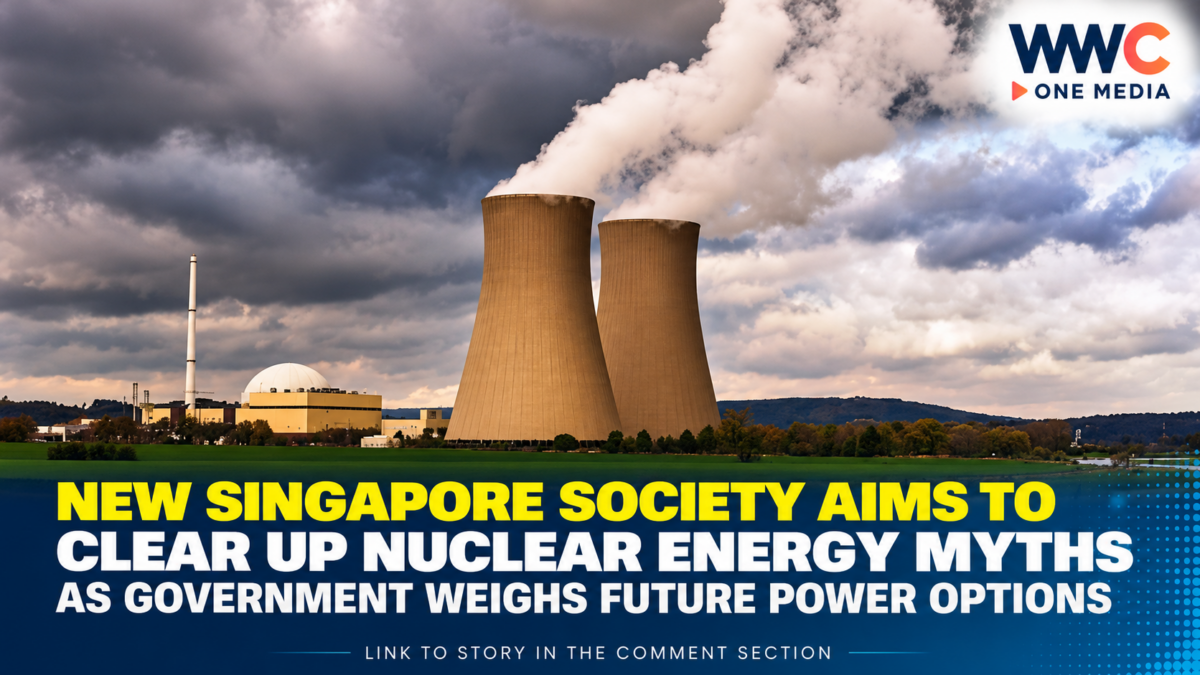
As Singapore explores whether nuclear energy could become part of its future electricity mix, a newly formed society is stepping in to help the public understand the technology, address misconceptions and ask questions without fear of being judged.
The Nuclear Learning & Understanding Society (NUCLEUS), established in September 2026, aims to make nuclear science and energy more accessible through public education, discussions and community engagement.
Its formation comes as Singapore strengthens its ability to assess advanced nuclear technologies amid growing concerns about energy security, electricity demand and the transition towards cleaner power sources.
However, the Government has stressed that exploring nuclear energy does not mean a decision has been made to build a nuclear power plant.
Why nuclear energy remains a sensitive subject
Matthew Chew, president of NUCLEUS, said nuclear energy remains a socially sensitive topic in Singapore, where public understanding of the technology can be limited.
In an interview with The Straits Times on Oct 7, Chew noted that people might support nuclear energy in principle but become less certain when considering whether a facility should be located near their homes.
One recurring concern is radioactive waste and whether it can be stored safely without exposing people or the environment to harmful radiation.
Chew explained that established approaches include storing radioactive waste in specially designed dry casks and placing certain types of waste in deep underground geological repositories.
A 2023 study conducted by Singapore authorities and a Swedish company found no major technical obstacles to storing Singapore’s potential nuclear waste, including through deep geological storage.
However, the findings were based on a desktop assessment rather than on-site investigations. Further studies would be needed to establish the suitability of any specific location.
Other concerns include nuclear plant safety, where facilities could be located and the career opportunities that might emerge if Singapore eventually adopts nuclear energy.
What NUCLEUS plans to do
The society currently has 10 members and has held two meetings since its formation to discuss its objectives and direction.
It plans to organise seminars, workshops and networking sessions, as well as conduct educational talks in schools. Its first networking event is expected to take place in November 2026.
NUCLEUS wants to provide a space where members of the public can learn about nuclear science, engineering and the reasons governments consider nuclear power as an energy option.
Chew emphasised that the organisation is not intended to advocate for nuclear energy or advise the Government on whether Singapore should adopt it.
Instead, its focus is on helping people develop a better understanding of the technology and encouraging open discussion.
The society’s committee includes business development manager Brendan Tan, senior scientist Rowinski Marcin, who holds a doctorate in nuclear engineering, and automation company managing director Nicola Scarpelli, who has a master’s degree in energy and nuclear engineering.
Tan hopes to contribute a perspective beyond the technical aspects of nuclear power, including how the technology could work in practice and how projects might be financed.
He is particularly interested in small modular reactors (SMRs), which are smaller-capacity nuclear reactors being explored internationally as a potential option for places with limited land.
Although SMRs may offer certain design and deployment advantages, their suitability for Singapore would still depend on detailed assessments of safety, cost, land requirements and other local considerations.
Singapore has not decided to adopt nuclear power
The Government is studying advanced nuclear energy technologies as part of efforts to assess possible future energy sources.
Singapore currently relies heavily on imported natural gas for electricity generation, while limited land constrains the amount of renewable energy the country can produce domestically.
In May 2026, the Government announced plans to undertake the International Atomic Energy Agency’s Integrated Nuclear Infrastructure Review Phase 1 Mission, beginning in 2027.
The review will assess Singapore’s capabilities across 19 areas, including nuclear safety, radioactive waste management, emergency preparedness and regulatory frameworks.
It is intended to help Singapore determine whether it has the expertise and institutions needed to make an informed decision about nuclear energy. It does not commit the country to building a nuclear power plant.
Any eventual decision would need to consider safety, reliability, affordability and environmental sustainability in Singapore’s specific circumstances.
Public understanding could shape the future debate
As Singapore continues studying its long-term energy options, public understanding will be an important part of the conversation.
NUCLEUS hopes to give residents opportunities to examine the science, raise concerns and learn about both the potential benefits and challenges of nuclear power.
For now, the society’s message is clear: learning about nuclear energy is not the same as endorsing it.
Whether Singapore eventually adopts the technology remains undecided, but NUCLEUS hopes that better-informed public discussions will help people understand the choices facing the country as it plans for its future energy needs.