NEW YORK — October 31, 2026
Wall Street’s biggest natural gas speculators are making an extraordinary bet on a warmer-than-normal American winter, building the largest short position on record as US natural gas prices plunge and expectations of weak heating demand dominate energy markets.
But the historic wager is creating a potentially explosive situation: if winter temperatures suddenly turn colder, the same traders betting on falling prices could be forced to buy back futures contracts, potentially accelerating a dramatic market reversal.
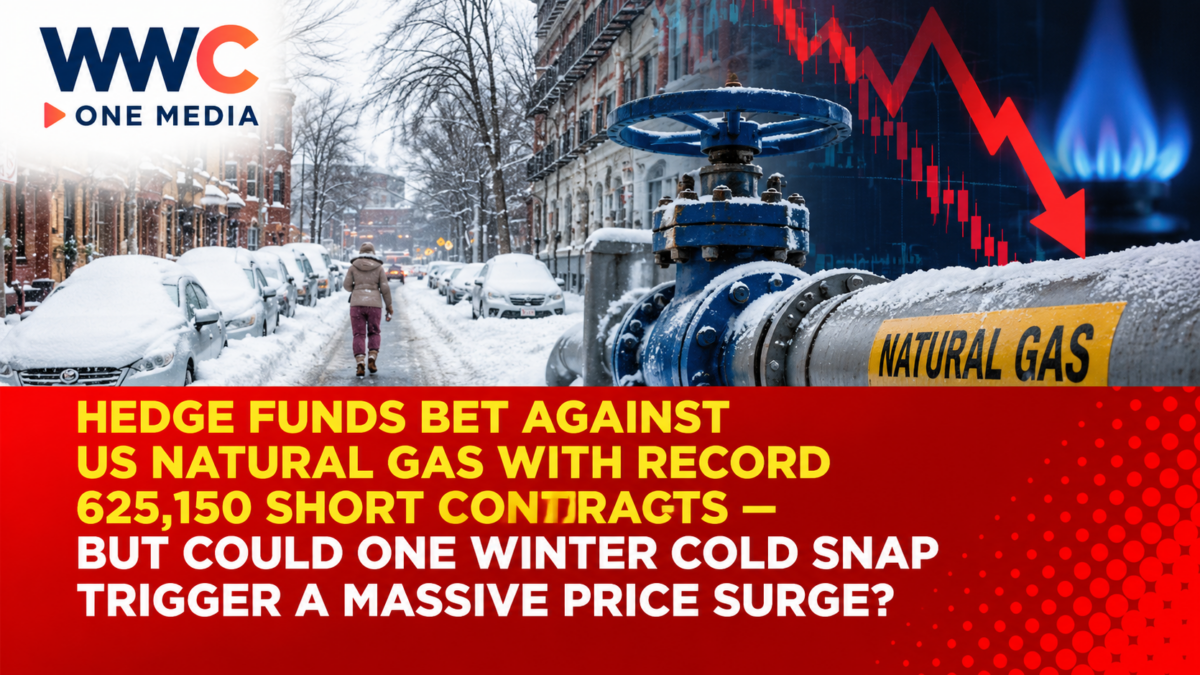
According to Bloomberg’s October 30 report, citing the US Commodity Futures Trading Commission (CFTC), hedge funds and other money managers increased their short-only exposure across seven benchmark Henry Hub natural gas contracts to 625,150 contracts.
That is the highest level in comparable records dating to May 2013, surpassing another record established just one week earlier.
The market’s net-short position also climbed to 223,591 contracts, its most bearish level since February 2020, when the onset of the COVID-19 pandemic disrupted energy demand and financial markets.
Meanwhile, US benchmark natural gas futures for December delivery have fallen approximately 18% over three weeks to $2.898 per million British thermal units, reflecting growing expectations that unusually mild weather will reduce heating demand.
The bearish positioning comes as forecasters anticipate above-normal temperatures across northern parts of the United States during the first half of November.
A potentially powerful El Niño weather pattern is also shaping expectations for the coming winter.
Yet extremely crowded market positions can become vulnerable when the underlying forecast changes.
The biggest question now is whether hedge funds have correctly anticipated a winter of unusually weak gas demand — or whether a sudden cold snap could ignite one of the energy market’s most dramatic short squeezes.
Hedge Funds Build Largest Natural Gas Short Position on Record
The latest CFTC positioning figures reveal how aggressively institutional investors are betting against US natural gas.
As of the October 27 reporting date, money managers held 625,150 short-only contracts across seven Henry Hub benchmark instruments.
That represents an increase of 25,419 contracts from the 599,731 recorded the previous week.
The earlier figure had already established a record in the comparable series.
Now traders have pushed bearish positioning to an even greater extreme.
Short positions are generally established when investors expect prices to decline.
In futures markets, a trader can sell a contract with the intention of buying it back later at a lower price.
If the price falls, the short position may generate a profit.
If the price rises, the trader faces potential losses.
The larger the short position, the greater the market exposure to an unexpected price increase.
The record aggregate position reflects confidence among money managers that US natural gas demand will remain relatively weak as the Northern Hemisphere enters the winter heating season.
However, it does not represent a guarantee that prices will continue falling.
Net-Short Exposure Reaches Most Bearish Level Since February 2020
Beyond the record number of outright short contracts, the overall balance between bullish and bearish speculative positions has shifted sharply.
Bloomberg reported that the aggregate net-short position increased to 223,591 contracts.
Net positioning accounts for both long contracts, which generally benefit from rising prices, and short contracts, which benefit from falling prices.
A net-short position means that speculative short exposure exceeds speculative long exposure.
The October reading marks the most bearish aggregate net position since February 2020.
At that time, the outbreak of COVID-19 caused major disruptions to global economic activity and energy demand.
The historical record net-short position in Bloomberg’s comparable series was 266,416 contracts, established in February 2020.
The latest reading remains below that net-short record.
This distinction is important.
Short-only exposure has reached a record, but the net-short position has not exceeded its February 2020 peak.
Both measures indicate substantial bearish sentiment, but they capture different dimensions of investor positioning.
Natural Gas Prices Fall 18% as Warm Winter Forecasts Dominate
The sharp increase in bearish positioning has coincided with a significant decline in US natural gas prices.
According to Bloomberg, December-delivery Henry Hub natural gas futures fell approximately 18% over the preceding three weeks.
The contract reached around $2.898 per million British thermal units.
The decline reflects expectations that warmer-than-normal weather will reduce the need for heating.
Natural gas is an important fuel for residential heating, commercial buildings, electricity generation and industrial activity across the United States.
During cold winters, demand can rise substantially as households and businesses consume more fuel.
During mild winters, less heating may be required.
That can leave additional gas in storage and reduce immediate pressure on prices.
The latest forecasts point toward above-normal temperatures across much of the northern United States during the first two weeks of November.
That region is especially significant because it includes large population centers with substantial heating requirements.
Commodity Weather Group has identified unusually warm conditions as a major influence on demand expectations.
However, weather forecasts become less reliable over longer periods.
A mild beginning to winter does not guarantee that all subsequent months will remain warm.
Super El Niño Is Driving Expectations of a Mild Winter
The anticipated El Niño weather pattern is a major factor behind the market’s bearish outlook.
El Niño involves unusually warm surface waters across parts of the tropical Pacific Ocean, which can influence global atmospheric circulation and regional weather patterns.
In some US regions, El Niño winters are associated with warmer conditions, particularly across portions of the northern states.
This can reduce heating demand.
However, El Niño’s effects vary geographically and do not eliminate the possibility of severe winter storms.
Individual cold events can still occur even during a season with above-normal average temperatures.
For natural gas traders, that distinction is crucial.
Futures prices respond not only to average seasonal forecasts but also to near-term changes in heating demand.
A sudden downward revision in temperature forecasts can quickly alter expectations about how much gas will be consumed.
And when large numbers of traders have positioned themselves for falling prices, an unexpected shift toward colder conditions can create pressure to unwind those bets.
The Hidden Danger: A Massive Natural Gas Short Squeeze
The most important risk emerging from the record positioning is a potential short squeeze.
A short squeeze occurs when rising prices force traders holding bearish positions to buy contracts to close their exposure.
Those purchases can add further upward pressure to prices.
That, in turn, may prompt additional short sellers to exit their positions.
The process can create a rapid market rally even when underlying supply and demand conditions have not changed enough to justify the full price movement.
In natural gas markets, weather surprises can make this dynamic especially powerful.
A severe cold snap can increase heating demand while potentially disrupting production and transportation infrastructure.
If traders are already heavily short, the resulting price increase may be amplified by speculative buying.
Bloomberg noted that a major winter storm earlier in 2026 triggered a substantial reduction in bearish positions.
In late January, money managers closed more than 53,000 short contracts in a single week, one of the largest reductions recorded over the preceding year.
That historical example demonstrates why bearish positioning can create financial risk even when near-term fundamentals appear weak.
However, a short squeeze is not inevitable.
For it to occur, market conditions would need to change sufficiently to force or encourage substantial buying.
If weather remains mild and supply stays comfortable, bearish positions could continue to benefit from lower prices.
US Gas Storage Remains Slightly Above Its Five-Year Average
The latest US Energy Information Administration (EIA) figures provide additional context for the market.
According to the agency’s October 29 Weekly Natural Gas Storage Report, working gas inventories totaled approximately 3,724 billion cubic feet as of October 23.
That represented an increase of 80 billion cubic feet from the preceding week.
Inventories were 147 billion cubic feet below the corresponding period in 2025 but approximately 38 billion cubic feet above the five-year seasonal average.
In percentage terms, stocks were about 1% higher than the five-year average.
These figures indicate that US natural gas storage is currently within its historical seasonal range, with a modest surplus relative to recent average levels.
That helps explain why traders are not yet pricing in an immediate nationwide supply shortage.
However, the surplus is relatively small.
A sustained period of colder-than-expected weather could increase withdrawals from storage and change the balance.
The key variable will be how quickly winter demand develops relative to domestic production and export commitments.
America’s LNG Export Boom Creates a Competing Source of Demand
Although domestic weather forecasts are exerting downward pressure on natural gas prices, another major source of demand continues to expand.
The United States is a leading exporter of liquefied natural gas, or LNG.
LNG is natural gas cooled to approximately minus 162 degrees Celsius so it can be transported by specialized ships.
American export facilities purchase domestic natural gas, liquefy it and ship it to customers around the world.
That creates demand for US gas beyond the domestic heating and electricity markets.
Export demand can support domestic natural gas consumption even when weather-related demand weakens.
The relationship between US gas prices and international LNG markets is particularly important during periods of global supply disruption.
European and Asian importers may face much higher delivered LNG prices because of liquefaction expenses, shipping costs and regional supply constraints.
A relatively low Henry Hub benchmark does not automatically mean overseas customers receive equally cheap LNG.
Bangladesh Turns to US LNG as Global Supply Disruptions Deepen
One example of rising international demand for American natural gas is Bangladesh.
The South Asian country is seeking additional US LNG purchases as disruptions involving traditional suppliers place pressure on electricity generation and industry.
WWC ONE MEDIA examined the development in Bangladesh Seeks More US LNG as Qatar Supply Crisis Deepens — But Will American Gas Rescue Its Energy-Hungry Economy?.
The report detailed ongoing discussions between Bangladeshi officials and American suppliers as well as the economics of purchasing LNG linked to US Henry Hub prices.
Some longer-term arrangements use pricing formulas tied to the American natural gas benchmark.
That makes movements in US gas futures relevant to overseas importers.
However, buyers must also account for transportation, liquefaction, regasification and contractual premiums.
For US producers and exporters, the expansion of international LNG markets could provide an increasingly important source of demand.
For hedge funds betting on lower prices, unexpectedly strong export activity could become a counterweight to mild domestic weather.
Indonesia’s Gas Export Cuts Reveal Global Supply Vulnerabilities
Other parts of Asia are facing different natural gas challenges.
Indonesia recently reduced some pipeline gas exports to Singapore to prioritize domestic electricity requirements.
WWC ONE MEDIA reported on the development in Indonesia Slashes Natural Gas Exports to Singapore as Electricity Price Fears Rise — But Could a Bigger Energy Crisis Be Looming?.
Singapore officials said the immediate reduction represented less than 2% of the country’s total daily gas demand and that alternative supplies were available.
Nevertheless, the incident highlighted the vulnerability of economies dependent on imported natural gas.
It also illustrates why gas prices can behave differently across regional markets.
US gas futures may fall because of mild domestic weather and comfortable storage.
At the same time, Asian gas markets may face higher prices because of shipping disruptions, import costs or reduced regional supply.
This difference matters for international investors.
There is no single global natural gas price.
Regional prices depend on local supply, infrastructure, transportation and trading conditions.
Trump’s Alaska LNG Ambitions Could Reshape Future Gas Demand
The United States is also pursuing major infrastructure projects intended to expand LNG exports.
One of the most ambitious involves Alaska.
President Donald Trump has encouraged international partners, including South Korea, to invest in a proposed pipeline and LNG export system designed to transport gas from Alaska’s North Slope to Asian markets.
WWC ONE MEDIA covered the negotiations in Trump Wants South Korea to Put Billions Into Alaska LNG — But Seoul Is Hesitating Over One Massive Risk.
The report explained that South Korean participation remains contingent on commercial viability, profitability and other conditions.
The project has not reached the point where its full proposed investment and export capacity can be treated as guaranteed.
If developed, additional infrastructure could alter the long-term geography of American LNG exports.
However, potential Alaska production and export projects should not be confused with the existing Henry Hub futures market.
Their development timelines, infrastructure costs and commercial arrangements differ.
For investors, the broader implication is that natural gas remains a strategic commodity despite near-term bearish trading sentiment.
Philippine LNG Investments Show Why Natural Gas Demand Matters in Asia
The Philippines is also examining new gas-fired electricity infrastructure.
On October 30, WWC ONE MEDIA reported on a proposed liquefied natural gas development in Aurora province.
The project involves the Aurora Pacific Economic Zone and Freeport Authority and potential American and Philippine partners.
Read the related report: APECO Signs ₱9.45-Billion LNG Power Agreement With US Partners as Aurora Eyes 2,000 MW — But Can the Project Deliver on Its Ambitions?.
The proposed LNG power development is still at an early stage and remains subject to feasibility studies, financing and regulatory approvals.
Nevertheless, it reflects the importance of natural gas in long-term energy planning.
For developing economies, gas-fired generation can help support electricity supply while renewable energy and grid infrastructure continue expanding.
However, imported LNG creates exposure to international commodity prices and shipping conditions.
A fall in US Henry Hub futures could eventually benefit some importers, depending on their contract structures.
But domestic electricity prices depend on additional factors, including currency movements, supply agreements, infrastructure costs and regulation.
Could AI Data Centers Add Another Source of Natural Gas Demand?
Artificial intelligence infrastructure is creating another potential source of demand for reliable electricity.
Data centers supporting AI applications require substantial power for computing equipment and cooling systems.
Natural gas-fired power plants are among the technologies that can provide dispatchable electricity to large industrial users.
If AI-related electricity demand grows faster than new renewable generation, transmission networks and energy storage capacity, gas-fired generation could play a larger role in some markets.
That creates a longer-term source of potential demand beyond residential heating.
However, the magnitude of that demand remains uncertain.
Future gas consumption will depend on the geographic distribution of data centers, energy policy, electricity prices and the mix of technologies used to provide power.
The near-term futures market is currently dominated by weather and storage expectations, but long-term investors must also consider these structural trends.
Why Traders Are Watching the First Two Weeks of November
The next major test for natural gas markets will be the evolution of weather forecasts.
Commodity Weather Group expects above-normal temperatures across the northern United States during the first half of November.
If those conditions materialize, heating demand could remain relatively subdued.
That would potentially allow more gas to remain in storage before the colder part of winter.
Traders will also monitor weekly EIA storage reports.
Smaller-than-expected withdrawals or additional storage injections could reinforce bearish sentiment.
Conversely, an unexpected shift toward colder weather could quickly change pricing expectations.
Production disruptions, LNG export activity and pipeline constraints may also influence the market.
The challenge for hedge funds is determining whether the current prices adequately reflect future risks.
With short positions at record levels, unexpected developments may trigger exaggerated market reactions.
Could Natural Gas Fall Further Below $3?
The December contract’s decline to approximately $2.898 per MMBtu demonstrates how strongly the market has responded to mild-weather expectations.
Further weakness is possible if forecasts continue to favor low heating demand and production remains resilient.
However, it would be misleading to present continued price declines as inevitable.
Natural gas is one of the most weather-sensitive major commodities.
Prices can change sharply when forecasts shift, especially during winter.
A prolonged period of extreme cold could increase demand while causing operational disruptions.
That combination can reduce supply flexibility and create rapid price increases.
Additionally, high short positioning may make price movements more volatile if traders begin covering their exposure.
The record bearish trade therefore presents both an opportunity and a risk for speculative investors.
What This Means for Global Energy Markets
The latest positioning figures highlight an important division between short-term and long-term energy expectations.
In the short term, traders are focusing on unusually mild US weather and relatively comfortable gas storage.
Those conditions have encouraged bearish positions.
In the longer term, international LNG exports, energy security concerns and electricity demand could support gas consumption.
Neither factor guarantees a particular price outcome.
The future direction of the market will depend on how weather, supply, exports and economic conditions interact.
For households and businesses, lower wholesale prices may eventually reduce some energy costs.
However, retail utility bills do not move in perfect alignment with futures markets.
Distribution charges, contract arrangements, regulation and taxation also influence what consumers pay.
The Bigger Question: Has Wall Street Become Too Bearish on Natural Gas?
The record accumulation of short positions creates a situation where much of the market appears to be betting on the same broad outcome.
That outcome is a relatively mild US winter with lower-than-normal heating demand.
The reasoning has support from current weather forecasts and storage conditions.
But weather forecasts can change.
And when speculative positions become heavily concentrated, even a relatively modest change in expectations can produce a substantial financial reaction.
A sharp rise in prices could force some traders to close their positions, potentially accelerating the rally.
On the other hand, a persistently warm winter could validate the bearish view and prolong the market’s weakness.
The latest CFTC data do not establish which outcome will occur.
They show that the market has become unusually exposed to the consequences of being wrong.
The Bottom Line
Hedge funds have increased their aggregate short-only positions in US natural gas to a record 625,150 contracts, according to CFTC data reported by Bloomberg.
The net-short position has reached 223,591 contracts, the most bearish level since February 2020.
December Henry Hub natural gas futures have fallen approximately 18% over three weeks as traders anticipate weak heating demand during an unusually mild start to winter.
US gas inventories remain slightly above their five-year seasonal average, reinforcing the bearish outlook.
But extreme positioning also creates substantial vulnerability to unexpected cold weather, production disruptions or stronger-than-anticipated LNG demand.
As Wall Street makes its biggest recorded bet against US natural gas, one question now hangs over the energy market: Have hedge funds correctly predicted a winter of falling prices — or could one powerful cold snap turn the record bearish trade into an extraordinary short squeeze?