
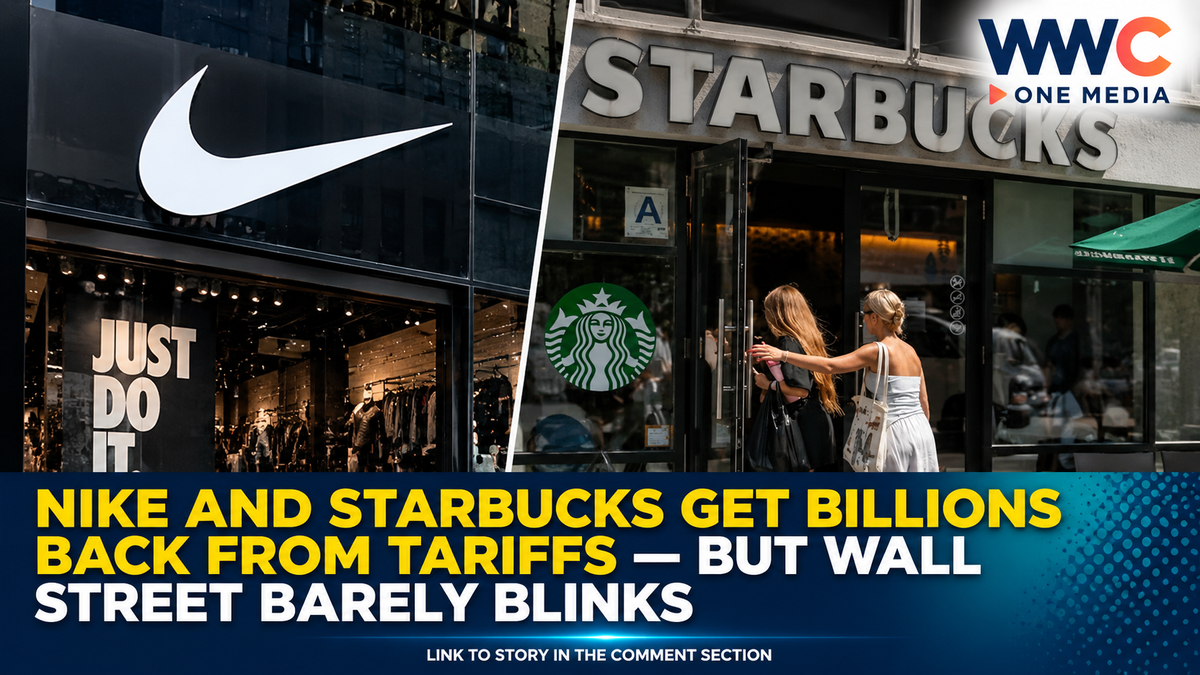
Companies including Nike, Starbucks, Apple, Amazon and FedEx have been recovering money from tariffs that were later struck down by the U.S. Supreme Court. Yet instead of triggering a major and lasting rally in their shares, the refunds have largely produced only muted stock-market reactions.
That disconnect is becoming one of the biggest questions surrounding the latest U.S. tariff fallout: If companies are getting billions of dollars back, why aren’t their stocks taking off?
Nike received nearly $1 billion in tariff relief
Nike is one of the clearest examples.
The sportswear giant recognized a $986 million benefit related to the recovery of tariffs imposed under the International Emergency Economic Powers Act, or IEEPA. Nike said the recovery largely offset tariff costs that had already been recognized during its fiscal 2026.
The impact on Nike’s quarterly numbers was substantial.
The company reported fourth-quarter gross margin of 49.2%, an increase of 890 basis points from a year earlier. Nike said the expected tariff recovery contributed approximately 900 basis points to that margin. Its diluted earnings per share came in at $0.72, including a $0.52 benefit from the tariff recovery.
But underneath that headline improvement, Nike’s underlying business remains under pressure.
Fiscal 2026 revenue was $46.4 billion, essentially flat from the previous year on a reported basis and down 2% on a currency-neutral basis. Fourth-quarter Nike Direct revenue fell 7%, while Converse revenue plunged 32%.
That helps explain why investors have been reluctant to treat the tariff recovery as evidence of a fundamental turnaround.
Starbucks also collected most of its tariff refunds
Starbucks has benefited from the same legal and tax development.
The coffee giant disclosed that it had submitted claims for qualifying IEEPA tariffs and had received substantially all of the refunds requested by the third quarter of fiscal 2026. The refunds largely offset tariff costs incurred during the first three quarters of the fiscal year.
Starbucks’ latest quarterly results also showed a healthier operating picture. North American revenue rose 7% to $7.4 billion, while comparable sales increased 8.1%. Operating income for the North America segment reached $1 billion. The company specifically said lower inflation and tariff refunds contributed to the improvement.
Yet Starbucks shares still fell 2.35% on Sept. 8, extending a three-session losing streak. MarketWatch reported that the stock closed at $102.01, about 7.7% below its Aug. 13 52-week high.
The market’s message appears straightforward: a one-time refund is not the same thing as sustainable earnings growth.
The refunds are huge — but investors see them as temporary
More than 40 S&P 500 companies had reported approximately $9.6 billion in tariff refunds, according to reporting summarized by The Wall Street Journal. Among the largest disclosed amounts were roughly $2.2 billion for Apple, $986 million for Nike, $800 million for FedEx, $640 million for Amazon and $500 million for General Motors.
That sounds like an enormous boost.
But investors typically value companies based on their ability to generate profits and cash flow repeatedly—not simply on a one-off payment.
Bloomberg’s analysis found that the stock-market response to tariff refunds has generally been limited, particularly for companies that suffered much larger losses when the tariffs were initially announced.
In other words, the refunds can improve a company’s balance sheet without fundamentally changing its long-term growth outlook.
The Supreme Court decision changed the equation
The refunds stem from the U.S. Supreme Court’s Feb. 20, 2026 ruling that the IEEPA tariffs at issue were unauthorized.
Following that decision, U.S. Customs and Border Protection opened a system in April for importers to submit refund requests. Starbucks confirmed that it used the system to seek reimbursement for qualifying tariffs, while Nike disclosed its own recovery.
The process has moved faster than some businesses initially expected.
Companies have already reported receiving billions of dollars, turning what was once viewed as a potential legal and administrative headache into a meaningful short-term financial benefit.
But another tariff problem remains
There is a crucial catch.
The refunds address tariffs that companies already paid. They do not necessarily eliminate the broader uncertainty surrounding U.S. trade policy.
Meanwhile, global markets are dealing with a fresh combination of inflation concerns, geopolitical tensions and rising energy prices. Reuters reported Sept. 9 that Brent crude was approaching $100 a barrel, adding to inflation fears and making the outlook for interest rates more complicated.
That environment makes investors even less likely to reward companies simply because they received a one-time government payment.
Nike’s bigger problem goes beyond tariffs
For Nike, the tariff refund cannot erase challenges in its core business.
The company continues to face weakness in China and other markets, while management is working through a broader turnaround under CEO Elliott Hill. Reuters reported after Nike’s fiscal fourth-quarter results that persistent weakness in China and a cautious outlook overshadowed the company’s revenue beat.
Nike’s fiscal 2026 results tell a similar story: the tariff recovery provided a major boost to reported profitability, but revenue remained broadly stagnant and several important business lines continued to decline.
The company is therefore facing a much harder question than “How much money will we get back from tariffs?”
The question investors really want answered is:
Can Nike grow again without the help of a government refund?
The same test now applies to Starbucks
Starbucks is in a somewhat different position.
The company has been pursuing its “Back to Starbucks” strategy while investing in labor, store operations and customer experience. Its recent North American numbers have shown stronger comparable sales and improving operating income.
But investors will ultimately judge the company on whether those improvements continue after the tariff benefit fades.
That is why the market’s muted reaction matters.
The bigger story is not the refunds — it’s what happens after them
The tariff refunds are real, substantial and financially meaningful.
But they are increasingly being treated by investors as a temporary earnings tailwind rather than a permanent improvement in corporate economics.
For Nike, Starbucks and other U.S. companies, the next test will be whether sales, margins, consumer demand and cash generation remain strong once the refund boost disappears.
And that is where the tariff story gets much more complicated.
The companies are getting their money back. The market, however, is asking whether they can make more money without it.




Leave a Reply