
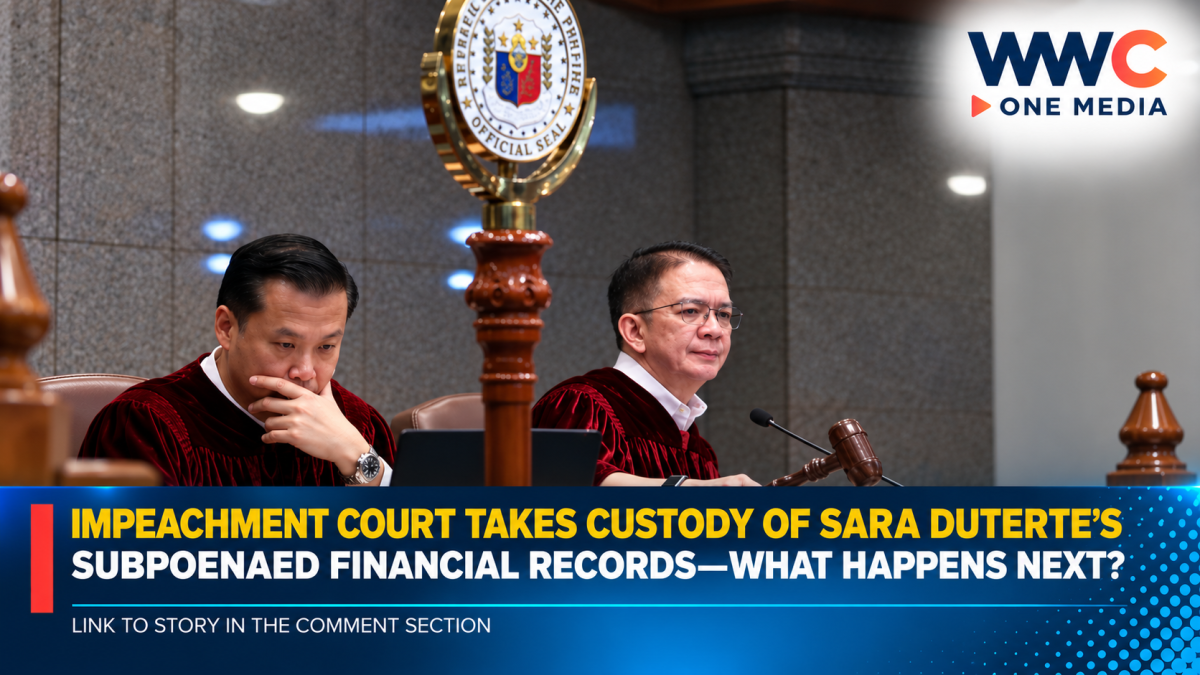
MANILA, Philippines — The Senate impeachment court has taken control of the handling and distribution of the subpoenaed financial records involving Vice President Sara Duterte, placing the documents at the center of the proceedings as prosecutors move deeper into allegations of unexplained wealth.
The development comes as the impeachment trial enters another critical phase, with the House prosecution preparing to present evidence under Article II, which concerns allegations involving Duterte’s wealth and financial transactions.
The court’s latest move does not mean the contents of the records have been made public. Instead, the Office of the Clerk of Court is responsible for receiving, inventorying and managing the documents before they are released to the parties, subject to the court’s rules.
Financial records now under court control
The Senate impeachment court earlier ordered banks, financial institutions and government agencies to produce records involving Duterte, her husband Manases Carpio, and certain companies linked to them.
The subpoenaed records include peso-denominated bank information and tax documents, while the Anti-Money Laundering Council (AMLC) was directed to submit its records to the court for private review before any turnover to the prosecution and defense.
The Bureau of Internal Revenue also complied with a separate subpoena for Duterte’s tax records after securing the necessary approval from the President.
The court has stressed that the records will be handled according to its procedures, rather than simply being released wholesale to the public.
What the court has received
Earlier reporting showed that subpoenaed financial institutions had begun turning over the requested documents to the Office of the Clerk of Court.
Among the banks ordered to comply were BDO Unibank, PSBank, Metrobank, BPI, Security Bank and LandBank.
The AMLC and BIR were also required to submit records under separate orders.
The documents arrived in boxes at the Senate, with the Office of the Clerk of Court tasked with keeping track of the submissions.
The court subsequently said it would conduct an inventory before releasing the records to the parties.
Importantly, the impeachment court said it would not disclose the amounts, specific contents or other substantive details while the inventory and processing of historical records were still underway.
Why the records matter
The financial documents are central to the prosecution’s effort to substantiate its allegations of unexplained wealth against Duterte.
When the Senate impeachment court approved the subpoenas in July, it allowed prosecutors to examine financial records dating back to 2007, including years when Duterte served as Davao City vice mayor and mayor.
The court explained that records from before Duterte became Vice President could be used to establish a financial baseline and help determine whether assets accumulated while she occupied an impeachable office were disproportionate to her lawful income.
However, the court placed an important limitation on their use: the older records cannot be used to introduce new impeachable offenses allegedly committed before Duterte occupied an impeachable office.
That distinction could become crucial as senator-judges evaluate the evidence.
Not every record requested was granted
The impeachment court did not simply approve every financial document sought by the House prosecution.
Its July ruling excluded foreign-currency deposits as well as financial records involving JTC Group of Companies Philippines Inc. and Pikimong Pikimong Philippines Corp.
The court said prosecutors had not sufficiently established the companies’ links to Duterte or Carpio.
The ruling therefore gave prosecutors access to significant financial information while placing boundaries on the scope of the investigation.
Defense had strongly opposed the subpoenas
Before the subpoenas were granted, Duterte’s defense team challenged the prosecution’s request.
Defense lawyer Michael Poa described the effort to obtain Duterte’s financial records as a potential “fishing expedition,” arguing that the prosecution was seeking information without sufficient justification.
The Senate impeachment court ultimately rejected those objections in part and authorized the examination of specified records under defined parameters.
The Palace subsequently said the impeachment court had the authority to issue the subpoenas.
More banks were later ordered to comply
The financial-record inquiry did not end with the court’s initial July order.
In late August, the impeachment court directed additional banks to submit records involving Duterte and Carpio.
Presiding officer Francis “Chiz” Escudero said the court was applying the same parameters and limitations contained in its July 20 ruling.
The additional orders came after the court gave concerned institutions a deadline to submit the required documents.
The money trail meets the confidential-funds case
The financial-record investigation is unfolding alongside testimony concerning Duterte’s controversial use of confidential funds during her time as Vice President and Education secretary.
Prosecutors have presented evidence involving P612.5 million in confidential funds, including P500 million from the Office of the Vice President and P112.5 million from the Department of Education.
The prosecution has argued that following the movement of these funds is important to its broader allegations against Duterte.
At the same time, the financial records subpoenaed by the impeachment court concern a separate evidentiary issue: whether Duterte’s declared income and financial position are consistent with the allegations of unexplained wealth.
The two lines of evidence could therefore become important parts of the prosecution’s broader case.
The records remain confidential for now
Despite the intense public interest, the Senate impeachment court has not opened the financial records for unrestricted public inspection.
The Clerk of Court must first complete its inventory and processing of the submissions.
The AMLC records, in particular, were ordered to undergo private court review before any release to the prosecution and defense teams.
That means reports about the exact amounts, transactions, account activity or other sensitive information should be treated cautiously until those details are formally introduced into the proceedings.
What comes next?
The Senate impeachment trial resumed Monday, September 7, with the House prosecution advancing its presentation on the allegations involving Duterte’s wealth.
The prosecution also planned to present Philippine Statistics Authority evidence concerning alleged confidential-fund recipients, while the court continues to deal with financial and documentary evidence.
The financial records could eventually become some of the most consequential documents presented in the trial—but only if the prosecution successfully establishes their relevance and admissibility under the impeachment court’s rules.
For now, the records are in the court’s hands.
And that leaves one question hanging over the next phase of the trial:
When the numbers are finally examined in court, will they strengthen the prosecution’s case—or give Duterte’s defense ammunition to fight back?



Leave a Reply