
PESHAWAR, Pakistan — Pakistan’s police are fighting a new kind of battlefield threat — and their latest defense looks surprisingly simple.
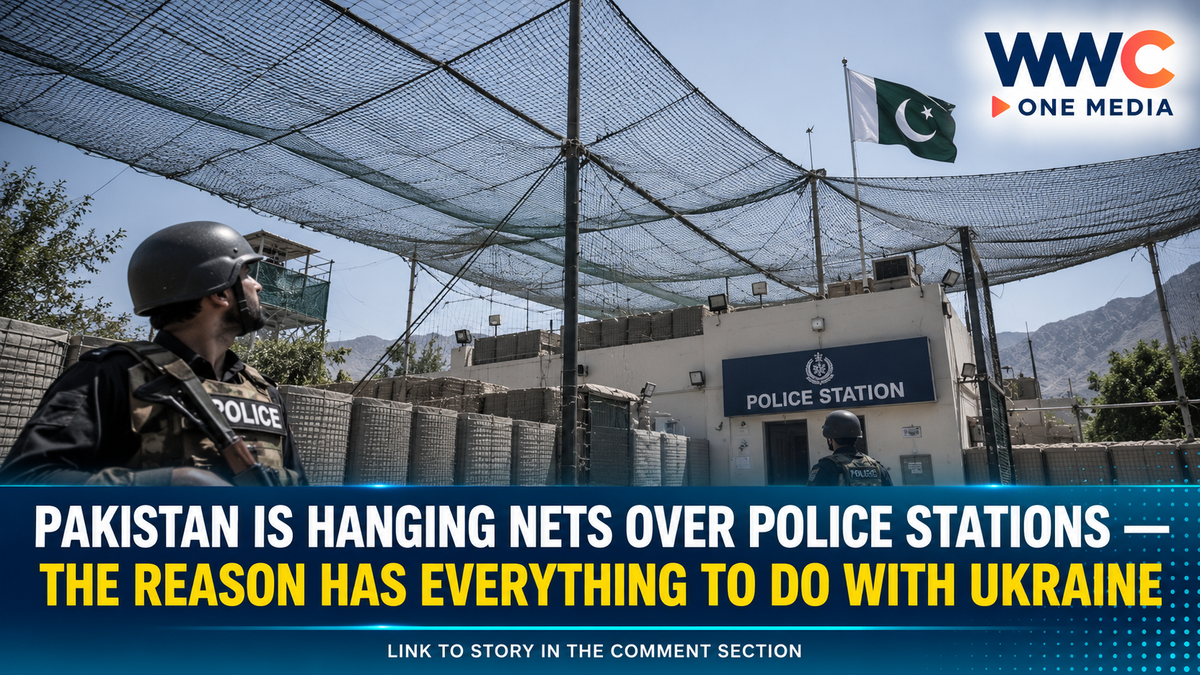
Across parts of Khyber Pakhtunkhwa, reinforced nets are being installed above police facilities to shield officers from drones that militants increasingly use for surveillance and attacks.
The tactic, inspired by defenses developed during the war in Ukraine, highlights how lessons from modern drone warfare are spreading far beyond Europe.
The nets are suspended several meters above buildings and between structures, creating a canopy designed to interfere with incoming drones or catch explosive devices dropped from above.
Khyber District police officer Waqar Ahmad told AFP that police had begun installing the nets to protect personnel from aerial attacks and reduce the danger posed by weaponized drones.
Why are Pakistani police worried about drones?
Militant groups in KP have increasingly adapted inexpensive commercial quadcopters for battlefield use.
According to AFP, drones have been used by militants not only to attack targets but also to conduct surveillance, allowing them to monitor police and security-force movements before an assault.
The threat has become serious enough that KP police are expanding their own drone capabilities.
Pakistan’s Dawn reported this week that the provincial police department has established a specialized UAV division, while similar units are being approved in high-risk districts. The Counter Terrorism Department is also expected to receive longer-range drones capable of operating at higher altitudes.
In other words, Pakistan’s security forces are increasingly fighting drones with drones, while also experimenting with physical barriers, jammers and other counter-drone systems.
The Ukraine connection
The net strategy is not unique to Pakistan.
During Russia’s war against Ukraine, large nets have been deployed over roads and around vulnerable areas to make it more difficult for drones to reach their targets.
The approach has also spread beyond military positions. Reuters recently reported that commercial ships operating around the Black Sea have adopted improvised anti-drone defenses including nets, although experts warn that such measures are far less effective against larger military-grade drones.
That distinction is important in Pakistan.
The nets are essentially an additional layer of protection, rather than a replacement for sophisticated air-defense systems.
Militants are exploiting cheap technology
One reason the threat is growing so quickly is accessibility.
AFP reported that commercially available drones can be purchased in electronics markets in the region and modified to carry explosive payloads. Police told the agency that such devices have become increasingly difficult to counter because they can be obtained relatively easily.
The broader trend has also been documented by security analysts.
The S. Rajaratnam School of International Studies said militant drone attacks in KP have expanded beyond Pakistan’s Afghanistan-border areas into urban and civilian parts of the province. Its assessment said commercially available drones are allowing militant groups to bypass traditional checkpoints and approach targets from the air.
Pakistan’s Express Tribune similarly reported in August that militants were increasingly using drones alongside thermal imaging and night-vision technology against police, security installations and government infrastructure in KP.
Police are trying to catch up
The response is going beyond protective nets.
According to AFP, KP police have begun training personnel to operate drones and use counter-drone equipment, including handheld jammers. The provincial police’s UAV division recently held its first drone course, involving 52 participants.
The goal is to give police their own aerial surveillance capabilities while developing ways to detect, disrupt and defend against hostile drones.
For officers stationed at vulnerable checkpoints, even relatively basic protection can make a difference.
One policeman interviewed by AFP said the combination of nets and existing boundary defenses had considerably reduced the danger from drone attacks and grenades being dropped onto the facility.
A bigger shift in modern warfare
What is happening in Pakistan reflects a much broader change in how armed conflicts are being fought.
Ukraine has become a major testing ground for inexpensive drones, electronic warfare and rapidly improvised countermeasures. Those lessons are now influencing military and security forces in countries far from the European battlefield.
Ukraine itself says 95% of UAVs procured for its armed forces in 2026 have been manufactured domestically, illustrating how rapidly drone production and battlefield adaptation have expanded during the war.
Other countries are responding as well. Germany and Ukraine are developing expanded cooperation on drones and counter-drone systems, while Japan has moved toward mass production of an interceptor drone designed to counter attack drones.
Pakistan’s use of reinforced nets may therefore look primitive compared with advanced air-defense technology — but it reflects the same reality confronting militaries around the world:
When cheap drones can threaten expensive and heavily protected targets, even simple defenses suddenly become strategically important.
The threat is still evolving
The biggest challenge for Pakistani police is that militants are also adapting.
AFP reported that the Tehreek-e-Taliban Pakistan (TTP) has increasingly incorporated drones into its operations, including surveillance and attacks. A militant commander told AFP that drones offer capabilities that traditional suicide attackers cannot, particularly because a quadcopter can reach areas behind the gates of police or military compounds.
Pakistan’s security forces are therefore facing a technological race: better drones, better detection, stronger jammers and increasingly improvised physical defenses.
And as the experience of Ukraine has shown, that race can move extremely quickly.
The striking part isn’t that Pakistan is using nets. It’s that a tactic born from the brutal drone battlefield in Ukraine is now appearing over police compounds thousands of kilometers away — a sign that the technology and tactics of modern warfare are spreading faster than ever.




Leave a Reply