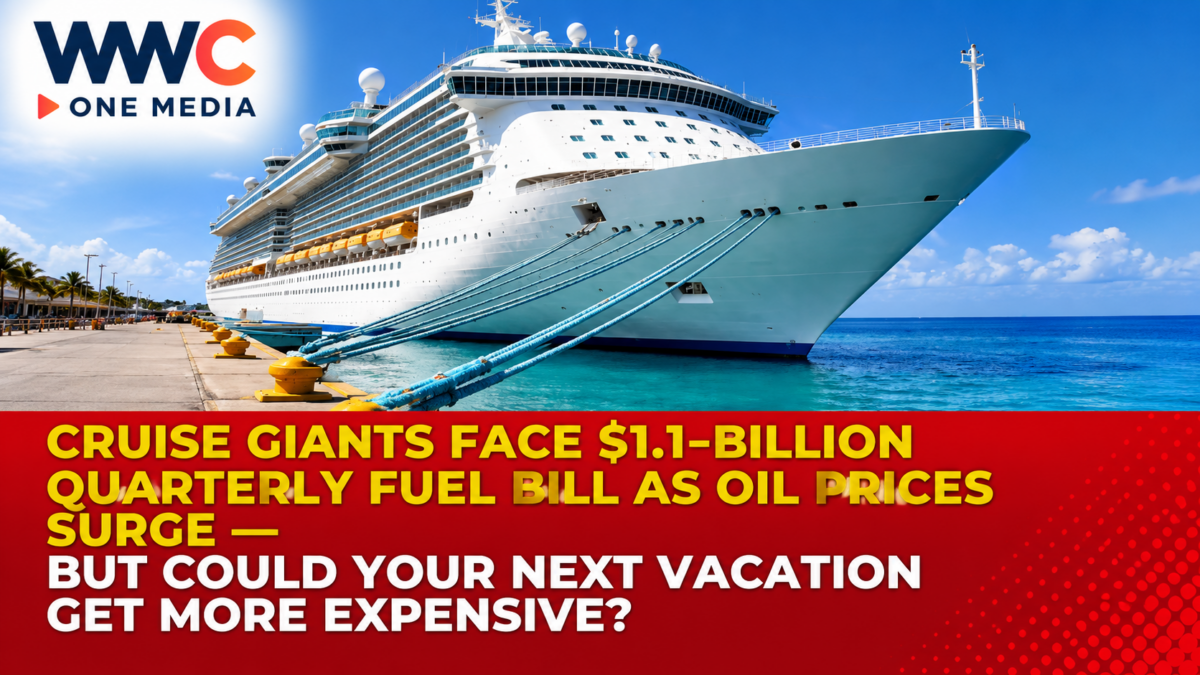
MIAMI, United States — October 30, 2026. The world’s largest cruise operators are confronting an increasingly expensive challenge as the Middle East conflict drives up global oil prices, forcing Carnival, Royal Caribbean and Norwegian Cruise Line Holdings to defend their profits through sharply different fuel-management strategies.
Together, the three companies reported approximately $1.16 billion in fuel expenses during their most recently disclosed third quarters.
The costs have become a growing concern as Brent crude trades above $100 per barrel and uncertainty surrounding the Strait of Hormuz continues to affect international energy markets.
For cruise companies operating enormous passenger vessels around the world, fuel is among the expenses most vulnerable to geopolitical shocks.
But the industry’s biggest players are responding in different ways.
Royal Caribbean and Norwegian use financial hedges to reduce their exposure to fuel-price swings. Carnival emphasizes lower fuel consumption through more efficient operations, fleet improvements and itinerary management.
Despite these pressures, all three have reported encouraging earnings or booking trends.
The question now is whether cruise companies can continue protecting their profits without passing more of the fuel burden onto travelers.
Oil prices turn into a major test for the cruise industry
The escalation involving the United States, Israel and Iran has significantly increased uncertainty in global energy markets.
Shipping disruptions and security concerns around the Strait of Hormuz have created pressure on crude oil prices, marine fuel costs and maritime logistics.
According to CNBC’s October 29 report, Brent crude recently settled at $116.72 a barrel, a six-month high.
Cruise ships rely on significant quantities of marine fuel to move passengers, operate onboard facilities and complete scheduled voyages.
When prices rise, companies face higher operating costs unless they have already secured some protection through financial contracts or can reduce consumption.
The challenge is complicated by the industry’s operating model.
Cruise itineraries are often scheduled far in advance, while passengers may book voyages months before departure.
That means companies cannot always adjust ticket prices immediately when their operating costs increase.
And when ships are already scheduled to sail, fuel remains essential regardless of changes in market conditions.
Carnival bets on using less fuel instead of hedging prices
Carnival Corporation has taken a fundamentally different approach from some major competitors.
Rather than relying heavily on fuel derivatives, the company has focused on cutting the amount of fuel consumed relative to its operating capacity.
Chief Executive Josh Weinstein told CNBC that Carnival has reduced its unit fuel-consumption rate by approximately 26% compared with 2019.
Carnival estimates that the improvement will generate approximately $700 million in fuel savings during 2026.
However, that $700 million represents an estimated benefit from improved efficiency, not additional revenue or a cash payment received from another company.
The savings depend on the baseline used for comparison and the company’s actual operating activity.
In its September earnings release, Carnival also reported a 3.8% year-on-year improvement in fuel consumption per available lower berth day, an industry measure that adjusts for passenger capacity.
The figures indicate that efficiency improvements have continued.
But even a more efficient fleet remains exposed to higher oil prices.
Carnival reported approximately $615 million in fuel expenses during its fiscal third quarter and projected around $640 million for its fourth quarter.
The company therefore faces a continuing challenge: improving efficiency fast enough to offset higher market prices.
Carnival reports record profits despite the oil shock
Carnival’s latest earnings demonstrate that expensive fuel has not prevented the company from generating substantial profits.
For its fiscal third quarter, the company reported approximately $1.9 billion in net income and $2 billion in adjusted net income.
The results exceeded its earlier expectations and were supported by strong bookings, revenue growth and cost discipline.
Management also reported record third-quarter customer deposits.
Carnival’s guidance identified a substantial adverse impact from higher fuel prices during the year, but operational improvements helped offset that pressure.
This suggests that the company has been able to protect profitability through a combination of stronger demand and efficiency measures.
Nevertheless, the outcome does not guarantee that future increases in oil prices will be equally manageable.
A prolonged energy shock could eventually outweigh savings from lower consumption.
Royal Caribbean uses hedging to cushion fuel volatility
Royal Caribbean’s strategy places greater emphasis on financial protection against price increases.
Fuel hedging generally involves derivatives that help lock in or manage the cost of future fuel purchases.
These arrangements can reduce the immediate effects of sudden increases in market prices.
Royal Caribbean CEO Jason Liberty said the company had hedged a little more than 60% of its fuel requirements for 2026 during an interview with CNBC.
Its subsequent official earnings guidance identified approximately 58% hedging coverage for the remaining 2026 consumption period.
The figures refer to different reporting dates or coverage periods and should not be treated as contradictory.
Royal Caribbean reported approximately $347 million in fuel expenses during the third quarter.
It expects fuel expenses to reach approximately $379 million in the fourth quarter.
That forecast reflects expected consumption, fuel prices and the effect of hedging arrangements.
The company also raised its full-year adjusted earnings outlook to between $17.85 and $17.95 per share.
However, management acknowledged that higher-than-expected fuel expenses had partially offset the benefit of stronger operating results.
The message is clear: hedging provides protection, but it does not make cruise companies immune to an oil shock.
Royal Caribbean says passengers are still booking
One encouraging development for Royal Caribbean has been the resilience of customer demand.
The company reported strong third-quarter bookings and said its 2027 reservations were running ahead of the previous year’s levels by a high-teens percentage, according to CNBC.
Management also indicated that consumers continued spending on vacations despite concerns about higher energy prices and economic uncertainty.
Strong bookings can provide visibility into future revenue.
But reservations are not the same as completed voyages or recognized earnings.
Customers can change plans, and companies may still face pressure to discount tickets or offer promotions.
The industry must therefore balance maintaining attractive prices with protecting margins.
If fuel expenses remain high, operators may seek additional revenue through ticket pricing, onboard spending, itinerary changes or operating efficiencies.
Norwegian hedges less fuel than Royal Caribbean
Norwegian Cruise Line Holdings also uses fuel hedging, but its disclosed coverage is lower than Royal Caribbean’s.
The company reported that approximately 48% of its projected fuel consumption was hedged for 2026 as of October 15.
For 2027, the figure was approximately 42%.
Norwegian’s hedges primarily cover heavy fuel oil and marine gas oil.
Its third-quarter fuel expense reached approximately $196 million.
The company’s net fuel cost per metric ton, after hedging, rose from $744 a year earlier to $819.
That represents an increase of approximately 10%.
Nevertheless, Norwegian reported that fuel consumption was slightly below expectations, helping limit the financial impact.
Its third-quarter revenue reached approximately $2.95 billion, while net income increased to around $491 million.
Adjusted earnings of $1.12 per share exceeded Wall Street forecasts.
The results demonstrate that better operating performance and stronger passenger spending can offset some of the pressure from fuel costs.
However, Norwegian’s more limited hedge coverage means a significant portion of its future fuel consumption remains exposed to price changes.
Norwegian’s turnaround still faces difficult financial choices
Norwegian has been working to strengthen its commercial performance and operating efficiency.
The company reported better-than-expected cost control, stronger late bookings and improved onboard passenger spending.
It raised its full-year adjusted earnings guidance to approximately $1.70 per share.
However, management also expects full-year net yields to decline by about 4.4% in constant currency.
Net yield is an important cruise-industry measure reflecting revenue performance relative to capacity.
That forecast shows that stronger quarterly results do not necessarily mean every part of the company’s operating outlook has recovered.
The company must continue balancing ticket pricing, occupancy, fuel expenses and other operating costs.
Norwegian’s future performance will depend on both passenger demand and its ability to execute its turnaround strategy.
A smaller cruise operator shows how serious the crisis can become
The consequences of higher fuel costs are already visible outside the three largest cruise groups.
The American-operated residential cruise ship MV Odyssey suspended its global voyage in Cambodia in late October.
Its operator, Villa Vie Residences, cited sharply higher fuel expenses that made the ship’s existing operating model difficult to sustain.
The interruption affected 203 passengers and 156 crew members.
According to the company, monthly fuel expenses per cabin had climbed from approximately $1,800 to between $6,000 and $8,000 in some Asian operating areas.
WWC ONE MEDIA covered the incident in MV Odyssey Cruise Suspends World Voyage in Cambodia, Leaving 203 Passengers Stranded After Fuel Costs Skyrocket.
The case demonstrates how fuel-price shocks can become severe enough to disrupt passenger travel.
But Villa Vie’s residential cruising model differs considerably from the business models of Carnival, Royal Caribbean and Norwegian.
Its operating difficulties should not be interpreted as proof that the major cruise groups face imminent insolvency or service suspensions.
Instead, the incident illustrates what can happen when fuel costs rise faster than an operator’s financial resources and ability to adjust prices.
Strait of Hormuz disruptions are driving wider transport costs
The cruise industry’s fuel problem is part of a much larger energy-market challenge.
The Strait of Hormuz remains a critical route for petroleum shipments from the Persian Gulf.
Disruptions have increased uncertainty about the availability, cost and transport of oil.
WWC ONE MEDIA previously examined these logistical pressures in Saudi Arabia Is Offering More Oil to Asia Through Oman — But the Crude Still Has to Survive the Strait of Hormuz First.
The report explained how exporters have sought alternative shipping arrangements while continuing to face substantial costs and risks.
Those disruptions matter for cruise operators because marine fuel prices are influenced by global petroleum markets.
However, Brent crude and the specific marine fuels used by cruise ships are not identical products.
Their prices may move differently depending on refining costs, fuel specifications, local supply and hedging arrangements.
As a result, a percentage change in Brent cannot automatically be applied directly to a cruise company’s reported fuel bill.
Thailand’s tourism industry faces similar fuel pressures
Higher energy costs are also affecting other travel businesses in Asia.
Airlines, tour operators and ground-transport companies face additional expenses when global petroleum prices increase.
WWC ONE MEDIA reported on the regional effects in Oil Price Shock Threatens Thailand’s High Season as Airlines and Tourism Face Rising Costs.
The article examined concerns that expensive fuel could affect travel affordability during Thailand’s important tourist season.
The situation has parallels with the cruise industry.
Both airlines and cruise operators must balance rising operating costs against consumer demand and competitive ticket pricing.
But their fuel consumption patterns, booking structures and operating expenses differ significantly.
The extent to which travelers experience higher prices will depend on the strategies adopted by each business.
Could rising fuel costs make cruises more expensive?
The possibility of higher cruise fares is becoming an important question for travelers.
Cruise operators have several ways to respond to fuel inflation.
They can absorb the additional cost and accept lower profit margins.
They can improve efficiency through operational changes.
They can adjust future ticket prices, increase onboard revenue or modify itineraries.
Some cruise contracts also permit fuel supplements under specified conditions.
However, the existence of a contractual surcharge provision does not establish that a particular operator has announced or imposed a new fee.
Travelers should review their specific booking conditions rather than assume that every cruise will automatically become more expensive.
Strong demand may give companies greater pricing flexibility, but aggressive price increases could also discourage budget-conscious passengers.
Operators must consider how much additional cost their customers are willing to bear.
Hedging versus efficiency: Which strategy is better?
Carnival, Royal Caribbean and Norwegian illustrate two major approaches to managing energy costs.
Hedging can protect a portion of fuel purchases against short-term price spikes.
This may make earnings more predictable.
But hedges expire and must eventually be replaced.
If high prices persist, future contracts may become more expensive.
Efficiency improvements can reduce the amount of fuel required to operate ships.
Those benefits may continue over time and can also reduce emissions.
However, improving efficiency may require expensive technology, vessel modifications, new ships and operational changes.
Neither strategy is universally superior.
The results depend on fuel prices, fleet composition, investment costs and the duration of the energy shock.
Many cruise companies also use combinations of operational efficiencies and financial risk management.
The important question is which approach can produce reliable long-term savings without weakening the passenger experience.
Higher fuel prices are not the only challenge facing cruise operators
Fuel is an important expense, but it is not the only factor determining profitability.
Cruise companies also face labor costs, ship maintenance, food expenses, financing obligations and the cost of developing new vessels and destinations.
Competition for passengers can also put pressure on ticket prices.
The Financial Times reported in October that additional cruise capacity and itinerary changes were contributing to discounts on certain Caribbean sailings.
That means some operators may face higher fuel costs at the same time they are offering lower fares to attract passengers.
The combination could place pressure on profit margins.
Strong onboard spending, efficient operations and high occupancy can help offset those challenges.
Nevertheless, cruise companies must manage several financial pressures simultaneously.
What does the fuel shock mean for Filipino travelers?
For Filipino travelers considering international cruises, higher fuel prices may eventually influence travel packages, transportation costs or additional charges.
But the effect will vary according to itinerary, departure port, cruise company and booking conditions.
The current earnings results do not establish that all cruise packages sold in the Philippines will become more expensive.
Travelers should compare the total cost of a booking, including port fees, gratuities, transportation and any contractual fuel supplements.
It is also important to consider itinerary changes and travel insurance conditions when planning voyages during periods of geopolitical instability.
The wider oil-price shock could influence airfare and land transportation connected with overseas cruises.
However, no specific Philippine cruise-fare increase can be confirmed from these corporate earnings announcements alone.
The bigger question: Can cruise giants keep the fuel shock away from passengers?
The latest earnings reports show that the cruise industry remains financially resilient despite expensive fuel.
Carnival has achieved record quarterly profits while reducing fuel consumption.
Royal Caribbean has benefited from hedging and strong advance bookings.
Norwegian has reported improved earnings and raised its full-year forecast while continuing a broader turnaround.
These results suggest that the major operators have tools to manage higher operating costs.
But they also reveal the limits of those protections.
Hedges cover only part of future consumption, while efficiency gains cannot eliminate the cost of marine fuel.
If the Middle East conflict continues to keep oil prices elevated, cruise companies may eventually face tougher choices involving fares, profitability and investment.
The cruise industry’s biggest companies are still attracting passengers and reporting strong results. But with more than $1.1 billion in combined quarterly fuel expenses and no certainty about when oil prices will stabilize, the real question is whether the next stage of the fuel crisis will be absorbed by the cruise lines—or passed on to travelers.