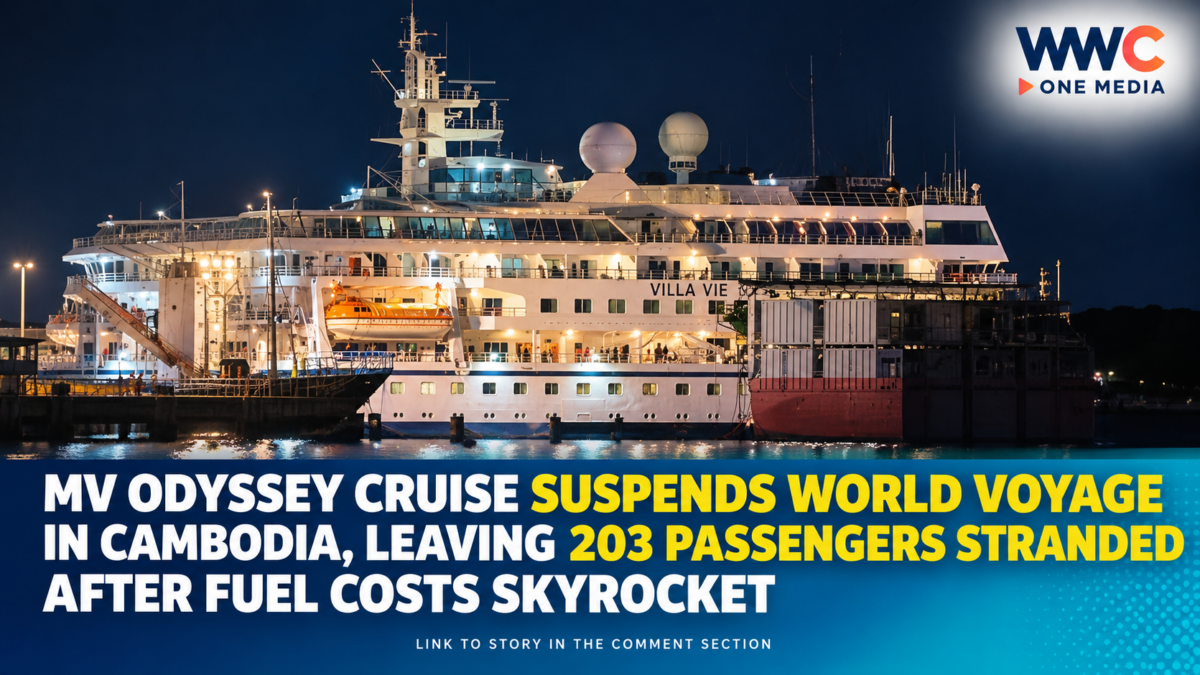
A dream voyage around the world has turned into an unexpected crisis for more than 200 passengers aboard the MV Odyssey after its operator abruptly suspended the ship’s operations in Cambodia, forcing residents to leave what many considered their permanent home at sea.
The US-operated residential cruise ship, run by Florida-based Villa Vie Residences, was docked in Sihanoukville, Cambodia, when passengers were informed that the company could no longer sustain its operations because of soaring fuel expenses linked to the Iran conflict.
The sudden announcement left 203 passengers and 156 crew members facing uncertainty about their accommodation, onward travel and the future of the ambitious world cruise.
For some passengers, the disruption was particularly devastating because they had invested substantial amounts of money to live aboard the vessel for years. Several had purchased cabins as long-term residences, while others had committed to extended stays as part of a lifestyle built around travelling continuously across the globe.
According to Cambodian officials, the passengers were given approximately seven hours to disembark after the company announced the suspension on October 27, 2026.
The ship had arrived in Sihanoukville on October 23 from Thailand and was originally scheduled to continue its journey to Vietnam.
Instead, passengers suddenly found themselves having to make arrangements on land thousands of kilometres away from their home countries.
Fuel Costs Surge From US$1,800 to as Much as US$8,000 Per Cabin
Villa Vie Residences attributed the suspension to extraordinary increases in fuel expenses, saying the financial pressure had made its existing operating model unsustainable.
According to the company’s statement, monthly fuel expenses that previously averaged approximately US$1,800 per cabin had climbed to an estimated US$6,000 to US$8,000 in parts of Asia.
The increase represents more than a threefold rise in operating expenses, creating a financial burden the company said it could no longer absorb.
The operator explained that passing the entire increase on to residents was not a realistic solution.
It had already attempted to reduce fuel consumption by slowing the ship’s itinerary and spending more time in ports rather than continuously sailing. However, those measures were insufficient to offset the rising costs.
The company said it was unable to continue carrying the resulting operating losses and would explore restructuring and recapitalisation options over the next 60 days.
However, no financing arrangement or guaranteed resumption of the voyage had been secured.
The disruption also highlights how international geopolitical conflicts can affect industries far beyond the countries directly involved, particularly businesses heavily dependent on global energy supplies.
Passengers Given Just Seven Hours to Leave the Cruise Ship
The abrupt disembarkation order became one of the most troubling aspects of the incident.
Cambodian provincial deputy governor Long Dimanche confirmed that 203 guests and 156 crew members had arrived aboard the Bahamas-flagged vessel.
He expressed concern over the sudden disruption, noting that many passengers were retirees and remote workers who had effectively been left without accommodation far from their home countries.
Some passengers managed to arrange flights out of Cambodia, while others remained in Sihanoukville while trying to determine their next steps.
The situation also raised questions about the assistance provided by the cruise operator.
Passenger Randy Cassingham, who documented his experience through his Residential Cruising blog, criticised the company’s handling of the situation.
He said passengers were informed that they had until 2pm to leave and described the announcement as the result of a series of problems involving management decisions, business operations and rising fuel expenses.
Other passengers also complained that they had received little practical assistance with finding hotels, arranging transportation or securing temporary accommodation.
Villa Vie Residences, however, said it was working with residents to coordinate their departure and identify temporary living arrangements while supporting affected passengers, crew members and employees.
Some Passengers Paid Hundreds of Thousands of Dollars to Live at Sea
The financial consequences could be particularly significant for people who purchased permanent or long-term residences aboard the Odyssey.
Villa Vie marketed the vessel as a floating residential community, offering customers the opportunity to travel internationally while maintaining a home on the ship.
Cabin prices varied depending on the accommodation and ownership arrangements. Some residences were advertised at approximately US$120,000, while more expensive suites reached around US$440,000.
The company also offered long-term residential arrangements, allowing customers to spend years living aboard the vessel while visiting destinations across different continents.
For some passengers, the decision involved selling property, leaving traditional homes or committing a substantial portion of their savings to the residential cruising concept.
The Associated Press reported that California resident Carol Larson and her sister Crystal Lavering had spent approximately 18 months aboard the vessel.
Larson purchased her cabin for US$120,000 through an instalment arrangement and also paid monthly maintenance fees.
Despite the sudden suspension, she said she hoped the ship could eventually be rescued through a new investment or ownership arrangement.
Her experience reflects the emotional and financial uncertainty facing residents who had built their daily lives around the promise of continuous international travel.
Passengers Had Already Reported Problems Before the Suspension
Although fuel expenses were cited as the immediate reason for suspending operations, some passengers indicated that the company’s difficulties had begun much earlier.
Reports from residents described concerns involving itinerary changes, unreliable internet connections, declining food quality and repeated requests for additional financial contributions.
Some passengers reportedly felt that the company had struggled to maintain the service standards originally expected when they signed up for the residential cruise.
The ship also never reached its full capacity of approximately 650 passengers, according to accounts from people familiar with life aboard the vessel.
This potentially placed additional pressure on the company’s finances because its business model depended on generating sufficient revenue from cabin sales, residential fees and onboard operations.
The fuel crisis ultimately added another major expense to an already challenging operating environment.
For passengers who had expected to spend several years travelling around the world, the suspension raised questions about whether the company could recover financially or find another operator willing to take over the voyage.
The Iran Conflict’s Impact on Global Shipping and Fuel Supplies
The suspension comes amid wider disruptions to international energy markets following the conflict involving Iran.
Restrictions affecting shipping traffic through the Strait of Hormuz have contributed to pressure on petroleum supplies and higher fuel prices.
The strait is one of the world’s most important energy transportation routes, carrying substantial volumes of internationally traded oil and petroleum products.
When supplies become constrained or shipping routes are disrupted, businesses that depend heavily on marine fuel can face significantly higher operating expenses.
For cruise operators, these increases can be particularly difficult to manage because vessels require enormous quantities of fuel to maintain long-distance itineraries.
The Odyssey’s situation demonstrates how rising energy costs can threaten even ambitious international tourism ventures, especially those operating on long-term residential arrangements.
What Happens Next to the MV Odyssey?
The future of the Odyssey remains uncertain.
Villa Vie Residences has indicated that it will spend the next 60 days exploring restructuring and recapitalisation options in an effort to address its financial difficulties.
Meanwhile, Cambodian authorities indicated that the vessel was expected to refuel and depart Sihanoukville on October 31. However, this was an expectation communicated by local officials, not a confirmed restart of its passenger voyage.
The company has not guaranteed that the original itinerary will resume.
For affected residents, the immediate priority is securing accommodation, arranging transportation and determining what happens to the money they invested in their onboard homes.
The incident also raises broader questions about financial protection for people purchasing long-term residential cruise packages, particularly when the operator encounters serious financial difficulties.
Unlike conventional holidays, residential cruising can involve substantial upfront payments and long-term commitments, making the consequences of an unexpected suspension considerably more complicated.
The Odyssey originally departed Belfast, Northern Ireland, in October 2024, promising passengers an extraordinary journey across the world’s continents.
More than two years later, that dream has encountered one of its biggest challenges.
For the hundreds of people whose lives were tied to the vessel, the biggest question is no longer which country the ship will visit next, but whether their floating home will ever sail again.