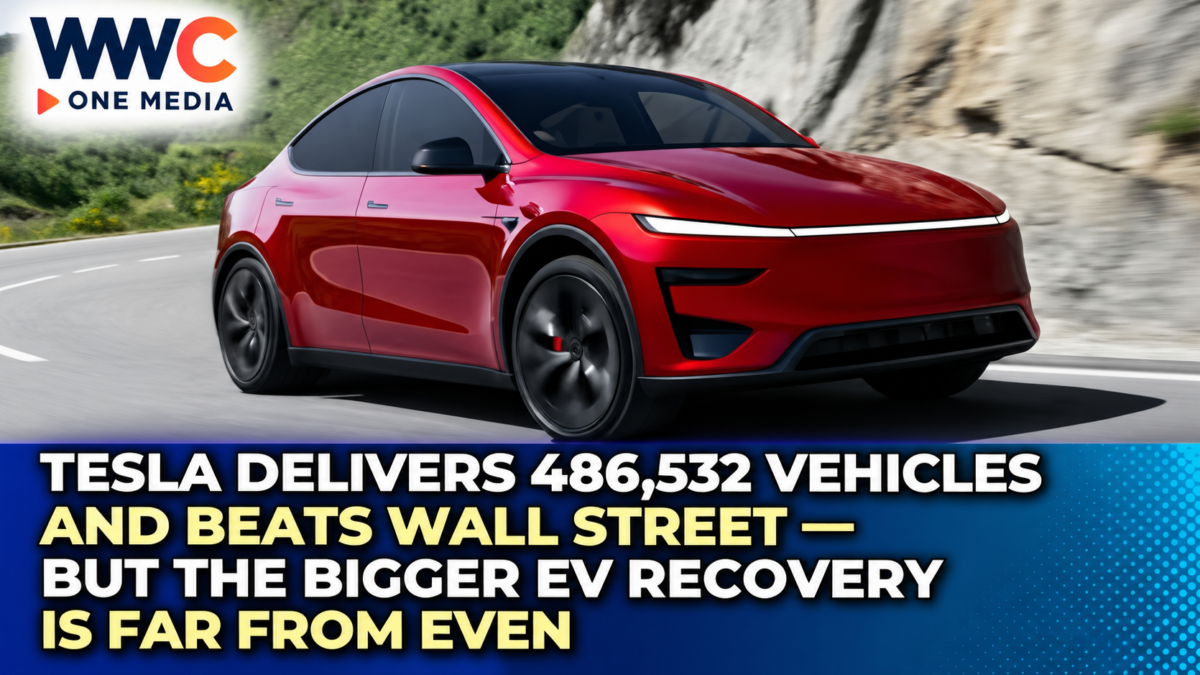
AUSTIN, Texas — Tesla delivered 486,532 vehicles in the third quarter of 2026, crushing Wall Street expectations and giving Elon Musk’s electric-vehicle company one of its strongest operational surprises of the year — but beneath the headline beat, the global EV market remains deeply divided.
Tesla said it produced 464,391 vehicles between July and September and delivered 486,532, significantly above the roughly 461,100 vehicles expected by Wall Street analysts.
The result immediately boosted Tesla shares as investors welcomed evidence that demand remained stronger than feared.
But there is an important qualification.
Deliveries were still down about 2.1% from the 497,099 vehicles Tesla delivered in the same quarter a year earlier.
So Tesla’s quarter was simultaneously:
better than Wall Street expected,
better than the previous quarter,
and still slightly weaker than a year ago.
That contradiction tells the larger story of today’s EV market.
Tesla Beat Expectations by Roughly 25,000 Vehicles
Wall Street had become increasingly cautious heading into the report.
StreetAccount’s consensus estimate was around 461,100 deliveries.
Tesla’s own company-compiled analyst consensus was similar at 461,974 vehicles.
Actual deliveries came in at 486,532.
That means Tesla exceeded Wall Street expectations by roughly 25,000 vehicles, or a little more than 5%.
For a company operating at Tesla’s scale, that is a meaningful difference.
Model 3 and Model Y Still Dominate Tesla
Tesla does not disclose exact delivery figures by individual model.
But it does separate its core Model 3 and Model Y vehicles from its other products.
The company reported:
478,237 Model 3/Y deliveries
and
8,295 deliveries of other models.
That means roughly 98% of Tesla’s quarterly deliveries still came from the Model 3 and Model Y.
The dependence is significant.
Cybertruck and Tesla’s remaining higher-end vehicles remain a relatively small part of overall volume.
That means Tesla’s automotive business still depends overwhelmingly on two mass-market models.
Tesla Produced Fewer Cars Than It Delivered
One unusual feature of the quarter was that Tesla delivered more vehicles than it produced.
Production totaled 464,391 vehicles, roughly 22,000 fewer than deliveries.
That suggests Tesla drew down some existing inventory.
Reducing inventory can be positive because unsold vehicles tie up cash and may eventually require discounts.
But it also means the delivery beat was not driven entirely by increased factory output.
Some of the strength came from selling vehicles Tesla had already built.
Deliveries Improved From Q2
The quarter also showed sequential improvement.
Tesla delivered 480,126 vehicles in Q2, meaning Q3 deliveries increased by roughly 1.3%.
That may appear modest.
But investors had entered the year worried that Tesla could experience a much deeper slowdown following the expiration of key U.S. EV incentives and increasing competition globally.
The Q3 result suggests demand has proven more resilient than those fears implied.
The U.S. EV Tax Credit Is Gone
One of the most important comparisons is with Q3 2025.
Last year’s quarter was unusually strong because American buyers rushed to purchase EVs before the federal $7,500 electric-vehicle tax credit expired.
That pulled significant demand forward.
As a result, Tesla’s year-over-year decline needs to be viewed against an unusually elevated comparison period.
The expiration of the credit also hit the broader U.S. EV market hard.
Several automakers experienced sharp declines after consumers lost that financial incentive.
The EV Market Has Contracted Sharply
Business Insider reported that U.S. EV sales have fallen dramatically compared with last year following the tax-credit expiration.
That makes Tesla’s relatively small 2% decline notable.
The company appears to have gained market share even though total EV demand weakened.
In other words:
Tesla sold slightly fewer vehicles.
But many competitors lost far more.
That is an important distinction.
Rivian Had an Even Stronger Quarter
Tesla was not the only EV company with good news.
Rivian delivered a record 19,248 vehicles in Q3, up approximately 46% from 13,201 a year earlier.
The company produced 19,751 vehicles during the quarter at its Normal, Illinois plant.
Rivian also beat Wall Street expectations of roughly 18,000 deliveries.
That makes Rivian one of the clearest EV growth stories in the quarter.
Rivian’s R2 Is Starting to Matter
The biggest reason is the R2.
Rivian’s new smaller and more affordable SUV represents the company’s attempt to move beyond the expensive R1S and R1T and reach a much larger customer base.
Reuters said the strong Q3 deliveries reflect the continuing rollout of the R2, which began reaching customers earlier in the year.
Rivian has maintained its full-year guidance of 65,000 to 70,000 deliveries.
But that also means the company still faces a demanding fourth quarter.
To reach even the low end of its target, Rivian needs more than 23,000 deliveries in Q4.
That would require another major sequential increase.
Rivian Shares Still Fell
Interestingly, Rivian’s stock fell after the strong delivery report.
Why?
Investors had hoped the company might raise its full-year forecast.
Instead, Rivian kept its guidance unchanged.
That highlights an important lesson for auto investors:
beating expectations is not always enough.
Markets also care about what comes next.
Rivian delivered a record quarter.
But Wall Street now wants proof that the R2 ramp can continue.
GM Shows the Other Side of the EV Market
General Motors reported a very different quarter.
Its overall U.S. vehicle sales declined 5.5% to 670,974 vehicles, down from 710,347 a year earlier.
EV sales were among the biggest problems.
Several GM electric models experienced enormous year-over-year declines after last year’s tax-credit-driven buying surge.
The Chevrolet Equinox EV fell more than 92%.
The Blazer EV declined roughly 84%.
Hummer EV sales dropped more than 70%.
Those numbers demonstrate just how disruptive the loss of federal incentives has been for some manufacturers.
GM’s EV Decline Does Not Mean Americans Stopped Buying Cars
This is another important distinction.
The U.S. auto market is not simply collapsing.
Consumers are changing what they buy.
Toyota continued gaining ground on GM partly because of strong demand for hybrids and other fuel-efficient vehicles.
Reuters reported that Toyota’s electrified vehicles—including hybrids—accounted for a substantial share of its sales as high gasoline prices pushed buyers toward more efficient options.
That suggests consumer interest in electrification remains.
But the preferred technology may be shifting.
For many buyers, hybrids currently offer a compromise between fuel savings and the convenience of gasoline.
Hybrids May Be the Biggest Winner
That is one of the most important trends in the U.S. auto market.
Battery EV sales have struggled following the removal of tax incentives.
Hybrids have remained strong.
Drivers get lower fuel consumption without needing to depend entirely on charging infrastructure.
Automakers including Toyota have benefited enormously from that strategy.
By contrast, manufacturers that bet aggressively on pure EVs have been forced to reconsider timelines and investment plans.
High Gas Prices Are Giving EVs Another Chance
Yet the story may be changing again.
Oil and gasoline prices have risen sharply because of the ongoing U.S.-Iran conflict and instability around the Strait of Hormuz.
Axios reported that gasoline prices above $4 per gallon are renewing some consumer interest in EVs.
That creates a fascinating reversal.
Last year, the loss of federal tax credits reduced EV demand.
This year, expensive gasoline may be making EVs more financially attractive again.
For consumers, the calculation is straightforward:
the more expensive gasoline becomes,
the more valuable electric driving becomes.
Tesla Could Benefit Most From Expensive Fuel
Tesla is uniquely positioned to benefit if high gasoline prices persist.
It has:
the largest U.S. EV manufacturing scale,
one of the most developed charging networks,
strong brand awareness,
and established production capacity.
Competitors still need to convince buyers that they can provide comparable charging convenience.
That gives Tesla an advantage when consumers reconsider EV ownership because of fuel prices.
But Tesla’s Long-Term Stock Story Is No Longer Mainly About Car Sales
This is where Tesla becomes very different from a normal automaker.
A delivery beat still moves the stock.
But many investors increasingly value Tesla based on businesses that do not yet contribute the majority of revenue.
Those include:
robotaxis,
autonomous driving,
artificial intelligence,
Optimus humanoid robots,
and energy storage.
Elon Musk has increasingly argued that Tesla should be viewed as an AI and robotics company rather than simply a carmaker.
That changes what investors expect from quarterly delivery numbers.
Cybercab Has Become Central to Tesla’s Next Chapter
Tesla has begun deploying its Cybercab robotaxi network in selected U.S. cities.
But the rollout remains significantly smaller than Musk’s earlier ambitions.
The Verge notes that Tesla’s robotaxi network has expanded, but previous targets for much broader availability were not met on schedule.
Waymo also remains a major competitor in autonomous ride-hailing.
That means Tesla still needs to prove that its self-driving technology can scale safely and commercially.
Q3 deliveries help the existing business.
They do not resolve the robotaxi question.
The Cybertruck Still Has Not Become a Major Volume Driver
Tesla does not break out Cybertruck deliveries separately.
But the entire “other models” category totaled just 8,295 vehicles during the quarter.
That category includes Cybertruck and other vehicles outside Model 3 and Model Y.
This shows that Cybertruck remains a relatively small contributor compared with Tesla’s core lineup.
That matters because Tesla once positioned Cybertruck as a potentially huge new product category.
So far, it has not approached Model 3 or Model Y scale.
Energy Storage Was a Mixed Result
Tesla also reported 13.7 gigawatt-hours of energy-storage deployments in the third quarter.
That remains a very large volume.
But MarketWatch reported that analysts had expected around 15.9 GWh, meaning the energy business missed expectations even while vehicle deliveries beat them.
That is another reason investors should not evaluate Tesla solely on car deliveries.
Energy storage is becoming increasingly important as utilities and data centers seek battery systems capable of balancing electricity demand.
Tesla’s Megapack business could eventually become one of its biggest growth engines.
AI Data Centers Could Become a Huge Battery Market
The explosion in AI infrastructure is creating new demand for electricity storage.
Data centers require enormous amounts of reliable power.
Battery systems can help stabilize grids and provide backup capacity.
That creates a potential growth opportunity for Tesla Energy even if automotive growth eventually slows.
It also links Tesla indirectly to the AI investment boom.
Tesla increasingly sits at the intersection of:
cars,
energy,
AI,
and robotics.
Tesla’s Q3 Beat Does Not Automatically Mean Profit Growth
There is another important caution.
Deliveries are not the same as earnings.
Tesla itself warns that vehicle deliveries are only one measure of financial performance.
Profit depends on:
vehicle prices,
discounts,
manufacturing costs,
regulatory credits,
foreign exchange,
and product mix.
Tesla could sell more vehicles while earning less per vehicle if it uses aggressive incentives to generate demand.
That is why investors will need to wait for the company’s full Q3 earnings.
Full Earnings Arrive October 21
Tesla is scheduled to report complete third-quarter financial results after the market closes on October 21.
That report will answer several critical questions.
Did margins improve?
How much discounting was required?
How profitable is Tesla’s energy-storage business?
What is happening with Cybercab?
And what is Musk saying about 2027 demand?
The delivery report is encouraging.
The earnings report will show how expensive that growth was.
Rivian Reports Later in October
Rivian will report its full Q3 financial results on October 29.
For Rivian, profitability may matter even more than deliveries.
The company has spent years losing substantial amounts of money while scaling production.
R2 is supposed to change that equation.
A cheaper vehicle can dramatically increase volume.
But only if Rivian can manufacture it efficiently enough to improve margins.
That will be the next test.
The EV Market Is Splitting Into Winners and Losers
The third-quarter numbers reveal a market that is no longer moving in one direction.
Tesla beat expectations but declined year over year.
Rivian grew dramatically.
GM’s EV sales collapsed from last year’s incentive-driven levels.
Hybrids continued gaining popularity.
And high gasoline prices are creating a new reason for consumers to reconsider EVs.
That makes broad statements like “EV demand is dead” or “EV demand is booming” increasingly inaccurate.
The reality depends heavily on:
brand,
price,
vehicle type,
tax incentives,
charging access,
and fuel prices.
Tesla Has Scale Rivals Still Cannot Match
Tesla’s biggest advantage remains scale.
Rivian’s record Q3 deliveries totaled just over 19,000 vehicles.
Tesla delivered more than 486,000.
That difference illustrates how far ahead Tesla remains in pure EV volume.
Legacy automakers produce far more total vehicles than Tesla, but many still struggle to sell EVs profitably at comparable scale.
Tesla has already built the production and charging infrastructure that competitors are still trying to replicate.
But Scale Alone Does Not Guarantee Future Growth
Tesla’s year-over-year decline shows that even the market leader faces limits.
Model 3 and Model Y are mature products.
Competition is increasing globally.
Chinese automakers continue expanding.
EV incentives are weaker in some markets.
And buyers increasingly expect lower prices and longer range.
Tesla therefore needs its next generation of products and technologies to create another growth cycle.
That is why Cybercab and autonomous driving matter so much to Musk’s strategy.
The Bigger Signal May Be Consumer Resilience
Wall Street expected a weaker quarter.
Consumers bought more Teslas than expected anyway.
That is arguably the most important takeaway.
Despite:
higher interest rates,
lost tax credits,
economic uncertainty,
and intense competition,
Tesla still delivered nearly half a million vehicles in three months.
That does not mean the company has returned to high-growth mode.
But it does suggest its automotive franchise remains much stronger than some pessimistic forecasts implied.
The Next Question Is Whether Q3 Was the Beginning of a Recovery
Tesla now enters Q4 with momentum.
Rivian enters it with record deliveries.
Gasoline prices remain elevated.
And consumers may be reconsidering electric vehicles as fuel costs rise.
Those conditions could support stronger EV demand.
But there are still serious headwinds.
Interest rates remain high.
Federal incentives are gone.
Competition is increasing.
And the industry is still trying to prove that EVs can generate sustainable profits without massive government support.
That is why Tesla’s 486,532 deliveries matter—but they do not settle the debate.
Tesla clearly beat Wall Street’s expectations.
The harder question is whether the quarter represents a genuine demand recovery—or simply one strong result inside an EV market that is still being reshaped underneath it.